
Copywriter for SEO: What It Is, Why It Matters, and How to Choose the Right One
Prefer to listen instead of read? Catch this post on the podcast.
If You Run a Health or Wellness Practice, This Post Is for You
Most articles about SEO copywriting are written for e-commerce brands, SaaS companies, or vague “service businesses.” You are none of those things. Your work is personal. Your clients are often in a vulnerable place when they search for you. And the way someone finds a health or wellness provider online is meaningfully different from how they shop for a product.
That context matters when it comes to copy.
A prospective client isn’t Googling your services the way someone Googles a restaurant. They’re searching from a place of frustration, hope, or quiet desperation — typing things like “nutritionist who actually listens” or “functional medicine doctor near me accepting new patients.” If your website isn’t written to meet them in that moment, it won’t rank for those searches. And even if it does, it won’t convert.
This guide covers what SEO copywriting actually is, how it works, and how to find the right person to do it. Along the way, you’ll find health and wellness-specific examples and practical recommendations — because the nuances of your industry deserve more than a generic answer.
Your Website Deserves More Than Pretty Words
You poured effort into your website—sharing your story, selecting colors, and writing from the heart.
Yet, when you search for your services on Google, your website is nowhere to be found.
This is understandably frustrating and confusing. You know your work helps people, but those who need you cannot seem to find you.
This predicament is common for health and wellness service providers. It’s not a reflection of your services, but often due to one missing element: SEO-informed copy.
The terms “SEO” and “copywriting” can feel like a foreign language. SEO sounds technical, and copywriting can sound like mere marketing propaganda. Many clinicians are unclear on how these two essential elements intersect.
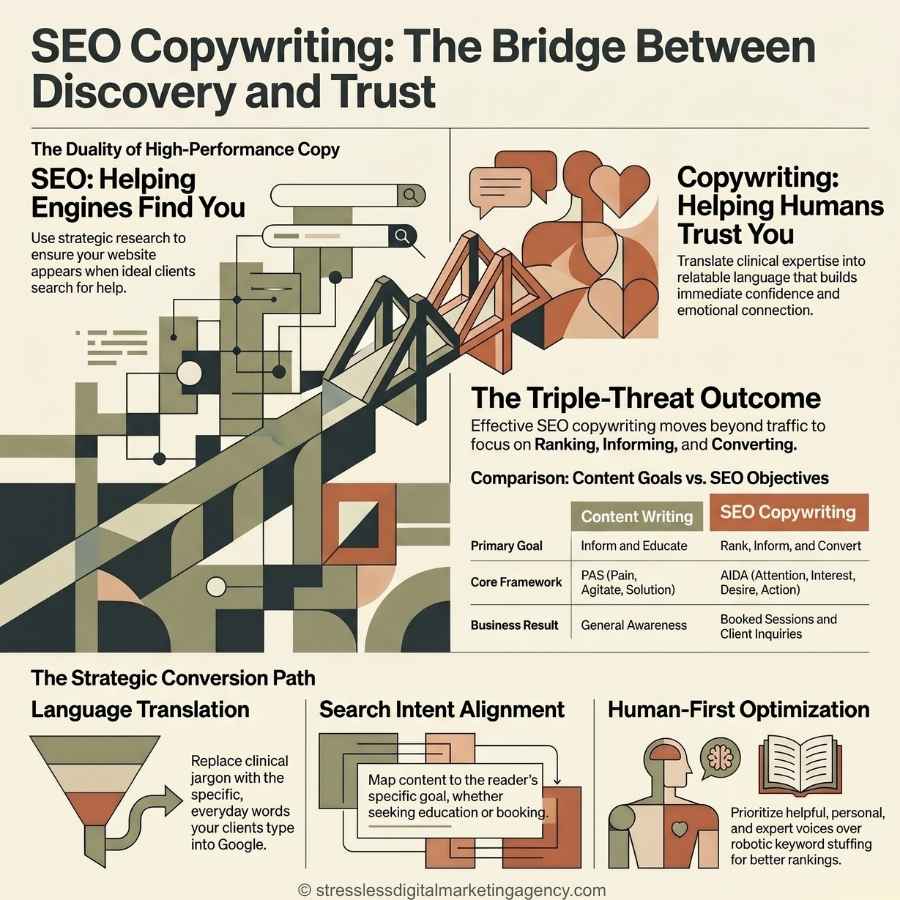
Here is the simple distinction for you to remember: SEO helps search engines understand your website, while copywriting helps humans trust it.
An SEO copywriter strategically combines search visibility, psychological principles, and marketing strategy.
Their job is two-fold: to ensure your website is discovered by the right people, and to build the confidence those ideal clients need to choose you.
I am driven by the belief that people should easily find the life-changing care they need, and dedicated service providers should not have to feel invisible online.
Related Article: SEO for Therapists: Is It Worth Your Time, Money, and Energy?
What Is a Copywriter for SEO Exactly?
SEO Copywriting vs Traditional Copywriting
Traditional copywriting is writing that persuades.
Sales pages. Emails. Ads. Social posts.
SEO copywriting does all of that plus one more thing.
It helps you get found on Google.
Traditional copywriting is focused on engaging a human audience, whereas SEO copywriting must appeal to both human readers and search engines.
Today, people search for things like:
- “Reiki Master near me”
- “EMDR trauma therapist”
- “Nutritionist for gut health”
If your website does not show up, you miss those clients.
A copywriter for SEO helps your website appear in search results and writes words that real people connect with once they arrive.
Persuasion Alone Does Not Equal Visibility
Having the most brilliantly written copy is useless if your audience can’t find it. It’s similar to the old saying: if a tree falls in the forest, does it make a sound?
If you have the most beautiful, persuasive argument ever for why your product or service is the best, but no one can find or hear it, it’s worthless. All that effort amounts to nothing. SEO copywriting makes sure your message is not only powerful but also visible.
Related Article: The Silent Salesperson: How Having Powerful Copy for a Website Brings In More Sales
SEO Copywriting vs Content Writing
Content Writing is primarily focused on informing and educating your audience.
- Examples: Blog posts, newsletters, and helpful articles.
- Goal: To provide information and guide potential clients through the customer journey (often utilizing a format like PAS: Pain, Agitate, Solution).
SEO Copywriting is a more comprehensive approach designed to both inform and convert.
- Goals:
- Inform the reader.
- Improve search engine rankings.
- Establish and build trust.
- Direct readers toward a desired action.
- Outcome: The goal extends beyond simple website traffic. It is about booked sessions, filled programs, and securing real clients by moving them through the AIDA format (Attention, Interest, Desire, Action) and building enough trust that they are confident you can solve their problem and are happy to invest in your services.
TL;DR:
- Content writing = Inform
- SEO copywriting = Inform, Rank, and Convert
How SEO Copywriting Actually Works (In Plain English)
Keyword Research Comes First
An effective SEO copywriter prioritizes listening and research before they write a single word.
They delve into how your ideal clients search on Google, explore online communities, analyze reviews, and study authentic conversations. This deep dive is crucial because the most compelling copy utilizes the precise language your clients are already using.
Key Research Approach:
- Understanding Client Search Behavior: I go beyond traditional keyword tools like Answer Socrates and incorporate strategies such as conducting clinical interviews and exploring the sources where your ideal client spends time, including Facebook groups, Amazon reviews, books, and Reddit.
- The Power of Listening: By actively listening to what your ideal client has to say in these spaces, you create the best copy directly from their own words.
For health and wellness business owners, this research phase often reveals a significant gap between how you were trained to describe your work and how your ideal clients actually talk about their struggles. You might call it “somatic nervous system regulation.” They’re searching for “why do I feel exhausted no matter how much I sleep.” Neither description is wrong — but only one of them shows up in a search bar. Good SEO copy bridges that gap without stripping your site of the expertise and voice that make you credible.
Search Intent Shapes the Message
Once the questions your clients are asking have been identified, an SEO copywriter must align the content response with the specific goal of that webpage. For example, is the primary purpose of this page to educate the client on a topic, or is it to drive a specific action, such as booking an appointment? The desired outcome will dictate how you craft your answers to their questions.
Page Structure Matters
Optimizing foundational elements—such as headlines, headers, meta descriptions, internal links, and title tags—is crucial, much like establishing the corner pieces of a puzzle to frame the final image. Properly incorporating keywords into these pieces is essential. This strategic use of keywords helps Google better recognize your web page, significantly improving its visibility in search results.
Affiliate Disclaimer: This page contains affiliate links and is a member of the Amazon Services LLC Associates Program. If you make a purchase using one of these Amazon links, we may receive compensation at no extra cost to you. See our Disclosure Policy in the Legal Hub for more information.
Note For DIY Lovers: I recommend the book Get Found: The No-Fluff Guide to Ranking Higher and Becoming Your Customers’ First Choice (Amazon Affiliate Link)
Writing Naturally (Not Keyword Stuffing)
Search engines now prioritize human-first writing. Years ago, you could stuff a page with keywords, and the search engine would simply rank it based on keyword density. That’s no longer the case. Computers are much smarter; they look for content that is helpful, unique, and personal. This means they want to hear your voice and your experiences, not just a generic, AI-like summary.
Publishing, Linking, and Improving Over Time
SEO is an ongoing process, not a one-time fix. As an SEO copywriter, my role involves more than just creating new content. Sometimes the best strategy is to revisit existing text for optimization purposes. I continually evolve the content alongside the audience and the practitioner, adapting as their services and skill sets evolve.
What a Copywriter for SEO Does That Most Website Writers Do Not
Builds Content Around Strategy, Not Guesswork
Many website writers create content based on trends (or, quite frankly, whatever topic you pay them to write).
An SEO copywriter, however, begins with a strategic plan.
The process involves answering key questions:
- What are your ideal clients actively searching for?
- Which pages will serve as the entry points to your site?
- What topics will be most effective in building audience trust?
This approach ensures your content is created with a clear purpose, replacing random effort with focused strategy.
Example of Strategic Impact: I worked with a client, a therapist/holistic wellness coach, who was launching a podcast, and I provided clarity on her ideal audience’s search behavior. This led to a 90-day strategy focused on discussions that maximize visibility. I identified high-volume, low-competition keywords and helped her map popular topics, enabling her to select interviewees efficiently and without wasted effort.
Related Article: “Is Content Marketing Necessary If I Get Referrals?” (Yes! Here are 7 Reasons Why.)
Writes for Real Business Outcomes
Traffic is a start, but it won’t pay your bills—clients will.
An SEO copywriter’s job is to craft pages that do more than just attract visitors. I focus on writing content that directly addresses potential clients’ questions, reduces their hesitation, and smoothly guides them toward taking the next step: booking a session or contacting you.
The goal isn’t just increased traffic; it’s about generating inquiries, bookings, and conversions. As a service provider, website visits don’t matter unless someone is actually sitting in your seat. That’s why I prioritize getting real bookings.
I help clients move people forward by building confidence to book that first session. This includes answering common questions to pre-qualify them—for example, clarifying your stance on insurance (in-network or out-of-network) and simplifying the superbill process associated with out-of-network providers.
This matters especially if you’re moving toward private pay or trying to attract a more specific client. When your copy pre-answers questions about fees, what your process looks like, and what a client can realistically expect in the first few sessions, you’re not just improving SEO — you’re pre-qualifying inquiries. The people who reach out already understand your approach and are already bought in. That reduces the time you spend fielding calls from people who aren’t a fit, which is its own return on investment.
Understands Both Psychology and Search Behavior
Reaching out for health or wellness support is an emotional journey, often accompanied by feelings of nervousness, shame, or uncertainty.
Your goal is to find a copywriter specializing in SEO who understands this emotional landscape and writes with genuine care (did you know, I am a retired psychotherapist?). Critically, they pair this empathy with an understanding of search data.
This unique combination of emotional resonance and data-backed strategy creates content that truly connects with the audience.
The Empathy-Data Blend in Practice:
As a former therapist, I understand that seeking help—especially for mental health—is often a last resort. People have exhausted self-help books and home remedies; they are, in a word, desperate. When someone reaches out, they are not only seeking a transformation but also facing deep fears, embarrassment, and shame. Essentially, they are saying, “I failed, and I need help getting out of this hole.”
By examining these powerful emotions and matching them with relevant data (keywords), I am able to map out the most effective content strategy for my health and wellness clients.
Common Myths About SEO Copywriting
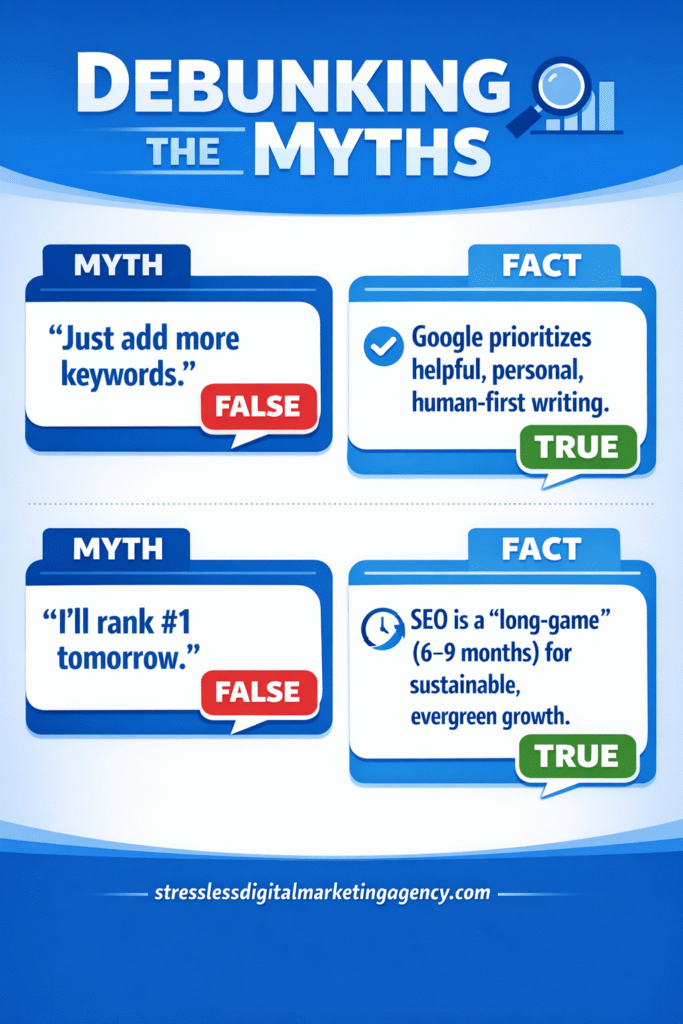
Just Add More Keywords
Modern SEO prioritizes natural language and keyword variations, not just keyword tracking. This is because search engines now want you to “talk to humans.” Using different variations of your core keywords (e.g., “EMDR therapist” and “therapist providing EMDR”) can help you rank for a wider range of searches while keeping your writing natural.
A #1 Ranking Can Be Guaranteed
No credible SEO professional can promise top rankings overnight (or ever, because the internet is always evolving and new content is being made daily).
SEO is a “long-game” strategy, and most businesses experience steady, incremental growth over several months. It can be frustrating to wait 6 to 9 months before seeing significant results. However, this period is spent building a solid foundation and an evergreen funnel that can continue to deliver client leads for years.
SEO Tools Will Fix Everything
While helpful, tools can’t replicate a genuine human voice or the real-world Experience and Expertise that your clients are searching for.
This human element is not just about connecting with your audience; it is now a critical factor in search visibility. Google increasingly prioritizes content that is unique, personal, and demonstrates deep, first-hand knowledge. Generic, AI-generated summaries are less likely to rank.
A genuine human connection, backed by your professional experience, acts as a high-quality signal that sets your content apart as authoritative and trustworthy—the foundation for long-term visibility and sustainable growth.
3 Things to Consider when asking “Do I Really Need a Copywriter for SEO?”
1. When DIY Writing Is Holding Your Visibility Back
Your services are exceptional, yet your website is invisible. This is a visibility problem, not a value problem.
You didn’t go to school for marketing, and while you know your clinical material, that’s precisely the issue. You speak the language of your peers (clinical jargon like EMDR, IFS systems, Gestalt therapy), but this is not the language your prospective clients use when they search on Google.
This creates a crucial SEO gap: When a client searches for their problem (e.g., “Will you help me stop my wife from complaining about my phone use?”), a website filled with technical terms (e.g., “I am a certified EMDR practitioner”) will not be recognized by Google as the best match for their question.
Another version of this I see often: a practice owner’s homepage leads with their credentials and certifications rather than the outcome the client is actually looking for. Your training is meaningful — but to someone searching “acupuncture for chronic back pain,” your list of certifications is secondary to whether your page signals that you understand their specific problem. The fix isn’t to downplay your expertise. It’s to lead with the transformation, and let your credentials support it rather than carry the whole message.
My job as an SEO-informed copywriter is to translate your clinical expertise into the client’s language—the language they are actually typing into the search bar—to ensure your business is visible and immediately connects with those who need you most.
2. When Traffic Isn’t Converting Into Clients
If people visit your website but do not reach out, your message needs support.
Rankings alone do not create bookings.
Problem: Your Clients Don’t Know What to Do Next
Your website may successfully convince a client, but if the Call to Action (CTA) is weak, confusing, or simply absent, that momentum is lost. Conversion requires copy that not only informs but also provides a clear, compelling, and friction-free path for the client to take the next step.
Problem: You Get the Wrong Kind of Inquiries
If your website is attracting the wrong kind of visitors—like people looking only for free advice or those who aren’t your ideal clients—your copy isn’t prequalifying leads. Effective conversion copy is a filter: it speaks so clearly to the right client that the wrong clients self-select out, saving you time and ensuring your bookings are high-quality.
3. When Marketing Feels Overwhelming
SEO, keywords, content, page structure, content funnels—it can feel like a language you never learned, demanding time and energy you simply don’t have.
You are a skilled service provider, not a full-time marketer, and the emotional toll of constantly trying to keep up with Google’s changing rules and confusing marketing tactics can lead to burnout and analysis paralysis. When marketing becomes a source of stress rather than a system of support, your energy is diverted away from the clients you love to serve.
A copywriter for SEO brings clarity, direction, and a plan you can follow.
I take the overwhelming, fragmented nature of online visibility and turn it into a cohesive, strategic system. I handle the complexity of search behavior and content architecture, giving you a clear roadmap and the confidence to stop guessing and start growing. Your only job is to deliver your excellent service; my job is to make sure the right clients can easily find their way to you.
Four Steps to Choosing the Right Copywriter for SEO
1. Look for Strategy, Not Just Writing Samples
Good writing is essential, but strategy is what drives results—and ultimately, revenue.
When evaluating a copywriter, look past surface-level samples and ask: How will this writing get me paying clients?
My approach utilizes the AIDA (Attention, Interest, Desire, Action) Customer Journey framework. This method is instrumental in writing copy that strategically guides readers from their first click to their first booking:
- Move clients toward booking: We craft messaging that guides a step-by-step progression through the customer journey, ensuring every piece of content has a clear, singular goal that moves the client forward.
- Establish clear content goals: This means setting distinct objectives for each section, such as using the Attention stage for compelling headlines that stop the scroll, the Interest/Desire stages for persuasive landing page body copy that builds trust and addresses fears, and the Action stage for a clear, friction-free Call to Action.
(For a detailed visualization, please refer to the provided AIDA chart below.)

2. Ask About Their SEO Writing Process
A proficient SEO copywriter should be able to articulate their specific process for researching, structuring, and optimizing content.
My copywriting process is a structured, five-step journey designed to transform ideas into high-impact results.
- Foundational Messaging Map Session: It begins with a collaborative session to build a detailed framework that captures your goals, offer, audience, and brand voice. (This ensures the entire project is strategically aligned to attract and speak directly to your ideal, high-value client.)
- Research & Writing: I move into deep SEO and audience research, developing a strategy and crafting copy that guides clients from their first click to a final inquiry. (This is where we bake in search visibility and emotional resonance, creating content that is easy to find and compelling enough to build instant trust.)
- First Draft Presentation: Once the writing is complete, I present a draft to ensure the style and direction perfectly align with your vision. (You see the entire content ecosystem and confirm the message will resonate with both your brand and your audience.)
- Revisions Phase: This is followed by two dedicated rounds of refinements to get the copy just right. (We fine-tune the persuasive elements and CTAs to ensure maximum conversion power.)
- Final Polish: The process concludes with proofreading and your final approval, leaving you with copy that is ready to launch. (You walk away with high-quality, conversion-ready assets, confidently prepared to attract and book paying clients.)

3. Check If They Understand Your Audience
Clients in the health and wellness space have specific needs, and your copywriter must understand them.
I bring a unique perspective, having started my career as a mental health therapist. This experience taught me how people think, feel, and ultimately make decisions. While I loved the clinical work, I realized I needed a path that honored my sensitivity and creativity—one where I could help others without becoming completely drained.
Now, I combine my clinical background with a data-backed SEO approach to translate complex expertise into clear, compelling content that builds genuine connections. I create a cohesive content ecosystem—including website copy, blog posts, newsletters, and social media content—designed to increase your visibility, build trust, and drive long-term growth.
4. Beware of Overpromising Results
No credible SEO professional can promise top rankings overnight. SEO is a “long-game” strategy, and most businesses experience steady, incremental growth over several months. As I mentioned earlier, it can be frustrating to wait 6 to 9 months before seeing significant results. However, this period is spent building a solid foundation that delivers clients for years to come.
What Success Looks Like With the Right SEO Informed Copy
Imagine a world where:
- Your website ranks on Google.
- The ideal clients consistently discover your practice.
- Client inquiries are steady and reliable.
- You feel proud and assured when directing people to your website.
This is the promise of sustainable visibility.
Where Should a Health and Wellness Business Owner Start With SEO Copy?
This is the question I get most often, and the honest answer is: it depends on where you are right now. That said, there’s a general order that makes sense for most established practice owners.
If you have no website or a very thin one, service pages come first. Before any blog strategy makes sense, Google needs something to index — pages that clearly name who you help, what you offer, and where you’re located. A homepage and two to three service pages written with SEO in mind will do more for your visibility than months of social media content.
If you have a website but it’s not ranking, the most likely culprit is one of two things: the copy is written in professional language your ideal clients aren’t actually searching, or the page structure isn’t giving Google the right signals. You’re looking for whether your pages use the phrases real people type — not just industry terminology that means something to your peers but nothing to someone in pain at 11pm trying to find help.
If you have traffic but no inquiries, the issue shifts from visibility to conversion. Your copy may be getting people to the page but not giving them enough reason to reach out. This is where the language around your specialty, your client outcomes, and what the first step looks like matters most. Read why your copy isn’t converting for a deeper breakdown of this specific problem.
If you rely heavily on directories or referrals, SEO copywriting on your own site is the most direct path to reducing that dependency. Every optimized page on your domain is an asset you own outright — one that compounds over time rather than disappearing if you cancel a subscription or a referral source dries up.
Not sure which category you’re in? Take the free marketing quiz to identify your biggest visibility gap.
Ready to Work With a Copywriter for SEO?
If your services are exceptional, your marketing should be too.
Your next step is simple: Download my services guide to explore ways we can work together.
Frequently Asked Questions About Copywriters for SEO
How long does it take for SEO copy to show results?
While updated website copy and refined funnels can lead to immediate improvements in conversion rates, the full return on investment (ROI) from search-engine-focused content is part of the “long game.” Sustainable growth requires patience and consistent effort—usually 6 to 9 months—to see meaningful long-term results.
I focus on building a strong, sustainable foundation for your business. This involves fully optimizing your website, creating engaging blog posts, and developing content funnels that effectively guide visitors toward booking. My partnership extends beyond just writing; I work with you for the long haul, helping you maintain visibility through consistent content publication, service page updates, call-to-action refinements, and performance monitoring. This ensures your website continues to attract the right clients and supports lasting business growth.
Do I need blog posts or website pages first?
Service providers typically begin by establishing core website pages and then supplement them with blog content. The blogs’ primary function is to guide readers toward learning more about your services by directing them to your service pages.
Consider your service pages the central part of a flower, and your blogs the petals. The eye-catching petals attract the bee (the reader), and the center provides the essential pollen (the valuable information).
Can I use AI instead of hiring a copywriter?
While AI is a useful tool for drafting, it can’t replace the strategic thinking and unique voice that a human copywriter brings. You’ve reached a point where DIY efforts are no longer enough, and it’s time to invest in expert support.
Hiring me is more than just purchasing words; it’s an investment in a strategic, data-backed approach that demonstrates your commitment to your practice. I combine buyer psychology with proven strategy to craft clear, simple messaging that resonates with your ideal clients. This level of customized, thoughtful support offers far more value than a generic AI tool.
How much does SEO copywriting cost?
Project pricing is customized based on the scope of work. Factors that influence the final investment include:
- Project Type: (e.g., blog posts, web pages, sales pages)
- Success Metrics and Timeline
- Number of Revisions
- Research Requirements
While my service guide provides starting budget ranges, all investments are adjustable to align with your specific needs as a service provider. For detailed questions about the investment for your project, please contact me through the provided form.
Does a copywriter for SEO need to specialize in health and wellness?
Not necessarily — but they need to understand a few things that are unique to your field. Health and wellness copy involves a different kind of trust-building than most industries. Your prospective clients are often making a decision that feels emotionally risky, and the wrong tone — too aggressive, too clinical, too generic — can make them leave before they ever see your qualifications. A copywriter with experience in health and wellness will already understand the sensitivity of the intake process, the private pay conversation, and why a potential client might visit your site multiple times before they feel ready to reach out. That context shapes every word, and it’s difficult to replicate from a single project brief alone.
Resource Library: Keep Reading
Every article below goes deeper into a specific piece of the SEO copywriting puzzle. Whether you’re trying to figure out why your site isn’t ranking, why visitors aren’t booking, or which tools are actually worth your time, there’s something here for you.
- Why Your Website Copy Isn’t Converting (And How to Fix It) Getting traffic but not getting inquiries? This one breaks down the most common conversion killers on health and wellness websites — and what to do about each one.
- The Silent Salesperson: How Powerful Website Copy Brings In More Sales. Your website is either working for you around the clock or quietly losing you clients. Here’s how well-written copy functions as a 24/7 sales tool — no networking required.
- Why Am I Not Getting Clients Even Though People Visit My Website? Traffic without bookings is one of the most frustrating visibility problems a practice owner can face. This article gets into exactly why that gap exists and how to close it.
- The Brains vs. The Brawn: Why Your Website Needs a Copywriter, Not Just a VA. A VA who writes posts and a strategic SEO copywriter are not doing the same job. If you’ve been wondering why content isn’t moving the needle, this is worth a read.
- Who Does What: SEO Copywriter vs. Web Designer vs. SEO Agency Three different roles, three different outcomes. If you’ve ever felt confused about who to hire for what, this breaks down the distinctions clearly so you can make the right call for your practice.
- A Practical Guide to Writing Website Copy for People Who Aren’t Professional Copywriters Not ready to hand it off just yet? This is the most practical starting point for DIY-ing your own copy — built specifically for health and wellness providers.
- What Makes a High-Converting Freebie (And Why Copywriting Is the Secret Sauce) Lead magnets only work when the copy behind them does. This article gets into what separates a freebie that grows your list from one that collects digital dust.


