Lead Magnet for Health and Wellness Service Providers: What Makes a Freebie Actually Convert
You’ve probably seen the advice a hundred times: create a freebie, grow your list, book more clients. Simple enough in theory. But if you’ve already tried it and watched your download numbers flatline after the first week, you know the reality is more complicated than that.
Most freebies don’t fail because the idea was bad. They fail because the copy doesn’t connect, the offer doesn’t lead anywhere meaningful, or the whole thing was built without a clear strategy behind it. A lead magnet isn’t just a free PDF you slap together to check a box — it’s the first real impression a potential client has of how you work. And in the health and wellness space, first impressions carry a lot of weight.
This post covers what actually makes a lead magnet work for established health and wellness business owners: the structure, the copy, and the strategic thinking that turns a freebie into a genuine client pipeline.
Related: The Silent Salesperson: How Powerful Website Copy Brings In More Sales
Key Takeaways:
- A lead magnet for service providers is only as powerful as the copy that surrounds it — the landing page, the thank you page, and the freebie content itself all need to work together.
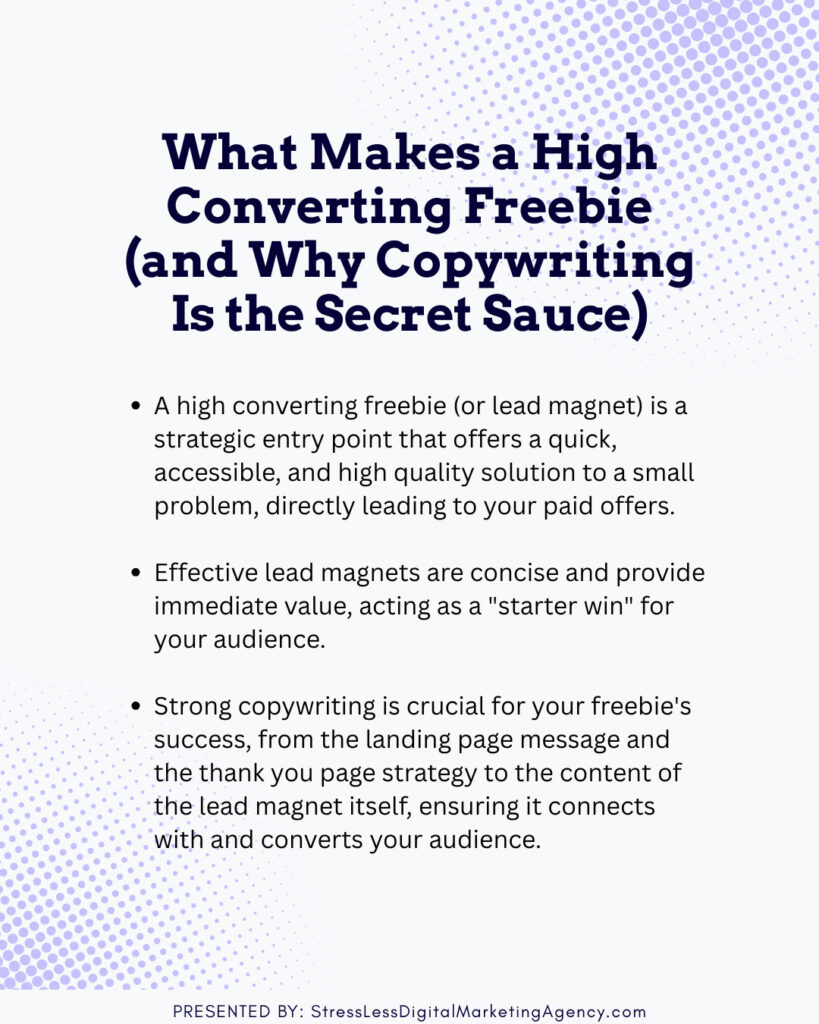
- High-converting freebies solve one specific problem quickly and lead naturally into your paid services.
- Most freebies fail not because the idea is bad, but because the copy is generic — it does not speak directly to the person you are trying to attract.
- For health and wellness providers, a freebie is often the first impression a potential client has of your brand. That impression needs to be strategic, not slapped together.
What a Lead Magnet Is Actually For
At its most basic, a lead magnet is a free piece of content — a PDF, checklist, quiz, mini training, template — that someone gets in exchange for their email address. That’s the mechanics. The strategy is something different.
The real job of a lead magnet isn’t to grow a list. It’s to start a relationship with the right person at the right moment and give them enough of a win that they want to keep hearing from you.
That distinction matters because it changes everything about how you build it. A list-building mindset produces generic freebies that attract everyone and convert no one. A relationship-starting mindset produces something specific enough to make your ideal client think, “this was written for me.”
For health and wellness business owners specifically, your prospective clients are often doing a lot of research before they reach out. They’re comparing options, reading everything they can find, and trying to figure out who they trust. A well-designed lead magnet accelerates that trust-building process in a way that a service page alone simply can’t.
The Anatomy of a Lead Magnet That Actually Converts
Not all freebies perform the same way, and the difference usually comes down to a handful of structural decisions made early in the process.
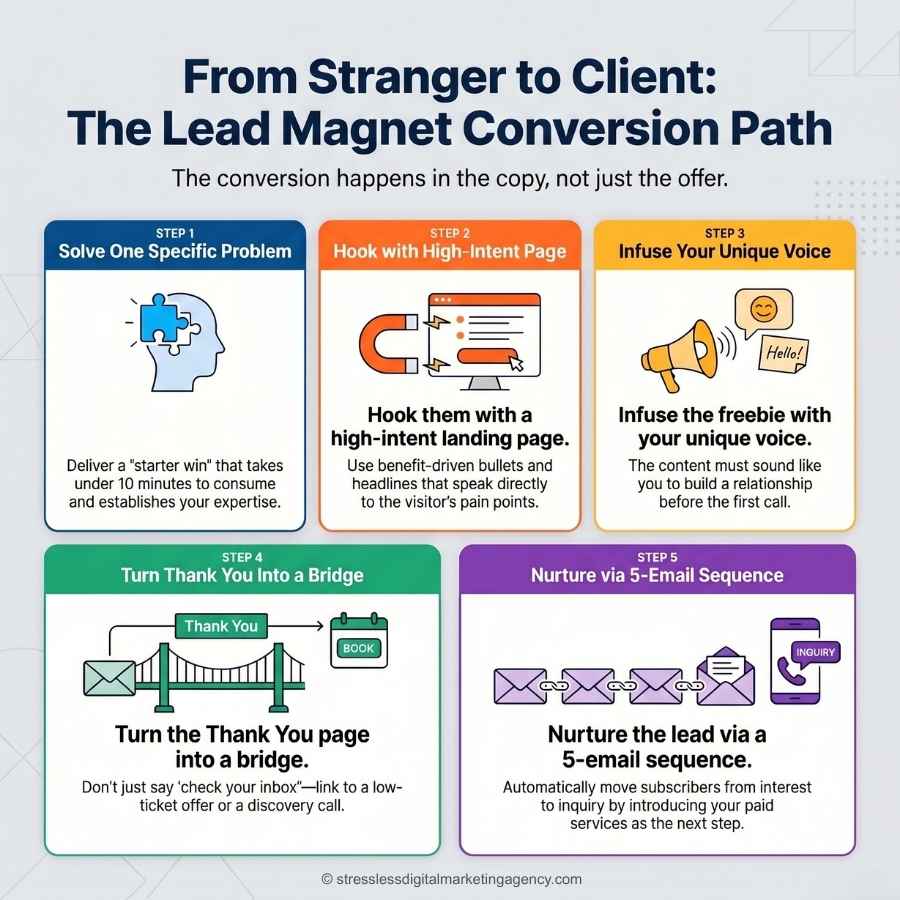
It solves one small, specific problem. The biggest mistake is trying to cover too much ground. A lead magnet that promises to fix your entire marketing strategy is overwhelming — and overwhelming is forgettable. The freebies that convert well solve a narrow problem so clearly that the right person sees the title and immediately thinks, “yes, that.” For a health and wellness practice, this might be something like a checklist for evaluating whether your website is set up to attract private-pay clients, rather than a broad guide to digital marketing.
It acts as a breadcrumb trail to your paid offer. The best freebies are designed to create the natural next question. If your lead magnet solves problem A and your paid service solves problems B through Z, there should be a felt sense of momentum — the freebie delivers a real win, and that win makes the bigger transformation feel both desirable and achievable. If your freebie and your offer feel unrelated, you’ll build a list that never converts.
It’s fast to consume. Not because people are lazy, but because your audience is busy running a practice and they have limited time. A 25-page ebook sounds impressive and sits unread. A focused two-page checklist or a ten-minute audio gets opened, used, and remembered. The faster someone gets a result from your freebie, the faster they associate your name with competence.
The quality matches what you charge. This one is non-negotiable. If your freebie looks like it was thrown together in twenty minutes, it signals something about your paid work whether you intend it to or not. For health and wellness business owners positioning themselves as established experts — not discount providers — the free content needs to reflect that standard.
Where the Copy Makes or Breaks Everything
You can have a genuinely useful lead magnet and still watch it underperform because the copy around it isn’t doing its job. There are three places where this tends to fall apart.
The opt-in page. This is where most of the conversion work happens, and most opt-in pages are written too vaguely to do it well. “Get my free guide” tells someone nothing. A strong opt-in page names the specific problem being solved, speaks directly to who this is for, and makes the value concrete enough that handing over an email address feels like an obvious yes. The headline does the heavy lifting here — if it doesn’t stop the right person in their tracks, nothing else on the page matters.
The thank you page. Most people treat this as an afterthought. That’s a significant missed opportunity. The moment right after someone opts in is one of the highest-trust moments in the entire client journey — they’ve already said yes once, which means they’re more open to a next step than they will be for a while. A strategic thank you page can invite a low-commitment next action: reading a specific blog post, watching a short video, or discovering what it looks like to work with you. It shouldn’t feel pushy. It should feel like a natural continuation of the conversation that just started. For more on how website copy guides clients forward, that piece goes deeper into the mechanics.
The freebie content itself. This is where a lot of health and wellness business owners write in their professional voice — clinical, credential-heavy, technically accurate — and inadvertently lose the reader. The content inside your lead magnet should sound like you at your best: knowledgeable, warm, and accessible. It should introduce your perspective and your approach in a way that makes someone want to know more, not just check a box and close the tab.
Related: What an SEO Copywriter Actually Does (and How to Hire One)
The Strategic Layer Most People Skip
Here’s something that often gets left out of the conversation about lead magnets: a freebie that isn’t connected to a broader content strategy is just an isolated piece of content. It might convert well on its own, but it won’t compound.
The health and wellness businesses that see the most return from their lead magnets are the ones where the freebie is part of a larger ecosystem — blog content that drives traffic to the opt-in, service pages that align with what the freebie promises, and a nurture sequence that bridges the gap between downloading something free and booking something paid. None of those pieces work as well in isolation as they do together.
If your website copy, your blog, and your lead magnet are all pulling in slightly different directions — different audiences, different language, different implied offers — that fragmentation shows up in your conversion numbers. Alignment across all three is what turns a decent lead magnet into a reliable client pipeline.
Related: A Practical Guide to Writing Website Copy If You’re Not a Professional Copywriter
A Quick Note on Freebies for Health and Wellness Practices Specifically
The trust dynamics in this industry are different from most. A prospective client downloading your lead magnet isn’t just looking for information — they’re quietly evaluating whether you understand their situation, whether your approach fits, and whether they’d feel comfortable handing over a credit card (or a vulnerable conversation) to you.
That means the emotional tone of your freebie matters as much as the content. Generic and breezy doesn’t land. Overly clinical doesn’t land either. What works is specific, grounded, and written like a person who genuinely understands the problem, which, if you’ve been in practice for any length of time, you do. The challenge is translating that expertise into language that connects on the page rather than getting buried under professional terminology.
If you’re not sure whether your lead magnet is doing that job, the free marketing quiz is a useful starting point for identifying where the friction is.
Lead Magnet Ideas for Health and Wellness Service Providers
If you are starting from scratch or rebuilding a freebie that is not working, here are formats that convert well for this audience — paired with what makes each one work from a copy standpoint.
Self-assessment or quiz
Quizzes are high-converting for health and wellness providers because they are interactive and immediately personal. The key copy element: the results page. Each result needs to speak directly to the reader’s experience and introduce your services as the relevant next step. Generic quiz copy kills the momentum the quiz itself builds.
Checklist or quick-start guide
One of the most shareable formats is when the topic is specific enough. The mistake is making the checklist too long or too broad. Five to ten items, all actionable, all relevant to the transformation your paid services complete. The copy on the checklist itself — not just the landing page — needs to sound like you.
Template or swipe file
Templates work especially well for providers whose clients struggle with communication — intake conversation starters, journaling prompts, sleep routine trackers. The copy job here is the framing: the intro page or instructions that position the template as a tool your client will actually use and come back to.
Mini training or audio guide
The highest-trust format because it puts your voice directly in someone’s ears. The copy job is the opt-in page and the email delivering the training — both need to set expectations clearly so the listener knows exactly what they are getting and why it matters before they press play.
Regardless of format, the copy is the thing. A beautifully designed PDF with weak, generic copy will underperform a simple Google Doc that speaks directly to your reader’s exact situation. If you are unsure whether your current freebie copy is doing its job, a copywriter for SEO can audit it and identify exactly where the conversion path is breaking.
Ready to Build a Freebie That Actually Converts?
A freebie that sits undownloaded isn’t helping anyone — not you and not the clients who would benefit from your work. If you’re ready to build something strategic, download the price and services guide to see how we can work together on the copy behind your lead magnet, opt-in page, and follow-up sequence.
FREE RESOURCES: Start Here Before You Build Your Next Freebie
These free resources will help you understand where your current visibility and conversion strategy stands — before you invest time in building something new.
Free Resources for Health & Wellness Service Providers
- Quiz: What’s Keeping You Stuck With Marketing?
- Stop Panicking When Clients Graduate: Your Website’s Guide to Organic Inquiries
- Free Blog Templates For Service Providers: Designed Specifically For Health & Wellness Clinicians
Related Reading
- Why Your Website Copy Isn’t Converting (And How to Fix It) Getting traffic but not getting inquiries? This one breaks down the most common conversion killers on health and wellness websites — and what to do about each one.
- The Silent Salesperson: How Powerful Website Copy Brings In More Sales. Your website is either working for you around the clock or quietly losing you clients. Here’s how well-written copy functions as a 24/7 sales tool — no networking required.
- Why Am I Not Getting Clients Even Though People Visit My Website? Traffic without bookings is one of the most frustrating visibility problems a practice owner can face. This article gets into exactly why that gap exists and how to close it.
- The Brains vs. The Brawn: Why Your Website Needs a Copywriter, Not Just a VA. A VA who writes posts and a strategic SEO copywriter are not doing the same job. If you’ve been wondering why content isn’t moving the needle, this is worth a read.
- Who Does What: SEO Copywriter vs. Web Designer vs. SEO Agency Three different roles, three different outcomes. If you’ve ever felt confused about who to hire for what, this breaks down the distinctions clearly so you can make the right call for your practice.
- A Practical Guide to Writing Website Copy for People Who Aren’t Professional Copywriters Not ready to hand it off just yet? This is the most practical starting point for DIY-ing your own copy — built specifically for health and wellness providers.
- What Makes a High-Converting Freebie (And Why Copywriting Is the Secret Sauce) Lead magnets only work when the copy behind them does. This article gets into what separates a freebie that grows your list from one that collects digital dust.
Common Questions About Lead Magnets for Service Providers
What is a good lead magnet for a health and wellness service provider?
A good lead magnet for a health and wellness service provider solves one specific problem quickly for one specific type of person. Quizzes, self-assessments, checklists, and short guides all work well — but the format matters less than the copy. The landing page needs a headline that speaks directly to your ideal client’s pain point, the freebie content needs to sound like you and introduce your approach, and the thank-you page and email sequence need to move the reader toward your paid services. The freebie is the beginning of a relationship, not the end of a transaction.
Why is my lead magnet not converting?
Most lead magnets fail for one of three reasons: the landing page copy is too generic to earn the opt-in, the freebie content does not deliver on the promise the landing page made, or there is no follow-up email sequence to move the subscriber toward booking. If you are getting downloads but no inquiries, the freebie content itself may be the issue. If you are getting very few downloads, the landing page copy is almost always the problem. In either case, the fix is the same: sharper, more specific copy that speaks directly to the person you are trying to reach.