The Best SEO Copywriting for Web Design: Know Who To Hire
When health and wellness business owners search for the best SEO copywriting for web design, they’re usually asking one of two questions underneath that search. Either: What does good SEO copywriting actually look like on a website? Or: Who handles what — do I need a copywriter, a designer, or both?
Both are fair questions, and the answer to each one affects how you spend your budget and who you hire first.
The short version: web design and SEO copywriting are not the same thing, they don’t overlap as much as people assume, and when they work together well — with copy leading and design following — the results are meaningfully better than when they’re treated as separate projects with no coordination between them.
This post breaks down exactly what each role does, where one ends, and the other begins, and how to figure out which one your website actually needs right now.
Related: Before diving in, if you want to understand what SEO copywriting actually involves and how to hire for it, the full SEO copywriting guide covers that in depth.
Key Takeaways
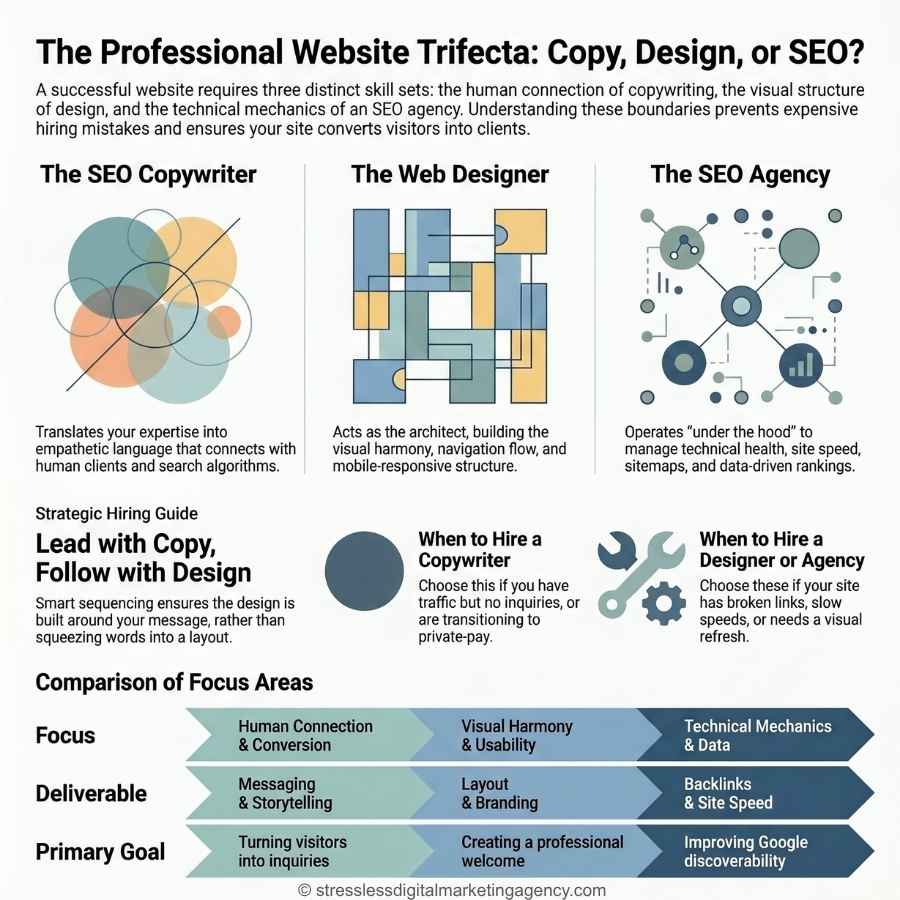
- SEO Copywriters focus on human connection and conversion: They translate your message into language that resonates with clients and optimizes content for search engines without sacrificing authenticity. They don’t handle technical SEO or web design.
- Web Designers build the visual and functional structure of a website: They create visual harmony, ease of navigation, and mobile responsiveness. Their limitations lie in deep SEO strategy and emotional messaging.
- SEO Agencies handle the technical aspects of search engine optimization: They manage sitemaps, page speed, crawl errors, backlinks, and data tracking to improve discoverability. However, they often focus on algorithms over empathy, which can lead to content that lacks emotional connection.

SEO Copywriters: What They Do (and Don’t Do)
The copywriter decorates the home and invites people to stay awhile.
Think of a copywriter as a translator — someone who takes what’s in your heart and turns it into language your clients (and Google) can understand. My work as an SEO copywriter blends psychology, storytelling, and strategy so your website speaks to both algorithms and actual humans.
Here’s what that looks like in practice:
Helping visitors feel seen and understood
Before I ever write a word, I listen — deeply. Years in therapy taught me how to hear what people mean, not just what they say. I use that same skill to do customer research: reading reviews, forums, and transcripts to uncover what your ideal clients are thinking in the quiet moments before they decide to reach out.
It’s about more than listing features or services. It’s creating that “this person gets me” moment. When your website mirrors someone’s unspoken thoughts, it stops being just a page. It becomes a conversation.
And because your clients are hiring you, not some AI-generated voice, I do a brand voice analysis to make sure the writing sounds like it came from your fingertips. My job is to slip into your rhythm, your phrasing, your warmth — so nothing feels “off.”
Writing content that addresses clients’ goals and pain points
Good copy doesn’t lecture — it reflects. Writing with one foot in your clients’ struggles and one in their hopes shows them the bridge your work provides. Instead of saying “I offer evidence-based nutrition counseling,” something like “You’ve tried the diets, tracked the macros, done everything right on paper — and you’re still exhausted” lands differently. That’s the difference between information and recognition. Every line has a purpose: to validate, to guide, or to move the reader toward the next step.
Crafting calls-to-action that turn browsers into clients
A good call-to-action should feel like a natural next step, not a sales pitch. It’s the gentle nudge that says, You’ve been thinking about this for a while. Here’s your moment.
Whether that’s booking a consultation, joining your email list, or downloading a resource, I design CTAs that feel empowering, not pushy.
The same way a good therapist offers a choice, not a command.
Optimizing for search engines without losing your humanity
SEO is the scaffolding; your message is the home. I make sure Google and AI tools can easily find your content, but the soul of your words stays intact.
That means weaving in keywords naturally, structuring pages strategically, and writing in a way that sounds like a real human, because THAT is who your clients want to connect with. You can rank high and sound like yourself. The two aren’t mutually exclusive.
This is what separates the best SEO copywriting for web design from copy written without design context — or design built without a copy strategy. The two inform each other, and when they don’t, you end up with a beautifully laid-out page that says almost nothing.
Strengths of an SEO Copywriter
A good SEO copywriter is like the bridge between your expertise and the people searching for it. We don’t just arrange words; we arrange meaning.
- I turn emotion into connection. The right words can slow a scrolling thumb. When your reader feels seen — when your message mirrors their thoughts — that’s when curiosity turns into trust, and trust becomes conversion.
- I make your expertise sound human. Instead of your site reading like a clinical resume, I translate your professional knowledge into stories and language your ideal clients can actually feel. Think less textbook, more conversation over coffee — informed but approachable.
- I blend heart with strategy. Every sentence is designed to serve two masters: your marketing goals and Google’s algorithms. The result is content that sounds natural to readers and signals relevance to search engines. You get visibility without sacrificing authenticity.
Limitations of an SEO Copywriter
An SEO copywriter tends the garden — but doesn’t build the soil.
- No coding or backend fixes. I don’t handle the technical side of SEO — things like site speed, schema markup, or plugin troubleshooting. That’s the realm of developers or SEO technicians.
- No web design or visual layout. I can suggest tweaks to structure, flow, and readability, but I’m not the one arranging colors, fonts, or graphics. My focus stays on the words and how they move your reader to act.
In short, I handle the language of visibility. The part that helps people find you, feel something, and take action. The more technical or design-heavy pieces are best left to specialists who speak that dialect fluently.

What this looks like for health and wellness practices specifically
The best SEO copywriting for web design doesn’t start with the design — it starts with the message. Most established health and wellness business owners come to a copywriter at one of two moments. Either their website has been live for a while, and they’re getting traffic that isn’t converting into inquiries, or they’re ready to rebuild and want to get the messaging right before the designer touches anything.
Both are valid starting points. The second is actually the smarter sequence — your copy should drive your design, not the other way around. When you write the words first, the designer has something to build around. When you design first and fill in copy later, the words get squeezed into a layout that wasn’t built for them, and it shows.
If you’re not sure which problem you have right now, the free marketing quiz is a useful starting point.
Web Designers: What They Do (and Don’t Do)
The web designer builds the house.
A web designer is like an architect for your online home — they draw the blueprint, choose the finishes, and make sure the structure feels inviting the moment someone walks in. Their work turns your ideas into something tangible, clickable, and beautiful.
Strengths of a Web Designer
A skilled web designer doesn’t just make things pretty — they make them work.
- They create visual harmony. A good designer knows how color, spacing, and imagery work together to shape first impressions. Your site becomes the digital version of a warm welcome: cohesive, professional, and aligned with your brand’s personality.
- They build for ease. When done well, a website’s navigation feels intuitive — like walking through a space where everything is right where you expect it to be. Designers think about flow, usability, and accessibility so visitors don’t get lost along the way.
- They bring function to form. Mobile responsiveness, layout balance, and user experience are all part of the craft. Their job is to make your site feel effortless — whether someone’s browsing on a desktop at work or scrolling late at night on their phone.
Limitations in Marketing
Here’s where the lines between design and marketing often blur.
- They focus on visuals, not voice. Designers are artists of layout and color — not words or emotional resonance. Your site might look incredible, but still fall flat if the copy doesn’t speak to the right people.
- They don’t handle a deep SEO strategy. Most web designers can set up the basics — title tags, meta descriptions, and clean structure — but they don’t dig into keyword research or the psychology behind what converts readers into clients.
- They prioritize appearance over connection. A beautifully designed site without strong messaging can feel like an elegant storefront with no one inside to greet you. It catches the eye, but not always the heart.
Best Times to Hire a Web Designer
Bring in a designer when your website needs structural care or a visual refresh — not when you’re trying to clarify your message.
- Fixing broken links, 404 errors, or layout quirks
- Redesigning for a smoother, more intuitive user experience
- Updating your brand visuals, colors, or overall site structure
SEO Agencies: What They Do (and Don’t Do)
The SEO agency wires the electricity.
An SEO agency is like the mechanic under the hood of your website — tuning the engine so it runs faster, smoother, and farther. They’re fluent in the technical language that search engines speak, ensuring your site is built on a foundation Google can easily understand and reward.
Strengths of an SEO Agency
A strong agency knows how to make the internet “see” you.
- They handle the technical side. From sitemaps and canonical tags to page speed and crawl errors, they make sure the behind-the-scenes mechanics of your website are humming. It’s the kind of work most people never notice — until something breaks.
- They track the data. SEO agencies thrive on numbers. They monitor keyword rankings, traffic sources, and conversion metrics the way a cardiologist reads a heart monitor — watching for rhythm, change, and opportunity.
- They improve discoverability. By strategically optimizing pages with keywords and backlinks, they help your content rise through the noise so your name appears when someone searches for the kind of help you provide.
Limitations in Marketing
But even a perfectly tuned engine can’t drive a connection.
- They focus on algorithms, not empathy. Many agencies are brilliant with data but less fluent in human nuance. The result? Content that might perform well in search results but doesn’t always resonate when someone actually reads it.
- They write for Google, not your clients. Over-optimized content can feel formulaic — like it was written at people instead of for them. It hits the right keywords but misses the emotional heartbeat of your brand.
- They can bring traffic, not trust. More clicks don’t always mean more clients. Without strong messaging and a clear emotional thread, visitors might find you — but not stay.
Best Times to Hire an SEO Agency
Think of agencies as your site’s technical partners — the ones who keep your digital infrastructure healthy and visible.
- Fixing or auditing technical SEO issues
- Managing backlinks and building domain authority
- Improving search rankings for long-term visibility
Who to Hire for What: Quick Guide
| Task / Goal | Web Designer | Copywriter | SEO Agency |
|---|---|---|---|
| Fix broken pages / 404 errors | ✅ Handles layout and technical fixes that affect usability. | ❌ | ✅ Monitors and resolves crawl errors that affect rankings.Note: Think of this as fixing the “plumbing” — essential, but not creative work. |
| Technical SEO (sitemaps, canonicals, page speed) | ❌May set up plugins, but doesn’t handle technical optimization. | ❌Doesn’t work with code or technical structure. | ✅Specializes in these behind-the-scenes details.Note: This is what helps Google read your site clearly — invisible to the eye, but vital to visibility. |
| Optimize website content for search & conversions | ❌ | ✅ Balances keywords with emotional messaging to convert visitors. | ✅ Focus solely on keywords, not messaging |
| Write content that connects with clients’ pain points & goals | ❌Designs the space but doesn’t write the story | ✅ Crafts language that mirrors client struggles and hopes. | ❌ Writes for algorithms, not emotion. |
| Design website layout/branding | ✅Shapes the visual flow and feel of your site. | ❌May guide structure but doesn’t design visuals. | ❌ |
| Clarify Brand Message & Ideal Client | ❌ | ✅ Deep dive into client psychology & positioning | ❌ |
| Create Blog Content or Ongoing SEO Writing | ❌ | ✅ Blog strategy + keyword integration written by a HUMAN | ⚠️ Often outsourced or AI-generated |
| Set Up Keywords / SEO Strategy | ⚠️ May do light setup (title tags, meta descriptions) | ✅ Keyword research aligned with client goals & voice | ✅ Advanced data-driven keyword strategy |
| Build or Manage Backlinks / Domain Authority | ❌ | ❌ (May advise or collaborate) | ✅ |
| Measure What’s Working (Analytics, Conversions) | ⚠️ Limited to traffic or visual heat maps | ✅ Measures engagement and conversion trends with simple tools | ✅ Deep-dive data reports & tracking |
| Improve Conversion Rates (turning traffic into clients) | ⚠️ Focuses on layout changes | ✅ Uses messaging, emotional resonance, and CTA flow | ❌ Usually focuses on traffic volume, not conversion quality |
| Tone, Story, & Emotional Engagement | ❌ | ✅ Core skill — brings warmth, trust, and a human voice | ❌ |
| Maintain & Update Site Over Time | ✅ Handles structural updates | ✅ Updates copy for SEO trends or new offers | ✅ Manages ongoing technical health |
When to Hire a Copywriter
Your website looks polished. Pages load. You show up in search results. But inquiries are still inconsistent — or the ones you do get aren’t the right fit.
That’s usually the signal. Not a broken website. Not missing traffic. A messaging problem.
A copywriter is the right hire when the structure is working, but the words aren’t doing their job. Maybe your service page explains what you do, but doesn’t connect it to what your ideal client is actually searching for. Maybe your about page lists your credentials, but doesn’t give a hesitant visitor a reason to trust you. Maybe your homepage sounds like every other practice in your niche because nothing in it is specific to the people you actually want to attract.
These aren’t design problems. They aren’t technical SEO problems. They’re copy problems that require a copy solution.
A few specific scenarios where a copywriter makes the biggest difference for health and wellness practices:
You’re transitioning to private pay.
The language required to attract self-pay clients is meaningfully different from insurance-dependent messaging. It needs to speak to the value of the investment, not just the services offered. Getting that language right is the difference between inquiries from clients who are already bought in versus those who lead with “do you take insurance?”
Your website copy was written in your clinical or professional voice.
You know your modalities, your certifications, and your methodology. Your prospective clients don’t — and more importantly, they’re not searching for those terms. A copywriter translates your expertise into the language your ideal clients actually use when they’re searching for help. This is covered in more detail in the full guide to hiring a copywriter for SEO.
You have traffic but no inquiries.
If people are finding your site but not reaching out, the problem is almost always conversion copy — weak or missing CTAs, unclear next steps, or copy that doesn’t pre-qualify the right client. The breakdown of why websites stop converting goes deeper on this if you want to diagnose it before hiring anyone.
You’re ready to stop relying on directories and referrals.
SEO-informed copy on your own website is how you build visibility you own — not visibility you rent from directories or word-of-mouth networks. Understanding why that distinction matters is worth doing before you invest in any marketing channel.
The Bottom Line
The best SEO copywriting for web design isn’t about stuffing keywords into a pretty layout — it’s about making sure the words and the structure are working toward the same goal, which is getting the right person to your page and giving them a clear reason to reach out.
A strong online presence needs all three roles — designer, SEO agency, and copywriter — but they solve different problems, and hiring the wrong one for the job you actually have is an expensive detour.
If your site has technical issues, broken pages, or needs a visual overhaul, start with a designer or SEO agency. If your site looks and functions fine but the right clients aren’t finding you or aren’t converting when they do — that’s a copy problem. And copy problems are what this work is built for.
The price and services guide outlines what working together looks like and where to start based on where you are right now.
LINK: https://stresslessdigitalmarketingagency.com/opt-in-service-price-guide-download/
ANCHOR TEXT: price and services guide
If you’re still figuring out which problem is actually yours, take the free quiz first — it takes about two minutes and gives you a clear answer.
Related: What a Copywriter Does vs. What a VA Does — if you’re weighing those two options specifically, this post covers the distinction in detail.