How Do You Write Your Website? Everything Health and Wellness Business Owners Need to Know

Let’s be honest about something: most health and wellness business owners didn’t get into their field because they wanted to learn copywriting. You got into it because you’re good at what you do and you want to help people. Writing website copy probably falls somewhere between “necessary evil” and “thing I keep pushing to next month.”
But here’s the reality. Your website is either working as a visibility asset that brings in clients while you sleep, or it’s sitting there looking nice and doing very little. The difference between those two outcomes usually isn’t design. It’s the words.
This guide is for the practice owner who isn’t ready to hand off their copy just yet — or who wants to understand what good website copy actually looks like before hiring someone to write it. You don’t need to become a professional copywriter. You just need a clear process and a few principles that make the difference between copy that gets skimmed and copy that converts.
If you want to understand the bigger strategic picture first, start with the SEO copywriting overview — it covers why SEO and copywriting work together and what to look for if you eventually decide to bring in help.
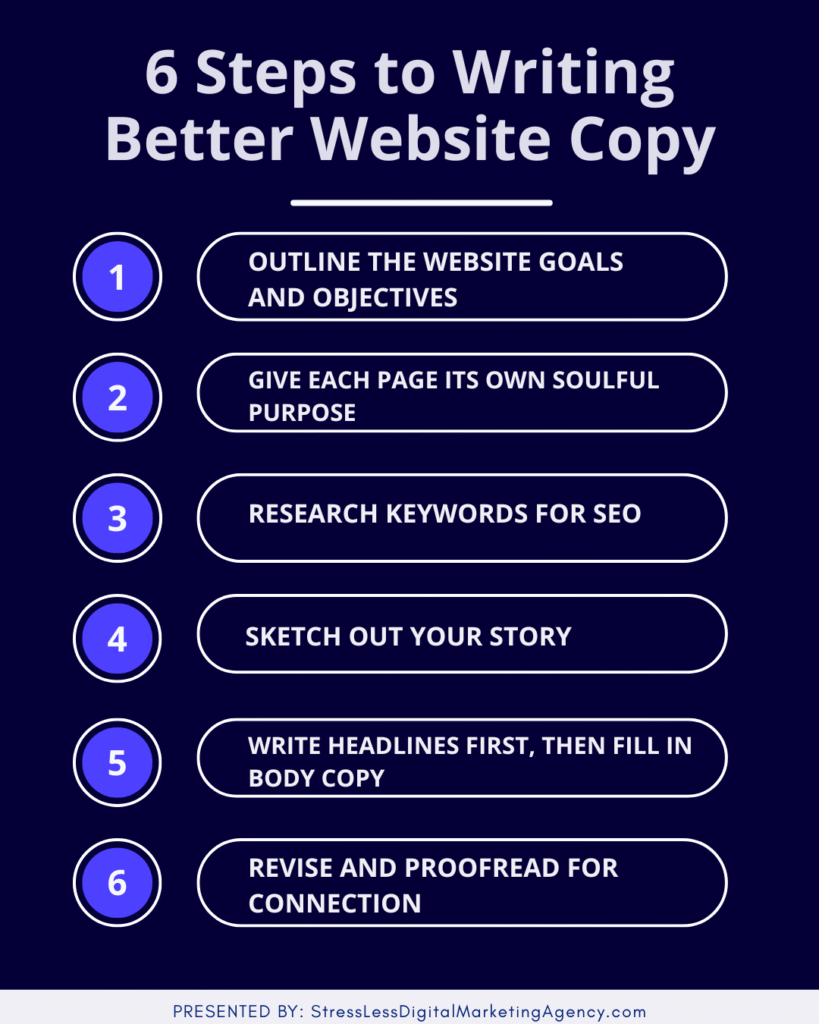
Step 1: Get Clear on What Each Page Is Actually For
Before you write a single sentence, you need to know what job that page is doing. This sounds obvious. Most people skip it anyway and end up with pages that try to do everything at once — inform, sell, build trust, explain the process, and answer FAQs — which means they do none of those things particularly well.
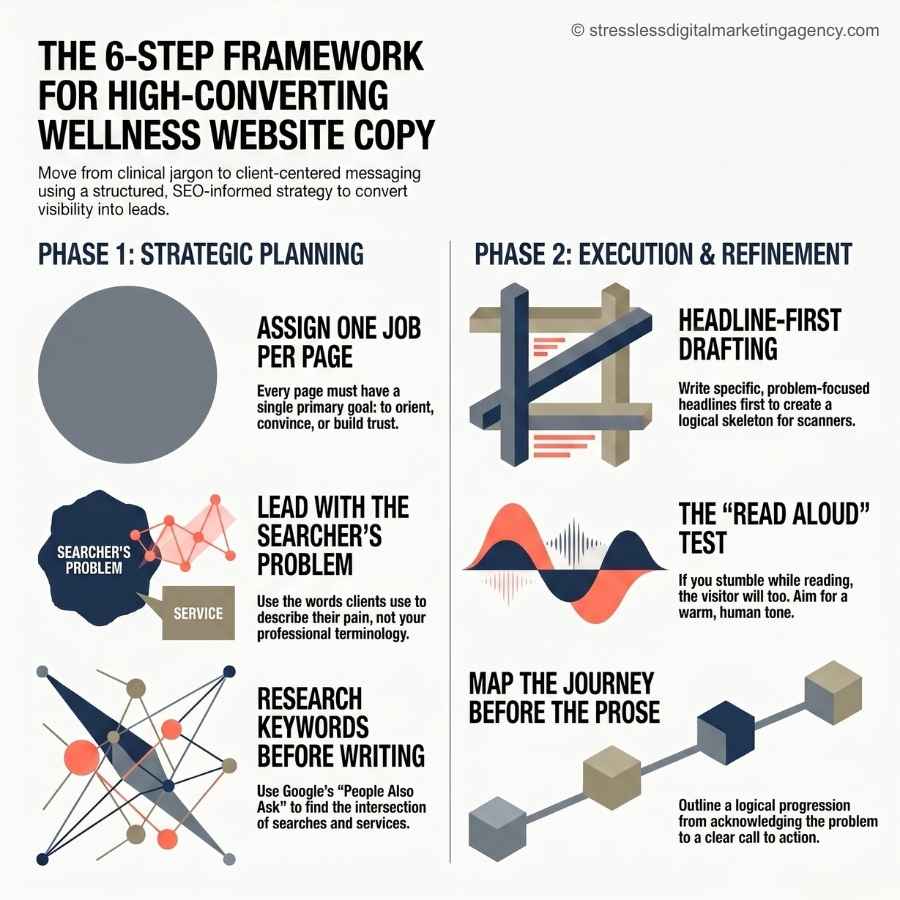
Every page on your website should have one primary goal. Your homepage exists to orient a new visitor and move them toward a service page or the next step. A service page exists to convince a specific type of client that this is the right solution for their specific problem. Your about page exists to build enough trust and connection that a hesitant visitor becomes a warm lead.
When you’re clear on the goal, every decision that follows — what to include, what to cut, where to put the CTA — becomes much easier. Vague pages produce vague results. Give each page a job and hold it to that job.
Step 2: Write for the Person Searching, Not the Person Providing
This is where most health and wellness business owners get stuck, and it’s completely understandable why. You know your work deeply. You have credentials, a methodology, years of experience — and it feels important to convey all of that. So you write from that place, leading with your training, your certifications, your theoretical framework.
The problem is that your prospective client isn’t searching for any of that. They’re searching from a problem. They type things like “why do I feel exhausted no matter what I do,” or “nutritionist for digestive issues Philadelphia,” or “why can’t I stick to healthy habits.” If your copy doesn’t meet them in that language, Google won’t surface your page for those searches — and even if it does, the visitor won’t feel seen enough to stay.
Writing for the person searching means leading with the problem before you introduce the solution. It means using the words your clients actually use, not the professional terminology your colleagues use. Your credentials belong on the page — they just don’t belong in the headline.
This is exactly the gap that makes hiring a copywriter for SEO worth it for established practices — translating clinical expertise into client language is a specific skill, and it takes time to develop.
Step 3: Research Keywords Before You Write, Not After
A lot of DIY website copy gets written first and optimized later, which is like building a house and then figuring out where the foundation should go. Keyword research isn’t a technical add-on — it’s part of how you figure out what to say and how to say it.
You don’t need expensive tools to start. Google’s autocomplete and the “People Also Ask” section are genuinely useful for understanding how your potential clients phrase their searches. Type in the core problem you solve and see what Google suggests. Those suggestions are real searches real people are making.
What you’re looking for is the intersection of what people search and what you actually offer. A wellness coach who specializes in burnout recovery might find that “burnout recovery coach” has strong search intent, while “somatic regulation for nervous system dysregulation,” though accurate, gets almost no searches. You build your copy around the phrases people use to find help, then demonstrate your expertise once they arrive.
For a deeper look at how keyword research actually works inside an SEO content strategy, this breakdown of content strategy for service providers is worth reading alongside this post.
Step 4: Outline Before You Draft
The temptation is to open a blank document and just start writing. For most people, that produces rambling copy that covers too much ground without committing to a clear through-line. An outline — even a rough one — forces you to make decisions about structure before you’ve invested time in prose you might have to cut.
For a service page, a simple outline might look like this: open with the problem your ideal client is experiencing, acknowledge why it’s hard, introduce your approach as the solution, explain what working with you looks like, address the questions or hesitations a reader might have, and close with a clear CTA. That’s not a rigid template — it’s a logical progression that mirrors how a prospective client actually makes a decision.
Your homepage needs a different structure than your services page, and your about page is different again. Each one earns attention in a different way. Map the journey before you write the sentences.
Step 5: Write Headlines First, Then Fill In the Body
Headlines do more work than most people give them credit for. Most website visitors don’t read — they scan. They move through the page catching headlines and subheadings, and they only slow down when something earns their attention. If your headlines are vague, visitors don’t get enough signal to know whether the page is worth reading. If they’re specific and problem-focused, the right reader will slow down.
Write your headlines before you write your body copy, for two reasons. First, it gives you a skeleton to build around — you can see whether the page has a logical flow before you’ve invested hours in paragraphs. Second, it forces you to be specific about each section’s purpose. “Why Choose Me” is a weak headline that tells a reader nothing. “How I Help Functional Medicine Clients Stop Googling Symptoms and Start Getting Answers” is specific enough to stop the right person mid-scroll.
Once your headlines are in place and the flow feels right, fill in the body. Write more than you think you need, then cut. Long-winded copy is usually a sign of unclear thinking — the cleaner your idea, the fewer words it takes to express it.
Step 6: Read It Out Loud Before You Publish
This sounds like a small thing. It is not a small thing. Reading your copy out loud is the fastest way to catch two things that a written review misses: sentences that are technically correct but sound robotic when spoken, and places where the flow breaks — where a reader would naturally pause and wonder what you meant.
If you stumble over a sentence while reading it aloud, a website visitor will stumble over it too. Simplify it. If a paragraph sounds like a brochure rather than a person talking, rewrite it until it sounds like you explaining something to a new client in your intake session. That’s the register you’re aiming for — knowledgeable, warm, and direct.
Grammarly and other tools are useful for catching typos and grammar errors. They won’t tell you whether your copy actually connects. Only reading it like a human will do that.
When DIY Gets You So Far — and No Further
There’s a real ceiling to what DIY website copy can achieve, and it’s worth naming honestly. You can write copy that’s clear, warm, and professional without being a copywriter. What’s harder to do on your own is build the kind of SEO-informed content architecture that consistently surfaces your pages to people who are actively searching for what you offer.
The strategic layer — knowing which keywords have real search intent, how to structure a page so Google understands its purpose, how to build internal links that signal topical authority — takes time to learn and even more time to execute well. If you’ve done the work of writing good copy and your site still isn’t ranking, that’s usually where the gap is.
Wondering whether you’re better off investing that time in learning it yourself or bringing in someone to handle it? This comparison of a copywriter versus a VA lays out the distinction clearly. And if your copy is technically fine but visitors aren’t converting, this breakdown of why website copy stops working is a useful diagnostic.
Next Steps
If this guide helped you see what your copy is missing, that’s a good sign. It means the gap is clear — and a clear gap is much easier to fix than a vague feeling that something isn’t working.
Download the price and services guide to see what working together looks like, or take the free marketing quiz if you want to identify your biggest visibility problem before deciding on the next step.
Free Blog Templates for Health and Wellness Clinicians — if you’re working on your blog content alongside your website copy, these templates are built specifically for service providers.