Brand Voice vs. Brand Tone: Why the Difference Matters for Your Therapy Practice

A potential client reads two blog posts on your website, then glances at an Instagram caption. In less than a minute, they’ve formed an impression about who you are and whether they feel safe reaching out. The words you choose matter, but so does the consistency behind them. Many private practice owners use the terms brand voice and brand tone as if they mean the same thing. They don’t, and understanding brand voice vs brand tone in your therapy practice is what allows your website copy, emails, and social posts to work together instead of pulling in different directions.
I learned this distinction the slow way, as a former psychotherapist turned copywriter. Clinical training teaches you a very specific voice: neutral, careful, measured. That voice is excellent in a session. It is a disaster on a website, and figuring out why took me longer than I’d like to admit.
What Is Brand Voice?
Your therapy brand voice is how your practice communicates its personality, tone, and values to clients. It’s the steady character that shows up whether someone lands on your homepage, reads a newsletter, or opens a brochure. Voice answers a simple question: who is my practice when it speaks?
If my own brand voice were a person, she’d talk like Rory Gilmore: intelligent and witty, thoughtful almost to a fault, the kind of person who reads faster than most people talk and still notices everything happening in the room. That’s not an accident. I built the voice on purpose, because I want to be a kind of matchmaker between clients and providers, a translator who turns clinical language into words a scared, tired person at 11pm can actually understand.
For health and wellness providers, a strong brand voice reflects the mission, vision, and values behind your work. It helps clients connect with you on a deeper level and understand what it would feel like to sit across from you in a session. Voice isn’t a marketing filter you switch on when you write. It’s an honest extension of how you practice.
There’s a useful rule of thumb for most therapists and coaches. Unless you work for a large corporate brand, your voice should sound like someone you’d want to grab lunch with, not like a brochure. Clients are looking for a real person with clinical skill and human warmth. A voice that feels stiff or generic pushes them away before they ever schedule an appointment.
What Is Brand Tone?
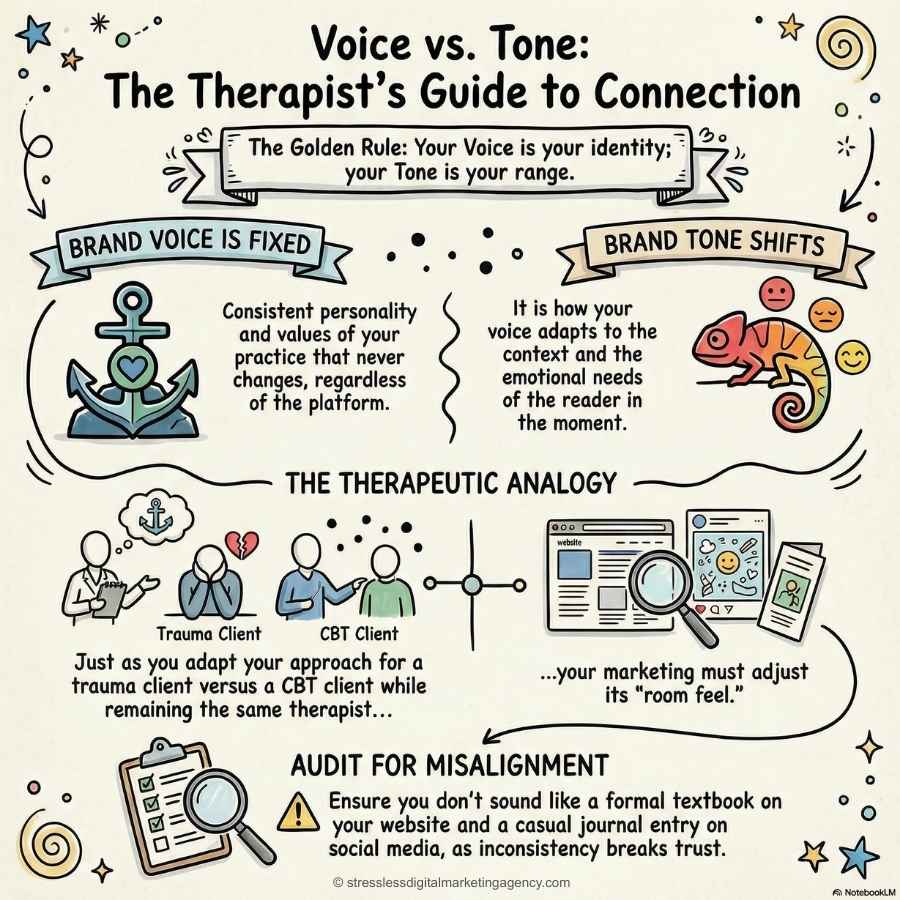
If voice is the person, tone is the mood in that person’s voice at any given moment. Tone is how your brand’s voice fluctuates based on the audience you’re speaking to, or the subject matter you’re speaking about. You keep the same personality, but you adjust your delivery to fit the context.
I once picked up a psychology book purely for fun and found myself bored stiff by page ten. The concepts were fascinating. The tone was so clinical and detached that I needed a mental dictionary just to follow a single paragraph. That’s what an overly formal tone does to a reader who’s already anxious and looking for help, not a lecture. Think about how a therapy session actually works. You don’t speak to every client in exactly the same way. With one client, you might be gentle and slow. With another, you might be more direct and practical. Your clinical identity stays stable, but your tone shifts to meet the person in front of you. Brand communication works the same way. Your voice remains recognizable, while your tone flexes for the platform, the reader, and the purpose of the message.
A tone that ignores context can feel cold at the wrong moment, while a voice that changes constantly can feel untrustworthy. Both elements need to work together for your copy to feel natural and intentional.
Brand Voice vs Brand Tone in Your Therapy Practice: The Core Difference
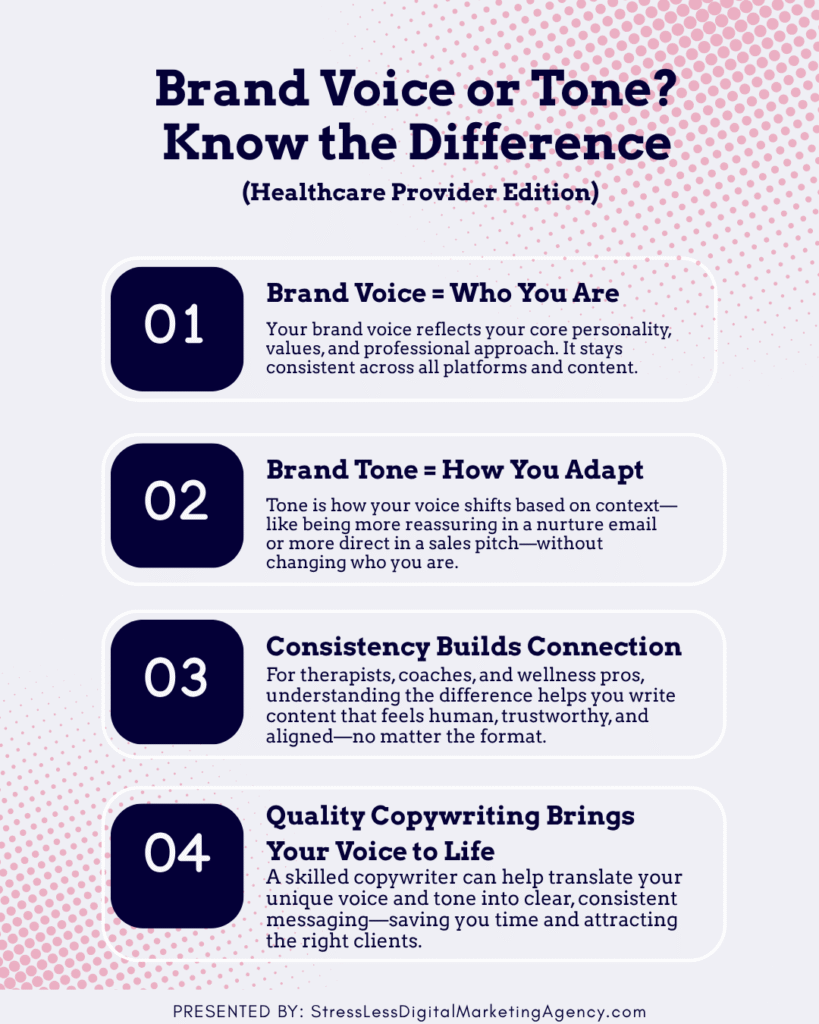
The simplest way to separate the two is to remember that voice is who you are and tone is how you sound in a specific situation. Voice stays fairly constant. Tone changes as you respond to different readers, platforms, and topics. A therapy practice might write a warm and reassuring blog post about anxiety, then write a clear and practical email reply to a prospective client who asked about fees. The voice behind both messages is the same practice. The tone is different because the needs of the reader are different.
| Brand Voice | Brand Tone |
|---|---|
| Who your practice is | How you express that identity in a given moment |
| Reflects your personality and values | Fluctuates based on audience and subject matter |
| Stays consistent across platforms | Shifts to fit the reader and the context |
| Builds long-term recognition | Helps the message land with empathy and clarity |
Why This Distinction Matters for Your Therapy Practice
Marketing for therapists isn’t about sounding professional at all costs. It’s about helping the right clients feel understood before they even contact you. When voice and tone get confused, copy ends up inconsistent. A website might sound warm and personal, while an email sounds stiff and corporate. That mismatch creates doubt exactly when you want to build confidence.
Clinical training teaches you to be a blank slate: stay neutral, don’t share, let the client lead. That’s excellent therapy. It’s a disaster for marketing. Your ideal client isn’t in your office yet. She’s on Google at 11pm, reading five different therapist websites that all say the same thing, warm, welcoming, safe space, no judgment. That’s the basic requirement for the job, not a reason to choose you. The practices that get found, and more importantly, get called, are the ones willing to have a point of view, to say who they’re for, and to be slightly uncomfortable for the people they’re not trying to attract.
Consistency Builds Trust
A clear and consistent voice builds trust with potential clients. When your practice sounds the same across every communication platform, people get a reliable sense of who you are and what to expect. Consistency signals stability, and stability is a deeply reassuring quality for someone choosing a therapist. The same principle applies whether you write a service page, answer a contact form, or share a resource on social media.
My own Psychology Today profile sat online for months without a single call while it read like a resume. Then I rewrote it, not as a full overhaul, just as someone who knew exactly who she helped instead of trying to sound like every other clinician on the directory. Within seven days, I had calls. Not because I’d suddenly become more qualified. Because the right people finally saw themselves in what I’d written. That’s consistency of voice doing its job.
Attracting the Right Clients
People seek therapy for personal reasons. The language a private practice uses tells potential clients whether they belong there. A voice grounded in your real values attracts the clients who are the best fit for your specialty and approach. A vague or overly clinical voice attracts no one in particular. When your brand voice reflects your actual way of working, the people who need your help can recognize you more easily.
How Voice and Tone Shift Across Platforms
Practitioners often ask whether their brand voice should change from one platform to another. The better question is how the expression of that voice should adapt. Your identity should remain recognizable, but tone can flex based on where you’re writing and who you’re addressing.
A website homepage for your therapy practice can carry a welcoming and unhurried tone because visitors are exploring. A community mental health organization might use a more reassuring tone when addressing patients at a stressful moment. A short social media post may feel lighter and more conversational, while a clinical resource page calls for a calm, grounded tone. The underlying voice stays present in both places. The tone adjusts to the platform and the emotional state of the reader.
The key is to change tone with intention rather than drift into a different voice by accident. If clients can’t tell that the same practice wrote two different pieces of content, the voice has become unclear.
Steps to Finding Your Brand Voice as a Therapy Practice
Most health and wellness business owners begin by looking at what other practices are doing and trying to create a slightly better version of it. That approach produces copy that sounds like everyone else. A more useful starting point is to define the voice that only your practice can offer.
Start With Your Values, Not a Brochure
A strong brand voice reflects your practice’s mission, vision, and values. Before writing any website copy, identify what you believe about therapy, healing, and the people you serve. Your voice should sound like someone clients would want to talk to, not like a brochure written by a committee. If your writing would sound odd coming out of your mouth in a session, it probably doesn’t fit your practice.
Say What You Are, Not What You Aren’t
Every Tuesday I take my daughter to soccer practice, and like any true four-year-old fashionista, she owns multiple pairs of shoes. One Tuesday I told her, wear the purple shoes, not the PAW Patrol ones. I’ll give you one guess which pair she brought back. If you guessed PAW Patrol, you understand the brain of a four-year-old. Whatever you tell someone they’re not, that’s what sticks. Our ideal clients work the same way. When your homepage spends a paragraph explaining what your practice isn’t, that’s the part the reader remembers. Tell them exactly what your services are, clearly and without hedging, and let that clarity carry the voice.
Stay Consistent Across Everything You Publish
Once you’ve identified your voice, apply it consistently across all communication platforms. Consistency is key because repetition builds recognition. Each blog post, service page, and email is a chance to reinforce who you are. The more aligned your published words are with your in-person presence, the easier it is for referrals to trust you before the first appointment.
Adjust Tone Intentionally for Each Reader
Because tone fluctuates based on the audience persona and the subject matter, plan for it. An ideal client reading a page about anxiety therapy may need a softer tone than a referring professional reading an email. You can stay true to your voice while still shaping your tone for the person on the other side of the screen. That flexibility isn’t inconsistency. It’s a communication skill.
Want Help Making Your Voice Sound Like You?
If you’re staring at your website wondering why it doesn’t sound like the person your clients meet in session, you’re not alone, and you don’t have to sort it out by trial and error. Download the free chapter of Stay Booked and see exactly how brand voice fits into a website that’s actually built to fill your practice.
Further Reading
Frequently Asked Questions
What is the difference between brand voice and brand tone?
Brand voice is how your practice communicates its personality, tone, and values to clients. It reflects who you are and stays consistent. Brand tone is how that voice fluctuates based on the audience you’re speaking to or the subject you’re discussing. Voice gives your practice a stable identity, while tone helps you respond appropriately to each reader and situation.
Should a therapy practice change its tone on different platforms?
Your brand voice should remain consistent, but your tone can change depending on the platform and the reader. A conversational social media post can use a lighter tone than a detailed clinical resource page. The underlying identity of your practice stays the same. What changes is the tone you choose to match the platform, the audience, and the purpose of what you’re writing.
Why does brand voice matter for building trust with clients?
A clear and consistent voice builds trust because it shows clients who you are and what you value. Trust grows when people experience the same personality across your website, emails, and social media. A thoughtful brand voice also makes your practice more personal and approachable, helping potential clients feel that you understand them before they ever book a session.