Steps to Finding Your Brand Voice as a Health and Wellness Business Owner
Most health and wellness business owners approach finding their brand voice the same way they approach building a website: they start by looking at what everyone else is doing and try to do a slightly better version of it.
This produces a slightly better version of average copy. Warm and welcoming. Professional but approachable. Evidence-based. Safe. Indistinguishable from the dozens of other providers in the same directory.
Your brand voice is not something you borrow from a competitor or generate from a template. It is already inside your practice — in the way you explain your work to a new client, in the analogies you reach for naturally, in the things you believe about how change actually happens that your colleagues might not. Finding it is not a creative exercise. It is an excavation.
This post is the practical guide to that process. If you want the full strategic framework for building on top of what you find, start with the guide on brand voice for service providers. Come back here when you are ready to do the work of actually locating your voice.
Why Finding Your Voice Is Different for Health and Wellness Providers
In most industries, brand voice development is primarily a marketing exercise. You identify your target audience, study what resonates with them, and craft a voice that speaks to their needs.
For health and wellness providers, the process has an extra layer of complexity. Your professional training has likely conditioned you to minimize your personal presence — to be objective, neutral, and clinically appropriate in how you communicate. For therapists, this is the blank slate model. For dietitians and coaches, it often shows up as over-reliance on credentials and evidence to establish authority.
Both instincts are clinically sound. Both actively undermine your marketing.
Your potential clients are not reading your website to verify your qualifications. They are reading it to find out if you understand them — if you sound like someone they would feel comfortable opening up to, investing in, and trusting with something genuinely tender. That requires a human voice. Not a professional one.
The other complexity is that your expertise is real and deep, and translating it into language a non-clinician can connect with is a skill most providers have never been asked to develop. Your voice work starts at that translation layer.
The core insight: Authenticity and relatability are not marketing tactics. For health and wellness businesses, they are the mechanism of conversion. Buyers and clients make decisions based on values and fit, not credentials alone. Your voice is what communicates both.
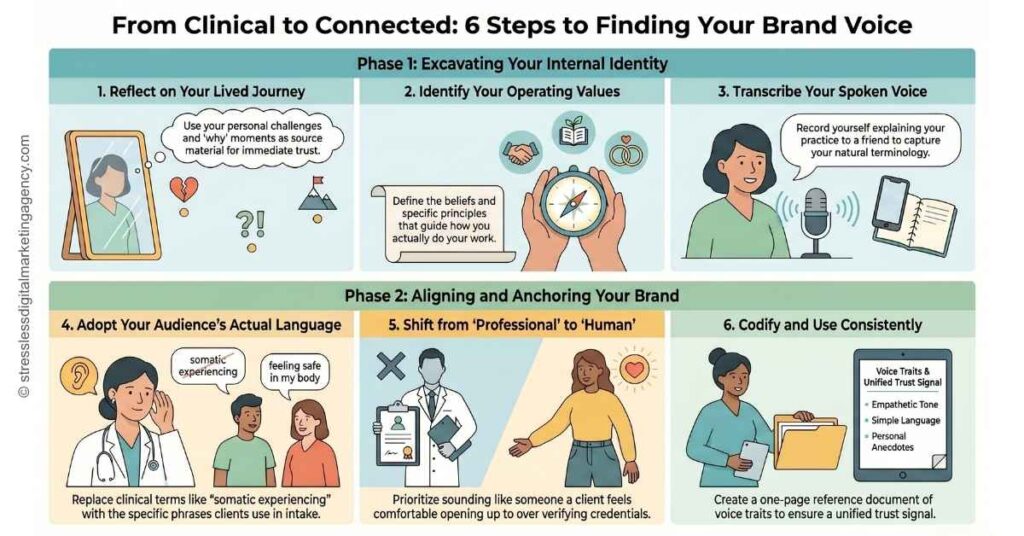
Step 1: Reflect on Your Journey — the Challenges and Wins You Have Actually Lived
Your brand voice is rooted in your personal and professional history, not your job title. Before you write a single word of copy, spend time with the following questions:
- What drew you to this specific area of health and wellness?
- What did you experience — personally or professionally — that shaped how you approach your work?
- What have you struggled with that your ideal client is struggling with right now?
- What moment made you realize this was the work you were meant to do?
These are not prompts for a personal essay. They are the source material for a voice that connects. When a potential client reads about a provider who has genuinely lived adjacent to what they are going through, the trust transfer is immediate in a way that credentials cannot manufacture.
When I was building my own private practice, I spent nearly a year assuming my clinical background and specialty would do the work for me. My Psychology Today profile was accurate, professionally written, and almost entirely personality-free. I went weeks without a single inquiry. What changed was not adding more credentials. It was finally writing copy that reflected why I had chosen brain injury and stroke rehabilitation specifically — the personal conviction behind the specialty, not just the training. Within seven days of updating my profile with that voice, my phone started ringing. The work had not changed. The human behind the work had finally shown up on the page.
Step 2: Identify Your Values — What Matters Most in How You Do Your Work
Your values are not a mission statement. They are the operating principles that actually guide your decisions, even when no one is watching. And they are one of the most powerful differentiators available to health and wellness businesses — because most providers never name them explicitly.
Ask yourself:
- What do you prioritize in a client relationship that other providers in your field might not?
- What do you believe about how change actually happens that is not widely held?
- What would you refuse to do for a client even if they asked, because it conflicts with how you work?
- What do you wish more people in your field stood for?
These answers are the backbone of a brand voice that has a perspective. And perspective is what makes content shareable, memorable, and worth reading. Generic wellness content has no perspective. It presents information. Content built on genuine values makes a reader feel something — and feeling something is what drives action.
A note on specificity: Do not be afraid to take a stance. A clear point of view will make some people uncomfortable and make others feel like you have been reading their mind. That is the point. Trying to appeal to everyone is the fastest way to connect with no one.
Step 3: Speak Like Yourself — Your Spoken Voice Is Already Your Brand Voice
Here is the most efficient shortcut to finding your brand voice: stop writing and start talking.
Pull out your phone, open your voice memo app, and describe your practice out loud. Explain what you do as if you are talking to a friend who is not in your field. Walk through how you approach a first session. Describe your ideal client without using any clinical language. Talk about what makes your work different from what a client might find elsewhere.
Then transcribe it.
What you find in that transcript is your brand voice in its most natural form. The analogies you reach for. The phrases you repeat. The places where your conviction comes through without you having to perform it. That is the material your written copy should sound like.
This is the same process I use with every client in a Foundational Messaging Map session. The session is a structured 60 to 90-minute conversation — recorded and transcribed — because the best copy is never manufactured from scratch. It is compiled from what a provider already knows and believes, organized into a framework that makes it usable across every platform and piece of content.
The biggest single mistake health and wellness providers make when developing their brand voice is assuming their credentials are enough — that listing what they are trained in will communicate who they are. The written voice that converts is the one that sounds like the same person who puts clients at ease in a first consultation. Your spoken voice is that person. Find a way to get it on the page.
Step 4: Tie Your Voice to Your Audience’s Actual Language
Finding your voice is only half of the equation. The second half is making sure your voice speaks to what your ideal client is actually experiencing — in the words they actually use, not the clinical terminology you use to describe their condition.
There is almost always a gap between how a provider describes their work and how a client describes what they need. A client seeking help does not type “somatic experiencing” into Google. They type something like: why do I feel numb even when good things happen, or my body feels tense all the time, and I do not know why. Those are the words your voice needs to meet.
Some practical ways to gather this language:
- Review your intake forms and look for the phrases clients use to describe their presenting concerns in their own words.
- Listen to your consultation calls and note the specific language people use before they have been introduced to your clinical framing.
- Read reviews or testimonials from providers in your niche and pull the exact words clients use to describe transformation.
- Notice what makes someone stop scrolling on your social posts — what did you say when engagement spiked? That is a voice signal worth capturing.
When your voice uses your client’s language to describe their experience, the connection feels immediate. The reader does not think: this provider understands anxiety. They think: this person knows exactly what my Tuesday afternoons feel like. That is the level of resonance a brand voice built on real client language can create.
Step 5: Document What You Find and Use It Consistently
None of the steps above produces lasting results if the voice you hear lives only in your head. Brand voice only builds recognition when it shows up consistently — across your website, your blog, your emails, and every other touchpoint a potential client might encounter.
That requires a reference document. It does not need to be long. A single page that covers your voice traits, your key phrases, the language to avoid, and two or three writing samples is enough to anchor everything you produce going forward — and to brief anyone who ever writes on your behalf.
For a deeper look at what that document should include, read the guide on brand voice guidelines.
The brands that become recognizable in the health and wellness space are not the ones with the best design or the largest social following. They are the ones that consistently sound like themselves — across a year of content, across every platform, across every piece of copy a potential client might encounter before they decide to reach out. Consistency is what turns a brand voice into a trust signal. And trust is what converts a reader into a client.
What to Do When You Cannot Find Your Voice on Your Own
Some providers go through every step above and still feel stuck. The words on the page do not sound like them. The copy they produce feels technically correct but flat. They know something is missing and cannot identify what it is.
This is not a failure of self-awareness. It is a structural problem: finding your own voice is genuinely difficult to do in isolation, for the same reason a therapist cannot be their own therapist. The blind spots that shape how you present yourself professionally are the hardest ones to see from the inside.
This is the problem the Foundational Messaging Map is designed to solve. Rather than asking you to find your voice alone, it is a structured conversation that draws it out — through the right questions, in the right order, in a format designed to surface the specific language and perspective that makes your practice distinct. Read more about foundational messaging for therapists and how the process works.
Ready to Stop Guessing and Find Your Voice?
Download the Price and Service Guide to learn how the Foundational Messaging Map helps health and wellness business owners build the messaging foundation that makes all future content work.
Not ready to dive in? Start here:
- Quiz: What’s Keeping You Stuck With Marketing? Find your #1 visibility blocker in under 3 minutes.
- Free Blog Templates for Service Providers: Designed specifically for health and wellness clinicians — ready-to-use structures that make content creation faster and more consistent.