Why Your Brand Voice Is Keeping Ideal Clients From Booking
One of my best-performing pieces of content opened with a single line: The monsters under your bed are real. They just move out from under the bed and into your head once you become an adult.
That line earned shares, saves, and comments from people who had never interacted with my content before. Not because it was clinically precise. Because it made someone feel seen before they even knew who I was.
That is what brand voice does when it is working. And it is the exact opposite of what most therapy practice websites are doing right now.
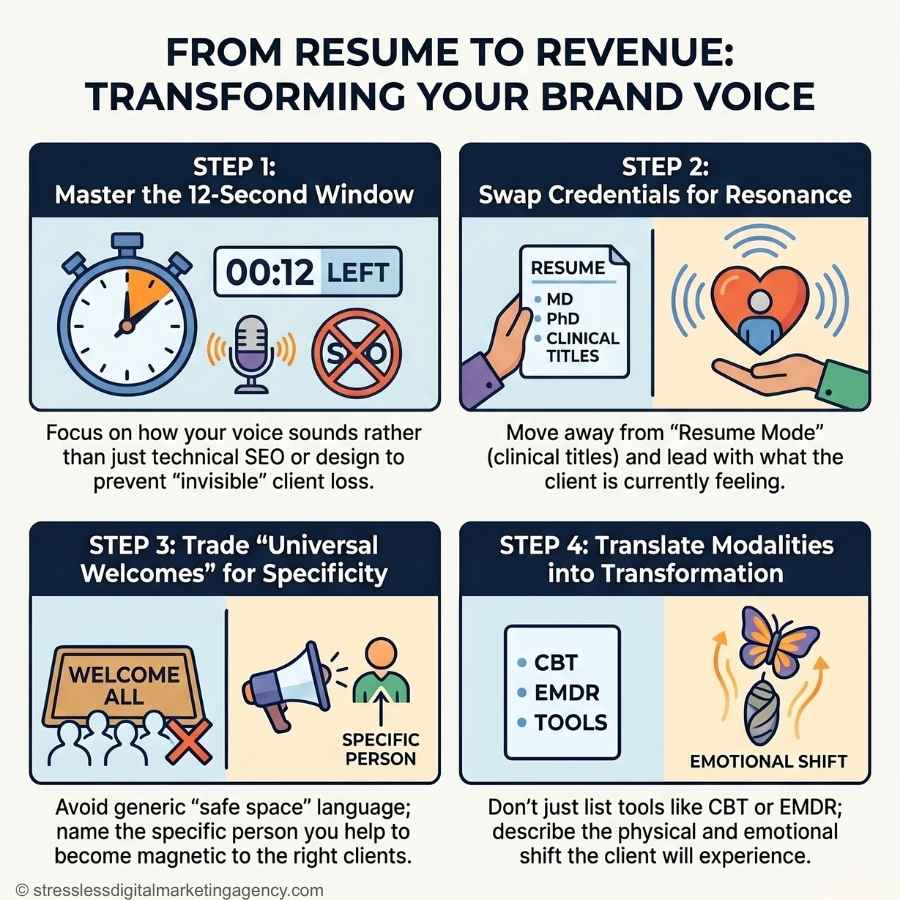
This post is not about whether your website looks good or ranks well. It is about what happens in the eight to twelve seconds after someone lands on your site and decides whether to stay or leave. In that window, your brand voice — the tone, the language, the personality behind the words — is either pulling your ideal client closer or quietly filtering them out.
Most practices never realize this is happening. They are too focused on what they are saying to notice how it sounds.
The Problem Nobody Names: Your Website Is Losing Clients You Never Knew You Had
Here is the uncomfortable part about a brand voice problem: the damage is almost entirely invisible. You do not see the people who found your site, scrolled for thirty seconds, could not figure out what made you different, and closed the tab. They do not send a note explaining why they chose someone else. They just disappear.
What you do see is the absence of inquiries. The dry spells between referrals. The Psychology Today profile that goes weeks without a single message. The social posts that get polite engagement but never drive someone to reach out.
The instinct is to assume something technical is wrong. The SEO needs work. The design is outdated. You need better photos. You need to post more content.
Those things might be true. But they are almost never the primary problem. The primary problem, in the majority of therapy practice websites I have reviewed, is that the voice does not sound like a human being a client would want to trust. It sounds like a credential list dressed up as a website.
The real filter:
Your ideal client is not reading your website to verify that you are qualified. They already assume you are qualified. They are reading to find out if you understand them — and whether they feel something when they read your words. If they feel nothing, they leave.
What ‘Safe’ Sounds Like — And Why It Does Not Convert
Spend an afternoon clicking through therapy practice websites in any major city, and a pattern emerges almost immediately. Warm. Welcoming. Non-judgmental. Safe space. All are welcome. Evidence-based. Holistic approach. Here to support you on your journey.
These are not bad words. They are just words that appear on every single website in the directory, in nearly identical combinations, in the same order.
Here is what I want to say, plainly: being warm, welcoming, and non-judgmental is not a differentiator. It is the baseline requirement for practicing ethically as a therapist. Putting it in your headline does not tell a potential client anything they did not already expect. It just confirms that you are licensed.
A colleague of mine wrote her Psychology Today profile like a wanted ad. She described her ideal client the way a casting director would describe a role. She named the specific kind of person she worked best with, the ones who had tried other things, the ones who were ready to do the real work. She got messages from potential clients saying she had described them perfectly.
That is not a trick. That is brand voice. She was willing to be specific enough to be polarizing, and in doing so became magnetic to exactly the right people.
The therapy practices that stand out online are not the ones with the most clinical credentials or the most polished design. They are the ones willing to have a point of view. The ones who sound like a specific human being with a specific way of seeing the world and a specific kind of client they are built to help.
What Private Pay Clients Are Actually Evaluating When They Read Your Site
This dynamic is especially consequential for practices transitioning to out-of-network or private pay. When a client chooses to pay your full fee without the buffer of insurance coverage, they are making a different kind of decision than a client whose insurance will reimburse most of the cost.
They are not just asking: is this therapist qualified? They are asking: is this therapist worth it? And they are trying to answer that question from your website before they ever get on a consultation call.
A private pay client reading your homepage is running a quiet internal evaluation that sounds something like this: Does this person understand what I am actually going through? Do they seem like someone I could talk to? Does their way of working sound like what I actually need? Would I feel embarrassed to bring my most complicated stuff into this office?
Your credentials do not answer those questions. Your voice does.
When a practice gets this right, something specific happens. The inquiries that come in are different. Instead of a generic message asking about availability and rates, you start getting messages that say things like: I feel like you have been in my head. I read your website and felt like you already understood what I was going through before we even talked.
That is not marketing magic. That is a brand voice that is specific enough to make someone feel seen. And it is exactly what converts a private pay visitor into a consultation request.
The private pay conversion truth:
Clients paying out of pocket need more than proof of competence. They need to feel like you are the specific right person for their specific situation. Generic voice cannot do that. Only a voice with a genuine point of view can.

But your inquiry form is quiet. The problem isn’t effort. Something specific in your marketing is broken, and until you know what it is, you’re just adding more tasks to an already full plate. Take the free 60-second quiz to find out exactly where your marketing is breaking down and what to fix first.
Three Tonal Patterns That Signal ‘Resume Mode’ to a Potential Client
Most resume-mode websites share the same tonal patterns. Here is how to recognize them — and what the revenue-mode version looks and feels like instead.
1. The Credential-Leading Introduction
Resume mode opens with what you are. Licensed clinical social worker. Registered psychologist. Certified in EMDR and somatic experiencing. Years of experience working with adults, couples, and adolescents. This information has its place. But when it is the first thing a reader encounters, it signals that you are thinking about your professional identity, not about them.
Revenue mode opens with what your client feels — or what they will feel differently after working with you. It earns the credential conversation by establishing resonance first.
2. The Universal Welcome
Resume mode says: I work with adults of all backgrounds navigating anxiety, depression, relationship challenges, life transitions, and more. This sentence technically communicates availability. It also communicates that you have not thought carefully about who you most want to work with, or who you are best equipped to help.
Revenue mode names someone specific. Not to exclude everyone else, but because specificity creates recognition. When a reader sees themselves in your words, they feel found rather than processed.
3. The Modality List Without Transformation Language
Resume mode: I use cognitive behavioral therapy, EMDR, mindfulness-based approaches, and somatic techniques. This is accurate and professionally appropriate. It is also completely meaningless to a client who has no idea what most of those things are or why they should care.
Revenue mode translates modality into experience: We do not just talk about what is happening — we work with it in your body, where it actually lives. That is how change that lasts gets made. The technique is implied. The transformation is named.
| Resume Mode | Revenue Mode |
I am a licensed therapist with 10+ years of experience working with adults navigating anxiety, depression, and life transitions. | You have been holding it together for a long time. The exhaustion you feel is real — and it is not a character flaw. Let’s figure out what is actually going on. |
| I offer a warm, non-judgmental space where all are welcome. | I work best with people who have tried the standard approaches and found them useful but incomplete. If you are ready to go a layer deeper, you are in the right place. |
| I use evidence-based modalities including CBT, EMDR, and somatic approaches. | The work we do together uses your body’s own signals as data. Because the story is not just in your head — it is in how you hold your breath, brace your shoulders, and brace for impact. |
Why Fixing Your Tone Starts Before You Touch the Copy
The instinct when you recognize a brand voice problem is to start rewriting. Swap out the clinical language. Add some personality. Try to sound more like yourself.
That helps, and it is not enough.
Tonal problems are a symptom of a missing foundation. Without clarity on who you are specifically talking to, what you want them to feel, and what your distinctive point of view actually is, rewriting individual sentences just produces a more personable version of the same unclear messaging.
The full framework for building that foundation is in the guide on brand voice and tone. The short version: your brand voice has to be excavated before it can be expressed. That means naming your actual perspective on how change happens, identifying the specific client you are built to help, and documenting the language that bridges your clinical expertise to what your client is actually experiencing. None of that happens by rewriting your About page one more time.
If you have done revisions and the copy still does not sound like you, the foundational messaging work has not happened yet. That is where to start. Read more about foundational messaging for therapists.

The Goal Is Simple: Make the Right Client Feel Found
When your brand voice is working, your ideal client reads your website and thinks: This person has been in my head. They get it. I have never met them, and I already feel understood.
That is the moment a visitor becomes an inquiry. And it does not happen because of better design, more frequent posting, or a higher SEO ranking. It happens because your voice is specific enough, human enough, and honest enough that the right person sees themselves in your words.
That voice already exists. It just needs the right process to surface it.
Ready to Build a Voice That Actually Converts?
Download the Price and Service Guide to learn how the Foundational Messaging Map helps therapy practices go from invisible to in-demand.
Not ready yet? Start here for free:
- [Freebie] Stop Panicking When Clients Graduate: Your website’s guide to organic inquiries that keep working when you are not actively marketing.
- Quiz: What’s Keeping You Stuck With Marketing? Find your #1 visibility blocker in under 3 minutes.