How to Justify Out-of-Network Therapy Rates (With Copy That Converts)

I took my daughter to a Savanna Bananas baseball game a while back. If you have never been, their whole philosophy is “fan first” — every single decision about the experience is built around the audience’s enjoyment, not the team’s convenience. Nothing about the evening makes you feel like a transaction.
Sitting there watching it, I could not stop thinking about therapy websites.
Because most of them do the exact opposite. They are built around the therapist — the credentials, the training years, the modality list. And the person reading it, the one who is exhausted and finally Googling help at 10pm, is sitting there asking the only question that actually matters: Can this person help me?
This problem is expensive for out-of-network therapists specifically, because you are already asking someone to pay more. You have less margin for a website that just lists credentials and hopes people will connect the dots. When someone is weighing your $200 session against an in-network copay, your copy has to work hard enough to make that math feel obvious.
Here is how to write it so it does.
Key Points:
- Out-of-network therapy rates are not a liability if your copy explains the value with specificity — they become a signal of expertise
- You are not selling therapy; you are selling a particular outcome that a general practitioner is not equipped to deliver
- The five things every out-of-network service page must communicate: who you help specifically, how your approach is different, what results look like, why not taking insurance benefits the client, and what the investment actually includes
- Transparency about pricing builds trust and pre-qualifies leads — hiding your rates does not protect you, it just creates friction
- Blog content and SEO visibility do the pre-selling work before a potential client ever reaches your contact page

Why Out-of-Network Therapists Need Stronger Copy
If you are charging out-of-network rates, you are not competing on price. You are competing on value. And if your website does not articulate that value in plain, client-centered language, people will default to the in-network therapist down the street — not because that therapist is better, but because the choice feels safer and the math is easier.
Think about what a potential client actually sees when they scroll Psychology Today. Half the listings accept insurance. The ones that do not look almost identical to the ones that do, except with a price tag attached and no explanation for why. Both say “warm, welcoming, safe space, evidence-based approaches.” One of them costs $200 out of pocket per session. The question your copy has to answer before they ask it: what am I getting here that I cannot get from someone my insurance covers?
If you cannot answer that clearly on your website, the consultation inquiry goes to someone who can. That is the whole problem, and it is entirely fixable.
For a broader look at how your website fits into a complete visibility strategy — not just the copy, but the SEO structure underneath it — this no-fluff SEO guide for therapists covers what makes a private-pay practice findable in the first place.
What You’re REALLY Selling (Hint: It’s Not Therapy)
When I was in private practice, I specialized in strokes and traumatic brain injury recovery. Private pay only. And I had to learn pretty quickly that leading with my LCSW and my years of experience was not going to fill my caseload.
Here is the version of my positioning that did not work:
“I’m an LCSW specializing in post-concussive therapy. I don’t take insurance. Sessions are $175.”
The version that worked was longer, more specific, and built entirely around the client’s experience rather than my credentials:
“You survived the injury. But no one prepared you for what comes after — the fog that makes a simple conversation feel like swimming through concrete, the frustration of losing words mid-sentence that used to come easily, the grief of not quite recognizing yourself in the mirror anymore. You have been cleared by your medical team, sent home, and told to rest. And yet something still isn’t right, and nobody seems to know what to do with that.
Most therapists are not trained in what happens to the brain after trauma like this. General talk therapy often makes it worse, especially when language and processing speed are affected — sitting across from someone asking you to reflect and verbalize is its own kind of exhausting when your brain is working twice as hard just to follow the conversation.
I specialize in this specific in-between place — the space after medical discharge and before feeling like yourself again. Using evidence-based approaches designed for brain injury recovery, and working in close coordination with your medical team, I help you rebuild at the pace your nervous system can actually handle. Investment: $175/session.”
Same rate. Same therapist. Completely different result — because the second version explains the gap I was filling, the client I was built for, and what they were actually getting for their money.
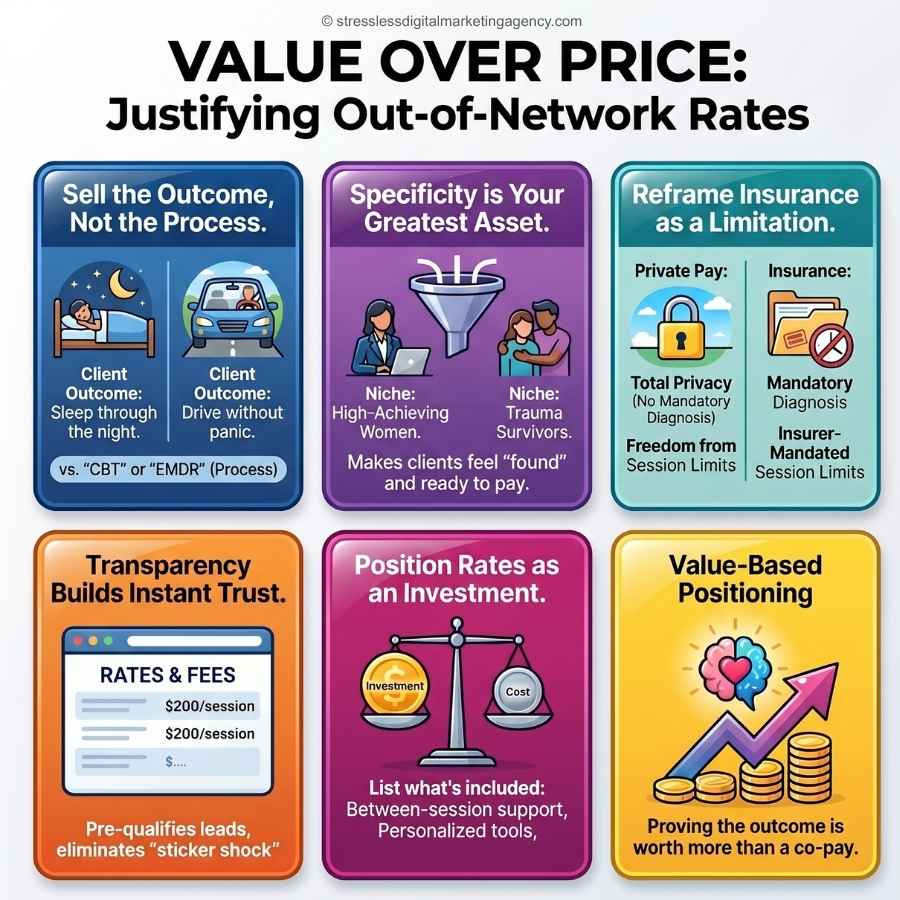
This is the reframe that changes everything for out-of-network therapists: you are not selling therapy. You are selling faster results because you specialize, deeper expertise because you have invested in advanced training, a better fit because you work with a specific population, more flexibility because you are not bound by what an insurer will approve. The $200 session does not feel expensive when a client understands exactly what they are getting that a $30 copay cannot provide.

The 5 Things Your Copy MUST Communicate
Every out-of-network service page needs to answer five questions — not someday, not in a FAQ buried at the bottom, but front and center where a first-time visitor cannot miss them.
1. Who You Help (And Be Specific Enough That the Wrong People Know to Look Elsewhere)
Vague positioning is invisible positioning. “I work with adults experiencing anxiety and depression,” describes roughly 40% of therapists on Psychology Today. The more specific you are, the more the right people feel genuinely found.
Compare: “I work with high-achieving women in their 30s and 40s who look successful on paper but are secretly drowning in perfectionism and self-doubt” versus the generic version. One of those lands. The other does not. Specificity is not about narrowing your reach — it is about making the right people feel seen before they have even spoken to you. I talk about this more in the context of marketing strategy for private practice, but the short version is: a stranger who recognizes themselves in your website copy converts at a completely different rate than one who has to guess whether you are the right fit.
2. What Makes Your Approach Different
Listing modalities is not the same as explaining your approach. “I use CBT, DBT, and EMDR” tells someone what tools you own. It does not tell them how those tools combine in your hands or why that combination produces different results than the therapist down the street who also trained in EMDR.
The difference worth communicating is the why behind the method — something like: “I combine EMDR with somatic therapy because trauma lives in the body, not just in your thoughts. Most talk therapy addresses the story. This work addresses what your nervous system is holding onto, which is why people often shift things in months that they have been stuck with for years.” Now the approach has a rationale. It explains a problem the client already suspects exists and positions your method as the solution to that specific problem.
3. What Results Clients Can Expect
Outcomes, not promises. There is a meaningful difference between “I help clients manage their anxiety” and “Most clients notice a significant reduction in panic attacks within eight to ten sessions, and many are able to re-engage with things they had been avoiding — driving, social events, air travel — without the same overwhelming response.” The first is a job description. The second is a reason to call.
Concrete, realistic outcome language also does something important for private-pay positioning: it reframes the cost as an investment with a return. If someone is weighing $200/session against a $30 copay, the calculation changes when your copy helps them see what the ten sessions are actually moving them toward.
4. Why You Don’t Take Insurance (And Why That Benefits the Client)
Most out-of-network therapists either say nothing about insurance or apologize for not taking it. Neither approach works. What does work is addressing it directly and reframing it as a deliberate choice that serves the client — because for most out-of-network providers, it genuinely is.
The privacy piece matters more than most therapists lead with: when you bill insurance, you are required to assign a diagnosis that enters a client’s permanent medical record. For clients in high-security careers, applying for life insurance, or simply protective of their privacy, that is a significant consideration. Add to that the session-limit problem — insurers capping how many sessions they will approve regardless of clinical need — and the case for private pay becomes a real benefit rather than an inconvenience.
A dedicated FAQ section titled something like “Why I don’t take insurance — and why that might actually benefit you” handles this objection before it is voiced, which means it never has to derail a consultation call.
5. What the Investment Actually Includes
“Sessions are $200” is not a price. It is a number sitting alone without context. What makes that number feel worth it is everything you wrap around it: the comprehensive intake assessment, the personalized treatment plan, the email support between sessions, the coordination with their medical team, the longer session availability when needed.
When the investment section of your service page reads like a full picture of what working with you entails — not just fifty minutes on a Tuesday — the number becomes part of a value equation rather than a sticker shock.
Real Examples: Bad Copy vs. Good Copy
Seeing the shift on paper helps more than any framework, so here are three real-world comparisons.
The Anxiety Specialist
Before: “I specialize in treating anxiety and depression using evidence-based approaches. I provide a warm, supportive environment where you can feel safe exploring your thoughts and feelings. Sessions are $225, and I don’t accept insurance.”
After: “I work with high-achievers who are exhausted from constantly overthinking, people-pleasing, and never feeling good enough — even when, by any objective measure, they are doing well. Using CBT alongside somatic practices, we work on both the thought patterns driving the anxiety and the nervous system response in your body, so you understand what is happening and can actually change how it feels. Most clients notice a real shift within eight to ten sessions. Investment: $225/session, which includes email support between sessions and personalized tools tailored to your specific triggers.”
The Trauma Therapist
Before: “I’m an LCSW with advanced training in EMDR and trauma-focused CBT. I have 10 years of experience working with trauma survivors. I don’t take insurance. Sessions are $250.”
After: “I specialize in helping women heal from childhood trauma and complex PTSD using EMDR intensives — three-hour sessions that allow for deeper processing than what traditional fifty-minute therapy can hold. Instead of spending months talking about your trauma, we work through it at the pace your nervous system can handle. Most clients complete their trauma processing in ten to fifteen intensive sessions, compared to six to twelve months of weekly therapy. Investment: $250 for individual sessions, $600 for three-hour intensives.”
The Postpartum Specialist
Before: “I work with new moms struggling with postpartum depression and anxiety. I know therapy can be expensive, but I believe every mother deserves support. Sessions are $180.”
After: “If you are a new mom having thoughts that terrify you, or wondering whether you made a terrible mistake, or just utterly unable to access the joy everyone told you you would feel, you are not broken, and you are not a bad mother. I specialize in perinatal mental health and offer evening and weekend appointments because you cannot just leave your baby, flexible scheduling for unpredictable newborn days, and evidence-based treatment for postpartum anxiety and depression that actually works. Most moms start feeling meaningfully better within six to eight weeks. Investment: $180/session.”
The pattern across all three: the before version is written for the therapist. The after version is written for the client. Dog trainers figured this out long ago — if the treat is not in it for them, they are not listening. The same is true of your website copy. If every sentence is about your credentials and your approach and your experience, the reader who needs help is sitting there wondering when you are going to say something about them.
How to Talk About Pricing Without Making It Awkward
Hiding your rates does not protect you from sticker shock. It just creates friction, breeds distrust, and filters out the clients who would have been a great fit if only they had not spent twenty minutes clicking around trying to find a number.
Put your rates on your website. Either on your FAQ page, your contact page, or your individual service pages — somewhere a first-time visitor finds without having to ask. Transparency pre-qualifies leads. The people who cannot afford your rates self-select out before they waste your consult time. People who can afford them feel more confident about reaching out because there are no surprises.
Call it an investment, not a cost. The word choice matters because it changes the frame. “Sessions cost $200” positions the exchange as a loss. “Investment: $200/session” positions it as a value-based offering. Small shift, real difference in how it lands.
Give the rate context. One sentence explaining why your rate is what it is goes a long way: “My rates reflect fifteen years of experience, specialized post-graduate training, and the individualized care I offer each client — including flexible scheduling, longer sessions when needed, and coordination with your medical team.” That is not defending a price. That is completing the picture.
Address the out-of-network reimbursement option. Many clients do not know they can submit a superbill to their insurance for partial reimbursement. Explaining this in your copy — “I am happy to provide a superbill you can submit directly to your insurer for possible out-of-network reimbursement” — removes a financial barrier that many people do not even know is removable.

Addressing “Do You Take Insurance?” Before They Ask
The most common question out-of-network therapists field on consult calls is one your website should have already answered. A dedicated section — your FAQ page, a callout box on your services page, or even a standalone paragraph on your contact page — that explains your insurance decision in client-centered terms does this work for you.
What that explanation needs to cover: the privacy benefit (no mandatory diagnosis in a permanent record), the clinical freedom benefit (no insurer-mandated session limits or treatment restrictions), and the relationship benefit (you can work at the client’s actual pace rather than the pace an insurance company approves). Frame it as choices you made for them, not constraints you are dealing with.
If you offer sliding scale spots, be specific about availability: “I reserve three sliding scale spots for clients experiencing financial hardship, ranging from $100 to $150/session based on income. Please mention in your consultation request if you are interested.” Specificity signals that this is a real offering, not a vague gesture toward accessibility.
What About Sliding Scale?
This is a personal decision, but here’s my take:
If you offer a sliding scale, be clear about:
- How many spots do you have available
- What income level qualifies
- What is your sliding scale range
Example: “I reserve 3 sliding scale spots for clients experiencing financial hardship. Sliding-scale rates range from $100 to $150/session based on income. Please mention in your consultation request if you’re interested in a sliding scale spot.”
If you DON’T offer a sliding scale:
That’s okay too. You don’t have to justify this decision or apologize for it.
What you can say: “I don’t currently have sliding scale availability, but I’m happy to provide referrals to therapists who do.”
The Secret to Converting Out-of-Network Clients: Education
Here is the part most out-of-network therapists skip, and it costs them. Education is the most efficient pre-selling tool available. When a potential client finds a blog post titled “How to use your out-of-network benefits for therapy” or “Why specialized therapy costs more — and what you get for it” before they ever reach your services page, they arrive already oriented. The objections you would have handled on a consult call have been addressed. The decision to reach out feels easier because they already understand what they are investing in.
This is exactly why building a content ecosystem for your practice matters so much for out-of-network providers specifically. The blog does not just drive traffic — it shapes the frame through which potential clients interpret your rates. A stranger who has read three posts explaining your specialty, your philosophy, and the logic of private pay therapy is not the same prospect as someone who just saw your Psychology Today listing for the first time. They convert differently, they ask different questions, and they rarely need convincing.
For the broader picture of how SEO fits into a private practice marketing strategy — and why it is the only channel that builds visibility you actually own — the full marketing strategy breakdown is worth reading alongside this one.
A Note on Apologizing for Your Rates
After I had my daughter, a lot of medical things came up for me personally. Between a newborn and managing my own health, I genuinely did not have the bandwidth to walk my dog Corbin like I used to. I had to hire a dog walker.
I was embarrassed at first. Who hires someone to walk their dog? It felt like an admission that I could not handle my own life. I also hated paying for it — in my head, that was money going somewhere it did not need to go.
But the question I eventually had to get honest about was not whether I could do it. It was whether it was getting done, and what leaving it undone was actually costing Corbin and me.
The therapists I work with who struggle most with their out-of-network pricing have the same dynamic. The embarrassment is not about the rate. It is about the discomfort of saying this is what my expertise costs, and I am not apologizing for it. But that discomfort is worth getting through, because the copy that converts is not apologetic copy. It is confident, specific copy that trusts the right client to recognize the value.
You do not have to justify your rates. You have to explain them — and there is a meaningful difference.
Questions about positioning your out-of-network practice? Get in touch—I’d love to help you craft a message that converts.
Your Next Step
If your website is currently listing your rates without the copy infrastructure that explains them, the rates are doing all the heavy lifting and they cannot carry it alone.
Download my Price and Service Guide to see exactly how done-for-you website copywriting works — including the service page strategy I use to help out-of-network providers communicate their value clearly enough that the right clients say yes without hesitation.
Or start with one of these free resources:
Quiz: What’s Keeping You Stuck With Marketing? Pinpoints where your visibility and conversion are actually breaking down — most practice owners are surprised by what comes up.
Stop Panicking When Clients Graduate: A practical guide to building a website presence that generates organic inquiries even when your referral flow slows or your caseload has openings.
Free Blog Templates for Service Providers: A repeatable SEO-informed structure for health and wellness clinicians, so you always have a framework to write into.
Keep Reading: Related Posts
- SEO for Therapists: The No-Fluff Guide to Getting Found on Google
- Marketing Strategy for Private Practice: What Actually Works (And What Doesn’t)
- Marketing for Private Practice: Why SEO & Copywriting Are Your 24/7 Sales Team
- AI for Therapists: Balancing AI and Human Creativity to Attract Private Pay Clients
- Why SEO Matters More Than Social Media for Therapists & Coaches