The #1 Marketing Strategy for Private Practice

I had a Psychology Today profile for years. It was live. I was listed. I was, technically, “out there.”
And I waited. Weeks went by with nothing. I told myself the market was slow, or I wasn’t networking enough, or maybe my niche was just too competitive for a directory to help.
Then I rewrote my profile — not a full overhaul, just a shift in framing. I stopped writing like a resume and started writing like someone who knew exactly who she helped: people with brain injuries and strokes who had fallen through the cracks of a medical system that sent them home before they were actually okay. Within seven days, I had calls.
Not because I was suddenly more qualified. Not because the algorithm changed. Because the right people finally saw themselves in what I wrote. That single shift is the foundation of everything I teach about marketing for private practice.
Your website is not a resume. It is a visibility asset. And the difference between those two things is the difference between waiting and attracting.
If you are an established health and wellness practice owner who is full but invisible — referral-dependent, insurance-tired, and wondering why your website is not doing anything for you — this guide is for you. We are going to cover the whole landscape: what marketing for private practice actually means, which strategies compound over time versus which ones cost you constantly, and why most therapists stay invisible despite doing all the “right” things.
Key Takeaways
- Most marketing advice was written for product businesses, not for solo clinicians running a full caseload
- There are four primary marketing channels available to private practice owners — and they do not perform equally
- SEO is the only channel that builds a true owned asset, one that keeps working without ongoing payment or constant content creation
- Your website needs to speak client language, not clinical language, before any other strategy will convert
- A simple, consistent content system will outperform any trending tactic every single time
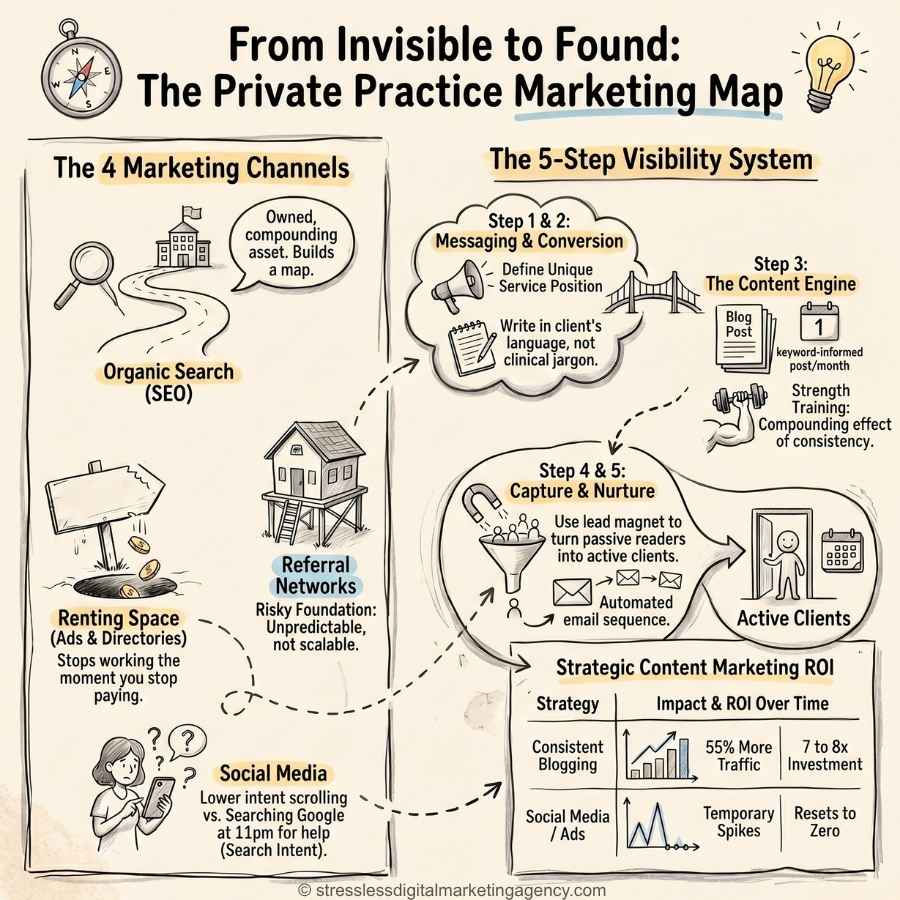
Why Traditional Marketing Advice Fails Private Practice Owners
Most marketing advice was written for product-based businesses or large corporate brands — not for a solo practitioner running 45 client hours a week with no marketing team and approximately zero bandwidth for a TikTok strategy. That mismatch is the first problem.
The second is deeper, and it has nothing to do with platforms or tactics at all.
Clinical training teaches you to be a blank slate. Stay neutral. Let the client lead. Don’t project. That is excellent therapy — and it is a complete disaster for marketing. Your ideal client is not sitting in your office yet. They are on Google at 11pm, skimming five different therapist websites that all say the exact same thing: warm, welcoming, safe space, no judgment. Here is what nobody tells you — that is not a brand. That is a job description. The practices that get found are the ones willing to have a point of view, to say specifically who they serve, to write in a way that makes the wrong-fit client self-select out.
The result of staying neutral in your marketing? Service pages that read like insurance intake forms instead of invitations. A directory listing indistinguishable from your fifty nearest competitors. A website that technically exists but does not work for you in any practical sense. For a deeper look at what this actually costs a practice over time, read Why Your Graduate Degree Didn’t Prepare You for This.
The 4 Marketing Channels Private Practice Owners Actually Have
Before we get tactical, let’s map the territory. Four primary channels are available to you — and understanding what each one actually does (and does not do) is the foundation of any real marketing strategy.
1. Organic Search (SEO)
This is the long game, and it is the one most practice owners underinvest in. When someone types “anxiety therapist in [your city]” into Google, organic search determines whether your practice shows up in those results. Build it well and it keeps sending you traffic without an ongoing ad spend. Ignore it and you are invisible to the people who are most ready to book.
Here is the metaphor I keep coming back to: SEO is building your own map. Directories and paid ads are renting space on someone else’s. One you own outright, and the value compounds over time. The other you owe the moment you stop paying. For a complete walkthrough of what this looks like in practice — keyword research, on-page optimization, local SEO, the works — this no-fluff SEO guide for therapists is the place to start.
2. Referral Networks
Word of mouth, colleague referrals, Psychology Today listings — most established practices built their caseload here, and there is nothing wrong with that. The problem surfaces when referrals become the only strategy. You cannot predict when a referring colleague will retire, relocate, or cut back their own caseload. You cannot automate a personal recommendation. You definitely cannot scale it across multiple specialties or clinicians without something more structural underneath it. Referrals are a beautiful supplement. They are a risky foundation.
3. Paid Advertising
Fast to spin up, easy to track, and completely dependent on a continuous budget. The moment you stop paying, the visibility stops too — which means you are not building anything lasting, you are just buying access to a channel that resets to zero the second your card is paused. For a practice already running lean on time and margin, ads tend to become a treadmill. They can work for specific campaigns or when you need to fill a caseload quickly, but they are a cost category, not an investment.
4. Social Media
Useful for staying visible to people who already know you exist. Not particularly useful for reaching people who have never heard of you, which is the actual goal of practice growth. The fundamental problem is intent: someone scrolling Instagram and pausing on your post about anxiety is not the same as someone Googling “trauma therapist near me” at a moment when they have already decided to get help. Social media belongs in your ecosystem as a relationship tool, not as your primary lead source. If you want the full case for why, here is the breakdown on why SEO outperforms social for practices that want consistent, predictable inquiries.
The best marketing strategy is not the one that’s trending right now. It is the one that reaches your ideal client where they are already looking — and stays within the actual bandwidth you have to sustain it.

Why SEO Is the Most Powerful Long-Term Strategy for Private Practice
I went from zero to 3,180 search impressions in 92 days. That is not a lucky break or a viral moment — it is what consistent, keyword-informed content does when it is built around what people are actually searching for.
What makes SEO different from every other channel is that it builds something you own. A well-optimized blog post keeps working for you at 2am on a Tuesday. It does not require you to keep paying, keep posting, or keep refreshing your directory profile. When someone types “private pay therapist for trauma in Austin” into Google, they have already made the decision to get help. They just need to find you. That is a fundamentally different starting point than someone passively scrolling a feed — and it converts at a completely different rate because of it.
Websites with consistent blog content generate 55% more traffic than those without, according to MonsterInsights. Businesses that invest in strategic content marketing see returns of 7 to 8 times their investment over time. That kind of ROI is genuinely hard to find in a private practice marketing budget.
SEO is like strength training. The results do not come from a single heroic effort — they come from not quitting on the weeks when nothing feels like it’s happening yet. Every post you publish before traffic arrives is still infrastructure. You are laying track. The train comes later.
How to Choose the Right Marketing Strategy: A Practical Framework
Rather than prescribing the same approach to every practice, here is a framework for actually thinking this through.
Start by asking where your ideal client is already looking. If they are Googling specialties and locations, your first investment should be SEO and a well-written service page. If most of your clients arrive through colleague referrals, your website still needs to hold up once they arrive — because they will Google you before they call, even when someone they trust recommended you.
Then ask what you can realistically sustain. This matters more than most practice owners admit. One consistent blog post per month beats a six-post sprint followed by four months of silence, because consistency is the actual mechanism behind compounding visibility. Ambitious plans that stall are not strategies. They are expensive false starts.
Finally, decide whether you are building toward short-term access or long-term authority. Ads give you the first. SEO and content give you the second. Neither is wrong, but conflating them leads to spending money on tactics that do not serve the same goal — and wondering why nothing is working.
Here is how a practical order of operations looks for most established practices:
Step 1 — Get your foundational messaging right first. Before any channel will perform, you need to know who specifically you help, what problem they are trying to solve, and what you offer that a generic “warm and welcoming therapist” does not. This is your Unique Service Position, and it is what every service page, every blog post, and every directory listing gets built on top of. Skip it, and everything else slides off.
Step 2 — Build a website that actually converts. Not a brochure, not a credentials list, not a contact form floating in white space. A client-facing asset with service pages written in your client’s language — the words they actually use to describe what is wrong, not the diagnostic terminology you learned in your graduate program. If you want to understand how AI is changing what clients now expect from a therapy website, that context matters before you touch your copy.
Step 3 — Start building content, one post at a time. One well-researched blog post per month, built around one keyword your ideal client is already searching, beats six posts built around nothing in particular. Over time, consistent posting builds topical authority — which is what makes each new piece rank faster than the one before it.
Step 4 — Give people a reason to stay in your world. A single high-quality lead magnet — a checklist, a guide, a quiz — turns blog readers into email subscribers before they leave your site. That handoff is where passive traffic becomes an actual relationship.
Step 5 — Nurture the people who raise their hands. A three-to-five email welcome sequence, written once and automated, does more conversion work than most practice owners realize. That is where a reader becomes someone ready to book.
Your Website Is Not a Brochure. It Is Your Best Employee.
Most therapy websites are digital waiting rooms that do nothing but hold space. They list credentials, name modalities, and include a contact form. What they do not do is build trust before a stranger clicks away, address the objections that keep people from reaching out, or explain in plain terms what it actually feels like to work with you.
There is a contemporary artist I love named Andrea Jacobs. What makes her work land differently is having someone there to walk you through it — to explain what the piece is doing, what the artist was thinking, what to look for. Without that guide, a lot of beautiful work just sits there. People look at it, think “it’s nice,” and move on. That is exactly what happens on most therapy websites. Beautiful design, no context, and the visitor leaves without ever understanding what they were looking at or what to do next.
A high-converting service page gives them the guide. It uses the language your clients would use to describe their own pain — not the language your supervisor used during your clinical training. It tells someone who is already struggling where to look and what the next step is. When the words on your service page match the words in a potential client’s head, something clicks. They feel seen before they have even spoken to you. That is what copy that justifies out-of-network rates actually does — it is not about defending a price, it is about building trust before the first conversation.
If your website still reads like a professional bio, the problem is not your credentials. It is the frame.
The Content System That Actually Works
The framework I use with every client is straightforward: your website is the foundation, your blog is the traffic engine, and your email list is the conversion system. Those three things, working together, form a content ecosystem. Any one of them working alone is just a piece of something incomplete.
Blog content targets the keywords your ideal clients are already typing into Google. Those posts link back to your service pages, which capture warm leads and direct them toward booking. It sounds simple because it is — the complexity is in doing it consistently and doing it well, not in the structure itself.
The most common objection I hear from practice owners at this point: “My clients don’t Google for a therapist. They come through referrals.” Fair. But here is what that assumption misses — even a referred client will Google your name before they call. They want to see that the person their colleague recommended actually has a real, professional presence. If your website doesn’t back up what was said about you, they second-guess the referral and move on to someone whose site makes them feel more certain. Referrals get people to your digital door. Your website has to open it.
And even if your referral pipeline is steady right now, one retirement, one colleague moving cities, one Psychology Today algorithm change can shift that overnight. SEO is not a replacement for the relationships you have built. It is the strategy that means you are never fully dependent on someone else’s action to keep your practice full.

What This System Actually Requires
Let me be honest about what sustainable marketing for private practice demands, because most people underestimate it before they start and overestimate how complicated it is once they do.
The starting point is a Unique Service Position — something more specific than “I help people with anxiety and depression.” Who specifically? What is their life like before they find you? What changes because of your work that they could not find somewhere else? The more clearly you can answer those questions, the more everything else performs. Vague positioning produces vague results, regardless of how good the underlying strategy is.
From there, the website needs to be rebuilt around the client rather than around you. That is not a criticism of how most therapists write their sites — it is just what graduate training produces. Clinical language, professional distance, credentials front and center. All of it is appropriate for your licensing board, none of it is particularly useful for someone Googling at 11pm trying to figure out whether you are the right person to trust with the worst thing happening in their life. Local keywords matter here, too. “Trauma therapist in [your city]” is a far more winnable search than “trauma therapy” nationally, and the person who included their location in that search is already significantly closer to booking than someone casually browsing.
Content follows — one focused, keyword-informed blog post at a time. Then, a lead magnet that gives readers a reason to stay in your world. Then, an email sequence that turns subscribers into clients. Written once, running in the background, doing its job without requiring you to tend it daily.
That is the whole system. Not glamorous. Not viral. But it compounds quietly, and it does not stop working just because you had a full week of sessions and didn’t open Instagram once.
How Long Does This Actually Take?
Six to nine months before meaningful organic traffic arrives — and that clock starts from consistent effort, not from publishing a single post and watching it.
Here is what that timeline actually means, though, because most practice owners misread it. Nothing is broken in those early months. Google is indexing your content, your site is building authority with each new piece, and the algorithm is slowly learning what you are most relevant for. The curve looks completely flat at the start and then, almost without warning, exponential. That is not a design flaw in the strategy. That is what compounding looks like before the inflection point.
Think of it like learning to swim. Thrashing burns everything you have and barely moves you forward. Once you stop fighting the water and actually learn the mechanics, the same effort covers dramatically more distance. SEO works the same way — getting efficient with your structure and your keyword selection early means every post you write later performs faster than the one before it.
The practices that build real visibility are simply those that do not quit before the curve tips. That is the whole secret, and it is less dramatic than most people want it to be.
Your Next Step
If you have been winging your marketing, leaning entirely on referrals, or spending time on social media while secretly knowing it is not really moving the needle, this is your invitation to do it differently.
Download my Price and Service Guide to see exactly how I build visibility for established practice owners: what is included, what it costs, and how the system works from foundation to content ecosystem.
Or start with one of these free resources right now:
Quiz: What’s Keeping You Stuck With Marketing? Find out exactly where your visibility is leaking — most practice owners are surprised by what they find.
Stop Panicking When Clients Graduate: A practical guide to building the kind of website that generates organic inquiries even when your referral flow slows down.
Free Blog Templates for Service Providers: A repeatable structure for writing SEO-informed posts, designed specifically for health and wellness clinicians.
Keep Reading: Related Posts
- SEO for Therapists: The No-Fluff Guide to Getting Found on Google
- Why SEO Matters More Than Social Media for Therapists & Coaches
- Marketing for Private Practice: Why SEO & Copywriting Are Your 24/7 Sales Team
- AI for Therapists: Balancing AI and Human Creativity to Attract Private Pay Clients
- How to Justify Out-of-Network Therapy Rates (With Copy That Converts)