How Much Time Will I Save If I Outsource My Content?
Last winter, we got thirteen inches of snow overnight.
I have a bad back. My husband was already stretched thin. So for the first time, we hired a snow removal company. We went to bed with a foot of snow piling up outside and woke up to a completely clear driveway — like snow fairies had come through at 3am and taken care of everything.
My daughter stood at the window watching the last flurries come down, totally delighted by it, completely unbothered. And I got to stand there with her instead of dreading the shoveling.
That’s what it feels like to outsource something you’ve been carrying alone.
Content creation for your health and wellness practice is exactly like that driveway. Someone has to do it. It matters — probably more than most practice owners realize. But there is absolutely no rule that says it has to be you.
So let’s answer the question you actually came here with: how much time will outsourcing your content realistically give back? And is it worth it?
Where Your Content Hours Are Actually Going
Before we get to the numbers, it’s worth naming what content creation actually involves — because most practice owners dramatically underestimate it.
When someone says, “It only takes me an hour to write a blog post,” they usually mean the writing itself. They’re not counting everything that happens before and after that hour.
Here’s the fuller picture of where the time goes each week:
Deciding what to create. This is the one that steals the most time invisibly. Sitting with a blank Google Doc trying to figure out what’s worth writing about, what your audience actually needs, what might rank, what you already covered — that indecision spiral can easily eat an hour before a single word hits the page.
Keyword research. If you’re doing this seriously (and for SEO content, you should be), this is its own task entirely. Finding the right phrases, checking competition and search volume, making sure you’re writing toward something people are actually searching for — that’s another 30 to 60 minutes per piece, minimum.
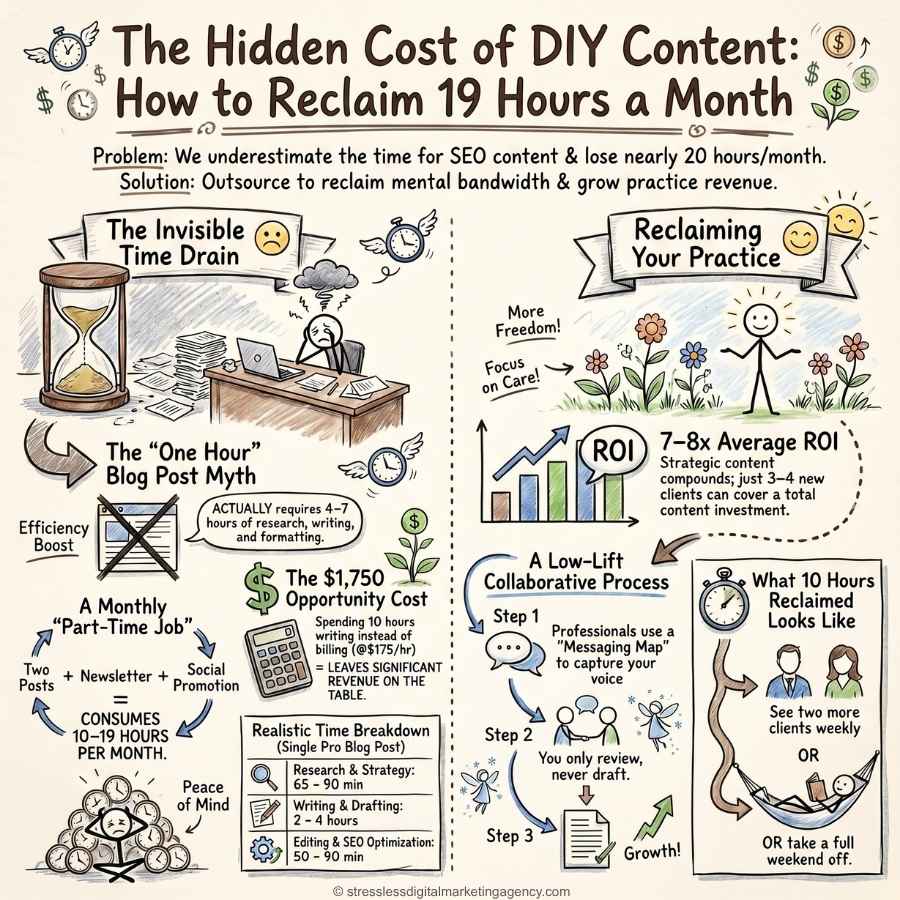
Writing the actual draft. For a properly in-depth blog post in the 1,500 to 2,500 word range that Google is going to respect, you’re looking at 2 to 4 hours. Not 45 minutes. Two to four hours — and that’s if you sit down with a clear outline and no interruptions, which almost never happens when you’re also running a practice.
Editing and proofreading. Reading back through, catching the passive voice, tightening the sentences that got away from you, checking that the thing actually flows the way it sounded in your head. Another 30 to 60 minutes.
SEO optimization. Adding the meta description, checking keyword placement, writing image alt text, making sure internal links are in place. If you’re using Rank Math or a similar plugin, this is somewhat guided — but it still takes time, and it still requires knowing what you’re doing.
Uploading and formatting. Pasting into WordPress, formatting headers, adding images, fixing whatever got mangled in the copy-paste. Probably 30 minutes, longer if anything goes sideways.
That is the actual process. Not the fantasy version where you dash something off in an afternoon.
Crunch The Numbers
Let’s put real numbers to it.
For a single well-written, SEO-optimized blog post:
| Task | Realistic Time |
|---|---|
| Topic + keyword research | 45-60 min |
| Outline | 20-30 min |
| First draft | 2-4 hours |
| Edit + proofread | 30-60 min |
| SEO optimization | 20-30 min |
| Upload + format | 20-30 min |
| Total per post | 4-7 hours |
Two posts per month — which is the minimum for meaningful SEO traction — lands you at 8 to 14 hours of content work. Per month. On top of everything else, your practice demands.
Add a monthly email newsletter (another 1 to 2 hours), and any social content you’re creating to promote the posts (another 1 to 3 hours), and you’re looking at 10 to 19 hours of marketing work every month that has nothing to do with serving your clients.
That’s a part-time job. One you never applied for.
The Hidden Cost Nobody Talks About
Here’s the number most people miss when they’re calculating whether to outsource: your hourly rate.
If you’re a therapist or health and wellness provider billing between $150 and $250 per session, every hour you spend on content is an hour you’re not spending in a revenue-generating session. That’s not a judgment — it’s just math.
Ten hours of DIY content creation per month at a $175 session rate is $1,750 in potential session revenue sitting on the table. Even if you can’t fill every single one of those hours with paid sessions, the opportunity cost is real. Time you spend writing is time you’re not spending on client care, business development, rest, or the parts of your practice that actually light you up.
There’s also the mental cost, which is harder to quantify but just as real. The cognitive load of context-switching between clinical work and marketing work is genuinely exhausting. If you’ve ever felt completely drained after a full day of sessions and then tried to stare at a blank Google Doc, you already know this. The writing doesn’t just cost you time — it costs you energy you were already running low on.
The writing is actually the easy part. What takes the most time is the research, the strategy, and the figuring out. A professional handles all of that before a single sentence gets written. That’s where the real savings are.
What You Could Do With Those Hours Instead
Say you get back 10 hours a month. That’s not a small number. Here’s what that could actually look like for your practice:
See two more clients per week. At $175 a session, that’s roughly $1,400 in additional monthly revenue — more than enough to cover most content retainer investments and then some.
Develop that group program you’ve been putting off. The one that’s been a note in your phone for a year. With 10 hours of cleared mental space, that can become a real thing.
Take one actual weekend off per month. Not a weekend where you’re drafting a blog post at 9pm on Sunday because it’s due Monday. A real one.
Invest in something that compounds. Time to learn something new, build a referral relationship, apply for a speaking opportunity, or develop the next offer your practice needs.
The goal isn’t just to outsource a task. It’s to reclaim the mental bandwidth that task was consuming — and redirect it somewhere it actually grows your practice or feeds your life outside of it.
But Is Outsourcing Actually Worth the Investment?
This is the question underneath the question, and it deserves a straight answer.
For an established health and wellness practice, strategic content is one of the highest-ROI marketing investments available — specifically because it’s owned visibility that compounds. A blog post you publish today keeps sending traffic for months or years, unlike a paid ad that stops the moment you stop paying. Unlike Psychology Today, you own your website. Nobody can raise the algorithm on you.
Businesses that invest in strategic content marketing see, on average, a 7 to 8x return on investment over time. Consistently blogged websites generate 55% more traffic than those that don’t publish regularly (MonsterInsights). And from a practice economics perspective, the math is relatively straightforward: at $150 per session with weekly attendance, three new ongoing clients brought in through content adds $1,800 per month to your practice. Six new clients adds $3,600. Just three to four consistent new clients can cover a typical content investment entirely — and every client beyond that is profit and stability.
That said — content marketing takes time to gain traction. Results from the SEO component typically start becoming meaningful at the 6 to 9 month mark. It is not a quick fix, and anyone who tells you otherwise isn’t being straight with you. The compounding happens over time, which is exactly why starting sooner matters more than waiting until it’s “the right moment.”
Disclaimer: SEO and content marketing are long-term strategies. Individual results vary depending on niche, competition, and audience. Rankings and income outcomes cannot be guaranteed.
“But Can’t I Just Use AI?”
Yes. And I do, too.
I use AI to voice-to-text ideas, rough out structure, and polish a thought that’s already half-formed. It’s a useful tool for getting unstuck. I’m not going to pretend otherwise.
But here’s what AI cannot do, and this distinction matters a lot before you make a decision about your content:
AI doesn’t know your story. The Psychology Today profile I rewrote years ago — the one where I stopped writing like a resume and started writing like someone who knew exactly who she helped — that got calls within seven days. Not because the words were prettier. Because the right people finally saw themselves in what I wrote. AI has no access to the specific clinical moment, the specific client transformation, the specific turning point that makes your content irreplicably yours. It can produce sentences that look credible. It cannot produce the story that makes a stranger trust you.
AI can’t read your data and adjust. I’ve had to cancel plans because reality didn’t cooperate — we were supposed to be in the Bahamas one Valentine’s Day and my daughter got sick. Marketing pivots the same way. Traffic drops. A post flops. A keyword you built a strategy around starts pulling the wrong audience. AI can write the content you asked for. It cannot look at your Google Search Console, notice you’re getting impressions for a search term you never targeted, and redirect the next month of content accordingly. That decision requires a human who is paying attention to what’s actually happening in your business — not just generating text.
AI doesn’t understand sales psychology. There’s a real difference between content that informs and content that converts. The AIDA framework — moving someone from awareness through to action — requires understanding where a specific reader is in their decision-making process and writing specifically to that stage. AI produces content shaped by what ranks broadly. A strategist produces content shaped by the psychology of your particular audience: what they’re afraid of, what they’ve already tried, what objection is quietly stopping them from booking. That’s not a writing skill. It’s a clinical skill applied to marketing — and it’s not something you can prompt your way into.
AI produces what already exists — organized differently. Google’s E-E-A-T guidelines (Experience, Expertise, Authoritativeness, Trustworthiness) exist specifically because AI content is everywhere now. What Google is actively rewarding is the thing AI fundamentally cannot replicate: real firsthand experience. Your twelve years in session. A client you remember specifically. A mistake you made and corrected. The insight that came from something that happened to you, not something you read on the internet. When a client reads one of my posts and realizes there’s a story they want woven in — a personal experience that changes the piece — that revision is what makes content impossible to replicate. It becomes something that could only have come from that practice, at that moment, with that history. AI cannot generate that no matter how good the prompt.
The analogy I keep coming back to: people ask ChatGPT questions they should really be asking a therapist. The output can look credible to someone who doesn’t know the field — structured, confident, reasonable-sounding. To someone trained in the clinical nuances, some of it is genuinely problematic. The person reading it doesn’t know the difference. That’s the same risk with AI-generated marketing content. It can look like it’s doing the job while quietly producing generic, search-unfriendly, psychologically flat output that doesn’t convert anyone.
So yes, use AI as a starting tool if it helps you get ideas onto a page. But the strategy behind the content — the audience mapping, the keyword research, the buyer psychology, the personal narrative, the data-informed pivots — that’s the part a tool cannot give you. That’s the part that’s actually worth outsourcing.
What to Look for When You Hire
Not all content help is created equal, and this distinction matters a lot for health and wellness practices.
A general VA who can write is not the same as an SEO copywriter. A copywriter who writes for e-commerce is not the same as someone who understands how therapy clients search, decide, and book. The output might look similar on the surface — words on a page — but the strategic and psychological underpinning is completely different.
Here’s what’s actually worth looking for:
Someone who does website copy AND content writing AND SEO together. Most copywriters specialize in one. When those three things are handled by the same person, your voice stays consistent across every touchpoint, and every piece of content is built to do actual SEO work, not just exist. For a deeper look at what that distinction means, copywriter vs. VA breaks down exactly why the hire matters as much as the output.
Someone who understands your audience from the inside. Health and wellness clients make decisions differently than someone buying software or hiring a contractor. The ambivalence, the stigma, the privacy concerns, the cost objections — all of it shapes how your content needs to be written. A writer who’s been in the therapy room, or who has worked deeply in this space, brings a layer of audience understanding that no amount of research fully replicates. For more on how that psychological lens translates to better content, the customer journey guide explains exactly how your ideal clients think their way toward booking.
Someone who can explain their process before you sign anything. This is non-negotiable for me. I once turned down a scholarship for a health and wellness coaching program because when I asked what working together actually looked like, the answer was “it’s personalized to you.” That is not a process. That is a deflection. Any professional worth hiring should be able to walk you through exactly what happens from the first conversation to the final deliverable.
Someone who uses your data, not just their instincts. Good content strategy starts with what Google Search Console is already telling you — what your site is ranking for, where you’re getting impressions without clicks, what phrases your actual audience is using to find you. If the person you’re considering doesn’t mention data in the conversation, that’s a flag worth noting.
What the Process Actually Looks Like
If you’ve never worked with a content copywriter before, the process is more collaborative than most people expect — and significantly less work on your end than DIY.
Here’s how it works in my practice:
Step 1: Foundational Messaging Map. Before any writing starts, we do a recorded kick-off session to capture your goals, your offer, your brand voice, and your audience. That recording becomes the foundation everything is built from — your actual words, your actual voice, not a generic template. This is the most important step, because great copy isn’t created from scratch. It’s compiled from the real language, concerns, and hopes of the people you serve.
Step 2: Research and Strategy. I handle keyword research, topic selection, and SEO strategy. This is the part that eats the most time in DIY content work — the research and strategizing, not the writing itself. You don’t touch this step.
Step 3: First Draft. For most projects, a first draft is in your hands within a week of the Messaging Map being approved. You read it and react — not line-edit it, just tell me what resonates and what doesn’t.
Step 4: Revisions. Two rounds of revisions to get it exactly right. The most common request at this stage is adding a personal story — a client will read something and think of an experience they want to weave in. That’s the kind of specificity that makes content uniquely yours and genuinely hard for competitors to replicate.
Step 5: Final Polish. Professional proofreading, final approval, delivered in whatever format you need for your site. Done.
The whole thing is designed to be as low-lift for you as possible. You bring the expertise and the stories. I bring the strategy, the SEO, and the execution.
Who This Is For (And Who It Isn’t)
Outsourcing content makes the most sense for established practices that have outgrown DIY marketing — where the bottleneck isn’t vision or expertise, it’s bandwidth.
This is a fit if:
- You’ve been in practice long enough to know what you do and who you do it best for
- You understand that content builds long-term visibility, not just short-term traffic
- You’re ready to hand something off and actually let it go, not micromanage every sentence
- You want consistent, strategic output rather than sporadic bursts of content when you get around to it
This probably isn’t the right time if:
- You’re still clarifying your offer or your niche (the copy can only be as sharp as the strategy underneath it)
- You’re in the early stages of practice and not yet at the revenue level where the investment makes mathematical sense
- You want a quick fix — content strategy takes 6 to 9 months to show meaningful SEO results, and that timeline doesn’t change regardless of who writes it
Not sure which camp you’re in? The content creation guide is a useful place to start — it covers the full strategy from audience mapping to content ecosystem so you can get clear on whether you need a system or a writer (usually, it’s both).
If you’re somewhere in between — creating your own content but not seeing the results you expected — the Weekly Copy Review service offers a middle path: expert eyes on your content every week so you can sharpen your own writing without handing it off completely.
Ready to Get Those Hours Back?
Here’s the summary: outsourcing your content realistically returns 8 to 14 hours per month for a practice publishing two quality posts plus a newsletter. The actual savings run deeper than the clock — the mental overhead of researching, strategizing, and switching between clinical brain and marketing brain goes with it.
For an established practice billing at health and wellness rates, the math on ROI is not complicated. Three new consistent clients from organic content covers most content investments entirely. The question isn’t really whether it’s worth it. It’s whether now is the right time — and whether you’re working with someone who can actually deliver what the investment requires.
Download the Price and Services Guide to see exactly what that looks like, what’s included, and what the investment is.
Also worth reading:
- Copywriter vs. VA — why who you hire matters as much as the output
- Content ecosystem for therapy practices — what a full system looks like
- The ultimate content creation guide — strategy, tools, and best practices
- Writing anxiety in business — if the blank page is part of the problem
- Content consistency tips — if you want to keep DIYing but need a system
Free resources to start with:
- Quiz: What’s Keeping You Stuck With Marketing?
- [Freebie] Stop Panicking When Clients Graduate
- Free Blog Templates for Health & Wellness Providers