What Is Ghostwriting — and Why You’re Already Behind
You’ve been told to “just write more content.” Nobody told you there was a legitimate way to publish under your name without writing a word of it.
There is something nobody tells you about the health and wellness providers who show up consistently online, week after week, with polished blog posts and thoughtful newsletters and content that sounds exactly like them.
A lot of them are not writing it themselves.
That’s not a criticism. It’s actually the point. The practices building the most visible, most trusted online presence in your niche have figured out a structural solution to a structural problem — and that solution has a name most providers never seriously consider because it carries a stigma it doesn’t deserve.
That solution is ghostwriting.
If the idea of having someone else write content published under your name feels strange, uncomfortable, or vaguely dishonest, you’re not alone in that reaction. You’re also working with a misconception worth clearing up, because ghostwriting is one of the oldest, most widely used, and most misunderstood tools in professional content creation. Presidents use ghostwriters. CEOs use ghostwriters. Bestselling authors use ghostwriters. The difference between providers who build compounding visibility online and the ones who stay stuck in the “I’ll write it this weekend” loop is often not talent, not expertise, and not commitment to their work. It’s infrastructure.
This post covers what ghostwriting actually is, how it differs from guest blogging, and when done-for-you content makes more sense than anything else you could do for your practice’s visibility.
What Is Ghostwriting?
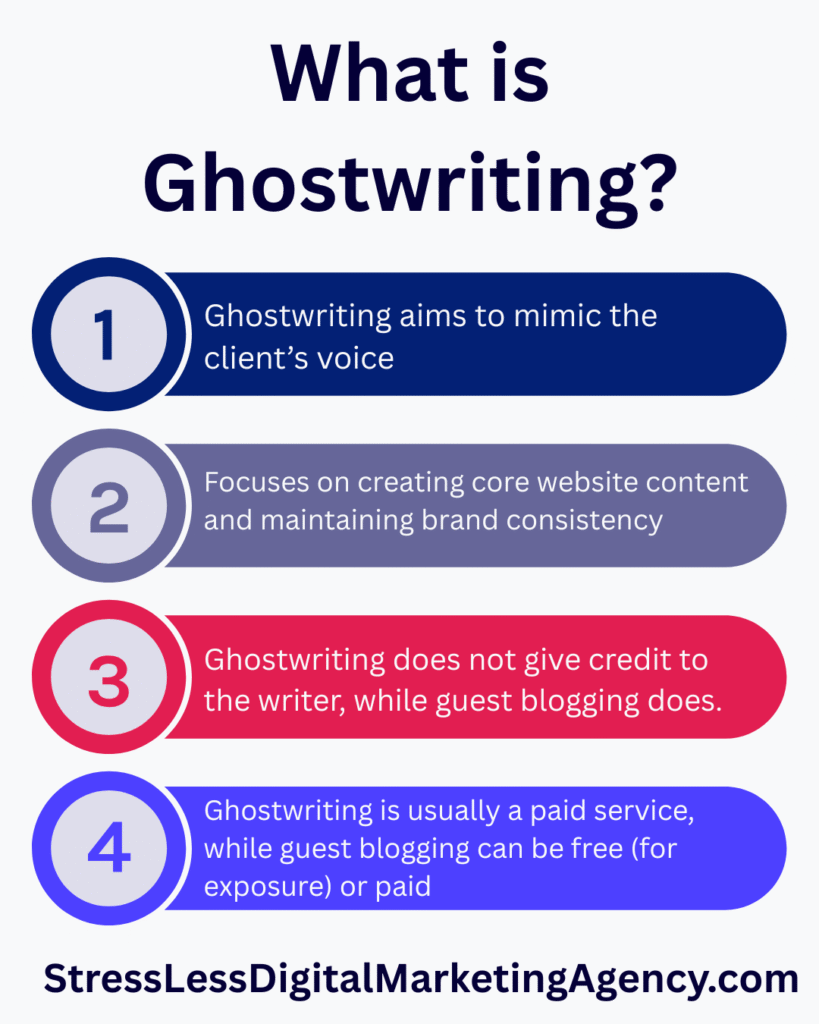
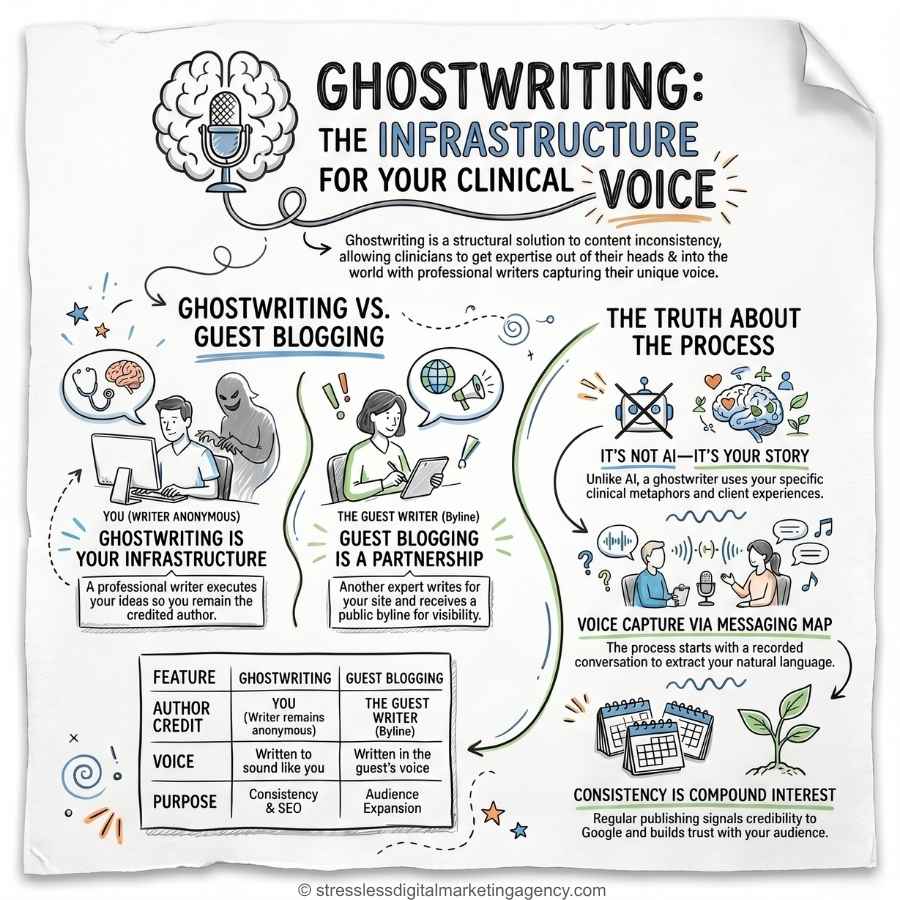
Ghostwriting is the practice of hiring a professional writer to create content that you publish under your own name. The writer remains anonymous — acknowledged only privately between the two parties — and the content is credited to you as the author.
For health and wellness practice owners, ghostwriting typically covers blog posts, email newsletters, website copy, LinkedIn articles, and other regular content that needs to reflect your voice, your perspective, and your clinical expertise over time. The ghostwriter is not inserting their own opinions or experiences. They are translating yours into something clear, strategic, and optimized — doing the execution so the thinking, the expertise, and the authority remain entirely yours.
The ideas are yours. The clinical insight is yours. The professional reputation behind every word is yours. The ghostwriter is the infrastructure that makes it possible to share what you know at the volume and consistency that actually builds search visibility.
The Misconception Worth Naming
The persistent belief that ghostwriting is inauthentic — that publishing content someone else wrote is a form of deception — is worth taking seriously before setting it down.
Ghostwriting has been standard practice in virtually every professional field for centuries. Political speeches. Business memoirs. Thought leadership columns in major publications. The industry norm for high-achieving professionals is not to personally type every word attributed to them — it’s to collaborate with skilled writers who can capture their voice and communicate their ideas at the volume their audience needs.
For health and wellness providers specifically, there’s actually a clinical argument for ghostwriting. You have twelve years of client experiences, clinical insights, and hard-won expertise that your ideal clients genuinely need in order to make informed decisions about their care. The question isn’t whether that knowledge belongs online. It clearly does. The question is whether you need to personally optimize every meta description and thread every internal link in order for that content to be legitimately yours.
You don’t. The knowledge is yours. The ghostwriter is the mechanism for getting it out of your head and into the world consistently.
What Ghostwriting Is NOT
Because the misconceptions run in both directions, a few things worth clarifying directly.
Ghostwriting is not AI content with your name on it. The distinction matters enormously — for quality, for E-E-A-T signals, and for actually sounding like a human being. A skilled ghostwriter captures your voice through a recorded conversation, pulls your real clinical insights and personal stories, and builds content around your specific audience and keyword strategy. AI generates text. It cannot generate your specific story, your clinical perspective, or the insight that came from a particular client session three years ago. That specificity is what makes content rank and convert.
Ghostwriting is not the writer doing whatever they want and handing you a finished piece. Good ghostwriting is deeply collaborative. The most common revision request I receive after a first draft is a client reading something and remembering a specific experience they want woven in — a clinical moment, a metaphor they’ve used with clients for years, a personal story that changes the piece. That revision is what makes ghostwritten content impossible to replicate. It becomes something that could only have come from your practice, at this point in your career, with your particular history.
Ghostwriting is not outsourcing your thinking. The ideas and the point of view are always the client’s. The ghostwriter’s job is to listen well, ask the right questions, and organize what they hear into something clear, strategic, and compelling. The best copywriting isn’t created. It’s compiled — pulled directly from the language, concerns, and experiences of the person it represents.
What Is Guest Blogging?
Guest blogging is a different arrangement entirely. Here, another writer or expert creates content for your website and receives public credit — usually an author byline. You’re not the author. You’re the host.
Guest blogging is a visibility tool that works in both directions. The guest writer gets exposure to your audience and a backlink to their site. You get fresh content and a new perspective without doing the writing yourself. Done well, it builds community, introduces your readers to complementary expertise, and adds variety to your content calendar.
For health and wellness practices, guest blogging works best for topics adjacent to your specialty. A trauma therapist hosting a piece from a somatic bodywork practitioner. A health coach publishing a column from a registered dietitian on the food-mood connection. A group practice featuring a post from a financial therapist on money anxiety. The guest serves your audience even though the topic falls slightly outside your direct lane, and the relationship between you and the guest often leads to mutual referrals over time.
Ghostwriting vs. Guest Blogging: Key Differences
The table below summarizes the core differences between the two:
| Feature | Ghostwriting | Guest Blogging |
|---|---|---|
| Author credit | No — you publish as the author | Yes — writer receives a byline |
| Voice | Written to sound like you | Written in the guest’s own voice |
| Ideas and expertise | Yours, captured by the writer | The guest’s own perspective |
| Purpose | Content consistency, brand voice, SEO | Audience expansion, community building |
| Payment | Always paid | Can be unpaid (exposure) or paid |
| Best for | Core content strategy, ongoing visibility | Supplemental topics, partnerships |
The short version: ghostwriting maintains one consistent voice across all your content. Guest blogging intentionally introduces a different voice. Neither is better — they serve completely different goals, and the best content strategies eventually use both.
Why Ghostwriting and Content Consistency Are Inseparable
This is the part that matters most for a practice trying to build long-term search visibility.
Google’s algorithm reads regular publishing as a credibility signal. A site that consistently produces helpful, specific, well-optimized content over twelve or more months builds topical authority in a way that sporadic publishing cannot replicate. The practices ranking for “trauma therapist [city]” or “burnout recovery coach” aren’t necessarily the most credentialed providers in their area. They’re the ones who showed up consistently long enough for the algorithm to take them seriously.
Two quality posts per month, published reliably for a year, outperforms twelve posts published in January followed by ten months of silence. That’s not just an SEO argument — it’s a trust argument. Your email subscribers, your returning site visitors, the warm referrals who look you up before reaching out — all of them build stronger confidence in your practice the more consistently your content appears. Consistency is the compound interest of content marketing.
The problem is that most practice owners cannot sustain that consistency on their own alongside a full clinical caseload. Not because they lack commitment, but because the combination of keyword research, writing, editing, SEO optimization, and publishing is a part-time job that was never in their job description.
Ghostwriting solves the logistics problem that keeps breaking the consistency. It doesn’t shortcut the strategy. It removes the constraint. For a full breakdown of what a sustainable content system looks like in practice — and what actually makes it fall apart — content consistency for practice owners is worth reading alongside this one.
Voice Capture: Why the Process Matters More Than the Writing
Here is the thing that separates good ghostwriting from generic content production: the ghostwriter’s job is not to write well. It is to write like you.
That distinction requires a specific kind of listening that most content mills and AI tools skip entirely. My process starts with a 60-90 minute recorded Foundational Messaging Map session — a structured conversation where we work through your work, your clients, your clinical lens, your personal history with the problem you solve, and the language you use naturally when you talk about your practice. That recording becomes the source document for everything I write. Every blog post, every email, every service page is built from your actual words — not a generic template recycled across clients.
One therapist I worked with recently told me that the Foundational Messaging Map session was the most clarifying thing she’d done for her practice in years. She came in not entirely sure what her strengths were. By the end she could name six distinct things she does that nobody else in her market does the same way. That clarity didn’t come from me — it came from the process of getting her out of the day-to-day and looking at her practice from the outside.
That is the foundation the writing is built from. And it’s why the most common revision request I receive after a first draft isn’t “this doesn’t sound right” — it’s “this reminded me of something specific I want to add.” A client story. A clinical moment. A metaphor they’ve used with clients for ten years. That addition is what makes the piece impossible for anyone else to replicate. It becomes something that could only exist on your website, grounded in your actual history.
That’s also the E-E-A-T signal Google is actively rewarding right now — not just well-written content, but content that demonstrates real firsthand experience. You can’t fake that. You can only pull it from the source. Before any ghostwriting or content production can work at that level, your brand voice for service providers needs to be established — because that’s the foundation everything else is built from.
What the Process Actually Looks Like
For health and wellness providers considering ghostwriting for the first time, the process is more collaborative — and more low-lift on your end — than most expect.
Step 1: Foundational Messaging Map. A 60-90 minute recorded conversation that captures your brand voice, ideal client profile, core offers, clinical perspective, and the transformation you provide. This is the most time-intensive ask on your end, and the only real upfront investment. Most clients describe it as clarifying rather than draining. Afterward, you can largely step back and let the process run.
Step 2: Research and Strategy. Keyword research, topic selection, and SEO architecture happen entirely on my end. I look at your Google Search Console data to see what your site is already getting traction for, research what your ideal clients are actually searching, and map a content plan that serves both the reader’s question and your visibility goals. You don’t touch this step.
Step 3: First Draft. For most ongoing content projects, a first draft is in your hands within a week of the Messaging Map being finalized. You read it not as an editor, but as the person who knows whether it sounds like you — noting what resonates and what feels off.
Step 4: Revisions. Two rounds, which is typically enough. This is where the personal stories come in. This is where the content stops being well-written and starts being unmistakably yours.
Step 5: Final Polish and Delivery. Proofread, SEO-optimized, formatted for WordPress, internal links in place. Delivered ready to publish. You hit publish. That’s the full extent of your involvement.
The writing honestly is the easy part. The research, the keyword architecture, the strategic planning, the internal linking — that’s where the hours actually live. Those are the hours that come back to you. For the specific time math on what that looks like for a busy practice, how outsourcing saves time runs the numbers directly.
When Ghostwriting Makes Sense for Your Practice
Ghostwriting is the right fit when your expertise is clear but the execution keeps breaking down.
You know who you serve and what you do for them. You can talk about your work fluently in a conversation — the ideas are there. But sitting down to research, write, optimize, and publish that knowledge consistently alongside a full caseload is where it falls apart. Every month. The same way.
It also makes sense when you understand that content builds compounding visibility on a long timeline — 6 to 9 months before SEO traction becomes meaningful, longer before it becomes reliable — and you’re building an owned asset, not looking for a quick traffic fix. Ghostwriting is a long-game investment in infrastructure that keeps paying out after you’ve moved on to other things.
What it requires from you is the ability to actually delegate. Not micromanage every word, not rewrite the draft from scratch, but give specific feedback — especially the personal stories — and trust that the process produces something better than you’d produce alone under time pressure. The providers who get the most out of ghostwriting relationships are the ones who show up to revisions with something to add, not something to undo.
If you’re not quite ready to hand content off completely, the Weekly Copy Review service is the middle path: expert feedback on the content you’re already creating, weekly, so it gets sharper every month without a full retainer commitment.
When Guest Blogging Makes More Sense
Guest blogging earns its place when the goal is audience expansion rather than consistency, and when you have relationships with complementary providers who genuinely serve your readers.
It works particularly well for topics adjacent to your specialty that you can’t credibly cover yourself. A trauma therapist hosting a somatic practitioner’s perspective on stored stress. A health coach publishing a registered dietitian’s take on anti-inflammatory eating. A group practice featuring a financial therapist on money and mental health. Each of those posts serves the audience, strengthens a professional relationship, and adds topical variety to the content calendar.
What guest blogging doesn’t solve is the consistency problem. If your content calendar depends on other people showing up with polished posts on schedule, it will be unpredictable by definition — because the timeline isn’t yours to control. Guest posts are a valuable supplement. They are not a content strategy.
Frequently Asked Questions About Ghostwriting
Is ghostwriting legal?
Yes, completely. It is standard and accepted practice across publishing, business, media, and marketing. There is no ethical issue with having a professional write content that reflects your expertise and publishes under your name — any more than there is an ethical issue with having a web developer build your website rather than coding it yourself.
Is ghostwriting ethical for licensed clinicians?
In most jurisdictions, yes. The content reflects your genuine clinical knowledge and perspective — it’s your expertise, expressed through a skilled writer. That said, if you have specific concerns about your licensing board’s stance on marketing content attribution, a quick check with your board or ethics consultant is always reasonable.
Will it actually sound like me?
When the process starts with a proper voice capture session — a recorded conversation, real language samples, personal stories from your clinical experience — yes. The most common feedback I receive after a first draft is “this sounds like something I would actually say.” The revision round is where it becomes specifically, irreplicably you.
Does Google penalize ghostwritten content?
No. Google evaluates content quality, relevance, originality, and evidence of real expertise — not who typed the words. What Google penalizes is thin, generic, AI-generated content that demonstrates no real experience or perspective. Good ghostwriting, built from a genuine voice capture process, produces the opposite.
How is this different from AI-generated content?
AI generates text shaped by what already exists on the internet. A ghostwriter generates content shaped by what’s inside your head — your stories, your clinical insights, your specific audience’s language and psychology. The output is categorically different. One sounds like it could have been written about any practice. The other sounds like it could only have been written about yours.
What types of content can be ghostwritten?
For health and wellness practices, the most impactful ghostwritten content is SEO-optimized blog posts, email newsletters, website copy (service pages, About pages, homepages), LinkedIn articles, and case studies. Social media captions can also be ghostwritten, though they benefit most from the provider adding a quick in-the-moment layer of specificity before posting.
How much does ghostwriting cost?
Rates vary widely depending on scope, expertise, and what’s included. A VA writing blog posts is a very different product from an SEO copywriter who does keyword research, writes to search intent, optimizes on-page elements, and builds internal linking architecture into every piece. The latter is a content infrastructure investment. Download the price and services guide for specific investment details.
What a Full Month of Done-For-You Content Actually Delivers
If the question underneath all of this is “what would it actually look like to hand this off” — here is the concrete answer.
A full month of done-for-you content through the SEO Content Ecosystem retainer includes:
Two SEO-optimized blog posts — fully researched, written to a target keyword your ideal clients are actually searching, internally linked to your service pages and related content, formatted for WordPress, and optimized in Rank Math before delivery. Written in your voice, from your perspective, with your clinical insights and personal stories woven in during revisions.
One email newsletter — written to go to your list the week each post publishes. Short, personal, links back to the post, and keeps your warmest audience engaged while the SEO works in the background.
Repurposed social content — LinkedIn posts extracted from each blog, ready to schedule. You share them. You don’t write them.
Strategic internal linking throughout — every piece connects back to your service pages and pillar content so the month of content is feeding one compounding visibility architecture rather than existing as isolated posts that go nowhere.
The result: a month of consistent, connected, strategically optimized content published under your name, in your voice, without a single hour of writing on your end.
This is what makes the consistency structural instead of aspirational. Not a better calendar. Not more discipline. A system that runs while you’re doing the work you actually trained for.
Explore the SEO Content Ecosystem retainer to see exactly what’s included and what the investment covers.
Or if you want to understand what this looks like from a strategy perspective before committing to anything, the ultimate guide to content creation covers the full system — from audience mapping and keyword research through content ecosystem architecture — all in one place.
Free resources:
- Quiz: What’s Keeping You Stuck With Marketing?
- [Freebie] Stop Panicking When Clients Graduate
- Free Blog Templates for Health & Wellness Providers
Keep reading:
- Content consistency for practice owners — the system that actually holds
- How outsourcing saves time — the honest time and ROI math
- Brand voice for service providers — the foundation the writing is built from
- Copywriter vs. VA — why who you hire matters as much as the output
- Ultimate guide to content creation — strategy, tools, and best practices