What Is a Customer Journey? (And Why Health & Wellness Providers Need to Understand the Psychology Behind It)

Nobody wakes up and decides to book a therapy appointment the same morning they first hear your name.
That’s not how it works. There’s a process, sometimes slow, sometimes surprising, almost always nonlinear, between the moment someone first becomes aware they need support and the moment they finally fill out your contact form.
That process has a name: the customer journey. And understanding it isn’t just a marketing tactic. It’s actually a clinical skill you already have.
Here’s what I mean by that.
I spent 12 years in the therapy room before I moved into SEO copywriting and content strategy. One framework I used constantly as a clinician was the Transtheoretical Model — the Stages of Change. I used it to assess clients’ readiness to change, how hard to push, when to hold back, and what kind of support they actually needed at each stage.
When I got into marketing, I realized that the AIDA framework, Attention, Interest, Desire, Action, maps almost exactly onto those same psychological stages. The customer journey reflects how humans actually move toward change through a sales process. If you’ve been doing clinical work, you already understand it better than most copywriters ever will.
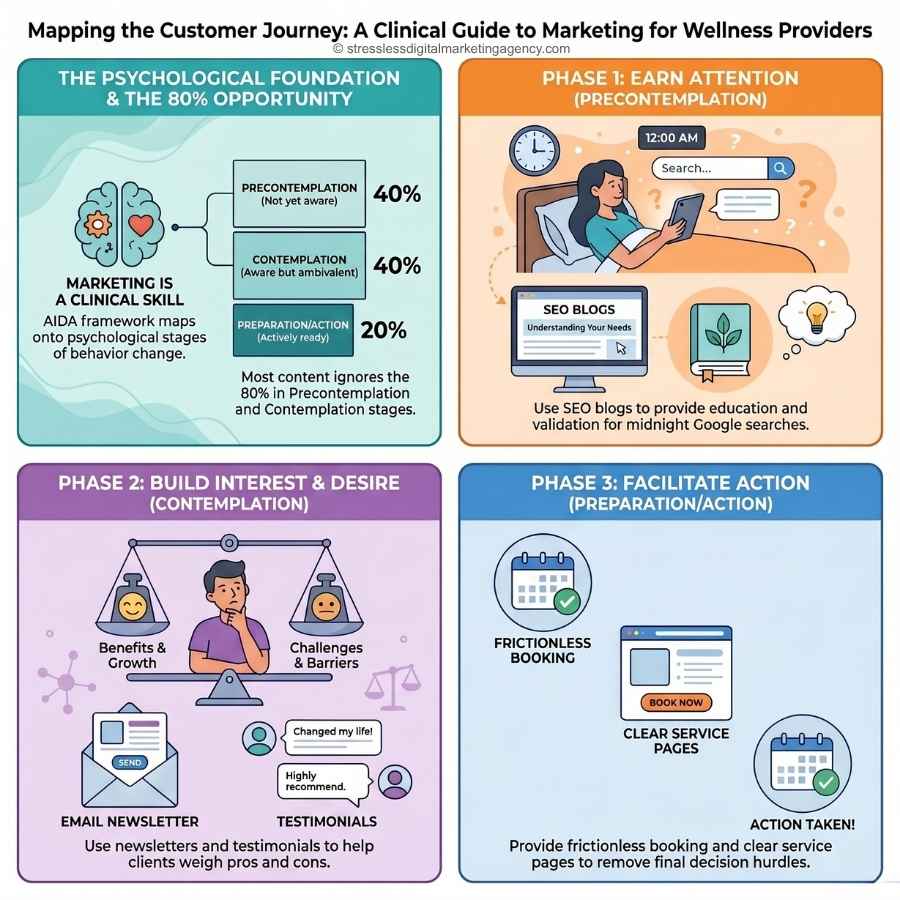
What most health and wellness providers don’t realize is that their content needs to serve every stage of that journey, not just the moment when someone is ready to book. When your content only speaks to the 20% who are almost ready, you’re invisible to the other 80% who are still circling.
Let’s fix that.
Key Points
- The customer journey describes the full path from “never heard of you” to “loyal client,” and it’s rarely a straight line.
- A customer journey and a customer journey map are two different things. The journey is the lived experience, and it happens whether you plan for it or not. The map is simply the tool you use to spot where that experience breaks down.
- The AIDA framework (Attention, Interest, Desire, Action) closely mirrors the Transtheoretical Model of behavior change, which means the psychology you already know transfers directly to marketing.
- Most health and wellness providers only create content for one or two stages of the journey, which leaves the majority of their potential audience without the support they need to move forward.
- A connected content ecosystem, blogs, website copy, email, service pages, is what guides people through the full journey naturally, without you having to manually chase every lead.
- Your content is often the first experience someone has with your work. It should reflect the same care, empathy, and clarity they’ll experience once they become a client.
What Is a Customer Journey?
A customer journey is the sequence of experiences someone goes through, from first discovering your business to becoming a paying client, and, ideally, a referral source who sends others your way.
The most important thing to understand about it: it is not a straight line.
Traditional sales thinking assumes a clean progression: see the ad, visit the website, book the service. Real human behavior doesn’t work that way, especially in health and wellness. Someone who needs therapy might read six of your blog posts over three months before they ever look at your services page. A health coach’s ideal client might follow their Instagram for a year, subscribe to their newsletter, and only book after a specific email finally articulates exactly what they’ve been feeling but couldn’t name.
Or the opposite happens. Someone gets referred by a trusted friend, lands on your site, and books a consultation within the hour. Every journey is different. But most people move through predictable stages, and those stages follow a recognizable psychological pattern.
Worth separating here: a customer journey and a customer journey map are not the same thing. The journey is what a person actually lives through, whether you’ve thought about it or not. A map is just your representation of that experience, sketched out so you can see where it breaks down. You don’t need software for a map. A notebook or a spreadsheet works fine, as long as it helps you spot the point where people go quiet.
I know some clinicians bristle at the word “customer.” Calling someone who’s grieving, or anxious, or exhausted a customer can feel cold, even reductive. But the mechanics underneath the word aren’t cold at all. They’re about noticing what a person needs before they’re ready to email you, which is a skill you already practice every day in session. The label matters less than what it points to.
Common Touchpoints in a Private Practice
A journey is built from touchpoints, whether you’ve deliberately designed them or not. In a typical practice, that list usually includes:
- The first search, often vague and often late at night
- A directory profile that gets read in fifteen seconds
- Your homepage, service pages, and about page
- An FAQ or fees page that answers the question someone is embarrassed to ask out loud
- A voicemail, contact form, or online scheduling page
- The first call or consultation
- The first session and the weeks that follow
- The decision to continue, pause, or refer a friend
Every one of these shapes how someone perceives your practice, even the ones that feel minor. When one page contradicts the tone of the next, or a form asks for more than a nervous person wants to type, you lose people who were already leaning toward working with you.
The AIDA Framework: How Decisions Actually Get Made
AIDA is a marketing framework that’s been in use since E. St. Elmo Lewis first conceptualized it in 1898. The fact that it’s lasted 125+ years says something. It describes something true about human psychology, not just an advertising trend.
The four stages:
- Attention — Your ideal client discovers you exist
- Interest — They start exploring, reading, and learning more
- Desire — They begin imagining what working with you could be like
- Action — They take the step to book, reach out, or begin the intake process
What makes this relevant for health and wellness providers specifically is that these four stages aren’t just a sales framework. They map almost perfectly onto how people move through change, which, if you’ve worked clinically, is a model you already know.
Where AIDA Meets the Stages of Change
When I was practicing, I used the Transtheoretical Model (TTM) constantly. It’s the framework that describes the six stages people move through when they’re considering and eventually making a significant behavior change — Precontemplation, Contemplation, Preparation, Action, Maintenance, and Relapse.
The parallel to AIDA is not superficial. It runs through the entire psychological process.
Someone in Precontemplation doesn’t believe they have a problem, or isn’t aware of it yet. They need consciousness-raising content, not a booking link. Someone in Contemplation is weighing the pros and cons, feeling genuinely ambivalent about whether change is worth the effort. They need to feel seen and understood before they’ll consider taking a step. Someone in Preparation is getting ready to act — building a plan, taking small steps, imagining what change looks like. That person needs social proof, a clear process, and a reason to choose you specifically.
I see practice owners constantly pushing for Action with people who are still in Contemplation. It doesn’t work, and it creates the exact feeling that makes health and wellness marketing feel “pushy” — not because the intent is wrong, but because the timing is off.
Understanding the customer journey means knowing where your audience actually is and creating content that meets them there, not where you wish they were.
Stage 1: Attention — Precontemplation to Early Contemplation
Where they are psychologically: Something is off. They might not have a name for it yet. Maybe they’re googling symptoms at midnight because they can’t sleep. Maybe they’ve started noticing that “tired all the time” isn’t just tiredness — it’s something more. They’re not looking for a therapist or a health coach. They’re looking for an explanation.
At this stage, research shows that the cons of change consistently outweigh the pros in the person’s mind. They’re not resistant because they’re difficult. They’re resistant because they don’t yet have enough information to see the value of taking action. Pushing for a booking at this stage doesn’t just fail, it creates friction and distrust.
What they need from your content: Education. Validation. The feeling that someone understands what they’re experiencing without immediately trying to sell them something.
The psychological process you’re supporting here is consciousness-raising — helping someone move from “I feel off” to “I understand what this is and why it matters.”
The content that serves this stage:
- SEO-optimized blog posts that answer the specific questions they’re typing into Google at 2am
- Social media content that names something they’ve been feeling but couldn’t articulate
- Educational posts that explain what a problem actually is (anxiety vs. burnout, somatic symptoms vs. “being dramatic,” etc.)
This is where SEO for health and wellness providers does its most important work. If your content isn’t showing up when your ideal client goes looking for answers, you don’t exist to them — regardless of how good you are.
What this looks like in practice: A blog post titled “5 Signs You’re Experiencing Burnout (And Why It’s Not Just Being Tired)” earns a click from someone who Googled “why am I so exhausted all the time.” They read it. For the first time, something clicks. They’re not dramatic. They’re burned out. They bookmark your site. They’re not ready to book — but they know you now. That is a successful Attention-stage interaction.
Stage 2: Interest — Contemplation
Where they are psychologically: They’ve acknowledged the problem. Now they’re doing what the Transtheoretical Model calls Decisional Balance — weighing the pros and cons of doing something about it. The cons feel very real right now: cost, time, vulnerability, uncertainty about whether it will even help. They’re curious, but cautious.
This is one of the stickiest stages. Research shows that in Contemplation, the pros and cons are often roughly equal in the person’s mind, creating genuine ambivalence and a feeling of being stuck. Many practice owners respond to this hesitation by adding more urgency (“limited spots!”) or more proof (“I’ve helped 500 clients!”). What actually moves people forward is feeling understood — content that reflects their internal experience back to them accurately enough that they think, “this person gets it.”
What they need from your content: A sense that you truly understand what they’re going through — not just the problem in the abstract, but the experience of living with it. They need to see that working with you is realistic, not idealized.
The content that serves this stage:
- Website copy that mirrors their language and their internal experience — written for how they think about the problem, not how you clinically categorize it
- Blog posts that go deeper on the “why” behind the problem and help them feel genuinely informed
- Lead magnets that offer a quick win — a checklist, a quiz, a guide — that proves you give real value before asking for anything
- Your About page, written to build connection rather than list credentials
Here’s where a quiz can be a surprisingly powerful tool. A well-built interactive quiz meets someone in their ambivalence and helps them self-identify where they are — which does some of the Decisional Balance work for them. Interact is the tool I use and recommend for this, specifically because it integrates cleanly with email platforms and allows you to segment subscribers based on responses.
Email enters the picture here. Someone in Contemplation who gives you their email address in exchange for a lead magnet is signaling something important: they want the conversation to continue. Your newsletter is what keeps you present while they keep weighing their options. Research suggests that 5-8 emails per month sits in the sweet spot for ROI — consistent enough to stay top of mind, spaced enough to not feel intrusive. For a full breakdown of how to build that system, email content strategy for wellness providers covers the mechanics in detail.
Stage 3: Desire — Preparation
Where they are psychologically: They’ve made a decision; they want to make a change. Now they’re developing a plan. The Preparation stage in the Transtheoretical Model is characterized by the person taking small, concrete steps: researching providers, comparing options, imagining what the process will look like. They’re visualizing the “after,” what life could look like on the other side.
This is where the emotional quality of your content shifts. In Attention and Interest, you were educating and empathizing. In Desire, you’re helping someone see themselves in a different future. Testimonials and case studies do this better than any claim you could make. A client describing how they went from dreading Monday mornings to actually sleeping well is worth more than a credentials list to someone in this stage.
What they need from your content: A concrete picture of what working with you actually looks like, clear evidence that it works, and enough specificity about your process that the uncertainty of the unknown doesn’t become a reason to keep waiting.
The content that serves this stage:
- Service pages that explain your process step by step — not in clinical jargon, but in plain language that a person at 6pm after a long workday can read and understand easily
- Client testimonials and case studies that describe transformation, not just satisfaction
- Email sequences that address the remaining “what ifs” — what if I can’t afford it, what if it doesn’t work, what if I’m not ready
A note on service page copy specifically: the most common mistake I see is service pages that read like a résumé. Credentials, approach, modalities, training. That’s all written from the provider’s perspective. What converts is copy written from the client’s perspective — naming the problem they’re living with, acknowledging what they’ve already tried, and then explaining how your specific approach addresses the thing that hasn’t worked before. Good service page copy isn’t about you. It’s about them seeing themselves in what you’ve written.
Stage 4: Action
Where they are psychologically: They’re ready. The Transtheoretical Model identifies the Action stage as the point of active behavior change and notes that this stage carries the highest risk of relapse. In marketing terms, even someone who is fully ready to book can be stopped by friction. A confusing intake form, a website that loads slowly, an unclear booking process, or copy that suddenly becomes clinical and cold at the exact moment they’re ready to trust you.
Clarity is what drives action at this stage, not creativity. Research consistently shows that the aesthetic appeal and emotional resonance that earn attention earlier in the journey become less important here. What matters is: can I find what I need, do I know what happens next, and do I feel confident this is the right decision?
What they need from your content:
- Service pages with a clear, prominent, frictionless call to action
- A booking or contact process that doesn’t require five steps and a password reset
- Final social proof — a client video, a specific testimonial, a well-placed FAQ that pre-empts the last remaining hesitation
One thing worth noting: your onboarding communication matters here too. A warm, clear welcome email after someone submits a contact form or books a consultation does real psychological work. It confirms they made the right decision and closes the loop on the trust your content spent months building. That email is still part of the customer journey — the journey doesn’t end at the booking.
What a Content Ecosystem Does That a Single Post Cannot
Here’s the thing about the AIDA framework and the Stages of Change model: they both describe a process that takes time. Sometimes weeks, sometimes months. And that process requires different things at different moments.
A single blog post can serve one stage beautifully. What it cannot do is guide someone through all four. That’s what a content ecosystem is for.
When your SEO blog posts earn you visibility in the Attention stage, your website copy deepens connection in the Interest stage, your lead magnet and email sequence nurtures readiness through Contemplation and into Preparation, and your service pages close the gap in the Action stage — that is a content ecosystem doing exactly what it’s designed to do. Every piece has a job. Every job connects to the next step.
What this looks like in practice:
- SEO blog posts bring in people who are searching for answers (Attention)
- Website copy makes them feel understood and curious (Interest)
- Lead magnets + email keep you present while they weigh their options (Interest into Desire)
- Service pages give them the confidence and clarity to commit (Desire into Action)
- Onboarding emails confirm they chose well and close the trust loop (Action into Maintenance)
The table below maps it all together:
| Marketing Phase | Psychological Stage | What’s Needed | Content Type |
|---|---|---|---|
| Grab Attention | Precontemplation | Awareness | SEO blogs, social content |
| Spark Interest | Contemplation | Education + empathy | Website copy, newsletters, lead magnets |
| Build Desire | Preparation | Vision + proof | Case studies, testimonials, service pages |
| Take Action | Action | Clarity + low friction | Service pages, simple booking, welcome email |
| Keep Them | Maintenance | Community + value | Follow-up emails, check-ins, referral asks |
If you’ve come across other frameworks that use different words for the same idea, they’re usually describing the same five moments: Awareness, Consideration, Decision, Onboarding, and Advocacy. Swap the labels and the map is nearly identical to the one above. What matters isn’t which vocabulary you use. It’s whether you’ve built something for each moment.
Make the journey measurable. You don’t need enterprise software to see whether any of this is working. Note which blog posts actually bring people to your site, which pages move them toward a contact form, and where in the process people tend to disappear. If analytics tools feel unfamiliar, a monthly glance at traffic and inquiries is enough to start. Marketing automation platforms can map more of this automatically later on, but that level of tooling is optional for a solo practice, and worth verifying current features and pricing directly with any provider before you buy in.
For a step-by-step breakdown of how to actually build this system for your practice, content ecosystem for wellness practices explains what each component looks like and how they connect.
Why Most Health & Wellness Content Misses the Mark
If you’ve ever felt frustrated that your website gets visitors but not bookings, or that your Instagram followers love your content but never inquire, this is most likely why.
Most practice owners create content for one or two stages and leave the rest unserved. Some create exclusively Attention-stage content (lots of education, lots of free value) and never make a clear invitation to work together. Others have strong service pages and a solid Action-stage offer, but nothing that helps someone in Contemplation feel understood enough to take the next step.
Research from the Transtheoretical Model is instructive here. In a typical audience, roughly 40% of people are in Precontemplation (not yet aware of or acknowledging the problem), another 40% are in Contemplation (aware but ambivalent), and only about 20% are in Preparation or Action (actually ready to make a move). When your marketing speaks almost entirely to that 20%, you’re effectively invisible to the other 80% who will eventually be your clients — just not today.
The practices that build consistent, compounding visibility aren’t necessarily creating more content. They’re creating content that serves the full journey. That distinction matters.
Real Talk: People Don’t Always Move Forward
Both the AIDA model and the Stages of Change model acknowledge something traditional sales training often ignores: the journey isn’t linear, and setbacks are part of it.
People cycle back. Someone who downloaded your lead magnet and seemed close to booking might go quiet for three months. That’s not a loss — that’s Contemplation. Research on the Transtheoretical Model consistently shows that most people who stop a change attempt don’t revert to Precontemplation. They return to Contemplation. They’re still thinking about it. They just need more time, a different trigger, or a piece of content that hits differently than it did before.
This has direct implications for how you treat your email list. Don’t delete subscribers who don’t book quickly. Keep sending helpful, valuable content. The person who opened nothing for six months might be the one who books next week because a newsletter subject line was finally the thing that broke through.
Patience isn’t just a virtue in marketing — it’s a strategy.
A Real-World Example: One Client’s Journey Through Your Content
Let’s say you’re a therapist who specializes in anxiety. Here’s how the customer journey might play out across your content ecosystem.
Stage 1: Attention. It’s 11pm on a Wednesday. Maya Googles “why do I feel anxious for no reason.” Your blog post shows up. She reads the whole thing, feels understood for the first time in months, and bookmarks your site. She’s not looking for a therapist. She’s looking for an explanation. Your content gave her one.
Stage 2: Interest. Over the next three weeks, Maya reads two more posts. She finds your About page and realizes you specialize in exactly what she’s experiencing. When you offer a free guide called “Understanding Your Anxiety: A Self-Assessment,” she downloads it and joins your email list. She’s still weighing whether therapy is the right move, cost, time, vulnerability, whether it will even help, but she’s letting you stay in her inbox while she thinks.
Stage 3: Desire. Your weekly newsletter keeps showing up. One email in particular lands differently; it describes the exact cycle she’s been living in and explains why anxiety doesn’t resolve on its own without structured support. She clicks through to your services page, reads a client testimonial that sounds like her own story, and starts imagining what therapy with you might actually feel like.
Stage 4: Action. She books a free consultation. Your booking confirmation email is warm, clear, and tells her exactly what to expect. She shows up to the call having already decided she wants to work with you. Your content did the trust-building. The consultation is just the formality.
That is a well-designed content ecosystem in action. Maya was never pushed. She was supported through her own process until she was ready to take the step on her own terms.
A Simple Way to Map Your Own Practice
If all of this still feels abstract, here’s the exercise version. It won’t take more than an afternoon, and it removes the blank-page problem better than almost anything else I’ve used with clients.
- Pick one real client type. Not “anyone struggling.” Maps built for “anyone” produce generic content that speaks to no one. Pick the client you most want more of.
- Write down what happened before they found you, including what they actually searched or who referred them.
- List every touchpoint between that first search and their first session, using the list earlier in this post as a starting point.
- Mark the point where people like this most often disappear. If you don’t know, a quick look at your analytics or a month of noticing will tell you.
- Write or rewrite one piece of content that fixes that specific gap. Just one.
- Repeat with the next gap once that one is handled.
That’s the whole method. A customer journey isn’t a document you finish once and file away. It’s a lens you use the next time you sit down and aren’t sure what to publish.
What This Looks Like When Someone Builds It Right
The practices that grow through content don’t necessarily have the most posts, the best graphics, or the biggest social following. What they have is a system where every piece of content has a purpose and every purpose connects to the next stage of the journey.
That system starts with understanding your audience deeply enough to know what they’re searching for, what they’re afraid of, and what they need to hear at each stage to feel ready to move. That is where a clinical background becomes a genuine competitive advantage in marketing — because you’re not guessing at the psychology. You’ve lived it with clients, over and over, for years.
For health and wellness providers who want to build that system, the ultimate guide to content creation walks through the full strategy from audience mapping to content calendar to internal linking — everything that connects into a compounding visibility asset.
If you want to understand how your brand voice ties into this, making sure your content sounds consistent and trustworthy across every touchpoint, brand voice for service providers covers the foundation that has to be in place before any of the above works consistently.
And if the question is whether any of this is actually getting you found — whether the SEO side of your content is doing what it’s supposed to do — SEO for therapists addresses that directly, in plain language, without assuming you have a background in technical marketing.
The Bottom Line: Meet Your Clients Where They Are
Understanding the customer journey isn’t about becoming a better marketer. It’s about respecting where your potential clients actually are in their process — and building content that honors that instead of trying to rush it.
Not everyone who finds you is ready to book today. Most of them aren’t. And that’s not a problem to solve. It’s a reality to design around.
When your content speaks to every stage of the journey — when it educates, empathizes, inspires, and then makes it easy to act — your marketing stops feeling like marketing. It becomes an extension of the care you provide. Because here’s what I believe deeply after twelve years as a clinician and several more in this work: the best copywriting isn’t created. It’s compiled from the real words, fears, hopes, and questions of the people you’re trying to help — organized into something that makes them feel seen before they’ve ever met you.
Your content is often the first experience someone has with your work. Make sure it reflects what they’ll find when they finally do.
Frequently Asked Questions
Is a customer journey the same as a sales funnel?
They overlap, but they’re not identical. A funnel describes the stages a marketer moves someone through, usually toward a booking. A customer journey describes what the person actually experiences, including the indirect touchpoints, like overhearing your name at a networking event or rereading a blog post from two years ago. The funnel is your plan. The journey is what really happens. Mapping the second keeps the first honest.
Do I need software to map my customer journey?
No. A customer journey map is just a visual representation of the steps someone takes, and a notebook or a spreadsheet is enough to start. Marketing automation tools can map more of this automatically later, but that level of tooling is optional for a solo practice and worth verifying directly with any provider before you commit to a plan.
Why does the psychology of change matter this much in therapy marketing?
Because your reader’s readiness varies more than most industries. Someone only beginning to consider therapy needs information and reassurance, not a booking button pushed at them. Someone who’s been ready for weeks needs the opposite. Content built for a single stage will either feel pushy or never invite action at all.
How often should I revisit my customer journey map?
Whenever something real shifts: a new service, a fee change, a new referral source, or a noticeable drop in inquiries. Otherwise, once or twice a year is plenty. Client behavior changes over time, so treat the map as a working document, not something you finish once.
Ready to build content that supports every stage of the journey?
Download the Price & Services Guide to see exactly how that comes together.
Or if you’re not sure where the gaps are in your current content, start here:
Free resources:
- Quiz: What’s Keeping You Stuck With Marketing?
- [Freebie] Stop Panicking When Clients Graduate
- Free Blog Templates for Health & Wellness Providers
Keep Reading:
- The ultimate guide to content creation — strategy, tools, and best practices
- Email content strategy for wellness providers — nurture sequences that convert without feeling spammy
- SEO for therapists — getting found for the searches that matter
- Brand voice for service providers — the foundation that makes everything else consistent
- Content ecosystem guide — how to build the full system
Works Cited
- Stimulating Sales Through AIDA: A Review Of Theoretical And Empirical Insights – IJCRT.org, https://www.ijcrt.org/papers/IJCRT2508158.pdf
- (PDF) Stimulating Sales through AIDA: A Review of Theoretical and Empirical Insights, https://www.researchgate.net/publication/394705490_Stimulating_Sales_through_AIDA_A_Review_of_Theoretical_and_Empirical_Insights
- Understanding the AIDA Model in Marketing Small Business in the Digital Age: Opportunities and Challenges, https://www.bircu-journal.com/index.php/birci/article/download/6016/pdf
- The AIDA Model: A Framework for Customer Engagement and Conversion, https://www.mxmoritz.com/article/aida-marketing-model
- AIDA Model (Marketing) – The Comm Spot, https://thecommspot.com/communication-basics/communication-theories/aida-model-marketing/
- AIDA (marketing) – Wikipedia, https://en.wikipedia.org/wiki/AIDA_(marketing)
- Transtheoretical Model/Stages of Change, https://hvresearch.org/wp-content/uploads/2023/04/Trans-Model_Stages-of-Change_FINAL-_New-Template.pdf
- The Stages of Change Model and How To Implement It – Relias, https://www.relias.com/blog/the-stages-of-change-model-and-how-to-implement-it
- Transtheoretical Model of Behavior Change – ProChange Behavior Solutions, https://prochange.com/transtheoretical-model-of-behavior-change/
- Stages of Change Theory – StatPearls – NCBI Bookshelf, https://www.ncbi.nlm.nih.gov/books/NBK556005/
- Prochaska’s Transtheoretical Model of Behavior Change in Marketing, https://www.vincidigital.com/applying-prochaskas-transtheoretical-model-of-behavior-change-to-digital-marketing/
- Reference Report: An overview of behaviour change models and their uses, https://research.fit.edu/media/site-specific/researchfitedu/coast-climate-adaptation-library/climate-communications/psychology-amp-behavior/Darnton.-2008.-Behaviour-Change-Models-Overview.pdf
- Relationship of AIDA Model towards Data Analytics Capabilities, Marketing Strategies and Digital Marketing Performance on Small – Semantic Scholar, https://pdfs.semanticscholar.org/3f3a/3ddbe23a8a8dedb701607f2e8eb9fd2da958.pdf
- Aida Consumer Advertising Model On Customer Loyalty | Rahmawati, https://ejeset.saintispub.com/ejeset/article/view/495
- (PDF) The Influence of Digital Content Marketing Fit on Customer …, https://www.researchgate.net/publication/395676368_The_Influence_of_Digital_Content_Marketing_Fit_on_Customer_Engagement_Through_Content_Engagement_in_B2B_Services
- Do Billboard Advertisements Drive Customer Retention?: Expanding the “AIDA” Model to “AIDAR” – ResearchGate, https://www.researchgate.net/publication/330607955_Do_Billboard_Advertisements_Drive_Customer_Retention_Expanding_the_AIDA_Model_to_AIDAR
- Some Insights in the Historical Perspective of Hierarchy of Effects Model: A Short Review – CORE, http://stresslessdigitalmarketingagency.com
- 2023 ISSN: 2581-4664 AIDA COMMUNICATION MODEL O, http://ijbmer.org/uploads2023/BMER_6_496.pdf
- Optimizing Digital Advertising Effectiveness: An … – APJCRIWEB, http://apjcriweb.org/content/vol11no1/9.pdf
- AI-Generated ads match human-created campaigns in effectiveness, global study finds, https://www.storyboard18.com/advertising/ai-generated-ads-match-human-created-campaigns-in-effectiveness-global-study-finds-88512.htm
- AI-generated ads outperform human ads in click-through rates, study finds | Mi3, https://www.mi-3.com.au/30-01-2026/ai-generated-ads-outperform-human-ads-click-through-rates-study-finds
- What is the AIDA Model? – DealHub, https://dealhub.io/glossary/aida-model/
- (PDF) Global youth perspectives on digital health promotion: a scoping review – ResearchGate, https://www.researchgate.net/publication/372621365_Global_youth_perspectives_on_digital_health_promotion_a_scoping_review
- The Transtheoretical Model (TTM) – The Decision Lab, https://thedecisionlab.com/reference-guide/psychology/the-transtheoretical-model-ttm
- Stages | Division of Cancer Control and Population Sciences (DCCPS), https://cancercontrol.cancer.gov/brp/research/constructs/stages
- The Transtheoretical Model of Stages of Change: Its Applicability to Psychiatric Disorders, https://www.jscimedcentral.com/jounal-article-info/Annals-of-Psychiatry-and-Mental-Health/The-Transtheoretical-Model-of-Stages-of-Change-Its-Applicability-to-Psychiatric-Disorders-12484
- Changing Behavior Using the Transtheoretical Model (Chapter 10), https://www.cambridge.org/core/books/handbook-of-behavior-change/changing-behavior-using-the-transtheoretical-model/3535BE14568D29F7064A34C3E07B8C79
- The Transtheoretical Model of the Stages of Change and the Phases of Transformative Learning: Comparing Two Theories of Transformational Change – ResearchGate, https://www.researchgate.net/publication/249633381_The_Transtheoretical_Model_of_the_Stages_of_Change_and_the_Phases_of_Transformative_Learning_Comparing_Two_Theories_of_Transformational_Change
- The transtheoretical model of health behavior change – PubMed – NIH, https://pubmed.ncbi.nlm.nih.gov/10170434/
- How does the Health Action Process Approach (HAPA) Bridge the Intention–Behavior Gap? An Examination of the Model’s Causal Structure | Request PDF – ResearchGate, https://www.researchgate.net/publication/235356681_How_does_the_Health_Action_Process_Approach_HAPA_Bridge_the_Intention–Behavior_Gap_An_Examination_of_the_Model’s_Causal_Structure
- Longer or shorter? A large-scale randomized field … – Frontiers, https://www.frontiersin.org/journals/psychology/articles/10.3389/fpsyg.2025.1568868/full
- Stages of Change Model – Rural Health Promotion and Disease Prevention Toolkit, https://www.ruralhealthinfo.org/toolkits/health-promotion/2/theories-and-models/stages-of-change
- Transtheoretical Model and stages of change: a critique | Health Education Research, https://academic.oup.com/her/article/20/2/244/712291
- The Impact of User Behavior Analysis on Conversion Rate Prediction – ResearchGate, https://www.researchgate.net/publication/385107012_The_Impact_of_User_Behavior_Analysis_on_Conversion_Rate_Prediction
Ready to build a content ecosystem that guides clients from their first visit to their first booked session? Let’s work together to create messaging that meets people exactly where they are.