Content Consistency: How to Publish Steadily Without the Stress

I go to the gym four days a week. I stretch to warm up, use resistance machines, and use a treadmill to cool down. I track my weights. I have a plan, and I follow it.
Some days I genuinely don’t want to go. Some weeks everything clicks, and I’m adding weight to every machine. Other weeks I can barely match what I did seven days earlier, and all I want to do is sleep. I used to fight that cycle. Now I just work with it, because fighting it never once made the bad weeks go away.
Here’s what I’ve noticed after doing this long enough: the results didn’t come from my best days. They came from not quitting on the ordinary ones. Showing up on a Tuesday when nothing feels right and doing the bare minimum, because the bare minimum still counts. It still compounds.
Content consistency works exactly the same way.
Not the inspired burst of posting every day for two weeks. Not the month-end scramble to publish something before you technically “missed” the month. The sustainable kind, showing up with something useful on a predictable schedule, week after week, is what actually builds visibility that compounds. And it is harder than it looks, especially when you’re also running a full clinical practice.
Three blog posts in January. Nothing in February. A burst of social posts in March, then silence until summer. Most private practice owners recognize that pattern, and most of them carry some guilt about it. The guilt is misplaced. The problem is rarely discipline. It’s the absence of a system that fits around a full client caseload.
So let’s talk about why it’s hard, what actually makes it work, and when it makes sense to hand it off entirely.
Why Content Consistency Feels Impossible When You’re Running a Practice
Let’s name the thing everyone is dancing around.
You are not inconsistent because you’re lazy, undisciplined, or bad at marketing. You’re inconsistent because you’re running a clinical practice that requires real cognitive and emotional output every single day, and then someone tells you that you also need to be producing SEO-optimized long-form content twice a month, posting on LinkedIn three times a week, and sending a newsletter every Tuesday.
That’s a lot. It is not an equal ask for someone who just finished a day of back-to-back therapy sessions versus someone whose entire job is content creation.
The practices that show up consistently online aren’t magically more motivated than you are. They’ve solved a logistics problem. Some batch all their writing into one day a month. Some have delegated the writing entirely. Some have a system tight enough that creating content takes 90 minutes a week instead of six hours. The output looks effortless from the outside because the infrastructure making it possible is invisible.
This post is actually about that infrastructure.
What Consistency Actually Means (And What It Doesn’t)
Before the tactics, a reframe that matters.
Content consistency does not mean posting every day. It does not mean never missing a week. It does not mean your content has to be long, polished, or brilliant every single time. It means regularly sharing something that aligns with your core message and values, instead of waiting for a quiet week, a redesigned website, or better lighting that never quite arrives.
What it actually means for your audience, and for Google, is that they can predict you’ll show up. Not the exact date, not the exact format, but the general rhythm. Once a week. Twice a month. Whatever cadence you choose, you hold it over a long enough timeline that the compounding effect can kick in.
Consistency does three specific things that a single great post never can. It builds trust, because trust accumulates slowly, post by post, until a reader feels like they already know you before they’ve ever picked up the phone. Someone reads a blog post about anxiety in new parents. Weeks later they see a short social post in the same warm, plain-spoken voice. A month after that, a newsletter lands in their inbox. None of those moments produced a booking on its own, but together they made your name feel safe. And safe is what a person needs before they call a stranger about something painful.
It also builds momentum, since content published on a steady rhythm gives search engines more pages to index and gives your audience more moments to find you. A habit that survives a busy month is worth more than an ambitious plan that collapses in the first week.
And it builds memorability. When your audience sees your voice and style again and again, you become the person they think of first when they finally decide to reach out, or when they forward your name to a friend who needs help.
Consistency and frequency are not the same thing
You can post five times a week and still feel inconsistent if your tone swings between clinical and cheeky, or your message wanders from anxiety to billing to a random meme. The reverse is also true. A practice that publishes twice a month in a clear, steady voice reads as far more consistent than one that posts daily in a different mood every time.
Your voice should stay recognizable everywhere someone meets you: your blog, your social captions, your reply to a Google review, your email replies. A 2021 Forbes Agency Council panel on building a strong brand voice made a similar case, arguing that voice needs to be developed alongside the rest of a company’s branding from the beginning, then carried across every touchpoint, both verbal and visual, for it to actually hold up as a company grows. Recognizable doesn’t mean identical. It means the same underlying tone, values, and vocabulary show up wherever someone finds you.
Why Google Cares About Your Publishing Schedule
This is the part most content advice skips, and it’s worth understanding.
Google uses crawl frequency as one of many signals when deciding how often to index your site and how much authority to assign it over time. A site that publishes regularly tells Google’s crawlers there’s new, relevant content there, worth coming back for. A site that publishes in bursts and then goes quiet gets crawled less often, so new content takes longer to index and rank.
Beyond crawl frequency, regular publishing builds topical authority. When your site consistently produces helpful, specific content on a topic, SEO for health and wellness providers, content strategy for private practices, therapy marketing, Google starts to associate your domain with expertise in that space. That association doesn’t happen from three posts. It happens from consistent content across twelve months or more.
And the numbers back up just how long that game actually is. In a Semrush survey of content marketers, 47% pointed to audience research as the biggest driver of content marketing success, with publishing frequency and content quality close behind. Ahrefs, meanwhile, studied roughly 14 billion pages in its Content Explorer database and found that 96.55% of all pages in its index get zero traffic from Google, with only 1.94% pulling between one and ten monthly visits. That’s a sobering number, and it’s exactly why the compounding, long-game approach matters more than any single post.
Ahrefs went a step further in a separate study, tracking two million pages over a year. The results were not encouraging for anyone hoping for a fast win. Only 5.7% of all studied pages ranked in the Top 10 search results within one year for at least one keyword, and the pages that did were disproportionately from sites with a strong existing backlink profile. Separate Ahrefs data on the age of currently top-ranking pages found the picture even starker for newcomers: the typical page holding a top 10 spot is over two years old.
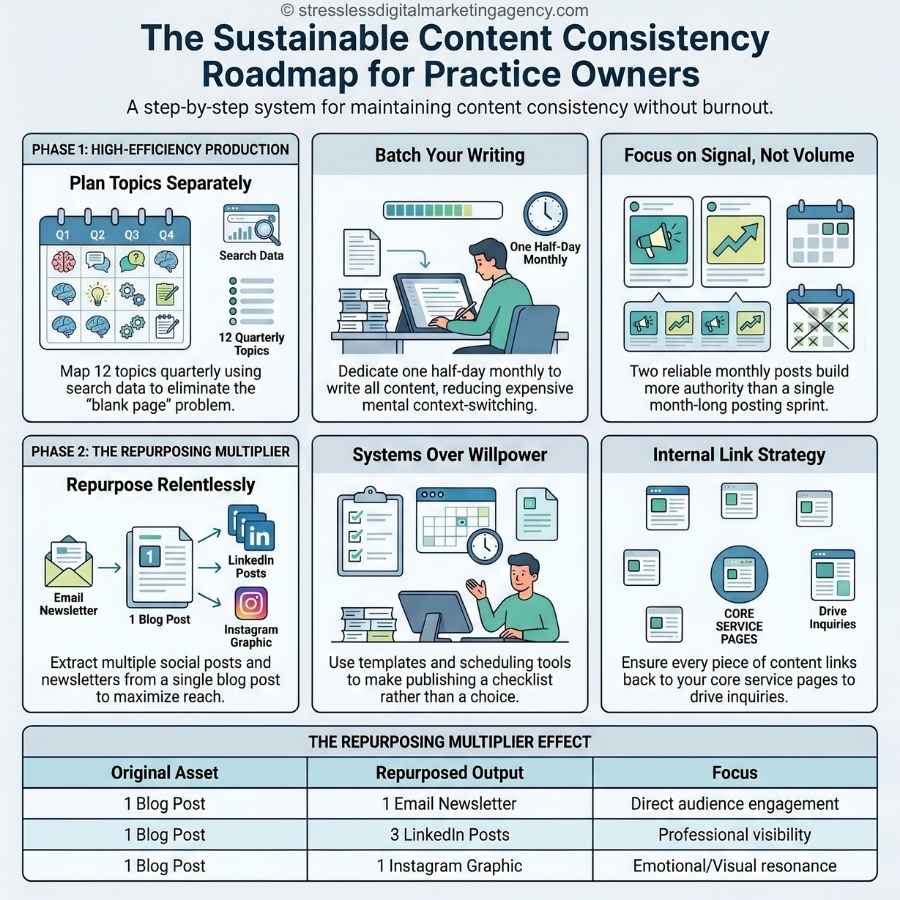
Two quality posts per month, published reliably for twelve months, build more search authority than twelve posts published in January followed by silence. The math isn’t about volume. It’s about signal, and Google reads consistency as a sign that your site is active, authoritative, and worth ranking.
For a deeper look at how that SEO foundation connects to your broader visibility strategy, SEO for service providers covers how consistent content translates into compounding search traffic.
The Real Reason Most Practice Owners Fall Off
Three real reasons content consistency breaks down for health and wellness providers, and “not enough time” is only one of them.
The blank page problem. Most people sit down to write without a topic, keyword, or structure decided in advance. That indecision costs as much time as the writing itself, and it makes the whole task feel enormous. When every piece of content requires a from-scratch planning session before you can even start, it’s not sustainable. The fix isn’t more discipline. It’s eliminating the decision fatigue by planning topics and keywords in a separate session, well before you sit down to write.
Perfectionism disguised as standards. A version of content perfectionism keeps practice owners from publishing anything because nothing feels quite good enough. The post isn’t finished. The topic doesn’t feel original. The intro needs one more pass. Done consistently and imperfectly outranks never published and perfect, every time. If writing anxiety is part of what’s making consistency hard, writing anxiety in business is worth reading before you assume the fix is a better calendar.
No system, only willpower. Willpower isn’t a content strategy. It depletes. Systems don’t. Practice owners who publish consistently have removed as many decisions as possible from the writing process. The topics are already chosen, the format is already established, the publishing schedule is already set. They’re executing a system, not summoning motivation from scratch every single time.
7 Strategies That Actually Sustain Content Consistency
These are the tactics that hold up long-term, not just for the first few inspired weeks.
1. Batch your writing
Pick one day or half-day per month and write multiple pieces in one sitting. Context-switching between clinical brain and writing brain is expensive. Once you’re in the creative headspace, staying there for a concentrated block beats writing in fragmented 30-minute windows between sessions.
If you want a workable structure inside that block rather than just staring at a blank doc for four hours, split it into stages instead of doing everything at once:
- Protect one repeating block of time, even 90 minutes, the way you’d protect a client session.
- Outline several pieces in one sitting. Outlines are quick, and working on two or three at once keeps you in the same mode.
- Draft in a separate stretch. Write badly on purpose and resist the urge to edit while you go.
- Edit afterward, reading your draft out loud to catch anything that doesn’t sound like you.
- Format and schedule everything at the end, so publishing doesn’t require a decision on a busy Tuesday.
For a practice publishing twice a month, a single half-day of focused writing can cover both posts. Add 30 minutes for scheduling and the month is handled.
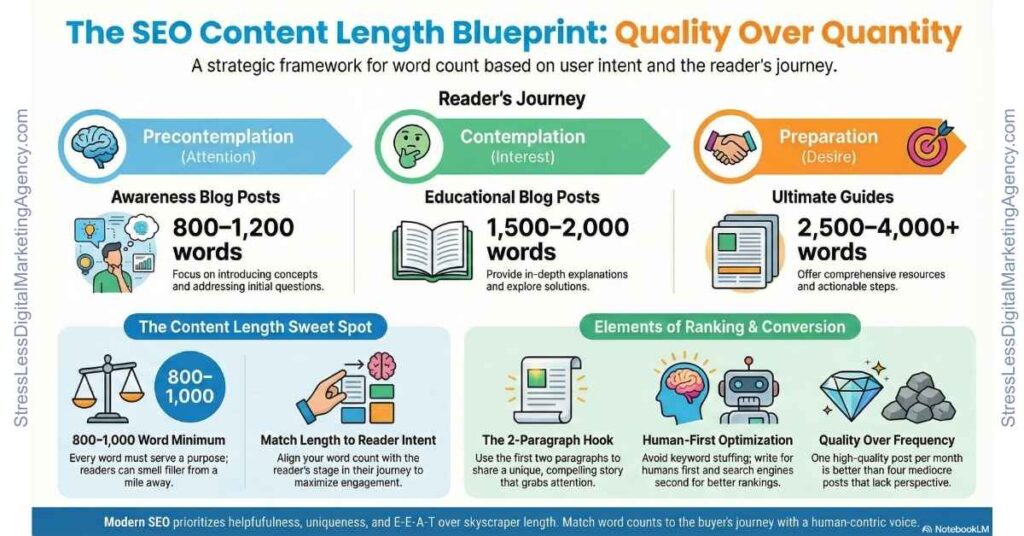
2. Plan topics separately from writing
Set aside 30 minutes once a quarter to map your next 12 topics. Use Google Search Console to see what your site is already getting impressions for. Use a keyword tool to find the specific phrases your ideal clients are searching. Write down 12 working titles mapped to keywords and audience intent.
Now, when you sit down to write, you’re never starting from scratch. The hardest part is already done.
3. Repurpose relentlessly
Every piece of content you produce has multiple lives. A 1,500-word blog post is also an email newsletter. It’s three LinkedIn posts. It’s five Instagram captions. A question you’ve already answered for a client, with every identifying detail removed, becomes its own short post. You wrote the ideas once. Let them travel.
4. Publish smaller when you need to
Not every piece has to be a comprehensive guide. A 600-word post that answers one specific question clearly, and links back to your pillar content, is a legitimate SEO asset. A short email sharing one insight from your clinical week builds relationship capital just as well as a long essay does.
The goal is to keep showing up, not to publish a masterpiece every time. Smaller, consistent content beats occasional ambitious content that depletes your reserves and leads to a two-month gap.
5. Build a content calendar you can actually maintain
Map one quarter at a time. Each entry needs a working title, a primary keyword, a target publish date, and one internal link you’ll include. That’s the whole plan. Anything more detailed than that adds overhead that makes the system harder to keep up.
Protect your publishing days the same way you protect client hours. If it isn’t blocked on your calendar, it will get bumped.
6. Use templates for repeating formats
If you publish a certain type of post regularly- a client FAQ post, a “what is” educational post, a personal story post- create a template with the structure already mapped: headings, approximate word counts per section, internal link placeholders. Starting from a template instead of a blank document cuts writing time and keeps the quality more consistent.
7. Write a one-page style guide
This is the cheapest consistency win most people skip. Note your preferred reading level, how long your paragraphs tend to run, how you handle clinical terms, whether you use humor, and how you sign off. Add a short list of phrases that sound like someone else and shouldn’t appear in your content.
The guide also protects you later. If you bring in a copywriter, a virtual assistant, or a colleague to help, they can match your voice from day one instead of guessing.
What a Realistic, Consistent Content Calendar Looks Like
Here’s what a sustainable month of content looks like for a solo or small practice.
| Week | Content |
|---|---|
| Week 1 | Blog post #1 published, plus an email newsletter sharing it with your list |
| Week 2 | 2 to 3 LinkedIn posts repurposed from blog #1 |
| Week 3 | Blog post #2 published, plus an email newsletter |
| Week 4 | 2 to 3 LinkedIn posts from blog #2, plus one standalone email (a personal story, a tip, a resource) |
That’s two blog posts, two newsletters, and roughly four to six social posts a month. It takes one focused writing day and maybe two hours of scheduling. It isn’t glamorous. It’s exactly what builds compounding visibility over a 12-month timeline.
The key is that every blog post internally links to a service page. Every email links back to a blog post or a lead magnet. Every social post drives traffic back to the website. The whole system points toward the same destination: your website, your service pages, your inquiry form. That connected structure is what turns content consistency into actual inquiries, not just traffic.
For a full breakdown of how those connections work across blog, email, and social, the content ecosystem guide maps the whole architecture in detail.
The Repurposing Multiplier: One Piece, Five Places
The most efficient path to content consistency isn’t creating more. It’s extracting more from what you already created.
A single well-written blog post contains several standalone ideas. Each section heading is a potential social post. The intro paragraph often makes a strong email opener. A pull quote from the body works as an Instagram graphic. The conclusion doubles as a newsletter sign-off. None of that requires additional writing, just extraction and light reformatting.
Here’s what one blog post can realistically become:
- Email newsletter: a 150-word intro plus a link to the full post (“I wrote something this week that I think you’ll recognize in your own practice…”)
- LinkedIn post #1: the opening story or hook, reformatted as a standalone observation with a call to read more
- LinkedIn post #2: one specific insight or data point, framed as a question or challenge to the reader
- LinkedIn post #3: a before-and-after reframe, one thing most practice owners believe versus what the research or your experience actually shows
- Instagram caption: the most visual or emotionally resonant line from the post, paired with a simple graphic built around your brand colors
Repurpose the substance, not the wording. Copying the same paragraph into five places makes your brand feel thin, while reframing one idea for a different channel keeps your message consistent without sounding repetitive. Five pieces of content from one writing session is the multiplier that makes a two-posts-per-month commitment feel manageable.

Two Habits That Make the Rhythm Durable
Everything above is structure. These two habits are what keep the structure from quietly falling apart six months in.
First, keep a running list of client questions. They’re the most reliable source of content your audience actually wants, and you never have to invent a topic from scratch again.
Second, forgive the skipped week quickly. Consistency isn’t a perfect record. It’s a pattern that resumes, and audiences respond to the resuming far more than they notice the gap. If a month goes sideways, pick up with the next block instead of restarting from the beginning. Catching up usually creates a frantic burst of low-quality content followed by another silence, and that’s worse than just picking back up where the calendar says you should be.
Affiliate Disclaimer: This page contains affiliate links and is a member of the Amazon Services LLC Associates Program. If you make a purchase using one of these Amazon links, we may receive compensation at no extra cost to you. See our Disclosure Policy in the Legal Hub for more information.
Tools That Make Consistency Less Painful
You don’t need an expensive stack. Start with whichever tool addresses your worst failure point. If you never publish content, scheduling matters most. If your writing sounds like three different people wrote it, start with a style guide. Adding a fourth tool before the first one is working just creates another abandoned login.
A simple content calendar. Google Sheets works. Notion works. The goal is one document that shows what’s planned, in progress, and published, so you’re never starting cold.
Canva (affiliate link) for graphics, featured images, and social content. Set up your brand colors and fonts once, and every piece of visual content takes minutes, not hours.
Google Search Console is free and the most underused tool in a practice owner’s marketing toolkit. It shows you exactly what phrases people are using to find your site, which posts are getting impressions without clicks, and how your rankings move over time.
A scheduling tool. Buffer, Later, or whatever your email platform supports. Write it once, schedule it, don’t think about it again until next month.
Rank Math or Yoast for on-page SEO guidance built into WordPress. Treating this as a pre-publish checklist removes a category of mistakes that quietly tanks content performance.
Link Whisper (affiliate link) if internal linking is the piece you never get to. It scans your site and suggests relevant internal links as you write, which matters more than it sounds. Every blog post in your calendar is supposed to link back to a service page, and that’s the first thing that gets skipped when you’re rushing to hit publish.
When DIY Consistency Stops Making Sense
There’s a point in a growing practice where the question stops being “how do I stay consistent?” and becomes “should I be the one doing this at all?”
That shift usually happens when the content is getting done, but it’s the thing that gets bumped every time something more urgent comes up, which is always the case in practice. You’ve been “almost consistent” for six months. The calendar exists. The posts sometimes happen. But the gap between the plan and the reality stays stubbornly wide.
Or the content exists, but it isn’t converting. Posts go up, traffic is okay, and nobody inquires. That’s usually a strategy and optimization problem, not a volume problem, and fixing it requires understanding keyword intent, internal linking architecture, and buyer psychology in ways that take real time to learn.
Or the hours you’re spending on content are hours you could spend seeing clients. At a $175 session rate, ten hours of content work a month is $1,750 in potential session revenue sitting on the table. That math changes the decision for a lot of people.
For a full breakdown of that calculation, how outsourcing saves time runs through the realistic numbers, including what you get back beyond the clock hours.
What Done-For-You Actually Solves
I spent years as a clinician before I did this for a living, so I understand exactly what it’s like to sit down at 8pm with nothing left to give a blog post. When I work with health and wellness practices on a content retainer, here’s what a full month looks like: built, optimized, and delivered so you can focus on your clients while your visibility keeps compounding.
Two SEO-optimized blog posts, fully researched, written to a target keyword, internally linked to your service pages and related posts, formatted for WordPress, and optimized in Rank Math before delivery. Each one is written in your voice, with your clinical insights and personal stories woven in during the revision round.
One email newsletter, written to go out the week each post publishes. Short, personal, links back to the post, and keeps your warmest leads engaged between sessions.
Repurposed social content, LinkedIn posts extracted from each blog and ready to schedule. You don’t have to think about what to post. You just share it.
Strategic internal linking, so every piece connects back to your service pages and pillar content, and the whole month of content feeds the same visibility architecture instead of existing as isolated posts.
The result is a month of consistent, connected, SEO-informed content, without a single hour of writing on your end. Not because you finally got more disciplined. Because you removed the constraint entirely.
Frequently Asked Questions
How often do I need to publish to be consistent? There’s no universal number, and chasing one usually backfires. Choose a rhythm you can hold during a heavy client week, whether that’s twice a month or twice a week, and let the predictability do the work.
What’s the difference between consistency and frequency? Frequency is how often you publish. Consistency is whether your voice, message, and values stay recognizable over time. You can publish often and still feel inconsistent if your tone swings wildly. You can also publish modestly and feel highly consistent, because readers know what to expect and trust that it will keep arriving.
Can batching make my content sound repetitive? Batching only sounds repetitive if you reuse the same wording across channels. Batching the work itself, outlining several posts in one sitting, doesn’t make the writing uniform. Pair it with a short style guide so you reframe each piece for its audience rather than copy it word for word.
What should I do if I fall off my schedule? Resume with the next scheduled piece rather than trying to make up lost ground. A pattern that restarts quickly is more valuable than a perfect record, and audiences rarely notice the gap as much as you do.
Start Building Your Own Rhythm
If content consistency is something you keep meaning to fix but never quite do, you don’t have to figure out the whole system before you take the first step.
Grab the free first chapter of my book, Stay Booked, for the fuller version of the mindset and messaging work that makes consistent content possible in the first place.

Keep Reading:
- Ultimate guide to content creation — the full strategy from audience mapping to content calendar
- How to build a content ecosystem — how every piece connects
- Writing anxiety in business — if the blank page is part of what’s making consistency hard
- How outsourcing saves time — the honest time and money math
- Email content strategy guide — making your newsletter as consistent as your blog
Sources
- Ahrefs, “96.55% of Content Gets No Traffic From Google” (Tim Soulo, December 2023): https://ahrefs.com/blog/search-traffic-study/
- Ahrefs, “How Long Does It Take to Rank in Google?”: https://ahrefs.com/blog/how-long-does-it-take-to-rank/
- Semrush, content marketing success factors survey (via Search Engine Journal, “6 Mission-Critical Content Marketing Statistics for 2023”): https://www.informatechtarget.com/blog/6-mission-critical-content-marketing-statistics-for-2023/
- Forbes Agency Council, “13 Ways For A Company To Create And Cultivate A Strong Brand Voice” (September 2021): https://www.forbes.com/councils/forbesagencycouncil/2021/09/15/13-ways-for-a-company-to-create-and-cultivate-a-strong-brand-voice/