How Long Should My Blog Posts Be? A Straight Answer From an SEO Copywriter

How long should my blog posts be? Therapists, counselors, coaches, private practice owners- they all want one number they can hit and then get back to their actual work.
Word count is a factor in SEO, but it sits far down the list of things that decide whether a page ranks. Chasing a number without understanding why length matters is how you end up with padded posts that read like filler and rank for nothing. Length is a signal. It only works when everything around it is doing its job too.
Why the Word Count Question Keeps Distracting You
A single number feels safe. It turns a vague, uncomfortable task into a finish line you can cross and forget about. Write 1,500 words, hit publish, done.
The problem? Word count tells you nothing about whether your ideal client found an answer. It measures volume, not usefulness. Two posts can both land at 1,400 words, and one ranks while the other collects dust, because the difference never came down to the number.
Why Content Length Is an SEO Signal, and What That Actually Means
Word count isn’t a ranking factor on its own. Search engines aren’t counting your words and scoring you against a threshold. Length helps search engines understand your topic, helps readers understand your message, and supports a page’s overall quality and relevance.
Longer content has historically correlated with higher rankings because thorough answers tend to require more words. A 300-word post about trauma-informed therapy probably can’t cover the topic well enough to satisfy someone actively researching it. But a 3,000-word post stuffed with repetition and filler won’t outperform a tight, well-structured 1,400-word post that actually answers the question. The relationship between length and rankings is about completeness. It was never about volume.
For a health and wellness practice, that has a specific implication. The posts that rank for your most important searches treat the topic seriously. That means enough depth to show expertise, enough structure to be easy to read, and enough specificity that readers walk away satisfied.

The Content Length Sweet Spot, Based on Real Data
If you want starting points rather than rules, these are the ranges that show up most often in published SEO guidance.
| Content type | Common benchmark | Why it lands there |
|---|---|---|
| Product descriptions | 200 words minimum | Short, specific, built to convert |
| Overview or summary pages | Around 200 words | Enough to give the gist without padding |
| Standard blog posts and pages | 300 words minimum | Room to establish a topic clearly |
| Average top-ranking blog post | About 1,500 words | What the average first result tends to run |
| Most SEO content | 1,400 to 1,500 words | A common working range for competitive topics |
| How-tos and timeless articles | 1,500 to 2,500 words | Longer because the topic demands steps and detail |
Treat those as a sanity check, not a target. They describe what tends to exist, not what you’re required to produce.
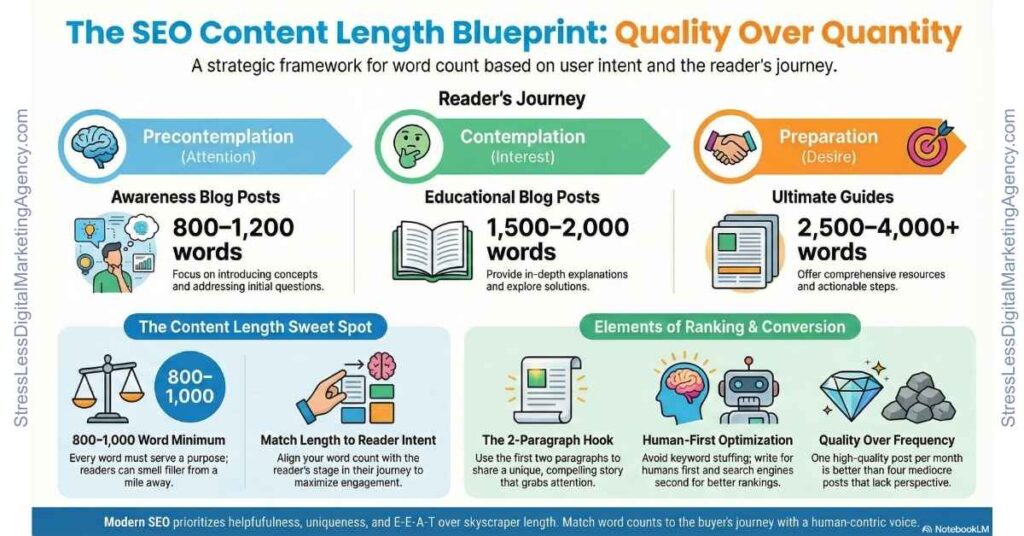
Length also depends on where your reader is in their decision to work with you. Someone Googling “what is EMDR” doesn’t want 4,000 words. They want a clear answer they can absorb in a few minutes, so 800 to 1,200 words is plenty. Someone Googling “how to choose an EMDR therapist” is much further along and ready for real depth, closer to 2,000 to 2,500 words, because they’re comparing options and deciding.
| Content type | Ideal length | Purpose | Where the reader is |
|---|---|---|---|
| Awareness posts | 800–1,200 words | Answer a specific question, grab attention | Just starting to look |
| Educational posts | 1,500–2,200 words | Build trust, explain concepts thoroughly | Actively researching options |
| Pillar guides | 2,500–4,000+ words | Comprehensive resource, demonstrates expertise | Comparing and narrowing down |
| Service pages | 400–600 words | Explain the offering, address objections, convert | Ready to reach out |
What the Numbers Actually Tell You
Attribution matters less than pattern here. The same ranges keep resurfacing across sources, which suggests they’re descriptive rather than prescriptive.
The average first result on Google runs around 1,500 words, and research points to 1,400 to 1,500 words as a strong working range for most SEO content. How-to guides and timeless pieces often stretch to 1,500 to 2,500 words, because they need steps, examples, and context to actually be useful. Short-form content still has a place, though. Around 200 words can be enough for an overview page, and product descriptions are commonly benchmarked at 200 words minimum. For AI-assisted summaries and skimmable formats, shorter sections matter more than total length anyway, so break long posts into tight, self-contained blocks.
When You’re Doing Everything Right and Still Not Seeing Movement
I’m a former clinician. My brain wants proof. I want to see the data, run the test, confirm the result before I trust that something is working.
SEO doesn’t give me that, at least not in the first six months. Some of my own pages sat there for weeks, not ranking, and I started spiraling a little. Something is wrong. I’m not good at this. So I paid for a professional audit of my Google Search Console backend, fully expecting to find the mistake. The verdict? I hadn’t done anything wrong. Google can take months to index pages, especially in competitive niches, and there was nothing to fix.
That experience is the reason I push clients so hard on originality instead of word count. If you’re writing about the benefits of a therapeutic approach, share your own case examples, your clinical instincts, the things you’ve actually noticed in the room. Don’t regurgitate the textbook. Google rewards that, and so does the person deciding whether to book you.

The Mistake That Cancels Out Your Word Count Entirely
Padding. It’s the fastest way to waste the effort you put into length.
Padding shows up as repeated points, long windups before the answer, and paragraphs that just restate the heading. Readers feel it immediately, and they leave. Whatever benefit you hoped to gain from a longer post disappears the moment someone bounces because the answer was buried in paragraph twelve.
The same logic applies to thin pages. A service page that says almost nothing about what you offer, who it’s for, and what happens next won’t rank just because you tacked on 400 words of pleasantries. Length can’t rescue a page that has no job to do.
The Other Mistake: Writing a Great Post for the Wrong Search
Here’s one I made myself. Early on, I wrote 2,500-word posts on topics my audience wasn’t actually searching for. Technically solid, well-researched, genuinely thorough. And completely invisible in search results, because I’d skipped the step that matters more than length ever will: figuring out whether anyone types that phrase into Google in the first place.
Word count means nothing if you’re answering a question nobody’s asking.
This is why keyword research comes before a single sentence gets written. You need the actual phrase your ideal client uses, not the one you assume they use. Therapists tend to write in the language of graduate school. Clients search in the language of the problem. Nobody Googles “post-traumatic stress disorder symptoms.” They Google “why do I flinch when someone raises their voice.” Once you know the real phrase, look at what’s already ranking for it. That’s your benchmark, not a number you picked out of the air.
What Search Engines Reward Beyond Word Count
Length works in combination with a dozen other signals, which is why some people write 2,000 words and watch nothing happen.
Relevance to the actual search query matters more than relevance to the topic you wish people were searching. How long readers stay and engage with the page counts. Page structure has to be something a crawler can follow, and a human can skim without effort. And whether the rest of your site backs up your authority on the subject plays into it too. Ahrefs’ analysis of longer content found it tends to earn more backlinks over time, which compounds into domain authority (Ahrefs, n.d.-a). But backlinks follow because the content is genuinely comprehensive, not because it crossed a word-count line.
Google’s quality guidelines were updated in 2022 to add a fourth E, for Experience, alongside Expertise, Authoritativeness, and Trustworthiness (Google Search Central, 2023). That update matters specifically for practitioners. You’ve sat with clients, made real clinical calls, and developed an actual point of view. That’s an asset a generic marketing blog can’t compete with, and it’s increasingly something both Google’s systems and your readers can tell apart from content that was only researched (Ahrefs, n.d.-b).
Your voice and lived experience belong on that list. A therapist writing about anxiety isn’t competing with a general marketing blog on knowledge alone. The clinical perspective is the differentiator, and it’s the one part word count can never manufacture for you. You don’t need to share anything clinical or break confidentiality to do this. You need a real answer, not a summary of what everyone else already said.
Posting Frequency and Content Length Work Together
Length is only half the publishing equation. How often you post changes what each piece has to do.
If You Want Faster Results: Daily Posting
Daily publishing compounds quickly, but only when each post still answers something real. If the pace pushes you into 300-word filler, the volume works against you. Shorter, sharper posts are fine at this cadence as long as every single one has a purpose, and results tend to show up faster simply because there’s more surface area for Google to index and evaluate. This pace also assumes real time or a real budget behind it. For most solo practitioners, it’s not sustainable for long.
If You Want Sustainable Results: Monthly Posting
Nobody loses weight and keeps it off by doing a 30-day cleanse. I know that firsthand. I’ve lost close to 50 pounds and kept it off for about a year, and none of the quick methods I tried before that (Atkins, South Beach, Weight Watchers, Noom, all of it) actually stuck. What worked was changing how I ate on a random Tuesday when nothing dramatic was happening and I was just hungry.
SEO works the same way. It’s not the launch campaign or the flashy redesign. It’s the post you publish in month seven when you’re not sure anyone is even reading it. The content compounds, but the habit is what makes it compound. Most of the practices that come to me for help have already tried the cleanse version of marketing, the paid ad burst, the social sprint, and they’re exhausted and still invisible. One substantial post a month, in the 1,500 to 2,500 word range, builds a library over time without wrecking your schedule. Depth does more of the work here because you’re publishing less often.
The Middle Ground: Weekly or Bi-Weekly Publishing
Weekly or bi-weekly sits in the practical middle. It’s enough consistency to signal an active site, and enough breathing room to actually write something worth reading. Most practices with a marketing support system land here, and for good reason. It’s sustainable without asking you to sacrifice depth, and it tends to land somewhere between the two extremes on timeline too: faster than the monthly approach, without the burnout that daily posting brings.
Whichever pace you choose, expect the timeline to run in months, not weeks. SEO content generally takes time to get indexed, evaluated, and ranked, and a post can keep climbing well after it first appears in search results. That’s not a sign something’s broken. It’s how the system works.
How to Audit Your Existing Content for Length and Quality
Before you write anything new, look at what you already have. Older posts often just need tightening or expansion rather than replacing.
- List every published post and page with its current word count.
- Flag anything under 300 words that’s meant to rank as a post or standard page.
- Read the flagged pieces and ask whether they fully answer the question in the title.
- Check structure. If there are no headings, no short paragraphs, and no clear sections, fix that before adding a single word.
- Cut repetition first, then add missing detail second, because expansion should add information, not sentences.
- Confirm the length still fits the content type. An overview page doesn’t need to become an article just because it’s on a list.
- Check whether each post links to at least one or two related posts and, where relevant, a service page. Posts sitting in isolation, with nothing pointing to or from them, are working much harder than they need to.
- Look at your H2s and H3s and ask whether they reflect what people are actually searching, not just what sounded clever when you wrote them.
- Confirm your images have real alt text. It’s a five-minute fix that helps both accessibility and visibility, and it’s one of the most commonly skipped parts of on-page SEO.
- Ask honestly whether the post says anything your competitors’ posts don’t. If the next ten results cover the exact same ground, length alone won’t move you past them.
An audit like this usually reveals that a handful of posts carry most of your traffic, and the rest need either a rewrite or a redirect. If your foundational pages have never had a real messaging strategy overhaul, that’s worth doing before you touch word count at all.
The Bottom Line for Health and Wellness Service Providers
There’s no magic number. The working ranges are useful guideposts, and 1,400 to 1,500 words is a reasonable default for most SEO content, with 1,500 to 2,500 words for how-tos and evergreen pieces. But those numbers describe what thorough content tends to look like. They’re not a threshold that guarantees a ranking, and they never will be.
Write until the question is answered completely. Then stop, cut anything that repeats itself, and make sure a real person can skim the page and find what they came for. That combination is what earns rankings, and it’s the part no word count can do for you.
Frequently Asked Questions
Is 300 words enough for a blog post? As a floor, yes. Commonly cited SEO guidance puts the minimum for regular posts and pages at around 300 words. That said, 300 words only works when the topic is narrow enough to answer completely in that space. If your post leaves the reader with unanswered questions, it’s too short no matter what number you hit.
Is a 3,000 word blog post too long? Not automatically. Long content earns its length when every section adds something the reader needs. Problems begin when a post repeats itself, restates the same point in new phrasing, or buries the answer under a long introduction. A tight 1,400 word post that answers the question beats a 3,000 word post nobody finishes.
Does word count still matter for SEO? It matters as a supporting signal, not a ranking factor on its own. Word count helps search engines understand the context of a page and helps readers follow your message. The right length depends on search intent, topic depth, competition, and the purpose of the page, so no single number works everywhere.
How long should a service page be compared to a blog post? Service pages can run much shorter than blog posts. Guidance suggests around 200 words is enough for a page that gives an overview, while blog posts and standard pages are typically expected to clear 300 words. A service page should stay focused on the outcome you offer instead of padding toward a blog-style count.
Next Steps: Build Your Content Ecosystem
If you’re staring at a blog with a dozen posts that never got past 400 words, you don’t need to write more. You need a plan for what each post is supposed to do. Grab my free blog templates for service providers if you want a starting structure built specifically for health and wellness clinicians, and download my price and service guide when you’re ready to hand the whole thing off.
Sources
- Ahrefs. (n.d.-a). Why does content length matter for SEO? Ahrefs Blog. https://ahrefs.com/blog/blog-post-length/
- Ahrefs. (n.d.-b). E-E-A-T: What it is and why it matters for SEO. Ahrefs Blog. https://ahrefs.com/blog/eeat-seo/
- Google Search Central. (2023). Creating helpful, reliable, people-first content. Google Developers. https://developers.google.com/search/docs/fundamentals/creating-helpful-content