How Long Does SEO Take To Work For A New Website?

If you’ve just launched a website — or finally decided to take yours seriously — the first question that shows up is almost always the same: how long until this actually works?
It’s a fair question. And I want to give you an honest answer, not a vague “it depends.”
Here’s the version I wish someone had given me when I opened my private practice in 2020: I assumed clients would find me. I was listed on Psychology Today. I was open for business. And I waited. Months went by with nothing. Then I tried Google Ads — because the person I hired at the time didn’t believe in SEO — and it became an expensive lesson in renting visibility. I was paying every single day for eyeballs I didn’t own, and the moment I stopped paying, I disappeared.
Once I found SEO, everything shifted. It took time — there’s no pretending otherwise — but the results compounded in a way that paid ads never could. That’s the version of this I want to walk you through.
How Long Does SEO Take to Work for a New Website?
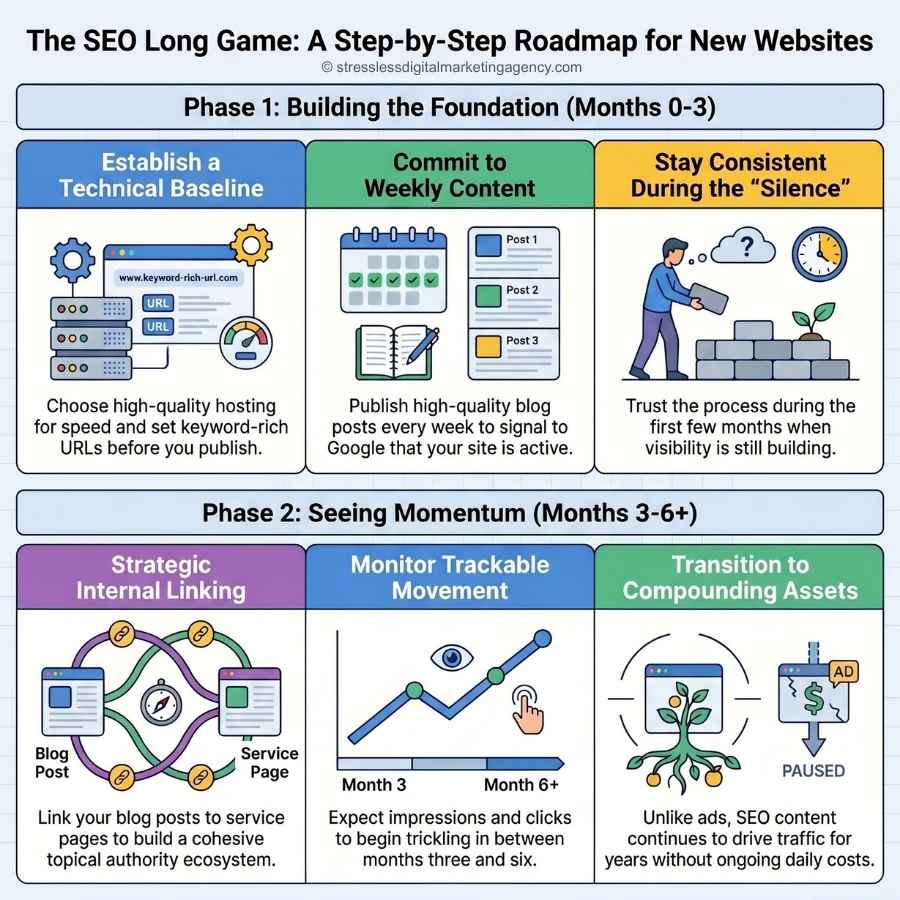
The honest answer: for a brand new website, you should expect to start seeing meaningful movement in about 3 to 6 months of consistent effort. Not virality. Not page one for every keyword. But real, trackable progress — impressions climbing, clicks trickling in, pages starting to index and rank.
Think of it the way I think about my fitness journey. Before I figured out what actually worked for my body, I tried everything — Atkins, South Beach, Weight Watchers, Noom. With Noom, I lost about 10 pounds, and as soon as I stopped using the app, I went right back. The quick-fix approach never stuck because it wasn’t a system — it was a sprint.
Nobody loses weight and keeps it off by doing a 30-day cleanse. They lose it and keep it off by changing how they eat on a Tuesday when nothing is happening, and they’re just hungry. SEO works the same way. The content compounds. The habits are what make it compound. Most of my clients come to me after the cleanse — after the flashy redesign, the paid ads burst, the social media sprint. They’re exhausted and still invisible. That’s when the real work begins.
What “consistent effort” actually looks like in practice:
- Publishing new, high-quality blog content at least once a week
- Keeping your service pages optimized and up to date
- Building internal links between your blog posts and your service pages
- Giving Google a reason to keep coming back to your site
If you want to understand all the levers you can pull, my complete SEO guide for service providers lays out the full picture in plain language.
>>> Related Post: The SEO Slow Burn: How to Measure SEO Results & Performance
Does Creating a New Website Affect SEO?
Yes — and in my experience, starting fresh is sometimes the smarter move, not the scary one.
When I first started my business, I was focused exclusively on clinical documentation for therapists. After some time, I wanted to expand into copywriting and general marketing support. I started adding new content to my existing site — but my older documentation posts kept outranking everything I published. Google had already put me in a box.
The honest realization: when you shift niches significantly, Google gets confused. It has been associating your domain with specific topics, and it takes a long time to relearn. In my case, the cleanest solution was building a new website specifically for the keywords and audience I actually wanted to serve. That’s this site — and it’s ranked from scratch, on purpose, because I built it with strategy from day one.
What I wish someone had told me: start SEO as soon as possible, even before you feel ready. You can always edit and grow as you go. Writing something once a week and getting it out there builds confidence, visibility, and the ability to find your voice. A brand new site with clean, focused content will often outpace an older cluttered one within six months.
If you have an existing site and haven’t changed your specialty — you’re just looking to revive it or give it a refresh — that’s different. You’re not starting from zero. There’s some domain authority already there, and consistent, well-targeted content can start gaining traction faster than you think.
The key in either case is consistency. Google wants a long-term relationship. It wants to know your information is reliable and your site is actively maintained. Posting consistently for six weeks and then going quiet is one of the fastest ways to stall momentum right as it’s building.
>>>> Related Post: Why Did My Website Traffic Drop?
Does Updating Your Website Help SEO?
Yes — updating your website, especially with relevant and helpful content, absolutely supports your SEO. Fresh content tells Google your site is active. Updated pages signal that your information is current and trustworthy.
The key is that updates need to be meaningful. Adding a paragraph of filler or swapping a word here and there doesn’t move the needle. What helps is genuinely improving a page — adding a section that answers a question your reader has, refreshing outdated statistics, strengthening internal links to related posts and service pages.
I think about this the way I think about showing up to the gym. My workouts are structured: elliptical to warm up, resistance machines, cool down on the treadmill. Some days I’m lifting heavy and everything feels good. Other weeks I can barely lift what I did the week before. I used to fight that. Now I work with it — because what matters isn’t the perfect session. What matters is that I showed up.
Content is the same. The post that gets published at 70% effort still builds topical authority. The blog you update in month seven, when you’re not sure anyone is reading, still gets crawled. The results came not from the hard days but from not quitting on the easy ones.
If content creation is something you struggle to stay consistent with, let’s talk about taking that off your plate.
Does Changing Your Website Name Affect SEO?
Yes and no.
You can call your business whatever you want, and that won’t directly hurt your SEO. But if you start changing your URL — the actual web address — that’s where things get complicated.
Think of it like your home address. You can legally change your name, and that’s fine. But if you change your physical address and don’t tell anyone, your mail doesn’t get there. When people type in a webpage, they’re entering an address. If that address changes and redirects aren’t set up properly, traffic goes nowhere — and Google notices.
If a rebrand is on the horizon, do it carefully. Make sure proper 301 redirects are in place from every old URL to the corresponding new one. And if you’re not sure how to handle it technically, get help before you make the move, not after. A botched migration is one of the most common reasons practices see a sudden traffic drop.
>>>> Related Post: How to Check for Broken Links on Your Website
Does Changing Web Hosts Affect SEO?
Directly? Usually not. I’ve changed hosting platforms myself — moving from Bluehost to Lyrical Host — and I didn’t see an SEO hit from the switch.
But your host absolutely affects your site speed. And site speed affects user experience. And user experience affects SEO — significantly.
Here’s the chain: if your website loads slowly, visitors leave before the page finishes loading. That’s called a high bounce rate. If Google sees people consistently leaving your site after two seconds, it reads that as a signal that your content isn’t helpful — and it stops recommending your pages as confidently.
Flip that around: a fast, smooth site keeps people reading. They click to another post. They find your service page. They fill out your contact form. Google interprets all of that as quality content and pushes it up the rankings.
So while your host isn’t an SEO factor in isolation, the site performance it enables absolutely is. If you’ve been noticing slow load times or you’re on a shared hosting plan that’s clearly struggling, it may be worth investigating. A quality host is part of a functioning SEO foundation.
>>>> Related Post: Slow Sites, Lost Clients: Here’s What You Need to Know About Website Hosting
Does Changing a URL Affect SEO?
Yes — and it’s rarely for the better.
When you first create a URL, getting the keywords right matters. A URL like /seo-for-therapists/ tells Google a lot about what that page is before it even crawls the content. But once that URL is set and has been indexed, changing it creates a break. The old URL still exists somewhere in the internet’s memory. If someone clicks a link to it — from an old email, a social post, another website — they hit an error page. Google hates that.
The rule I follow: get the URL right the first time. Put the keywords in. Keep it clean and readable. Then leave it alone.
If you must change a URL, set up a 301 redirect immediately from the old address to the new one. That tells both users and search engines where to go. But it’s still not seamless — authority built on the old URL doesn’t transfer perfectly — so the best move is always to get it right before you publish.
>>>> Related Post: I Used to Guess What Was Working in My Business — Then I Discovered UTM Tracking
The Honest Bottom Line on SEO Timelines
Here’s what I came to understand through my own expensive trial and error: SEO isn’t an overnight solution, and it isn’t magic. It’s a long-term strategy that delivers sustainable growth without paying for every single visitor.
When I was pouring money into Google Ads, I had visibility — but only as long as I kept paying. The moment I paused the campaign, I vanished. SEO builds something different. It builds an asset. A blog post that ranks today will still be bringing in traffic in two years, three years, longer — without you paying for it again.
The practices and service providers I see succeed with SEO are the ones who commit to the long game. They publish consistently. They link strategically. They treat their website like the business asset it is, not a digital business card they set up and forgot.
The ones who quit at month four — right before things typically start to move — are the ones I think about most. They were so close.
If you want to understand how to build that foundation the right way, from keyword strategy to service page copy to blog content that actually ranks, start with my complete SEO guide for service providers. It covers the whole picture.
And if you’re ready to stop doing this alone, download my price and service guide to see exactly how I help service providers build visibility that compounds over time.
Still figuring out where your biggest roadblock is? Take the free quiz: What’s Keeping You Stuck With Marketing?
correct the first time and avoid changing things later, because that will seriously mess with your SEO.