SEO for Service Providers: How to Get Found by Clients Ready to Book
Prefer to listen instead of read? Catch this post on the podcast.
A client who is ready to book usually starts with a search. They type a few words into a search engine, review the results, and decide who looks like the right fit. For a service provider, that search is an opportunity. The question is whether your practice appears in front of the people looking for exactly what you offer.
I learned this the hard way. When I opened my private practice in 2020, private pay, I assumed clients would flood through the door. They didn’t. After months of crickets, I finally hired someone to write my website and my Psychology Today profile, and things changed. But the person I hired didn’t believe in SEO, so I also tried Google Ads. That became an expensive lesson in renting visibility. Every day, I was paying for eyeballs I didn’t own. Once I actually learned SEO, I realized I could get the same results without paying every single time someone found me.
SEO, which stands for search engine optimization, is the practice of improving a website’s visibility in search engine results pages for relevant searches. It’s the work that helps the right clients find the right provider.
For service-based businesses, SEO means optimizing your online presence to attract potential clients searching for the services you offer. It is not about chasing random visitors. It’s about connecting with people who have already identified a need and are looking for someone who can help. When your website matches those searches with clear, useful pages, you position your practice in front of clients who are ready to take the next step.
Affiliate Disclaimer: This page contains affiliate links and is a member of the Amazon Services LLC Associates Program. If you make a purchase using one of these Amazon links, we may receive compensation at no extra cost to you. See our Disclosure Policy in the Legal Hub for more information.
What SEO Looks Like for a Service Business
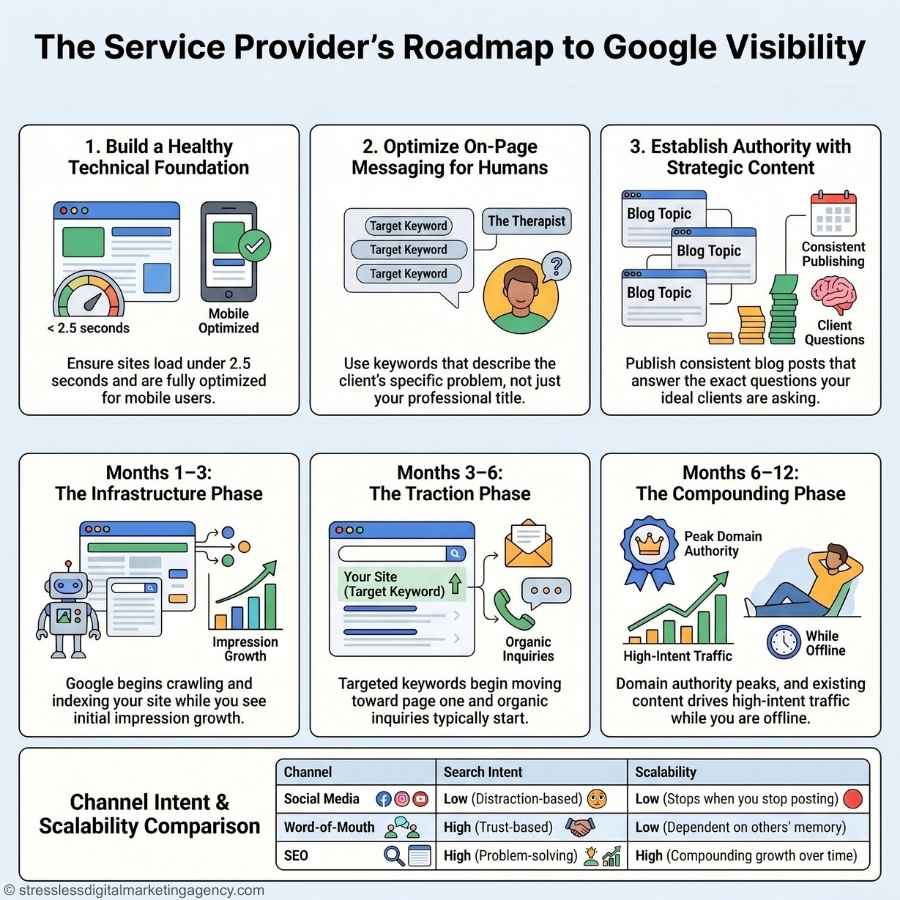
SEO for a service provider works differently than SEO for an online store. A store might try to rank for hundreds of product-related terms. A service business usually needs fewer pages, but each page has to do more work: rank for a relevant search, answer a reader’s question, and guide that reader toward contacting you. SEO for home service companies is the process of updating and optimizing your website so that each web page ranks at the top of search engines for helpful searches, and the same idea applies to therapy practices, coaching businesses, and other professional services.
What does that mean in practice? You look at each piece of your website and ask what search it’s meant to satisfy. A homepage might speak broadly about your approach and your areas of focus. A service page can speak directly to a specific problem a client is facing. An about page can build trust and help a visitor decide whether you’re someone they feel comfortable reaching out to. When every page has a clear purpose, search engines can understand your website, and visitors can quickly find what they need.
Why SEO Matters When Clients Are Ready to Book
Your website is a powerful sales and marketing tool, but only if clients can actually find you online. Too many providers invest in a professional website and then wait for the phone to ring. Without visibility in search results, the website can’t do its job. SEO services help your business rank higher on Google and drive consistent, qualified traffic, and for a service provider, that consistency matters more than almost anything else. Referrals come and go. A steady presence in search results keeps your practice visible to new clients over time.
Think of it like the difference between using a travel agency and knowing the city yourself. For years, I used a travel agency. The itinerary was planned for me, it was efficient, and I never had to think twice. But I was completely dependent on someone else’s map, and when something changed, I had no idea where I was. That’s what it looks like to depend entirely on paid ads or a directory listing. You’re renting someone else’s map. When the rates go up, when the algorithm shifts, when the directory changes its rules, you’re lost. SEO is building your own map. You learn the streets. You know the shortcuts. And when things change, you’re not starting from scratch.
A person who searches for a service isn’t casually browsing. They’re looking for a solution to a problem, and they’re often ready to move forward. That type of visit is different from social media traffic or a random website click. Someone searching for your service has already told you what they want, and the search itself reveals their interest. Qualified traffic is more valuable to a service business than a high number of visitors who never needed your help in the first place. SEO brings you the people who are genuinely ready to book.
- Higher rankings for the search terms your future clients use
- Consistent traffic from people actively looking for the services you provide
- More visibility in local searches so nearby clients can find you
- More website traffic, phone calls, and leads for your practice
Local SEO Puts You in Front of Nearby Clients
If your clients come to your office, meet you online for sessions, or rely on services in your area, local visibility matters. Local SEO strategies attract nearby clients and increase visibility and leads, and for a private practice owner, this is often the most practical place to start. Someone who searches with your city or neighborhood in the query has already narrowed down their options. If your website doesn’t show up in that moment, that searcher may never know you exist.
Local optimization can include making sure your website clearly identifies the community or communities you serve, using language that matches the way local clients search, and creating content that speaks to the local nature of your work. A therapist serving a specific city doesn’t need to compete for attention with providers across the country. She needs to be visible in the place where her clients actually live. When your practice is easy to find locally, you create a steady source of new inquiries from people who are nearby and ready to make an appointment.
Make Your Website a Place Clients Want to Land
Ranking well is only half the job. If your website reaches the top of search results but the content doesn’t connect with the person viewing it, they’ll leave and try one of your competitors. SEO works best when visibility and quality go together. For service-based businesses, optimizing your online presence is about more than search engines. It’s about creating a website that genuinely helps potential clients decide to work with you.
You don’t need to sound like a marketing brochure, and honestly, you shouldn’t. The providers who get found are often the ones who write about their clients’ real concerns with clarity and compassion. A page that explains your approach, describes what a client can expect, and answers common questions gives a searcher a reason to stay. That human connection is what turns a click into an inquiry.
Use the Words Your Clients Actually Search
Clinical training teaches you to be a blank slate. Stay neutral. Don’t share. Let the client lead. That’s excellent therapy. It’s a disaster for marketing. Your ideal client isn’t in your office yet. She’s on Google at 11pm, reading five different therapist websites that all say the same thing: warm, welcoming, safe space, no judgment. That’s the basic requirement for the job, not a reason to hire you.
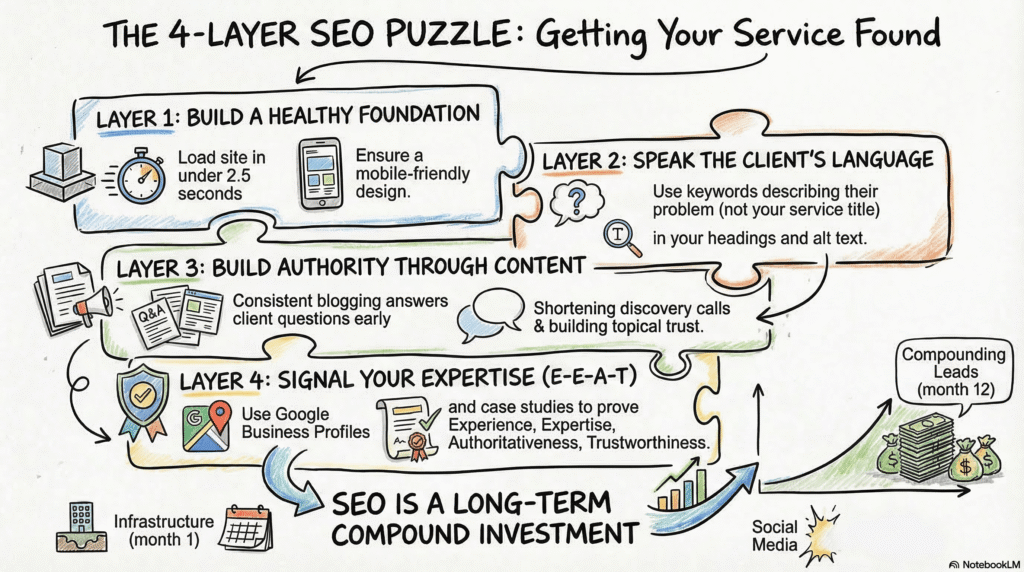
When someone looks for a service provider, they rarely use formal industry language. They use their own words, often the same words they’d use talking to a friend. A good way to review your website is to imagine the questions your clients ask before they book. If a potential client is searching for help with anxiety, relationship concerns, or a life transition, does your website speak to that exact concern? The practices that get found, and more importantly, get called, are the ones willing to have a point of view. Optimizing each page around the searches that matter to your practice helps search engines understand what you do. It also helps visitors recognize themselves in your words.
Keep Content Focused and Answer Real Questions
Content can do more than describe your services. It can answer the questions clients carry before they reach out. Many people are unsure what a first session looks like, whether your approach fits their situation, or how to begin. A website that provides that clarity reduces hesitation. Content doesn’t need to be long or complicated. It needs to be useful. Each piece of content can target a topic a future client might search for, then guide them toward your services in a natural way.
The Main Areas of SEO for a Service Provider
Practical strategies for a service-based business touch more than one area. Good local SEO work generally includes local optimization, content, and technical considerations, and understanding how those pieces fit together makes the whole process a lot less overwhelming.
Local optimization keeps your practice visible in the area you serve, connecting your website with searches that include your city, neighborhood, or service area so nearby clients can find you before they find a competitor.
Content is where you build trust and relevance. This includes the copy on your service pages and any other material that answers common client questions. Strong content helps your website appear for relevant searches and gives visitors a reason to choose you.
Technical factors support everything else. A website that’s easy for search engines to understand gives your pages a stronger chance of ranking well. I still remember auditing my own Google Search Console after weeks of watching new pages sit unranked, convinced I’d broken something. The verdict? I hadn’t done anything wrong. Google can take months to index pages, especially in competitive niches. That experience is exactly why I tell clients not to panic when rankings move slowly, and why unique content, not textbook language, is non-negotiable. When technical health is combined with clear copy and local relevance, these pieces work together to bring consistent, qualified traffic to your practice.
SEO Support for Busy Service Providers
Many service providers are trained as clinicians, coaches, or wellness professionals. Their expertise is in the work they do with clients, not in keyword research or technical website decisions. If you’ve tried to learn SEO between sessions and felt your energy drained, you’re not alone. SEO services exist exactly for that reason. They help your business rank higher on Google and drive consistent, qualified traffic, so you can focus on the client work in front of you.
The level of support can vary. Some providers need help rewriting the core pages of their website. Others want ongoing content that keeps them visible in search results over time. Some prefer a full strategy that ties together the website, content, and local presence. Whatever form it takes, good support should stay grounded in the services you offer and the clients you want to reach. It should also sound like you, not like a template. Human-first copy that respects the reader’s experience tends to perform better than copy stuffed with keywords and marketing jargon. I know this firsthand: the version of my own website that finally worked wasn’t the one written like a resume. It was the one that sounded like me.
Start With the Search a Client Would Make
If you’re not sure where to begin, start with the person you most want to help. Imagine the moment she decides to look for a provider like you. What would she type into a search engine? How would she describe her problem? Then visit your own website and ask whether it answers that search. If the page doesn’t exist, if it’s unclear, or if your practice doesn’t show up for that phrase, you’ve found your starting point.
SEO for service providers isn’t a one-time project. It’s an ongoing practice of refining your website so it continues to match the way clients search and the questions they ask. The providers who get found are the ones who keep showing up for the searches their ideal clients are making. When your website speaks directly to the person on the other side of that search, a click can become a call, and a call can become a booked client.
Ready to Build a Website That Actually Fills Your Practice?
I wrote Stay Booked: The Therapist’s Guide to Building a Website That Fills Your Practice because I lived every mistake in it before I figured out what actually works. Download the free chapter and see exactly where your website is losing clients who were already looking for you.
>>> Get your free chapter of Stay Booked
Frequently Asked Questions
Here are answers to common questions service providers ask before getting started with SEO.
What does SEO stand for and why does it matter for my practice?
SEO stands for search engine optimization. It’s the practice of improving a website’s visibility in search engine results pages for relevant searches. For a service-based business, the goal is to attract potential clients who are searching for the services you offer. When your practice ranks for those searches, you receive consistent, qualified traffic from people who are already interested in what you provide.
Is local SEO necessary if my practice serves clients in one area?
Yes. Local SEO strategies are designed to attract nearby clients and increase visibility and leads. If most of your clients come from your city or surrounding communities, being visible in local searches is often the highest-value part of your SEO work. It helps nearby searchers find you at the moment they’re looking for the type of service you provide.
What are the main parts of SEO for a service business?
Three areas matter most: local optimization, content, and technical website factors. Local optimization connects you with nearby clients, content helps you appear for relevant searches and answer client questions, and technical factors help search engines understand your website. When a provider addresses all three, the website is more likely to rank higher and attract clients ready to book.
All Resources: The SEO for Service Providers Library
Everything in this guide points somewhere deeper. Each section above is a doorway — a summary of a topic that has its own dedicated resource, written in full. Below is the complete library of spoke posts in this content cluster. Bookmark this page and come back as new resources are added.
Technical SEO
- How to Check for Broken Links on Your Website — Broken links quietly hurt your rankings and your user experience. This guide shows you how to find them, fix them, and keep them from coming back.
- The Complete Guide to Alt Text — Every image on your site is an SEO opportunity most service providers are leaving on the table. Here’s exactly what alt text is, why Google cares, and how to write it correctly.
- Slow Sites, Lost Clients: What You Need to Know About Website Hosting — If your website takes more than 2.5 seconds to load, Google is already penalizing you. Here’s what to know about speed, hosting, and Core Web Vitals.
Tracking & Measurement
- How to Use Google Search Console to Track Your SEO Performance — The free tool Google gives you to see exactly how your site is performing in search. Here’s how to read it in plain English and what to do with what you find.
- I Used to Guess What Was Working — Then I Discovered UTM Tracking — Stop wondering which marketing channel is actually sending you clients. UTM tracking gives you a direct line to the answer.
- Why Did My Website Traffic Drop? — The step-by-step diagnostic guide for when your numbers suddenly go the wrong direction.
SEO Strategy
- How Long Does SEO Take to Work for a New Website? — Month-by-month expectations for new sites, recently relaunched sites, and sites that have made major structural changes.
- AI’s Transformative Impact on SEO: What Health & Wellness Providers Need to Know — What’s actually changing, what you can safely ignore, and what to do right now to stay competitive in an AI-influenced search landscape.
Tools & Research
- Answer Socrates Review: The Budget-Friendly Keyword Tool I Keep Coming Back To — Keyword research doesn’t have to be expensive. This tool surfaces exactly what your ideal clients are typing into Google, for free.