How to Build a Content Ecosystem for Your Therapy Practice

Nobody teaches you a marketing funnel in grad school.
I spent years training to sit with people in their hardest moments. To notice what wasn’t being said. To build a treatment plan that actually fit the person in the chair across from me. Nobody handed me a syllabus on website architecture, keyword research, or how an email sequence is supposed to move someone from curious to committed. When I left the therapy room to build this agency, I started from the same blank slate every clinician-turned-business-owner starts from: deep clinical skill, and no real idea how a website is supposed to work.
That gap is where most health and wellness practice owners still live. You’re full. Your calendar is packed with clients, your inbox is full of intake questions, and somewhere in a Google Doc is a blog post you started back in the spring that still trails off mid-sentence. That unfinished draft isn’t proof you’re bad at marketing. It’s proof you’ve been running your marketing on the same energy reserve you use for client care, and that reserve runs dry.
There’s a different way to build this, and it doesn’t require more hours in your week. It requires a system where the pieces connect instead of competing for your attention. That system is called a content ecosystem, and understanding how it’s built is the difference between marketing that compounds while you sleep and marketing that quietly exhausts you until you give up on it.
Key Points:
- Website Is the Hub. Every blog post, email, and social update should point back to a specific page on your site, not just your homepage, so trust has somewhere real to land.
- Map Before You Build. Before writing anything new, take honest stock of what content already exists, what job each piece does, and where the real gaps are.
- SEO and Email Do the Heavy Lifting. Blog posts attract people who are actively searching. Email nurtures them for as long as it takes, without you having to be present for every touch.
- Build in Layers. Sustainable content marketing runs at the pace you can hold during your busiest month, not your best one.
What Is a Content Ecosystem?
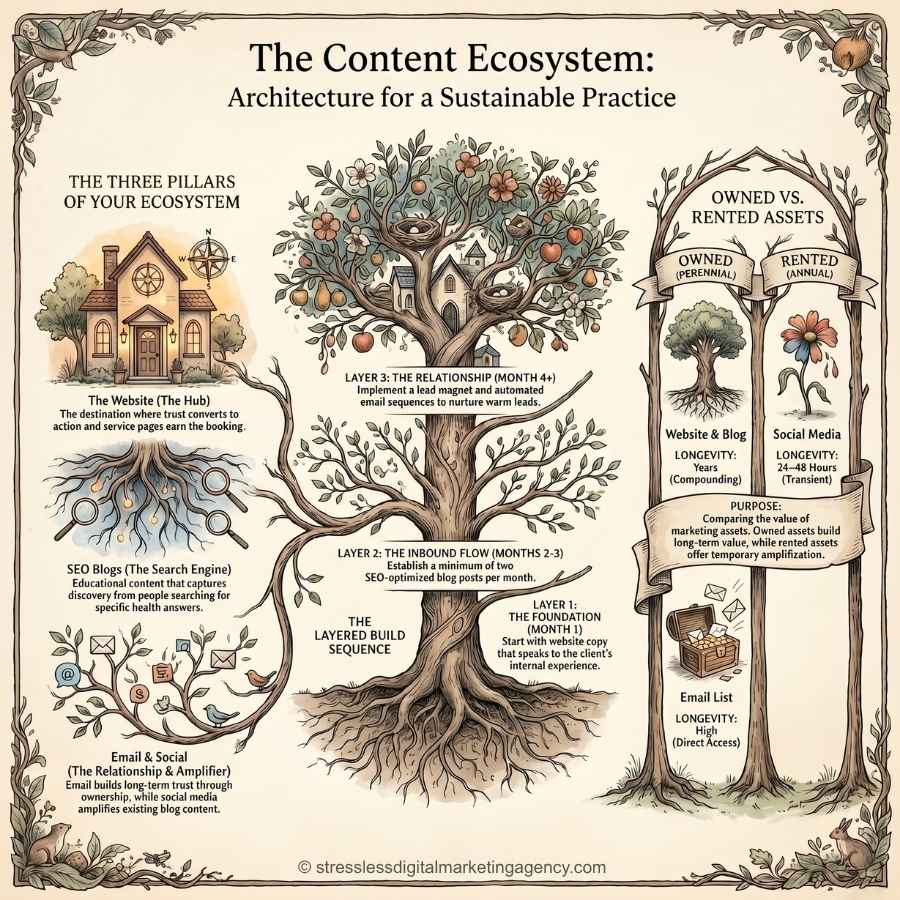
A content ecosystem is a connected set of content — your website, your SEO blog posts, your email list, your social presence — where every piece has a specific job, and every job hands off to the next step in a stranger’s path toward becoming your client.
I like to think of it the way you’d think of a vineyard instead of a single potted plant. Everything shares the same root system. Nothing goes to waste. A blog post feeds the email list. The email list warms up an audience that social media then amplifies. Pull one part out and the whole thing gets weaker, the same way removing one species from an ecosystem destabilizes what’s left.
This is a meaningfully different idea than a content calendar. A calendar tells you when to publish. An ecosystem tells you why a piece exists, where it sends the reader next, and what it’s earning its place by doing. Ahrefs describes this kind of structure as a hub built around one central topic, with a broad pillar page linked to narrower supporting posts that each go deeper on a specific angle. That’s the architecture. The reason it matters for a health and wellness practice is simpler: almost nobody who finds you is ready to book on the first visit. They need to encounter your voice more than once, in more than one place, before trust runs deep enough to act. A content ecosystem is the infrastructure that makes those repeat encounters possible without you personally showing up for each one.

Why One-Off Content Burns You Out
Here’s the part almost every practice owner learns the hard way, usually more than once.
You write a genuinely strong blog post. It gets some traffic. Nobody inquires. Meanwhile, you post consistently on Instagram for three months straight, and while the engagement looks fine on paper, no new clients show up in your inbox because of it. It’s tempting to decide that content marketing just doesn’t work for practices like yours.
That conclusion isn’t accurate, and I’ve watched it play out from the inside. I remember pulling up Google Search Console for a new client early in our work together and feeling my stomach drop. Six straight weeks of a flat impressions graph. It looks like failure. It’s usually just early. What actually happened in most of these cases wasn’t that the channel failed. Each piece was working alone. The blog post had no email capture to capture visitors who liked what they read but weren’t ready to book yet. The Instagram posts had no owned destination to send an engaged follower to beyond a homepage that read like a resume instead of a conversation.
Individual pieces of content are like instruments with no arrangement. Each one can make a sound on its own. What produces music is the relationship between them.
| One-Off Content | Content Ecosystem | |
|---|---|---|
| Planning | Whatever feels urgent this week | A small set of themes mapped to what your clients actually ask you |
| Creation | Written from scratch every time | One core piece reshaped for several channels |
| Distribution | Posted once, then forgotten | Flows across your site, email, and social over months |
| Measurement | Rarely checked | Reviewed regularly to see what actually earns inquiries |
| Effect on You | Constant pressure, inconsistent output | A cadence you can sustain without reinventing the process each time |
That doesn’t mean a single blog post can’t bring in a client. It happens. The point is that one piece is a moment. A connected set of pieces keeps working while you’re in session.
Start With a Content Ecosystem Map
Before you write a single new word, draw a map of what already exists. This is the step most practices skip, and it’s usually the one that saves the most time.
List every place your words already live. Website pages, blog posts, old newsletters, social profiles, directory listings, intake paperwork, client handouts you’ve written by hand a dozen times.
List the systems behind each one. Your website platform, your email tool, wherever your drafts sit and quietly age, the scheduler clients actually book through.
Name the job each piece does. A service page has a job. A blog post has a job. If you can’t say what that job is in one sentence, that piece is a candidate for a rewrite or for retirement.
Mark the gaps. Which questions do prospective clients ask you again and again, in intake calls or discovery emails, with no written answer anywhere on your site?
Do this on paper, in a spreadsheet, or as an actual diagram if that’s how your brain works. The format matters far less than the honesty. Most practice owners who do this exercise find more usable raw material than they expected, and fewer genuinely finished assets than they’d hoped. Puzzle pieces you didn’t know you had, scattered across a dozen places, waiting to be laid out on the same table.
The Four Components of a Health and Wellness Content Ecosystem
Each piece plays a specific role, and the role doesn’t change even as the way you build and maintain it does.
Your Website: The Hub
Everything points back here. Not to your homepage broadly, but to the right page at the right moment. A blog post about setting boundaries with adult children should link to your family therapy service page, not a generic “learn more.” A newsletter should link to one post, one lead magnet, one service page, never just “visit my website.”
Internal links matter more than most owners realize. Rank Math describes internal linking as a core structural signal that shows search engines how your pages relate to each other while distributing authority across your site. A blog with no path back to a service page is traffic that can’t convert. A service page with no path out to relevant posts misses the trust-building that gets someone comfortable enough to book. For what actually makes a service page convert once someone lands on it, SEO website copywriting covers the standard your hub needs to meet before anything else in the ecosystem can perform.
SEO Blog Posts: The Search Engine
This is how strangers find you. Not through referral, not through people who already follow you. Through search, at 11pm, typing “trauma therapist who takes insurance near me” or “how to find a private pay therapist” into Google.
Ahrefs frames strong SEO content as building depth on a topic through a pillar piece connected to narrower supporting posts, so the whole cluster signals authority rather than one page trying to carry the weight alone. Content that exists wins over content that doesn’t, every time. This post isn’t the place to walk through keyword research or how to structure a post that actually ranks. For the full strategy, the ultimate guide to content creation covers picking keywords, structuring posts, and building topical authority over time.
Email: The Relationship Builder
The blog earns the visit. Email earns the relationship.
Most people who find your blog are nowhere near ready to book. They’re in the “is this bad enough to get help” phase, and they need repeated value before that shifts. Email keeps that relationship alive without asking them to remember your name after their Instagram feed rearranges itself again.
The distinction that matters most: you own it. Forbes Advisor’s research on email marketing found that email consistently delivers a strong enough return that nearly nine in ten marketers plan to hold steady or grow their spending on it. Instagram can throttle your reach tomorrow. Psychology Today can raise its rates next quarter. Your list belongs to you either way. For the architecture of a welcome sequence and newsletter cadence that actually converts, email content strategy for wellness providers covers segmentation and automation in depth.
Social Media: The Amplifier
Social media has one job here: amplify existing content and stay visible to an audience that isn’t ready to book yet.
It’s not the foundation, and it can’t replace owned content. A Tuesday post has roughly a 48-hour window of relevance. A blog post from two years ago can still be earning inquiries today. Semrush’s own guidance on repurposing describes turning one piece of existing content into new formats across social, email, and other channels, extending its reach without requiring a fresh draft each time. Three to four posts a week, pulled from content you’ve already written, is enough. You’re not creating for social. You’re extending the reach of what you already built for your site.
How the Pieces Actually Connect
Here’s what that architecture looks like in motion, moving someone from stranger to client.
Discovery. Someone Googles “signs of high-functioning anxiety.” Your blog post answers it directly and shows up in the results. They click, and they read.
First trust signal. The writing doesn’t sound like a brochure. It sounds like someone who has actually worked with people carrying this particular weight. They click through to your About page. They feel that specific, hard-to-fake sense that she gets it.
Email capture. They’re not ready to book, but they’re interested enough to download a checklist or a self-assessment. They join your list.
Welcome sequence. Over the next week or two, you introduce your approach, share a little of your own story, and make the next step visible without pushing. You’re building on what the blog post already started.
Continued nurture. For weeks or months afterward, your newsletter shows up. They read it on their phone at a red light, or over coffee before the kids wake up. Every touch reinforces the same message: you know this territory, and you can help them through it.
Amplification. Between newsletter sends, they see an Instagram post quoting something from a recent blog. It lands differently because they already know the source. They share it.
Action. Three months after they first found you through a Google search, they book a consultation. When they show up, they say, “I feel like I already know you.”
That’s the ecosystem doing exactly what it was built to do. You wrote the blog post once. The email sequence ran on its own. The social post took fifteen minutes to pull from something you’d already written. None of it required you to be personally present at every touchpoint, and it worked because every piece handed off to the next.
The Compounding Effect
A social post earns attention for roughly 48 hours. A well-built blog post can earn attention for years. That’s not a small gap. It’s a completely different category of investment.
Forbes’ Agency Council points out that evergreen content keeps generating value well past its publish date, especially when you repurpose it into new formats over time instead of publishing once and abandoning it. As you publish more on a defined set of topics, whether that’s anxiety, burnout recovery, or trauma-informed care, your domain starts to read as an authority on that territory. New posts rank faster because the surrounding content already signals depth. Add an email list that grows every week as blog traffic converts, and the compounding happens in the relationship layer too. A subscriber who’s been in your world for six months is a categorically warmer lead than someone who found you yesterday.
This is what “stop renting your visibility, start owning it” actually means in practice. Psychology Today is rented. Instagram’s algorithm is rented. Your own blog archive and your own email list are owned, and neither disappears because someone else changed the rules. For the specific mechanics of what that build looks like over a full year, content consistency for practice owners maps the timeline directly.
Common Ecosystem Mistakes
Building amplification before the foundation. Starting with Instagram because it feels accessible is the most common sequencing error I see. It sends interested people to a website that can’t convert them, or to a blog with two posts and no way to capture an email. Foundation first, amplification second.
Treating every channel like its own strategy. Blog content, email content, and social content don’t need to be invented three separate times. They create an unsustainable workload, and they miss the compounding that happens when one idea travels through the whole system. The blog post is the source. Everything else is distribution.
Writing for peers instead of the person searching. Clinical language signals expertise to other clinicians. Someone searching for help at midnight wants plain language and a sense that you understand what they’re going through, not a diagnostic vocabulary lesson.
Skipping measurement entirely. If you’re tracking Instagram likes and email open rates but not inquiries from organic search or which blog posts lead to a consultation booked, you’re measuring attention instead of whether the ecosystem is actually functioning.
How to Sequence the Build So You Don’t Burn Out
The overwhelm most owners feel isn’t a motivation problem. It’s a sequencing problem, usually from trying to run every layer at once.
Layer one is always the website. Not a light refresh, real copy that speaks to your ideal client’s internal experience instead of your credentials.
Layer two is the SEO blog. Two posts a month minimum, built around real search intent, internally linked to your service pages. Give this two full months before you add anything else.
Layer three is email. A lead magnet that captures the interest the blog is already generating, a welcome sequence that runs on its own, and a newsletter cadence you can actually sustain.
Layer four is social. Repurposing what already exists, not creating anything net-new.
Separate thinking from writing as you build this. Capture ideas whenever they come to you during the week, in one running list, whether that’s a note on your phone after a session or a line jotted down between clients. Draft during a scheduled block, never in the gaps between appointments. That single boundary often separates a content ecosystem that survives a hard month from one that quietly dies in a half-finished Google Doc.
| Month | Focus | What You’re Building |
|---|---|---|
| 1 | Website foundation | Service pages, About page, and homepage copy built to convert the traffic the ecosystem will bring |
| 2–3 | SEO blog foundation | First 2–4 posts targeting your highest-intent keywords, internally linked to service pages |
| 4 | Lead magnet + welcome sequence | An opt-in that captures interested visitors, plus 3–5 automated emails that build the relationship |
| 5–6 | Email newsletter cadence | A sending rhythm you can hold, working alongside the blog |
| 6+ | Social amplification | Repurposed content extending your reach, the system running as a whole |
Most owners try to run all of this at once in month one. That’s the fastest route to deciding none of it works and walking away from the whole thing. The sequencing isn’t a convenience. It’s the strategy.
When to Build It Yourself vs. When to Hand It Off
DIY makes sense when you have the time, a clear strategic foundation, and the main constraint is execution rather than knowledge. If you’re early in building a content presence and want to understand how the pieces fit before you delegate, there’s real value in building the first layer yourself.
It stops making sense when the system keeps breaking down at the same point. The blog posts don’t happen because they always get bumped for clinical work. The email list isn’t growing because the lead magnet has been “almost ready” for four months. The website copy still reads like a resume after three rounds of self-editing. Those aren’t motivation problems. They’re capacity problems, and capacity problems need a structural solution, not more willpower.
I’ve seen what happens on the other side of that fix. One client’s website copy was rewritten around a specific ideal client instead of a general credential list, and she had booked calls within seven days. Nothing else changed. The audience got sharper, and the visitor finally recognized themselves in the words.
A done-for-you content ecosystem retainer produces each monthly layer: SEO blog posts, email newsletter, social captions, and the internal linking that ties it all together, without any writing time on your end. Your expertise gets captured once in a strategy session and then expressed through everything that follows. The system runs. You see clients. For the honest math on what that trade actually returns in hours and opportunity cost, how outsourcing content saves time covers it directly.
Frequently Asked Questions
What is a content ecosystem in simple terms? A content ecosystem is a connected system for creating, distributing, and measuring content so every piece supports the same goal. Instead of publishing isolated posts whenever you find a spare hour, you plan a small set of themes, reuse one piece across several channels, and check what actually brings people in.
Do I need special software to build one? No. You need one place where drafts live, one place where finished content publishes, and one place where your email list sits. Adding tools before you have a workflow creates more friction, not less.
How much content should an established practice publish? As much as you can sustain during your busiest month, and no more. For most practices, that’s one solid blog post a month plus a newsletter. Consistency across a year beats intensity across three weeks, especially when client care has to come first.
How do I know if my ecosystem is actually working? Watch which pages people visit before reaching your contact form, which emails get replies, and which questions keep showing up from people who found you online. Review those a few times a year and adjust your themes based on what you learn, not on vanity metrics.
Ready to Build a System Instead of a To-Do List?
Every principle in this post, the map, the four components, the sequencing, gets a full chapter treatment in Stay Booked. Download Chapter 1 free and see exactly how the ecosystem comes together, page by page.
Free resources:
- Quiz: What’s Keeping You Stuck With Marketing?
- [Freebie] Stop Panicking When Clients Graduate
- Free Blog Templates for Health & Wellness Providers
Go deeper on each component:
- Ultimate guide to content creation — SEO strategy, tools, and content architecture
- Email content strategy for wellness providers — building the relationship layer
- Content consistency for practice owners — making the system sustainable
- Customer journey for health providers — the psychology behind each ecosystem touchpoint
- How outsourcing content saves time — the honest time and ROI math
- What is ghostwriting — the done-for-you option explained

Sources
- Ahrefs, “Content Pillars: What They Are & How to Build Them for SEO” — https://ahrefs.com/blog/content-pillars/
- Rank Math, “What are Internal Links?” — https://rankmath.com/seo-glossary/internal-links/
- Forbes Advisor, “49 Top Email Marketing Statistics” — https://www.forbes.com/advisor/business/software/email-marketing-statistics/
- Semrush, “Repurposing Content: How to Get More Out of Every Piece” — https://www.semrush.com/blog/repurposing-content/
- Forbes Agency Council, “Creating Evergreen Content: A Guide For Marketers” — https://www.forbes.com/councils/forbesagencycouncil/2024/08/21/creating-evergreen-content-a-guide-for-marketers/
Ready to build a system instead of a to-do list?
Download the Price and Services Guide to see exactly what a done-for-you content ecosystem includes and what the investment looks like.
Or explore the SEO Content Ecosystem retainer directly.