Is Your Website Not Getting Clients? Here’s How to Tell If You Have a Traffic Problem or a Copy Problem
An LCSW reached out to me recently. She wanted more clients, and she’d already done the diagnostic work herself: her website had no content, wasn’t optimized for SEO, and wasn’t showing up in search. She knew it needed help. She was ready to do something about it.
I asked her one follow-up question before I said anything else.
“Are you sure the people landing on your website aren’t booking? Or do you actually need more traffic?”
She paused. She wasn’t sure.
That moment — that pause — is what this entire post is about.
Because here’s the thing: “I need more clients” and “I need to fix my website” are not the same problem. And jumping straight to a solution before you’ve diagnosed which problem you actually have is one of the most expensive mistakes a practice owner can make. You can pour months of effort and real money into SEO and content — getting more people to find your site — and still end up with the same empty inquiry form if the real issue was that visitors weren’t converting in the first place.
My follow-up question wasn’t meant to slow her down. It was meant to make sure she fixed the right thing first.
Here’s how to figure out which problem you have — and what to do about it once you know.
The Two Problems That Keep Practices Invisible
Before we get into the diagnosis, let me give you a frame that makes this easier to think about.
Imagine your website as a therapy practice waiting room.
There are two ways the room can fail to fill up with clients.
Option A: Nobody is walking through the front door. The building exists. The office is set up. But nobody finds the address, nobody knows you’re there, and the waiting room stays empty because you never got the foot traffic in the first place.
Option B: People do walk in. They look around, maybe they sit down, and they pick up a brochure. And then they leave without booking. They came in, they considered it, and something about the experience didn’t close the gap between curious and committed.
Option A is a visibility problem. Option B is a conversion problem. And the reason this distinction matters so much is that treating Option A with Option B’s solution — or vice versa — doesn’t just fail to help. It wastes the time and money you invested in the wrong fix.
A beautiful, brilliantly written website that nobody finds is still an invisible practice. And a website that floods with traffic but loses visitors at the contact form is costing you bookings that should have been yours.
You need to know which room you’re standing in before you decide what to fix.
Problem 1: The Traffic Problem (Not Enough People Finding You)
This is the most common starting point for established practices that built their websites once, with a designer, and haven’t touched them much since.
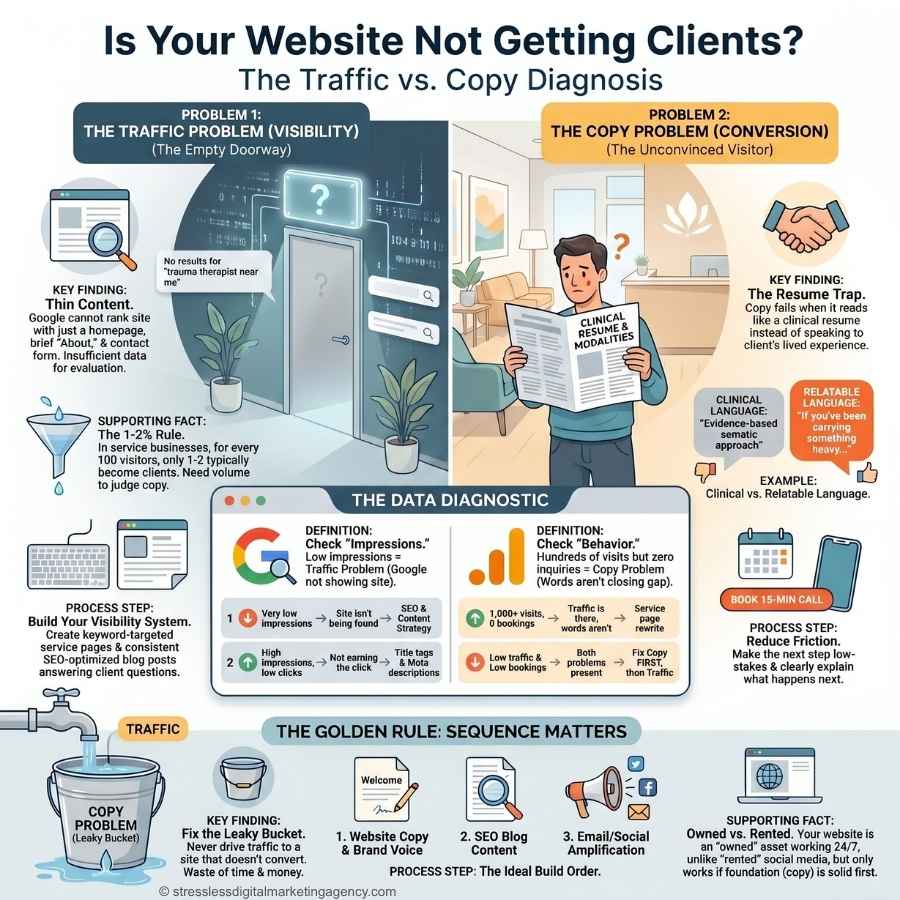
The traffic problem looks like this: your website exists, it works fine technically, it has your services and contact information — but it isn’t being found by people who don’t already know your name. Google doesn’t know what you’re about. Your pages aren’t showing up when your ideal clients type “trauma therapist near me,” “health coach for burnout,” or “private pay anxiety therapist in [city].” The site is a digital business card that only works if someone already has your card. You’re using it as a reference for people who already know you — not as a tool for finding people who don’t.
The mechanism is straightforward. Google ranks pages based on their content. If your content is thin — a homepage, an about page, a contact page, and a services page with a few paragraphs each — there’s not enough for Google to evaluate. Without content that specifically matches what your ideal clients are searching for, the site stays invisible to everyone except people who already knew to look for you. If that sounds like your current situation, the provider who reached out to me had diagnosed herself correctly: no content, no SEO, no visitors. That’s not a copy problem. That’s a traffic problem.
Here’s the important expectation-setter: the industry-standard conversion rate for most service businesses is 1-2%. Meaning for every 100 people who land on your website, one or two of them should turn into clients. So if you’re getting 50 visitors a month, you might get zero to one inquiry — not because something is broken, but because the math is working as expected. You need volume before you can really evaluate whether your copy is converting or not. That means the very first goal is to get enough traffic to the site so the numbers start to mean something.
A traffic problem is an SEO and content problem. The solution is building the kind of content that earns search visibility: well-researched, keyword-targeted blog posts that answer the questions your ideal clients are Googling, service pages written with the specific phrases your clients use, and an internal linking architecture that tells Google what your site is about and who it’s for.
This is the owned visibility argument that runs through everything I do: your website, when it’s built correctly with SEO content supporting it, is an asset that works for you around the clock. It’s findable at 11pm when someone is ready to ask for help, and you’re not awake to receive a referral text. The blog post you published six months ago can be the thing that brings someone to your contact form today. That’s the compounding quality that no amount of Instagram posting or Psychology Today listings replicates, because those platforms are rented. Your own site is owned.
For a full breakdown of what that content infrastructure looks like and how it builds over time, the ultimate guide to content creation covers the complete architecture from keyword strategy through content calendar.
Read more about website traffic in: Why Did My Website Traffic Drop?

Problem 2: The Copy Problem (People Visit But Don’t Book)
The copy problem is quieter and, in some ways, more frustrating — because the work of getting traffic is already done. People are finding you. They’re spending time on your site. And then they’re leaving without booking.
This is the website that looks professional, has good photos, lists your credentials, and says something like “I offer a warm, supportive space for clients seeking growth and healing.” It’s not bad copy exactly. But it’s not doing the job that copy is supposed to do: making your ideal client feel so specifically understood that booking feels less like a decision and more like a relief.
The conversion problem usually lives in one of a few places.
The service page reads like a resume. Your credentials, your modalities, your training, your approach — all written from your perspective as the provider. Nothing about what it actually feels like to be the client in your care. Nothing that names what they’re living with or acknowledges what it costs them to keep trying to manage it alone. The reader scans it, concludes it sounds fine, and moves on to the next therapist on the directory.
The language is too clinical. EMDR, somatic experiencing, trauma-informed CBT — if those phrases mean nothing to the person reading your page, they create distance rather than confidence. Your ideal client isn’t searching for a modality. They’re searching for relief from a specific experience. The copy needs to speak to the experience first and the method second.
The next step is unclear or uncomfortable. The contact form is there, technically. But there’s no sense of what happens after someone fills it out. How long until you respond? What does the first call look like? Is it scary? Is it a commitment? The uncertainty at the action stage stops people who were otherwise ready. A single paragraph explaining exactly what the first contact looks like — and what it doesn’t lock you into — removes that friction.
The page isn’t written for the right person. This is the subtlest version of the problem. The copy might be well-written, but aimed at a slightly different client than the one you actually want more of. If you’re trying to attract private-pay clients but your copy still hedges toward insurance language, the signal is mixed. If you’re trying to position yourself as a specialist but the page reads like a generalist, you’re not attracting the people who specifically need what you do best.
The fix for all of these is the same: copy that’s written from deep inside your ideal client’s experience, using the language they would use to describe their own situation, that moves them from “this sounds interesting” to “this is exactly what I’ve been looking for.”
For the specific elements that make a service page convert, SEO website copywriting for health providers covers what that foundation needs to look like.
Read more about copywriting problems: Why Your Website Copy Isn’t Converting (And How to Fix It)
How to Tell Which Problem You Have
When the provider sent me that video, my first question back to her was: “Are you sure that the people landing on your website aren’t booking? Or do you need more traffic?”
That question has a specific logic behind it. And it’s the same question I want you to sit with before you decide what to fix.
Here’s the cleaner version of the two scenarios:
Scenario A — People are finding your website and booking. If this is you, your copy is solid. The words are working. The gap is volume. You just need more people discovering you, and that’s where SEO and consistent blog content are going to be the most helpful things you can do. More traffic to a site that already converts means more clients. Simple math.
Scenario B — People are finding your website but not booking. If this is you, getting more traffic will not fix the problem. More traffic to a site with a conversion issue just means more people leaving without booking. This is the leaky bucket problem: no amount of filling it will keep it full if the hole at the bottom is still there. The copy has to come first.
The conversion rate context matters here: the industry standard for service businesses is 1 to 2%. For every 100 visitors, one to two should become clients. So if you’re getting meaningful traffic — say, 1,000 visitors a month — and booking nobody, that is a copy problem. The traffic is working. The words aren’t.
The honest truth is that you need enough traffic before you can even evaluate the copy accurately. With 50 visitors a month, the numbers aren’t meaningful. But once you’re at a few hundred monthly visitors and still seeing no inquiries, that’s when the data starts to tell you something worth acting on.
Before you look at any data, answer these two questions honestly.
Question 1: When you look at your website, honestly — or show it to a trusted colleague — does it sound like you and speak clearly to the clients you most want? Or does it feel generic, overly formal, or like it could belong to any provider in your specialty?
Question 2: Do you know how much traffic your site is actually getting? Not a guess — the actual number from Google Analytics or Search Console?
If the answer to Question 1 is “it feels generic” and you don’t know the answer to Question 2, you need to set up your data tools before making any decisions. That’s the third option we’ll cover at the end.

What Your Data Is Actually Telling You
I want to be real with you about something: most practice owners have Google Analytics installed and have never looked at it. Which means they’re flying completely blind on a decision that’s costing them clients every single month.
We were supposed to be in the Bahamas one Valentine’s Day weekend. My daughter got sick, plans canceled, pivot required. Marketing works the same way — you can have the perfect plan, the right keywords, the best content calendar, and then reality hits. Traffic drops. A post flops. The only way to know when to pivot and when to stay the course is to look at the data. AI can write copy. It cannot look at your Google Analytics and say, “Hey, people are bouncing after 10 seconds — something’s off.” That requires a human who is paying attention.
Here’s what the two tools tell you, in plain language:
Google Search Console answers the traffic question. It shows you how many times your pages appeared in search results (impressions), how many times someone actually clicked through to your site (clicks), and where your pages are ranking on average. If you have low impressions — say, under a few hundred per month for your service pages — that’s a traffic problem. Your site isn’t being found. If you have reasonable impressions but a very low click-through rate, that could be a title or meta description problem — you’re showing up but not earning the click.
Google Analytics answers the conversion question. It shows you how many people visited your site, how long they stayed, and what they did while they were there. If you’re getting a few hundred visits per month to your services page but almost nobody is filling out your contact form, that’s a copy problem. The traffic is there. Something is breaking down between “visiting” and “booking.”
Here’s the quick diagnostic table:
| What the data shows | What it means | What to fix |
|---|---|---|
| Very low impressions in Search Console | Site isn’t being found in Google | Traffic problem — SEO and content |
| Impressions but low clicks | Showing up but not earning the click | Title tags and meta descriptions |
| Decent traffic, 1-2% booking rate | Working as expected | Just need more volume |
| 1,000+ visits/month, 0 bookings | Traffic is there, copy isn’t converting | Copy problem — service page rewrite |
| Traffic and bookings both low | Both problems present | Fix copy first, then build traffic |
| No data at all | Analytics not set up | Set up GA4 and Search Console today |
The bottom line: if you don’t have Google Analytics and Google Search Console set up, you cannot diagnose your problem accurately. You’re guessing. And in my experience, practice owners who are guessing almost always guess wrong — they assume they need a new website design when the problem is invisible in search, or they start blogging when the problem is actually that visitors aren’t converting.
If You Have a Traffic Problem: What to Do
A traffic problem is a content and SEO problem. Here’s the specific sequence that builds search visibility for a health and wellness practice.
Start with your service pages. Every service you offer should have its own page, written with the specific phrases your ideal clients are using to search for that service. Not “I offer EMDR” — but “EMDR therapy for anxiety in [city]” placed naturally in your headings and body copy. Service pages are your highest-converting real estate, and they need to be optimized before anything else.
Add a consistent blog. This is where the long-game compounding happens. Two SEO-optimized blog posts per month, published consistently for 12 months, builds topical authority that makes your whole site more findable — not just the posts themselves, but your service pages and homepage too. Google reads a site that consistently covers a specific topic as an authority in that space.
Build your internal linking. Every blog post should link to a relevant service page. Every service page should link to relevant blog posts. This architecture tells Google what your site is about and creates pathways that move a reader from a blog post they found in search to your contact form. Without internal links, each page is an island.
Research what your clients are actually searching. Keywords are just the language your ideal clients use when they’re looking for help. A trauma therapist’s keyword might be “how do I know if I have trauma” or “EMDR therapy near me.” A health coach’s keyword might be “how to recover from burnout” or “burnout coach for nurses.” Those phrases belong in your content — naturally, not stuffed — because they’re the bridge between your ideal client’s search and your website.
For the full content strategy that builds this visibility system layer by layer, how to build a content ecosystem maps exactly how the pieces connect over time.
If You Have a Copy Problem: What to Do
A copy problem is a messaging and conversion problem. The visitor is there. Something in the words is creating distance instead of connection.
Rewrite from the client’s perspective, not yours. Read your service pages and ask: Is every sentence written for the person reading this, or for the person who wrote it? “I use a trauma-informed, somatic approach grounded in evidence-based practice” is written for the provider. “If you’ve been carrying something heavy for a long time and keep wondering why you can’t just move on — that’s actually one of the most common things I hear. And it’s exactly what we work on together,” is written for the client. The difference in conversion is significant.
Name the problem before you name the solution. Your ideal client comes to your website with a specific experience they’re trying to put language to. The copy that converts names that experience first — specifically enough that the reader thinks “how does she know?” — before ever mentioning a service or modality.
Make the next step obvious and low-stakes. “Schedule a free 15-minute consultation” with a sentence about what that call looks like and what it doesn’t commit you to is more effective than a contact form sitting alone at the bottom of the page. Reduce the friction of the first step. The lower the perceived risk of reaching out, the more people reach out.
Make sure your voice is actually in the copy. Generic copy — the kind that could belong to any provider in any city — doesn’t build trust. Your specific perspective, your clinical background, your honest opinions about how change actually happens — that’s what makes the copy yours. The best service page copy isn’t written; it’s compiled from the real language you use when you talk about your work. For what that process looks like, brand voice for service providers covers the foundational layer.
What If You Have Both?
This is more common than either problem in isolation, especially for established practices that built their websites several years ago and haven’t touched them since.
The sequence matters enormously here: fix the copy first, then drive the traffic.
Here’s why. If you have a copy problem and a traffic problem simultaneously, and you solve the traffic problem first, you’ve just built a faster pipeline to the same broken outcome. More people find you, more people leave without booking, and you conclude that SEO and content don’t work — when actually the content worked fine, but it was delivering people to a page that couldn’t close the gap.
The leaky bucket. No amount of filling it keeps it full if the hole at the bottom is still open.
Get your copy working first. Get to that 1 to 2% conversion baseline — meaning for every 100 visitors you’re booking 1 to 2 clients, or for every 1,000 visitors you’re booking 8 to 10 consistently. Once that’s working, once the baseline is established, then you scale the traffic. Then the math compounds in your favor because you know the system is converting at a healthy rate, and more visitors means proportionally more bookings.
Trying to do both simultaneously is possible, but rarely efficient. You end up guessing which fix worked, you can’t isolate your variables, and you often underfund both efforts because the resources are split.
Get the foundation right first. Service pages that convert. A homepage that clearly communicates who you are, who you’re for, and what the first step is. A brand voice that sounds like you rather than a professional template. Then layer the traffic strategy on top of a site that’s ready to receive it.
For practices starting from scratch on both fronts, the sequencing I use with clients is: website copy first, then SEO blog content, then email, then social amplification. Each layer builds on the one before it. The content ecosystem guide covers that build sequence in detail.
The Third Option: You Have No Idea
This is the honest answer most practice owners would give if nobody were watching. And it’s completely valid — you went to school for clinical work, not marketing analytics. There’s no reason you should intuitively know the difference between an impression and a click, or understand why your service page ranks on page four for a keyword nobody searches.
The answer for “I have no idea where to start” is data, read by someone who knows what they’re looking at.
Google Analytics and Google Search Console are both free and both essential. Setting them up gives you the numbers. Understanding what the numbers mean is a separate skill. My monthly analytics service is built specifically for practice owners who have the data but can’t translate it into decisions — a custom Looker Studio dashboard pulling from both platforms, delivered with a plain-language monthly summary that tells you what changed, what it means, and what to watch next month.
No jargon. No spreadsheets you have to decipher alone. Just a clear answer to “is this working, and what do I do next?”
FAQs
How do I know if my website is getting traffic? Google Search Console shows you exactly how many impressions (appearances in search) and clicks your site receives. Google Analytics shows you how many people actually visited. If both numbers are very low — under 100 visits per month for an established practice — you have a traffic problem. Both tools are free and take about 20 minutes to set up.
Why is my website not converting visitors to clients? The most common causes are copy that’s written for providers rather than clients, service pages that describe credentials instead of transformation, unclear or friction-heavy contact processes, and a voice that sounds generic rather than specific. Any one of these can stop a ready-to-book visitor from following through.
Should I fix my SEO or my copy first? Fix your copy first. Driving traffic to a page that doesn’t convert is wasted effort. Get your service pages and homepage working as conversion tools before you invest in building search traffic.
What is a bounce rate, and why does it matter? Bounce rate is the percentage of visitors who land on a page and leave without taking any action — not clicking to another page, not filling out a form. A high bounce rate on a service page (above 70-80%) suggests something about the page isn’t earning the reader’s continued interest. It could be slow load speed, confusing layout, or — most commonly — copy that doesn’t immediately connect with what the reader was looking for.
What’s the difference between SEO and copywriting? SEO gets search engines to find you. Copywriting gets humans to trust you. You need both, working together. An SEO-optimized page that reads robotically doesn’t convert. A beautifully written page with no keyword strategy doesn’t get found. The practices that see the best results from their websites have both — optimized for search and written for humans.
Do I need to hire someone or can I do this myself? You can do both yourself, and many practice owners do, especially in the early stages. The constraint is usually time and the steep learning curve of doing keyword research and SEO optimization correctly. The honest math: at a $175 session rate, the hours you spend learning and implementing SEO and copywriting cost more than the investment in professional help. For the specific time calculation, how outsourcing content saves time runs those numbers directly.
Feeling Overwhelmed?
That’s what the data is for — and it’s what I look at before recommending anything. If you want a clear picture of what your website is actually doing and what needs to change first, download the price and services guide to see how I approach that diagnosis and what working together looks like.
Free resources:
- Quiz: What’s Keeping You Stuck With Marketing?
- [Freebie] Stop Panicking When Clients Graduate
- Free Blog Templates for Health & Wellness Providers
Keep reading:
- The ultimate guide to content creation — the full content strategy that builds search visibility
- SEO for service providers — how search visibility works for health and wellness practices
- How to build a content ecosystem — the layered build that connects traffic to conversion
- Brand voice for service providers — the messaging foundation that makes copy convert
- How outsourcing content saves time — the time and ROI math for delegating this work
- Content consistency for practice owners — making the content system sustainable once it’s built