Blogs to Write as a Health and Wellness Service Provider: 3 Formulas That Are Client-Focused Magnets

If you’ve ever opened a blank Google Doc, typed “Blog Post” at the top, and then stared at it for twenty minutes — this is for you.
Figuring out what blogs to write is genuinely one of the most common sticking points I hear from therapists, coaches, and wellness practitioners. Not because they don’t have anything to say. They have years of expertise, a clear sense of who they help, and plenty of hard-won clinical insight. The problem is translating all of that into the specific kind of content that Google can actually surface, and that ideal clients actually trust.
This post gives you a working system for that. Three formulas, each built around a different kind of search your ideal clients are already doing — plus concrete topic examples for each one so you can walk away with a real list of blogs to write, not just another content framework to file away and forget.
I spent years as a psychotherapist before making the shift to SEO copywriting, and that clinical background shapes how I think about every one of these formulas. Knowing where a person is in their decision-making process, what they actually need to hear in that moment, and what moves them from curiosity to action — that’s buyer psychology, but it’s also just good therapy. The two have more in common than most people realize.
Key Takeaways
- Blogging is still one of the highest-ROI marketing tools available to service providers — unlike social media posts that disappear in hours, a single strategic blog post can generate views, inquiries, and new clients for years after it’s published. It meets ideal clients exactly where they already are: in a late-night Google search looking for answers.
- Three post types cover the full client journey. The Quick-Answer Post captures early-stage searchers with direct answers to specific questions. The Evergreen Resource Post goes deeper for people actively researching their options — it’s the pillar content that becomes a “digital calling card” and builds long-term authority. The Authority-Building Story uses narrative to convert warm readers into inquiries by building trust through a real professional perspective.
- SEO and client-centered writing have to work together. Technical elements — keyword strategy, readable formatting, optimized meta descriptions, alt text, internal linking — are what make content findable. But the writing itself needs to feel natural, ethical, and emotionally intelligent. One without the other doesn’t convert.

Why the Blogs You Write Determine Whether Clients Can Find You
Before the formulas, a quick piece of context that changes how you think about all of this.
Every blog post you write is a door into your website. When someone types a question into Google, they get a list of pages that might answer it. If you have a post that addresses that question, your door shows up. If you don’t, it doesn’t. It’s that direct.
The problem most service providers run into is that they write blogs about things they find interesting or feel qualified to explain, rather than about things their ideal clients are actively searching. Both can be good content. Only one of them reliably brings in organic traffic. The goal is to find the overlap: topics you know deeply, written in the language your clients actually use, targeting phrases they’re genuinely typing into search bars.
The three formulas below are organized around three different search patterns your ideal clients have. Together, they cover the full arc of someone moving from “I think I might need help” to “I want to work with this specific person.” For a broader picture of how blog content fits into a full SEO strategy for your practice, the complete guide to SEO for service providers walks through the whole ecosystem.
Formula 1: The Quick-Answer Post — Blogs to Write for Clients Who Are Just Starting to Search
What it is: A focused, 800 to 1,200-word post that answers one specific question your ideal clients are already typing into Google.
Who finds it: People in the earliest stage of awareness. They know something is off, they’re doing research, and they’re not yet committed to anything. These are the “late at night, finally admitting I need something” searches.
Why it works: Google’s job is to match a searcher with the most helpful, direct answer to their query. Short, focused posts that clearly answer one question are among the easiest content to rank — especially when you target a specific phrase with lower competition. Every one of these posts is a new door into your site. More doors, more chances to be found.
Blogs to Write: Quick-Answer Post Ideas for Health and Wellness Providers
Here are 12 topic ideas in this format, organized by niche. Each one reflects a real search pattern and can be written in under two hours with a clear structure.
For therapists and mental health practices:
- What Is the Difference Between a Therapist and a Life Coach?
- How Do I Know If I Need Therapy?
- What Happens in the First Therapy Session?
- Is Private-Pay Therapy Worth It? (An Honest Breakdown)
- How Long Does Therapy Usually Take?
For somatic and body-based practitioners:
- What Is Somatic Therapy and Is It Right for Me?
- How Is EMDR Different From Talk Therapy?
- What Does a Somatic Therapy Session Actually Look Like?
For coaches and wellness practitioners:
- What Is the Difference Between Therapy and Coaching?
- How Do I Know If I’m Ready for a Health Coach?
- What Is Holistic Wellness, Really? (Plain-Language Explanation)
- How Often Should I See a Wellness Provider?

How to Write a Quick-Answer Post (Step by Step)
Step 1: Start with real client questions. Go back through your intake forms, your email inquiries, and your consultation notes. What do people ask before they book? Those questions are your topics. Each one is a post.
Step 2: Write a headline that mirrors the actual search query. “How Do I Know If I Need Therapy?” will outperform “Signs That Professional Support Might Be Right for You” — even if they mean the same thing — because the first one is what people actually type.
Step 3: Answer the question in your first two paragraphs. Don’t build suspense. Give the clearest, most direct answer you can right away, then spend the rest of the post expanding on it. This is what Google’s quality guidelines reward, and it’s what keeps readers on the page.
Step 4: Add your clinical lens. This is the piece that separates your post from every generic version of the same answer. What do you know from practice that a Google summary wouldn’t tell someone? What nuance matters? That perspective is an SEO asset, and it’s what makes a cold reader feel like they’ve stumbled upon someone who actually gets it. When I provide done-for-you content writing for clients, I take a 60-minute conversation and turn it into a month’s worth of content pulled directly from your mouth.
Step 5: Close with one clear next step. Link to a relevant service page, your contact page, or a related post. Don’t leave readers at a dead end — give them somewhere to go.
Formula 2: The Evergreen Resource Post — Blogs to Write for Clients Who Are Actively Researching
What it is: A longer, more comprehensive guide — typically 1,500 to 2,500 words — on a topic your ideal clients care deeply about once they’ve decided they want help.
Who finds it: People further along in their research. They know they want therapy, coaching, or wellness support. Now they’re evaluating options, comparing approaches, and building the courage to actually reach out.
Why it works: These are your cornerstone posts. They tend to rank for multiple related keyword variations simultaneously, earn links from other sites over time, and build what Google calls topical authority for your whole site. One strong evergreen post can generate traffic for years. (Content length plays a real role in how these posts perform — here’s how to think about that.)
Blogs to Write: Evergreen Resource Post Ideas for Health and Wellness Providers
For therapists and mental health practices:
- The Complete Guide to Private-Pay Therapy: What It Costs, Who It’s For, and How to Get Started
- What to Expect in Your First Month of Trauma Therapy
- How to Find a Therapist Who’s Actually a Good Fit (Not Just Available)
- EMDR Therapy Explained: What It Is, How It Works, and What to Expect
For somatic and body-based practitioners:
- How Somatic Therapy Works — And Who Gets the Most Out of It
- The Beginner’s Guide to Nervous System Regulation: What It Is and Why It Matters
- What Is Polyvagal Theory? A Plain-English Guide for Anyone Curious About Body-Based Healing
For coaches and wellness practitioners:
- The Complete Guide to Working With a Health Coach: What to Expect, What to Budget, and How to Know If It’s Working
- What Is Functional Wellness? A Practical Guide for People Tired of Band-Aid Solutions
- How to Build a Sustainable Self-Care Practice That Doesn’t Fall Apart in Week Three
How to Write an Evergreen Resource Post (Step by Step)
Step 1: Pick a topic your ideal client cares about — not one that impresses your colleagues. There’s a version of this mistake I see constantly: practitioners writing about their theoretical frameworks, their modality lineage, their training approach. Interesting to other clinicians. Not what someone who’s never been in therapy is searching for at 10pm. Your evergreen posts should be written for the person considering working with you, not for a peer-review panel.
Step 2: Build a real structure with meaningful headings. An evergreen post needs a clear intro, several organized sections with H2 and H3 headings, and a conclusion that points toward action. Those headings aren’t just for readability — Google crawls them to understand whether your post covers the topic completely. A post with vague or creative-but-unclear headings is harder for both Google and readers to navigate.
Step 3: Write from your clinical experience, not just from research. This is your competitive advantage, and it’s significant. Anyone can summarize what EMDR is. You can describe what you actually observe when clients go through it — the moments they get stuck, what tends to shift things, what you wish more people understood before starting. That first-hand clinical perspective is what Google’s E-E-A-T guidelines specifically reward, and it’s what makes your post worth reading instead of just worth skimming.
Step 4: Link internally to related posts and your service pages. Every evergreen post should connect to two or three other pages on your site — Quick-Answer posts that cover related subtopics, your services page, and your contact page. Internal linking is what turns an isolated post into part of a visibility system. It signals to Google that your site has depth, and it gives readers a natural path to keep exploring.
Step 5: Plan to update it. Evergreen doesn’t mean write-it-once. Refreshing a post with new information or a new section signals to Google that the content is still current. Set a calendar reminder to revisit your best evergreen posts once a year. That maintenance is part of what makes them compound over time.
Formula 3: The Authority-Building Story Post — Blogs to Write for Clients Who Are Almost Ready
What it is: A narrative post that weaves a real scenario (fully anonymized), your professional perspective on it, your process, and an invitation to connect.
Who finds it: Warm traffic — people who’ve already read something else on your site, were referred to you, or are somewhere between interested and ready. This post is what converts that warmth into an actual inquiry.
Why it works: People hire providers they trust. Trust gets built through a specific feeling: this person understands what I’m actually dealing with. A well-written story post creates that feeling faster than any credential list or modality explanation ever could. It also earns longer time-on-page, which is a behavioral signal Google tracks as a quality indicator.
This is also, honestly, the hardest type to write. Moving into a narrative voice after years of clinical neutrality feels uncomfortable for a lot of practitioners — it can feel too promotional, too personal, or just too different from how you’re trained to write. If that lands, it’s exactly why this post type is the one I most often handle for clients.

Blogs to Write: Authority-Building Story Post Ideas for Health and Wellness Providers
For therapists and mental health practices:
- What I’ve Learned From Working With High-Achieving Clients Who Are Quietly Burning Out
- The Most Common Thing New Therapy Clients Get Wrong About the Process
- Why “Just Talking About It” Actually Works — A Therapist’s Honest Explanation
- What Happens in the Body During Anxiety? (A Clinician’s Perspective)
For somatic and body-based practitioners:
- What I Wish People Knew Before Their First Somatic Session
- The Pattern I Keep Seeing in Clients Who’ve “Tried Everything” Before Finding Body-Based Work
- Why Some People Cry in Sessions and What That Actually Means
For coaches and wellness practitioners:
- What My Clients Who Stop Self-Sabotaging All Have in Common
- The Difference Between Clients Who Transform and Clients Who Don’t (It’s Not What You Think)
- Why Information Isn’t the Problem — And What Actually Gets People to Change
How to Write an Authority-Building Story Post (Step by Step)
Step 1: Choose a theme your ideal clients recognize in themselves — not a diagnosis, a lived experience. “The exhaustion of being the person everyone else leans on.” “What it feels like to accomplish everything on your list and still feel completely empty.” “The specific loneliness of being a high-functioning person who is quietly not okay.” These are the kinds of themes that make someone stop scrolling at 11pm and think, wait, that’s me.
Step 2: Open with the scene, not the lesson. Resist the urge to lead with the insight. Start in the middle of the experience. Let the reader find themselves in it before you explain anything. The clinical instinct is to begin with the framework — the story instinct is to begin with the moment. For this post type, lead with the moment.
Step 3: Bring in your perspective as the guide, not the authority. This is where your training becomes visible — not as a list of credentials, but as genuine insight. What do you understand about this pattern that the person living it can’t easily see from inside it? What have you observed over and over again? Write that. That’s the expertise that makes this post valuable.
Step 4: Describe the path forward without overpromising. This is the piece that requires the most care, and it’s where my clinical background helps me when writing these for clients. There’s a meaningful line between “here’s what becomes possible” and “here’s what I guarantee,” and staying on the right side of it while still giving the reader hope is its own skill. The goal is for the reader to finish thinking: this person understands what I’m dealing with, and I think they might actually be able to help.
Step 5: One clear invitation — and make it easy. Not a pitch. Not a multi-item offer summary. Just: here’s what working together looks like, and here’s how to reach me if this resonated. Then link directly to your contact page or discovery call scheduler.
A note on anonymization: everything in a story post should be fully anonymized, with no identifying details or recognizable combinations of circumstances. Composite several client experiences if needed, or write entirely from your own perspective as a practitioner navigating this work. Your point of view is enough to anchor the post.
The SEO Elements That Make Every Blog You Write Actually Rank
Writing the posts is half the work. These are the on-page elements that determine whether Google can find and rank what you’ve written.
Keyword placement. Your primary keyword should appear in the post title, within the first 100 words, in at least one H2 heading, and naturally throughout the post. Not repeated until it sounds robotic. Just present the way you’d naturally use any phrase in a real conversation.
Readable structure. Short paragraphs. Descriptive headings. Occasionally, bold on your most important lines. These choices affect how long people stay on your page, and time-on-page is a behavioral signal Google uses to evaluate quality. If your post looks like an unbroken wall of text, a significant percentage of visitors will leave before reading a word.
Meta descriptions. The 155-character summary is shown beneath your title in search results. It doesn’t directly affect rankings, but it dramatically affects whether someone clicks. Write it like one sentence that makes the most curious person in your target audience want to keep reading.
Alt text on every image. Each image on your site needs a descriptive alt tag that tells both Google and screen readers what the image depicts. Most providers skip this entirely. It’s a straightforward accessibility and SEO win that takes about thirty seconds per image. The complete guide to writing alt text covers the specifics if you want to audit what you have.
Internal links in every post. Each post should link to at least two or three other pages — related posts, service pages, your contact page. This is how Google understands your site’s architecture and how readers find more of what they came for. A post that sits in isolation, with no links pointing toward or away from it, is working at a fraction of its potential. Consistent linking is part of what separates a content strategy that builds topical authority from one that just produces posts.
Tracking what’s working. Once you’re publishing consistently, you need to know which posts are gaining traction, which keywords you’re ranking for, and where readers drop off. Google Search Console gives you that data for free — and it’s the first place I look when auditing a client’s content performance.
How Many Blogs Should You Write Before You See Results?
The honest answer: consistency matters more than volume. One well-researched, strategically optimized post per month outperforms four rushed ones every time. Most SEO content takes three to six months to gain meaningful ranking movement — that timeline is longer than social media and shorter than building a referral network from scratch. For a realistic look at what that SEO timeline actually looks like, that post walks through what to expect and when.
What I tell every client: start with one post in each of the three formats above. Three posts. Done well, properly linked, targeting real search terms. That’s your foundation. Everything after that builds on it.
Start Here: Free Blog Templates Built for Health and Wellness Providers
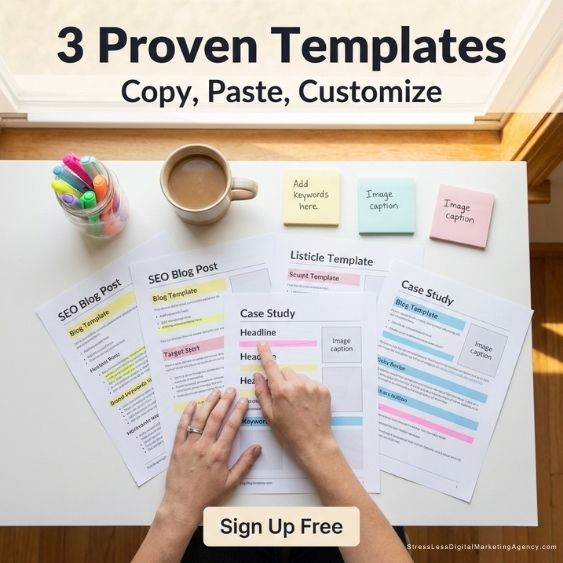
If you’re ready to write but want a structure to follow, I built three free blog post templates specifically for health and wellness service providers. Each one maps directly to one of the three formulas above — with pre-built section structure, prompts for each heading, and notes on where to place keywords and internal links.
They’re formatted as Google Docs. Make a copy, fill in your content, and you have a post ready to optimize and publish.
Download the Free Blog Templates for Health and Wellness Service Providers

Ready for Someone Else to Handle the Blogs Entirely?
The templates exist because not everyone is in a position to hand off their content right now — and that’s completely fine. But if you’ve been putting off building a consistent content strategy because you genuinely don’t have the bandwidth, or if you’ve tried writing regularly and it keeps falling off the calendar: that’s exactly what my done-for-you SEO content retainers are built for.
Here’s what working together looks like. You don’t write a single word. I handle keyword research, post structure, writing, SEO optimization, internal linking, and meta descriptions for every post, every month. You review, approve, and publish. Your practice builds a compounding content system without the hours.
To see what’s included, what it costs, and whether it’s a fit for where your practice is right now:
Not sure what’s actually keeping clients from finding you?
Take the free quiz: What’s Keeping You Stuck With Marketing?
Works Cited
- Google Search Central. (2023). Creating helpful, reliable, people-first content. https://developers.google.com/search/docs/fundamentals/creating-helpful-content
- Ahrefs. (n.d.). How long does SEO take? https://ahrefs.com/blog/how-long-does-seo-take/
- Content Marketing Institute. (2024). B2C content marketing benchmarks, budgets, and trends. https://contentmarketinginstitute.com/articles/b2c-content-marketing-research/