5 Best Ways To Monetize A Blog As A Service Provider (While Boosting SEO and Attracting Clients)
About a year after my daughter was born, I was looking for a way to earn income that didn’t require being in a therapy room for eight hours a day.
I started selling documentation note templates — the kind of clinical paperwork that every private-practice therapist drowns in — on Etsy. They took off faster than I expected. But Etsy takes a significant commission cut, and I got curious about whether I could redirect that traffic to my own website instead and keep more of what I earned.
So I started building web pages, writing blog posts, and pointing people toward my own site. Products started selling directly. Then I started writing affiliate reviews. And here’s what I noticed over the next twelve months: the more helpful content I published, the more traffic the site got. The more traffic, the more Google recognized it as useful. The more Google recognized it as useful, the faster new posts automatically gained traction.
It wasn’t overnight. It took about a year to reach around 800 views a month, starting from zero. But I was building something. Every piece of content I published was still working for me months later. That compounding quality is what separates a blog from every other marketing channel — and it’s why I’m still writing about it now.
Here’s what I learned, translated specifically for health and wellness service providers who want their blog to do more than just exist.
Key Takeaways For The Best Ways To Monetize A Blog
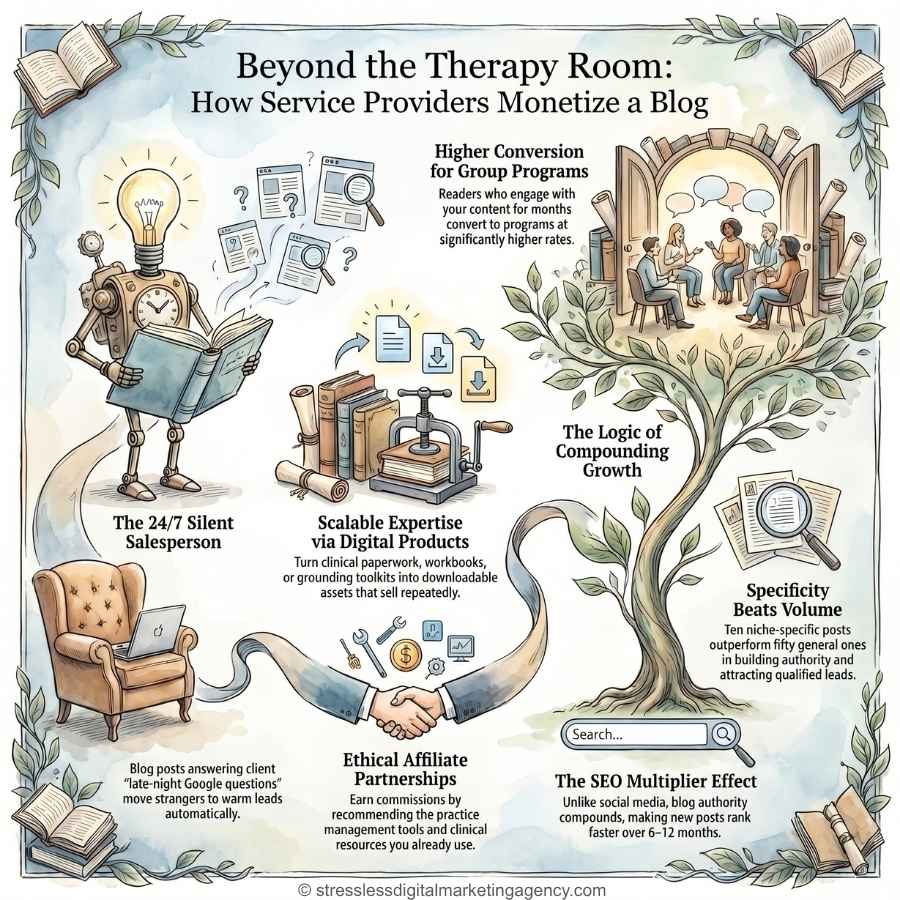
1. Your blog is your most powerful client attraction tool — when it answers the exact questions your ideal clients are Googling, every post becomes a quiet salesperson working around the clock.
2. Digital products turn expertise into scalable income — documentation templates, workbooks, guides, and courses let you earn without adding clinical hours.
3. Affiliate marketing earns passive income from tools you’re already recommending — ethically and with full FTC disclosure, it’s one of the least effortful income streams available.
4. Your blog fills workshops and group programs with warm leads — people who have been reading your content for months convert into program participants at significantly higher rates than cold audiences.
5. Consistent SEO-optimized content builds the authority that attracts partnerships — as your domain authority grows, collaboration opportunities find you.
Why Monetizing a Blog Is Different for Service Providers
Most advice about blog monetization is written for content creators — people whose primary product is the content itself. Display ads, brand deals, merchandise.
Service providers work differently. Your blog isn’t the product. It’s the introduction to the product, which is your expertise, your services, and the transformation you create with clients.
That shift changes everything about how you approach monetization. For a health and wellness practice owner, the highest-value thing a blog can do is bring in qualified clients who are already pre-sold on working with you by the time they reach your contact page. Every other income stream — digital products, affiliates, programs, partnerships — is built on top of that primary function.
Which means the question isn’t just “how do I make money from my blog?” It’s “how do I build a blog that compounds in value, attracts the right people, and creates multiple income pathways without adding to my workload?”
That’s the version of blog monetization worth understanding.
Disclaimer: I am not a lawyer
Nor do I play one on TV. Every license, state, and practice is different, so please be sure to check with your licensing board and malpractice to clearly understand your legal and ethical responsibilities. When in doubt, get written permission from them. And my general rule of thumb: if it feels like a grey area, it is. Protect your license; you worked hard for it.
Way #1: Use Your Blog to Attract and Convert Clients
The most direct way to monetize a blog as a service provider costs nothing beyond the time it takes to write well, and it compounds for years after each post is published.
Every time you publish a post that answers the exact question your ideal client typed into Google at 11pm — “how do I know if I need therapy,” “signs I’m experiencing burnout,” “what is EMDR therapy,” “how to find a private pay therapist near me” — you’re doing three things simultaneously.
- You’re showing up in search results.
- You’re demonstrating expertise before a single dollar has changed hands.
- And you’re moving a reader from curious stranger to warm lead, sometimes within a single read.
The mechanism is the customer journey. Someone in the early stages of considering support isn’t ready to book — they’re looking for information and validation. A blog post that meets them there, names what they’re experiencing, and explains what their options look like is doing the exact psychological work that moves someone from contemplation toward action. That’s not just content strategy. It’s applied buyer psychology — and if you’ve worked clinically, it maps directly to the Transtheoretical Model you already know.
The practical execution: every blog post needs one clear next step. Not three options, not a menu — one invitation. “If this resonates, here’s how we can work together” is more effective than a wall of links. The post earns the trust; the call to action converts it.
For a full explanation of how the customer journey maps to your content at each stage, the customer journey guide covers the AIDA framework and buyer psychology in detail — including what content serves readers who aren’t ready to book yet.
Way #2: Sell Digital Products Rooted in Your Expertise
Digital products are how you scale your expertise beyond your available hours — and your blog is the most efficient distribution channel for them.
Here’s how I know this firsthand. Those documentation templates I started selling on Etsy postpartum? They were purely a reflection of my clinical expertise. Every therapist I knew struggled with the same paperwork. I packaged what I knew into a downloadable product, redirected traffic from Etsy to my own site, and the income became genuinely passive — still earning while I was home breastfeeding my daughter and not seeing a single client.
For health and wellness providers, the digital product landscape is wide. What you’re looking for is the intersection of what your clients repeatedly ask for and what you can package once and sell repeatedly without additional time investment:
Documentation templates and clinical paperwork — every therapist in private practice eventually drowns in this. If you’ve solved it, other therapists will pay for your solution.
Psychoeducation workbooks — the handouts and exercises you’ve been giving clients in session for years, formatted as a purchasable guide. A trauma therapist’s grounding toolkit. A health coach’s meal prep planning guide. A burnout recovery framework distilled into a fillable workbook.
Mini-courses or recorded trainings — if you speak at continuing education events, lead group supervision, or teach other providers in your specialty, that knowledge translates directly into a purchasable format.
Printable guides and checklists — lower price point, lower barrier, and often the entry product that introduces someone to your paid ecosystem before they’re ready for one-on-one services.
The blog connection: every post that ranks well for a relevant keyword becomes a long-term distribution channel for your product. A nutritionist who writes “How to Break the Sugar Cycle” and connects it to a Healthy Eating Reset Guide creates a passive sales funnel from a single piece of content. The post earns the search traffic; the product converts it.
For the strategic architecture that connects your blog content to your products and services, the content ecosystem guide maps how every piece connects into a compounding system.
Way #3: Earn Through Affiliate Marketing (Ethically)
Affiliate marketing earns commission when your readers purchase a product or service you’ve recommended through a tracked link. Done right, it’s one of the lowest-effort income streams available to a service provider with an established blog — because you’re getting paid for recommendations you were already making.
I want to be direct about the ethical piece here, because it matters more for health and wellness providers than it does in most industries. Your audience trusts you with a specific kind of professional confidence. That trust is the entire asset. Any affiliate partnership that compromises it — products you haven’t used, services you’d never personally recommend to a client, platforms that don’t serve your audience’s actual needs — isn’t worth the commission. Full FTC disclosure on every post containing affiliate links is non-negotiable, both legally and professionally.
Affiliate Disclaimer: This page contains affiliate links and is a member of the Amazon Services LLC Associates Program. If you make a purchase using one of these Amazon links, we may receive compensation at no extra cost to you. See our Disclosure Policy in the Legal Hub for more information.
The affiliate products that work best for health and wellness practices are the ones already embedded in your workflow:
Bookkeeping and business tools — if you use a specific platform to manage your practice finances, a review post or recommendation carries genuine weight. The Headway affiliate partnership I have is built entirely on this: I actually used the platform, it solved a real problem, and my audience of practice owners has the same problem.
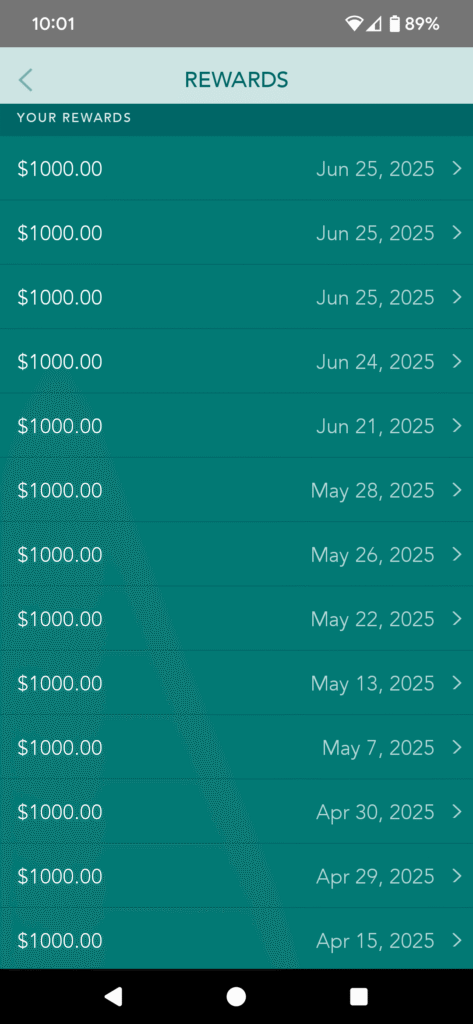
EHR and practice management software — SimplePractice, Jane (affiliate link), and similar platforms all have affiliate programs. A detailed, honest comparison post earns search traffic and affiliate income for years.
Continuing education platforms — if you’re already recommending CE courses to colleagues, an affiliate review post formalizes that recommendation into a tracked income stream.
Books and clinical resources — Amazon affiliate links in resource roundup posts are among the easiest implementations. Modest commissions, but they accumulate. Here are some examples of my favorite therapy books for kids and adults.
The post format that consistently earns best: a specific, honest, first-person review with real use-case context. Not “here are five tools I’ve heard are great.” The post that reads like “here’s what I actually use, what problem it solved, and what to watch out for” earns trust and converts traffic in a way a generic roundup never does.
For a real example of what a single well-written affiliate post can generate over time, how I wrote one affiliate post that earned over $10K covers the strategy and structure in specific detail.
Way #4: Fill Workshops and Group Programs With Warm Readers
This is the monetization pathway most service providers underestimate — and it’s arguably the most powerful for building sustainable income without adding individual client hours.
The insight: someone who has been reading your blog for three months is not a cold lead. They’ve read your perspective on burnout recovery. They recognized themselves in your description of high-functioning anxiety. They felt seen by the way you write about the exhaustion of trying to perform wellness while privately struggling. By the time you invite that person into a group program or workshop, you’re not introducing yourself. You’re deepening a relationship that already exists.
This matters because group programs and workshops require a critical mass of participants to be viable. Paid advertising can fill a program, but the conversion rates from cold traffic are low, and the ad costs are high. Warm readers who have been built up through consistent, specific content convert at dramatically higher rates — which means your blog does the pre-selling before you’ve spent a dollar on promotion.
What this looks like in practice:
A therapist writing consistently about stress and burnout recovery builds an audience of readers who recognize those patterns in themselves. When she announces a six-week group for high-achieving women experiencing burnout, her email list and her blog readership are already filled with exactly those people — warmed up, pre-qualified, and significantly more likely to enroll than someone who saw a Facebook ad.
A health coach who publishes detailed content on nervous system regulation builds an audience that trusts his expertise in that area. A workshop or mini-course on somatic regulation tools for everyday life sells to that audience without a hard launch — because the blog has been doing the trust-building work for months.
The SEO dimension: optimized blog content on your workshop topic brings in new readers who are searching for that exact problem right now. The blog grows your audience while your existing audience warms toward the offer.
Way #5: Build Partnerships and Sponsorships as Authority Grows
The compounding nature of SEO means that the longer you publish consistently, the more authority your domain accumulates — and the more that authority attracts inbound opportunities that don’t require you to pitch yourself.
This is the income stream that takes the longest to develop and requires the least active effort to maintain once it’s working. Brands, wellness companies, and complementary providers start to notice a blog that consistently ranks well and attracts a specific audience. Sponsorship and partnership inquiries come in. Guest posting invitations arrive. Collaboration offers appear.
For health and wellness providers specifically, the most common and most valuable partnerships tend to be:
Complementary service providers — a therapist and a psychiatrist. A health coach and a registered dietitian. A yoga teacher and a somatic therapist. Cross-referral partnerships that formalize in blog content — a guest post exchange, a co-authored resource, a joint workshop promoted on both platforms — benefit both parties’ SEO and expand both audiences.
Practice-adjacent brands — continuing education platforms, EHR software companies, wellness product brands with appropriate audience alignment. These can become sponsored content relationships or ongoing affiliate partnerships.
Speaking and media opportunities — a well-ranking, well-written blog is increasingly the portfolio piece that earns podcast invitations, speaking slots, and media quotes. Journalists and podcast hosts research potential guests; a substantive, authoritative blog is a more compelling pitch than a social following.
One principle worth holding throughout all of this: protect your audience’s trust above every income opportunity. A sponsorship that doesn’t serve your specific readers is worth declining regardless of the rate. The long-term value of your audience’s confidence in your judgment is always worth more than a short-term sponsored post.
For how content authority connects to your broader visibility strategy, SEO for service providers covers how topical authority builds over time and what makes a domain attractive to both Google and potential partners.
The SEO Multiplier: Why Every Strategy Above Gets Stronger Over Time
Every monetization strategy above has a compounding quality that’s specific to blog content and unavailable in almost any other marketing channel.
A single SEO-optimized post earns traffic for years. A digital product linked from a ranking post sells without additional promotion. An affiliate review written two years ago still earns commission from readers who find it through search today. A workshop audience built through eighteen months of consistent content converts at rates that cold advertising can never match.
The mechanism is topical authority. When your blog consistently publishes helpful, specific, keyword-researched content on a defined topic area — therapy for anxiety, health coaching for burnout recovery, nutrition for hormonal health — Google progressively associates your domain with expertise in that space. New posts publish and rank faster because the surrounding content already signals authority. The compounding accelerates over time rather than flattening.
This is the core of the owned visibility argument: social media posts disappear after 48 hours. Psychology Today listings and insurance panels can be disrupted by external decisions. A blog that’s been building topical authority for two years is genuinely difficult to displace. It’s yours. Nobody can change the rules on your own website.
Understanding content strategy for your practice — how topics connect to keywords, how posts link to service pages, how the whole ecosystem builds visibility — is the foundation that makes each of these five monetization strategies actually work.
What Makes Blog Monetization Actually Work
The five strategies above are proven. What determines whether they produce income for your specific practice is how well they’re executed — and execution comes down to a few factors that are worth naming directly.
Specificity beats volume. Ten posts on one specific niche topic outperform fifty general posts in building topical authority, attracting qualified readers, and converting to any of the income streams above. The health coach who writes deeply about burnout for high-achieving women in healthcare will build a more monetizable audience than one who writes generally about “wellness tips.”
Keyword research before writing, every time. A post written without a target keyword is a post that earns traffic by accident rather than by design. Identifying what your ideal readers are actually searching for — the specific phrase, the specific question — before you write is what makes content findable. Content consistency for practice owners covers the quarterly topic-planning process that builds keyword research into your content calendar before you ever open a document.
Internal linking connects the income streams. A post about anxiety that links to your anxiety therapy service page, your anxiety workbook product, and your upcoming anxiety management workshop is doing three income streams’ worth of work from a single piece of content. Every post should link to at least one service page. Every product should have blog content feeding it. The connections compound the returns.
Consistency is the non-negotiable. One post a month published for two years outperforms twelve posts published in January, followed by silence. Google rewards regularity. Audiences build through predictable presence. The compounding only activates when you give it enough runway. If content consistency has been the sticking point, that post addresses the structural fixes directly.
FAQs: Monetizing a Blog as a Service Provider
Can I actually make money from a blog as a health and wellness provider?
Yes, but the timeline and mechanism are different from those of content creators who monetize through display ads. For service providers, the highest-value blog income comes from client attraction (which converts into your primary service revenue), digital products built on clinical expertise, and affiliate partnerships with relevant tools. Display ads require traffic volumes that most practice blogs won’t reach, and the revenue per click is minimal compared to these alternatives.
How much traffic do I need before my blog can earn income?
Client attraction and digital products can generate revenue from modest traffic — even a few hundred monthly visitors will convert if the content is highly specific and the offer is relevant. Affiliate income builds as traffic grows. Partnerships and sponsorships typically require more established traffic and domain authority. Focus on quality and specificity first; monetization follows naturally from a well-targeted audience.
How do I choose which affiliate programs to join?
Start with tools, platforms, and resources you’re already using and recommending in your practice. EHR software you actually use. Bookkeeping platforms you rely on. Books you genuinely recommend. The most effective affiliate content comes from real experience with the product, which is also what protects your audience’s trust and your professional integrity.
How long does it take for blog content to earn income?
Client attraction from SEO content typically begins gaining traction at the 6 to 9-month mark as posts accumulate domain authority. Digital products can earn from the first visitor who lands on a relevant post. Affiliate income builds over 12 to 18 months as traffic compounds. The posts that earned me consistent passive income for years were written once and never substantially updated — that long tail is what makes the investment worthwhile.
Do I need to disclose affiliate relationships?
Yes, always. FTC guidelines require clear disclosure when you have a material connection to something you’re recommending and earn compensation from it. For health and wellness providers with licensed credentials, the professional ethics argument for transparency is even stronger than the legal one. Every post containing affiliate links should include a clear disclosure statement at the top.
What if I don’t have time to write all this content myself?
That’s a legitimate constraint, not a character flaw. The time math on outsourcing content is worth understanding — at typical therapy session rates, the hours spent on DIY content often cost more than the investment in professional help. Done-for-you blog content that’s keyword-researched, written in your voice, and internally linked to your service pages and products can generate all five of the income streams above without a single hour of your writing time.
I’m Alexandria — a retired psychotherapist turned SEO copywriter and content strategist.
I help health and wellness practice owners build content that attracts clients, builds authority, and creates income streams that compound over time.
Here’s how we can work together:
Done-For-You Content — blog posts and newsletters written in your voice, optimized for search, and connected to your service pages and income pathways.
SEO Copywriting — website copy that converts the traffic your blog builds into actual inquiries.
Free resources:
- Quiz: What’s Keeping You Stuck With Marketing?
- [Freebie] Stop Panicking When Clients Graduate
- Free Blog Templates for Health & Wellness Providers
Keep reading:
- How I wrote one affiliate post that earned over $10K — the strategy and structure behind it
- The customer journey guide — how blog content moves readers toward booking
- Content ecosystem for wellness practices — how every piece connects
- Content consistency for practice owners — making the publishing schedule actually hold
- Ultimate guide to content creation — strategy, tools, and best practices

Best Ways To Monetize A Blog Tip 1: Use Your Blog to Promote Your Own Services
The simplest and most effective way to make money from your blog is to use it to attract and convert clients.
Every time you publish a post that answers the exact questions your ideal clients are searching for — like “how to reduce anxiety before bed,” “why my neck pain won’t go away,” or “how to create better boundaries at work” — you’re doing more than helping. You’re showing up in Google searches with value and positioning yourself as the trusted expert they’ve been looking for.
At the end of your post, guide them toward the next step — booking a call, scheduling a session, or joining your program.
Each post becomes a quiet little salesperson working for you around the clock.
💡 Pro tip: Add a clear, intentional call to action at the end of every blog. “If this resonates, here’s how we can work together” can make all the difference.
Best Ways To Monetize A Blog Tip 2: Sell Digital Products or Resources
If you’ve ever wished you could reach more people without working more hours, digital products are your next move.
Think:
- Mini-courses or guides
- Workbooks, templates, or journals
- Downloadable checklists or scripts
Your blog is the perfect launchpad for these. Each blog post can naturally lead into your product — for example, a nutritionist might write “How to Beat Sugar Cravings” and link to a Healthy Habits Journal, or a coach could write about “How to Stop Self-Sabotage” and promote a Goal Setting Toolkit.
Every post that ranks well on Google becomes a long-term sales funnel for your product — without needing constant promotion.
Best Ways To Monetize A Blog Tip 3: Earn Through Affiliate Marketing
If you recommend tools, books, or products your clients already ask about, affiliate marketing lets you earn passive income from those mentions — ethically.
You simply share affiliate links to resources you genuinely use and believe in, like your favorite scheduling app, meditation tool, or continuing education course platform.
When your readers buy through your link, you earn a small commission.
The key? Stay authentic. Choose partnerships that align with your brand and serve your audience, not random products that dilute your message.
💡 Pro tip: Create resource-style blogs like “My Favorite Tools for Streamlining Client Sessions” or “3 Platforms That Make Online Scheduling Easier.” These posts tend to rank well and convert steadily.
Best Ways To Monetize A Blog Tip 4: Offer Workshops or Group Programs
Your blog isn’t just about traffic — it’s a stage. Use it to fill your workshops, groups, or programs with warm leads who already trust you.
For example:
- A therapist could blog about “How to Cope with Burnout” and invite readers to join a small group on stress recovery.
- A business coach could post “How to Plan Your Next Quarter with Ease” and link to a live planning session.
- A yoga teacher could write “The Benefits of Nervous System Regulation” and promote a mini-course or virtual series.
When your blog is SEO-optimized, you’re not just depending on followers — you’re showing up in front of new people who are ready to invest in what you offer.
Best Ways To Monetize A Blog Tip 5: Build Partnerships and Sponsorships
Once your blog starts attracting steady traffic, opportunities often find you. Brands, wellness companies, and even local organizations might reach out to collaborate or sponsor a post.
Sponsorships can look like:
- Featuring a trusted brand’s product in a blog post
- Guest posting on another platform for exposure
- Partnering with complementary service providers for cross-promotion
You can also pitch collaborations yourself — especially if your blog positions you as a thought leader in your niche.
Just keep one rule in mind: stay selective. Protect your audience’s trust. Long-term credibility is worth more than short-term cash.
The Hidden Payoff: SEO Power
Each of these monetization strategies doubles as an SEO strategy.
Because the more high-quality, keyword-rich content you publish, the more your website becomes visible in search results — bringing in readers who are already looking for your kind of help.
Blogging isn’t just about income; it’s about visibility, authority, and longevity.
When your content consistently shows up in Google, your ideal clients start coming to you — ready to book, buy, and trust.
Ready to Turn Your Blog Into a Marketing Machine?
I’m Alexandria — a therapist turned SEO copywriter and content strategist. I help service providers clarify their message, write SEO-optimized blogs, and create content strategies that bring consistent inquiries and income.
Here’s how we can work together:
🖋️ Done-For-You Copywriting – I’ll write blog posts and web pages that sound like you and attract the clients who are already searching.
🧭 1:1 Strategy Sessions – A personalized roadmap to plan your next 30–60 days of blog and SEO content.
Blogging doesn’t just build your SEO — it builds your business. When you use your blog intentionally, every post becomes an asset that can bring in clients, sales, and opportunities long after you hit publish.
The internet rewards consistency and clarity. Show up strategically, and your blog will do the rest.