
Website Copywriter for Service Providers: Do You Need a Copywriter or a VA?
There is a version of this story a lot of health and wellness business owners know personally. You hired a VA to handle the content. Blog posts went up. Captions got scheduled. Emails went out. The to-do list got shorter.
And the clients still did not come.
That is not a VA problem. It is a strategy problem — specifically, a copy strategy problem. A VA who writes and a copywriter are not doing the same job, even when the output looks similar on the surface. Understanding the difference is what determines whether your content just exists or actually works.
Related: If you want to understand what strategic SEO copywriting involves before reading the comparison, the full overview of what an SEO copywriter does covers the role in depth.
What is a Virtual Assistant (VA)?
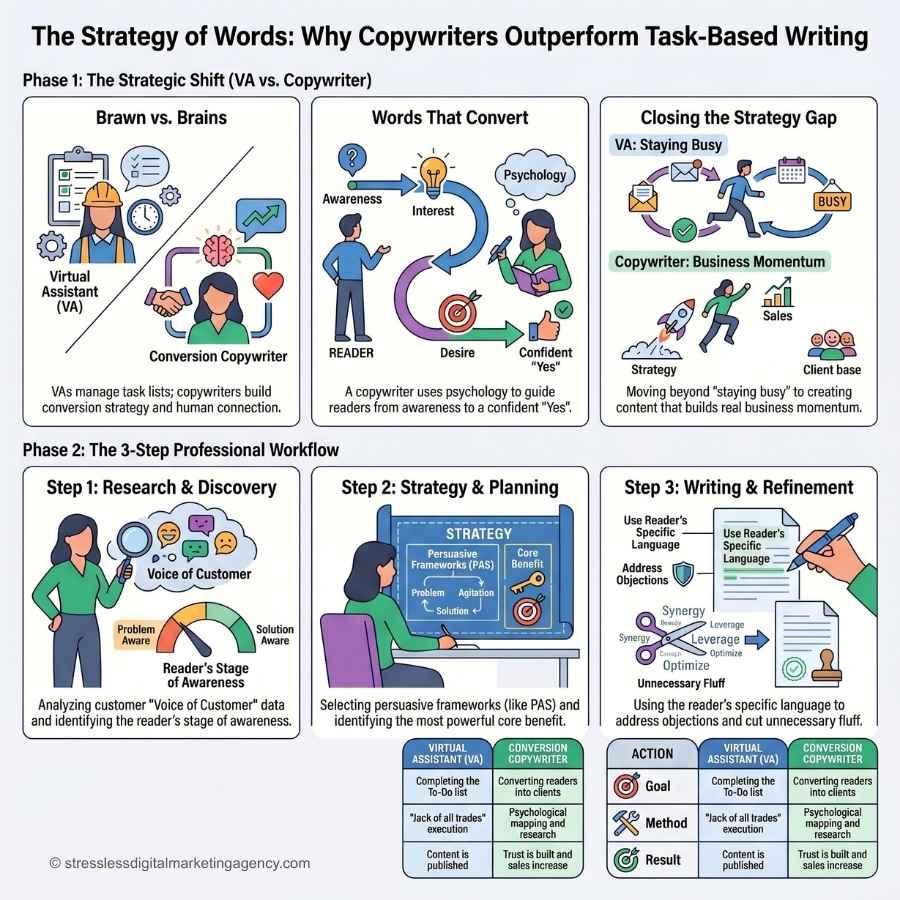
A virtual assistant is a generalist. Their value is in execution — taking tasks off your plate so you can focus on delivering your work. A good VA is organized, responsive, and capable across a wide range of functions: inbox management, scheduling, social media posting, basic content drafting, and administrative support.
When a VA writes, they are typically following a brief, filling in a template, or producing something functional. There is nothing wrong with that. But functional content and strategic copy are two different things. A VA is not trained to think about buyer psychology, search intent, conversion architecture, or what makes a hesitant prospect finally reach out. That is not their job.
The confusion happens because both roles produce words. But producing words is not the same as producing copy that moves people.
A VA checks the box. A website copywriter changes what the box is for.
What a Website Copywriter for Service Providers Actually Does
I spent years as a mental health therapist before I became an SEO copywriter. The skill I carried out of the therapy room — the one that shapes everything I write — is this: I know how to listen for what people are not quite saying yet.
Early in my career I rewrote my own Psychology Today profile. Not a full overhaul — I simply stopped writing like a resume and started writing like someone who knew exactly who she helped and what made her approach different. Within seven days I had calls. Not because I was suddenly more qualified. Because the right people finally saw themselves in what I wrote. That is the whole job.
Here is what the work looks like in practice when you hire a website copywriter for service providers:
1. Research before a word is written
Every project starts with the voice of the customer research — pulling the exact language your ideal clients use when they describe their problem, their hesitation, and what they are hoping for. That language becomes the foundation of every page. Keyword research happens here too: identifying the specific terms people type into Google when they are ready to book, not just browse.
For a full picture of what a copywriter for SEO actually does, from research to publication, that post covers every layer.
2. Strategy mapped to your buyer’s journey
Your website visitors are not all in the same place. Some are just becoming aware they have a problem. Others are comparing options. Others are ready to book right now. A copywriter writes to where your reader actually is — using the AIDA framework (Attention, Interest, Desire, Action) to move them from the first line to the inquiry form. This is buyer psychology applied to marketing. It is the work I did in the therapy room, translated into copy.
3. On-page SEO built into every draft
This is the layer that separates a copywriter from a content writer. Every page is built with a keyword-optimized H1, supporting H2s that match real search queries, a meta description written to earn the click, and internal links that distribute authority across your site. The SEO is not added after the writing. It shapes the writing from the start.
Understanding copywriter vs designer agency roles is also worth reading before you decide who to hire — so you are paying for the right outcome.
4. Performance monitoring after launch
Writing the copy is not the finish line. I review Google Analytics and Search Console data for three months after every website project — tracking impressions, clicks, position, and contact form completions. If something is not working, we adjust. That ongoing feedback loop is what turns a good launch into a long-term asset.
VA vs. Website Copywriter: What Each Role Delivers
Here is the clearest way to see the difference at a glance:
| Virtual Assistant | Website Copywriter | |
| Primary role | Task executor | Strategist + writer |
| Writes website content? | Yes — follows your instructions | Yes — built on keyword research & psychology |
| SEO keyword research? | Rarely, if ever | Always — built into every page |
| Understands search intent? | Not typically | Core to the entire process |
| On-page SEO structure? | No | Yes — H1, H2s, meta, internal links |
| Voice of customer research? | No | Yes — drives all messaging |
| Monitors performance data? | No | Yes — GA4 + Search Console |
| Outcome | Content gets published | Content ranks, converts, and compounds |
The right comparison is not cost per post. It is cost per outcome. A VA who produces content that never ranks is more expensive in the long run than a website copywriter whose pages compound in value month after month.
Copywriter vs. SEO Copywriter
One distinction worth drawing here: a conversion copywriter and an SEO copywriter aren’t quite the same role, though they overlap. A conversion copywriter focuses on moving a reader to action. An SEO copywriter does that, plus ensures your pages are structured and written in a way that Google can surface to the right people in the first place. For health and wellness business owners building long-term visibility, you generally want both — which is why understanding what SEO copywriting involves before hiring matters.
When a VA Makes Sense — And When It Does Not
A VA has a real place in your marketing once the foundation is built. If your service pages are optimized, your messaging is clear, and your content strategy is working — a VA can help you execute and scale. They are excellent at getting content published once you know that content is built on the right strategy.
Where it breaks down is when the VA is hired to fill the strategy gap. When you hand off content creation before your messaging is clear, your keywords are identified, and your pages are optimized — you get a lot of content that goes nowhere. Publishing is not the same as ranking. Staying busy is not the same as building momentum.
Start by checking whether your website copy is actually converting before adding more content on top of a weak foundation. And if you want to see a direct cost comparison, hire copywriter vs VA breaks down what each investment actually looks like.
You would not add more furniture to a house with a cracked foundation. Fix the foundation first. Then scale.
What Happens When the Website Copy Actually Works
Your website is the only marketing asset you own outright. Social platforms rent you an audience. Ads stop the moment you stop paying. Referrals depend on other people’s goodwill. A website with the right copy and the right SEO strategy compounds. A page that ranks today keeps ranking.
That is what website copy drives sales means in practice — not a clever concept, but actual inquiries from people who found you through search and felt seen enough by your words to reach out.
If you are not yet ready to invest in a copywriter and want to strengthen your website yourself first, the writing website copy tips post is a practical starting point.
And for the full picture of how SEO copywriting, content strategy, and organic visibility work together, the SEO copywriting for service providers pillar page covers everything in one place.
The Copywriter’s Process (Step-by-Step)
Copywriting isn’t just sitting down to write—it’s layered. Intentional. Strategic. When I partner with a business, we’re not just churning out words. We’re digging. Mapping. Listening for the heartbeat beneath the brand.
Here’s a peek behind the scenes—what really happens when I take on a new copy project, and why every step matters more than you’d think.
Research & Discovery:
- Determine your customer’s stage of awareness: This involves understanding where potential customers are in their buying journey.
- Are they completely unaware of their problem?
- Are they problem-aware but not solution-aware?
- Or are they solution-aware and ready to make a purchase?
This determines the type of message that will resonate most effectively.
- Craft voice-of-customer (VOC) data via review of testimonials, client reviews, and/or surveys: This is about gathering direct feedback and language from existing customers. Analyzing testimonials and reviews reveals what customers value, what problems they face, and the specific words they use to describe their experiences. Surveys can be used to collect more structured data and insights.
Strategy & Planning:
- Find your most powerful benefit: Identifying the single most compelling reason why someone should choose the product or service. This benefit will often be the core of the messaging.
- Choose your framework based on your core message: This refers to selecting a persuasive writing structure or formula (example: PAS – Problem, Agitate, Solution) that best suits the message and the target audience.
- Amplify your guarantee to ensure a confident buyer: Strengthening any guarantees or assurances to reduce risk and build trust in the potential buyer’s mind. This can include money-back guarantees, free trials, or other risk-reversal tactics.
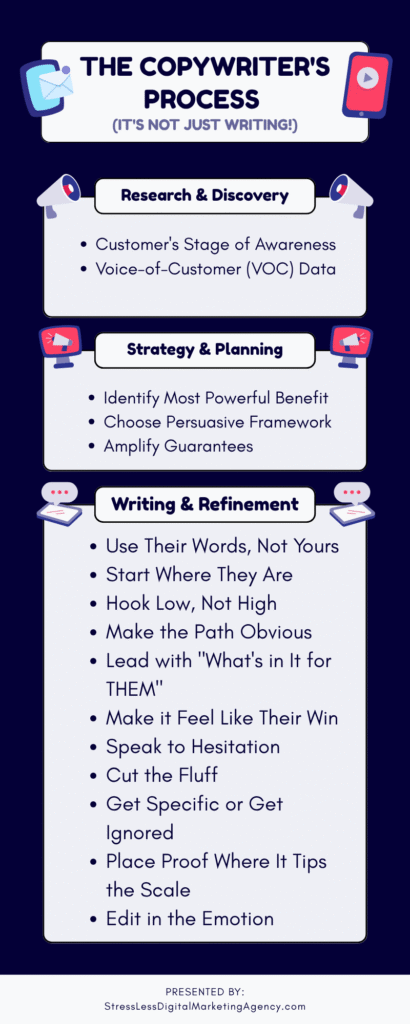
Writing & Refinement:
- Use their words, not yours. The most resonant copy doesn’t come from brainstorming—it comes from listening. When you echo your audience’s actual words, fears, and desires, your message doesn’t just sound good—it feels true. That’s how you write copy that clicks, connects, and converts.
- Start where they are. If you want to build trust, you have to begin by meeting your reader in their current headspace. Health and wellness providers — you already do this in your client work. Meeting people where they are is foundational to what you do. The same skill translates directly to copy.
- Hook low, not high. Don’t overthink your opening. Your first line should be a nudge, not a dissertation. A quick hit of relevance. A “wait… that’s me” moment. That’s what gets them to keep reading.
- Make the path obvious. Your reader doesn’t need to be dazzled—they need to feel understood. So lay it out. Here’s the problem. Here’s the plan. Here’s how this helps. When your solution is mapped with clarity and empathy, decision-making gets a whole lot easier.
- Lead with what’s in it for them. Subheadings shouldn’t just label a section—they should pull the reader in. Think: clarity over cleverness. Use crossheads that speak to the benefit, not just the topic. Because when your reader sees themselves in the value, they’re far more likely to keep reading.
- Make it feel like they win. Don’t just list features—translate them into actual, lived benefits. Instead of “16 GB RAM,” say “no more freezing mid-Zoom call.” Ground the copy in what your reader gets, not just what the product does.
- Speak to the hesitation before it speaks to them. Your reader is already wondering, Is this worth it? What if it doesn’t work for me? Anticipate those questions. Ease the tension. Let them feel seen in their uncertainty—and offer a clear, calm path forward.
- Cut the fluff. If the words aren’t adding weight, they’re dragging the message down. Every sentence should either build trust, spark curiosity, or move them toward clarity. Anything else? In the words of Elsa…. 🎶 Let it go 🎶
- Get specific or get ignored. Vague promises fall flat. Instead of saying “you’ll grow your business,” say “book five discovery calls this week without cold DMs.” Specificity builds trust. Precision sells.
- Place the proof where it tips the scale. Don’t just sprinkle testimonials like confetti—use them like anchors. Think about when your reader might need that extra nudge. That’s where the social proof belongs.
- Edit in the emotion. Once the strategy’s solid, go back and add the feeling. A sentence that lands like, “You’re tired of doing all the right things and still wondering if it’s enough.” That’s what hits the heart. And hearts make decisions.
Why This Actually Matters
You can hire a VA to make content. But a copywriter? A copywriter makes content that moves. That builds trust, sparks clarity, and gets your reader to think: Finally—someone gets it.
If a copywriter handles the words and the conversion strategy, you may be wondering where that leaves questions about design, technical SEO, or even whether you need all three. The breakdown of what an SEO copywriter, web designer, and SEO agency each handle is a useful read before you decide who to hire first.
And if you’re currently getting visitors to your site but the inquiries still aren’t coming in, the problem is almost certainly in the copy. Here’s what to look for when diagnosing why a website stops converting.
Ready to Build a Website That Actually Works?
This isn’t about filling a page. It’s about knowing your people so well, they feel like you’ve been reading their mind. It’s about writing in a voice that sounds like you—not generic brand-speak that makes your stomach twist. It’s about not wasting hours staring at a blinking cursor, wondering how to say what you know is powerful.
It’s knowing where to place the right story, the right proof, the right pull.
It’s about the big idea behind the offer—and the emotional truth beneath the decision.
Because when the words work, your business does too.
A VA can help you check the box. A copywriter helps you change the game.
If you’re ready for content that doesn’t just sound good but actually connects, converts, and reflects who you are — download the price and services guide to see what working together looks like. Or if you already know you’re ready, reach out directly and let’s get started.
Not Sure Where to Start? Grab These First.
Before you hire anyone — copywriter or VA — these free resources will help you understand exactly where your website stands right now.
- Quiz: What’s Keeping You Stuck With Marketing?
- Stop Panicking When Clients Graduate: Your Website’s Guide to Organic Inquiries
- Free Blog Templates For Service Providers: Designed Specifically For Health & Wellness Clinicians
Common Questions About Hiring a Website Copywriter vs. a VA
Do I need a VA or a website copywriter for service providers?
It depends on where your marketing foundation is. If your website is already optimized — clear messaging, keyword-targeted service pages, a working content strategy — a VA can help you execute and scale that content. If your website is not yet ranking or converting, a VA will produce content that goes nowhere. In that case, a website copywriter for service providers builds the foundation first. You can always bring in a VA for execution once the strategy is working.
What does a website copywriter do that a VA does not?
A website copywriter researches your ideal client’s language, maps their buyer journey, identifies the keywords they use when they are ready to book, writes copy that is structured for both search engines and human psychology, and monitors performance after launch. A VA executes tasks you define. A copywriter defines the strategy and executes it. The distinction is not about writing ability — it is about who owns the outcome.


