
Why My Website Copy Isn’t Converting — And How to Fix It
I spend a lot of time reading psychology books. Always have. But the best ones are sometimes the hardest to get through — because the language is so elevated, so clinical, so loaded with terminology that I find myself translating every paragraph before I can understand what it actually means in real life. No examples. No stories. Just research stacked on research.
At some point while slogging through one of those books, I thought: this must be exactly how a prospective client feels when they land on a health and wellness website full of professional language and cannot figure out whether you can help them.
That is one version of why website copy does not convert. But it is not the only one. There are four patterns I see consistently — and they each have a specific fix. That is what this post covers.
One important distinction worth making upfront: if you are not sure whether copy is actually the problem — versus a traffic issue, a technical issue, or something else entirely — that is a different question with a different answer. Start with the diagnostic post on why visitors aren’t becoming clients, then come back here once you’ve confirmed copy is what needs fixing.
If you already know copy is the bottleneck, keep reading.
Key Points
- Your website copy is your silent salesperson—working 24/7 to build trust, answer objections, and guide people toward booking
- Most health & wellness websites fail at conversion because they focus on credentials instead of client outcomes and emotional connection
- Strategic copywriting follows a proven sequence — attract attention, spark interest, build desire, invite action — and when any stage is missing, the whole page underperforms
- SEO-optimized copy ensures people can actually find your website before your copy can convert them
- You do not need to write it yourself — and if you want to understand what a strategic SEO copywriter actually does before hiring one, [the full overview]
What Website Copy Actually Is (And Why It Matters)
Website copy is every word on your site—from your homepage headline to your service descriptions, About page, FAQ section, and the buttons people click to book with you.
It’s different from blog content, which builds trust over time through education and SEO. A blog post educates and builds trust over time. Website copy has one job: move someone from “just looking” to “ready to book.”
But here’s what most health and wellness providers get wrong: they think website copy is about them—their credentials, their training, their approach. And while those things matter, they’re not what make someone book.
What actually converts: Copy that makes potential clients feel seen, understood, and confident that you can help them solve their specific problem.
There is also something worth noting about how copy and design interact. Most practice owners build their site by designing first — getting the layout right, choosing fonts and colors — and then filling in the words afterward. The copy ends up squeezed into whatever space the design left. Headlines run too short. Service descriptions feel thin. CTAs get buried where the layout happens to have room. Copy should drive design, not the other way around. When the words are written first, the designer builds a structure that actually fits what the copy needs to say. The result is a page that works as a whole rather than one where the visual and the words are pulling in slightly different directions.
Why Your Website Copy Probably Isn’t Working
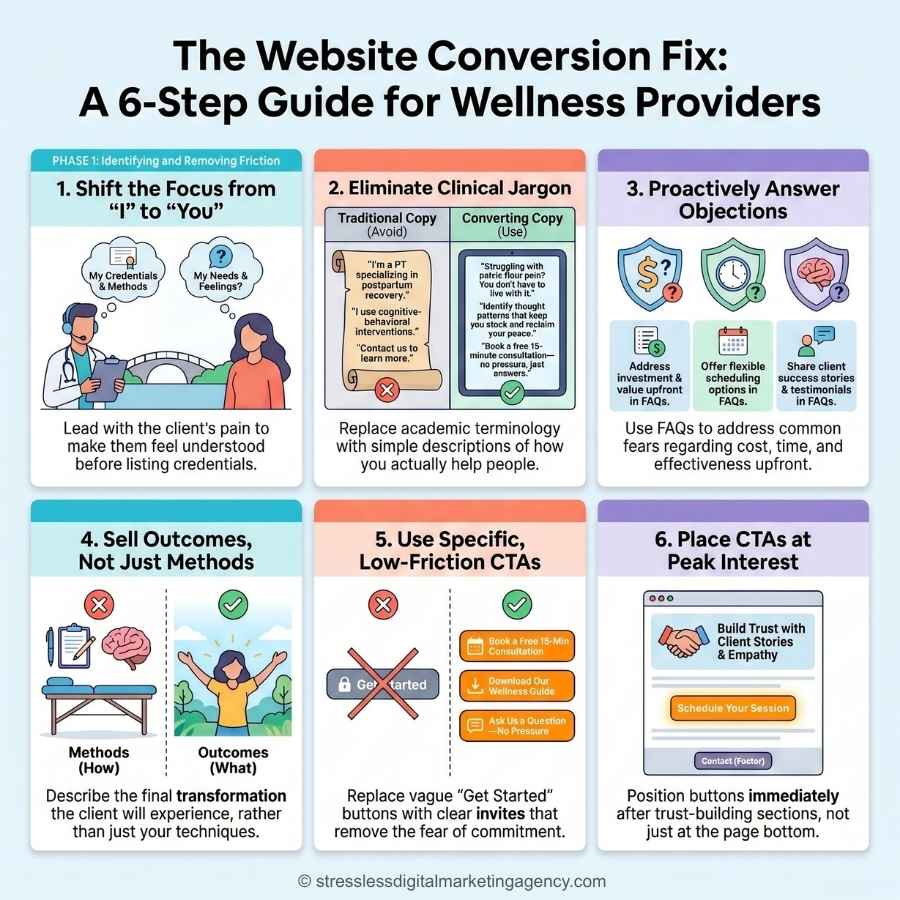
Problem 1: You’re Talking About Yourself, Not Them
Clinical training — in any health or wellness field — teaches you to be authoritative. Your credentials signal competence. Your training signals rigor. So when you sit down to write a website, the natural instinct is to lead with those things. It makes sense. It just does not work.
I see it constantly. Websites that open with:
- “I’m a Licensed Clinical Social Worker with 15 years of experience…”
- “Our practice offers evidence-based treatment modalities…”
- “We believe in a holistic approach to wellness…”
All of that is fine. But it doesn’t answer the question your potential client is actually asking: “Can you help me?”
What to do instead: Lead with their pain point, their struggle, their question. Make them feel understood before you tell them about your credentials.
Example:
❌ “I’m a physical therapist specializing in postpartum recovery.”
✅ “Struggling with pelvic floor pain after having a baby? You’re not broken, and you don’t have to live with it.”
See the difference? One is about you. One is about them.
The fix is not to hide your credentials — it is to lead with empathy and let your qualifications support the case rather than open it. Once a reader feels understood, they become genuinely curious about who you are and why you are qualified to help. That curiosity is what earns your credentials real attention.
Problem 2: You’re Using Jargon That Confuses People
I was reading a book about status anxiety recently. Genuinely fascinating subject. I was so intrigued by it that I kept picking it up — and so bored by the language that I kept putting it back down. The concepts were all translated into academic terminology. Every point required its own translation in my head before I could understand what it meant in real life. No examples. No stories. Just elevated, clinical prose that assumed I already spoke the language.
Somewhere around chapter three, I thought: this is exactly what happens to a prospective client on a health and wellness website written in professional vocabulary.
You know what your modalities, certifications, and clinical frameworks mean. Your colleagues know. But a person searching for help at 11pm does not need to understand your theoretical orientation — they need to know whether you understand their situation well enough to help. Jargon creates distance at the exact moment you need to be building trust.
What to do instead: Explain your approach in plain language that focuses on outcomes, not techniques.
Example:
❌ “I use cognitive-behavioral interventions combined with mindfulness-based stress reduction.”
✅ “I help you identify the thought patterns that keep you stuck, and give you practical tools to manage anxiety in real-time—so you can stop spiraling and start living.”
Clarity beats cleverness. Always.
Problem 3: You’re Not Addressing Objections
When someone’s considering working with you, their brain is running through a list of fears and questions:
- “Is this really going to work?”
- “Can I afford this?”
- “What if I’m too far gone?”
- “What if I don’t like them?”
- “How long will this take?”
If your website doesn’t address these objections, people leave. They might not even realize why—they just feel unsure, and unsure people don’t book.
What to do instead: Anticipate their questions and answer them proactively. Add an FAQ section. Include testimonials that address common fears. Explain your process clearly so they know what to expect.
Problem 4: Your Calls-to-Action Are Weak (or Missing)
A call-to-action (CTA) is the part of your website that tells people what to do next:
- “Book a Free Consultation,”
- “Download the Guide,”
- “Schedule Your First Session.”
If your CTA is vague (“Learn More,” “Get Started”), people won’t know what they’re actually agreeing to. And if you don’t have CTAs on every page, people will leave without taking action simply because you didn’t tell them what to do.
What to do instead: Make your CTAs specific, clear, and low-friction.
Example:
❌ “Contact us to learn more.”
✅ “Book a free 15-minute consultation—no pressure, just answers.”
The second one tells them exactly what they’re getting and removes the fear of commitment.
One more CTA pattern worth flagging: the invitation that only appears at the very bottom of the page. A reader who is convinced halfway through a service page should not have to scroll through everything else to find out what to do next. CTAs placed only at the end catch the readers who were already going to reach out. CTAs placed at the moment of highest interest — right after you have built the most trust, answered the biggest objection, told the most resonant story — catch the ones who were almost convinced. That is where bookings come from.
The Core Principles of High-Converting Website Copy
If you want your website to actually convert visitors into clients, your copy needs to follow these principles:
1. Be Clear, Not Clever
You’re not writing poetry. You’re helping someone make a decision about whether you’re the right fit for them.
What this looks like:
- Use short sentences
- Break up text with headings and bullet points
- Write at a 5th-grade reading level (yes, really—even your highly educated clients will appreciate it)
- Avoid flowery language that sounds pretty but says nothing
2. Focus on Outcomes, Not Credentials
Your credentials build credibility, but they don’t sell your services. Outcomes do.
What this looks like: Instead of: “Board-certified in functional medicine with advanced training in hormone optimization.” Try: “Help women in their 40s finally lose the weight, balance their hormones, and feel like themselves again.”
Lead with the transformation. Back it up with credentials.
3. Use “You” More Than “I” or “We”
This is a simple test: read your homepage out loud. Count how many times you say “I” or “we” versus “you.”
If you’re talking more about yourself than your client, flip it.
What this looks like:
❌ “We offer personalized treatment plans…”
✅ “You’ll get a treatment plan tailored specifically to your needs…”
Small shift, big impact.
4. Show, Don’t Just Tell
Don’t just say you’re compassionate, experienced, or results-driven. Prove it.
What this looks like:
- Include client testimonials that describe specific outcomes
- Share case studies (with permission and anonymity)
- Tell stories that illustrate your approach
- Use specific language (“After 8 weeks, Sarah’s panic attacks decreased from daily to once a month”) instead of generic claims (“My clients see amazing results”)
If you want to work through these principles page by page and write your own copy before hiring anyone, the step-by-step guide to writing your website covers the full DIY process built specifically for health and wellness business owners.
The Essential Pages Your Website Needs (And What They Should Say)
Homepage
Purpose: Grab attention, build trust, and guide visitors to the next step
What to include:
- A headline that speaks directly to their pain point or desire
- A subheadline that clarifies who you help and how
- A brief intro that makes them feel understood
- Your main services or offerings
- Social proof (testimonials, credentials, media mentions)
- Clear CTAs throughout
Example opening: “Feeling anxious all the time, even when everything seems fine? You’re not being dramatic—and you don’t have to figure this out alone. I help high-achieving women in New York calm the constant worry and reclaim their peace of mind.”
About Page
Purpose: Build connection and credibility by sharing your story and why you do this work
What to include:
- Why do you do this work (your “origin story”)
- Who you are as a person (not just as a professional)
- Your relevant credentials and training
- What makes your approach different or unique
- A photo that feels warm and approachable
What NOT to do: Don’t make it a resume. Make it a story that helps people connect with you as a human.
Service/Specialty Pages
Purpose: Explain exactly what you offer, who it’s for, and how it works
What to include:
- Who this service is for (be specific)
- What problem does it solve
- How it works (your process, step-by-step)
- What results can clients expect
- Pricing (if you share it) or a clear next step to learn about investment
- FAQs that address common objections
- Testimonials from clients who’ve been through this service
- A strong CTA
Pro tip: Create separate pages for each specialty or service. This improves SEO and allows you to speak more specifically to different client segments.
Contact Page
Purpose: Make it ridiculously easy for people to get in touch
What to include:
- A simple contact form
- Your email and phone number (if you’re comfortable sharing)
- What to expect after they reach out (“I’ll respond within 24 hours” or “You’ll hear back within one business day”)
- Optionally: your availability, location, or whether you offer virtual sessions
What NOT to do: Don’t make them jump through hoops. Keep it simple and low-barrier.
A Quick Note on Page Priority
Not all pages carry equal conversion weight, and trying to fix everything at once usually means nothing gets fixed well. If you are deciding where to start, this is the general order that makes sense for most health and wellness practices:
Service pages first if you have no organic traffic — Google needs something specific to index before any visibility strategy can work. A homepage and two focused service pages written with the right keywords will outperform months of social media content.
Homepage first if you have traffic but a high bounce rate — visitors are landing and leaving, which usually means the first ten seconds of your homepage are not giving them enough reason to stay.
About page first: if you are getting inquiries but not closing them, this is the page people read when they are almost convinced and want to know who they are dealing with. A resume-style about page loses the hesitant visitor at the final hurdle.
Not sure which problem you are actually dealing with? The free marketing quiz identifies your biggest visibility gap in about two minutes.
How SEO Fits Into All of This
Here is an important distinction that often gets blurred: copy converts the traffic you already have. SEO brings the right traffic to your site, so the copy has someone to work on. Both matter. They just solve different problems, and understanding which one you are dealing with changes where you start.
Why my website copy isn’t converting is the right question when people are finding you and leaving without booking. If the problem is that people are not finding you at all — low impressions in Google Search Console, no organic traffic — that is an SEO problem, not a copy problem, and fixing the words will not change the numbers.
When copy and SEO work together, each piece of content on your site does two jobs simultaneously: ranking for the searches your ideal clients make and converting those visitors once they arrive. One without the other produces either invisible-but-beautiful pages or visible-but-empty traffic. The goal is both.
For a look at how long it realistically takes SEO to produce results and what to expect at each stage, the SEO timeline breakdown covers that specifically.r website isn’t optimized for these searches, you’re invisible to the people who need you most.
Why Hiring a Copywriter Is Worth It
Look, I get it. You didn’t go to school to become a marketer. You went to school to help people. And the idea of writing your own website copy—on top of everything else you’re managing—probably feels overwhelming.
That’s exactly why hiring a strategic copywriter isn’t an expense—it’s an investment.
The timepiece is real and often underestimated. The writing itself is the easy part — the research, the strategy, the keyword work, figuring out which framework fits which page — that is where the hours go. Most health and wellness business owners who try to DIY their website copy do not stall because they cannot write. They stall because the research stage runs into the wall of an already full schedule.
Beyond time, there is the psychological layer. Years of clinical training gave me an ear for how people describe what is hard — not the presenting problem, but the language underneath it. The actual words someone uses when they are finally ready to ask for help. The best copy does not invent that language. It pulls it from the mouths of the people you are trying to reach and organizes it into a page that mirrors how a real person makes a decision. That is a different kind of skill than writing, and it is why results differ even between pages that are technically well-written.
What you end up with is a website that works independently of your referral network and your social media activity. Every page is a long-term asset. It does not require your attention every week to keep producing results.
If you are currently weighing whether to hire a copywriter or a VA, the full breakdown of what each role actually does is worth reading before you make that call.
The ROI: If hiring a copywriter helps you book even two extra clients per month, it’s already paid for itself. And the reality? Good copy usually brings in way more than that.
How I Help Health & Wellness Providers Build Websites That Convert
This is what I do. I specialize in writing SEO-optimized website copy for health and wellness service providers who want to attract the right clients and actually convert them.
My “Write My Website” package includes:
- Homepage: Clear, compelling copy that hooks your ideal client and guides them through your site
- About Page: Your story told in a way that builds trust and connection
- Service/Specialty Pages: Detailed pages that explain what you do, who you help, and how it works
- SEO Essentials: Keyword research, meta titles and descriptions, internal linking strategy, and clear CTAs on every page
Every page is written to reflect your unique voice and expertise—while following proven conversion principles that actually work.
Download my Service & Pricing Guide to see exactly how I can help you build a website that works as hard as you do.
The Bottom Line: Your Website Should Work For You, Not Against You
Your website isn’t just a place where people learn about you. It’s your most important marketing tool—working 24/7 to build trust, answer questions, and guide people toward booking.
If your current website isn’t converting, it’s not because you’re not good at what you do. It’s because your copy isn’t doing its job. And that’s fixable.
Whether you tackle it yourself using the principles in this post, or you hire someone (like me) to do it for you, the important thing is this: don’t let unclear, generic, or confusing copy cost you, clients.
You’ve worked too hard to build your skills and your practice. Your website copy should reflect that.
Ready to stop losing clients to unclear website copy? Let’s work together to build a website that actually converts visitors into paying clients.


