Writing Anxiety: Why It’s Killing Your Practice Visibility
“Am I the only one who dreads writing blog posts and emails?”
Clinical training teaches you to be a blank slate. Stay neutral. Don’t share. Let the client lead.
That is excellent therapy. It is a disaster for marketing.
Your ideal client isn’t in your office yet. They’re on Google at 11pm, reading five different therapist websites that all say the same thing — “warm, welcoming, safe space, no judgment.” That’s not differentiating. That’s the basic requirement for the job.
The practices that get found — and more importantly, get called — are the ones willing to have a point of view. To say who they are for. To be slightly uncomfortable for the people they’re not trying to attract.
And here’s the uncomfortable truth underneath that: the reason most health and wellness providers aren’t doing that isn’t strategy. It’s fear. The fear of putting yourself into words. The fear that what you write won’t be good enough, won’t be original enough, won’t accurately represent the depth of what you actually do.
That’s writing anxiety. And it’s costing your practice more than you think.
Affiliate Disclaimer: This page contains affiliate links and is a member of the Amazon Services LLC Associates Program. If you make a purchase using one of these Amazon links, we may receive compensation at no extra cost to you. See our Disclosure Policy in the Legal Hub for more information.
What Is Writing Anxiety?
Writing anxiety is the persistent, often disproportionate fear or dread associated with producing written content — not just occasionally, but as a pattern that disrupts your ability to show up consistently in your business.
It’s different from ordinary procrastination, though the two get tangled together constantly. Procrastination is a behavior: you delay the task. Writing anxiety is the emotional and psychological state that makes the task feel threatening in the first place — the reason the delay happens over and over, even when you know the stakes, even when you genuinely want to do it, even after you’ve blocked off the time and opened the document.
For health and wellness providers, writing anxiety tends to cluster around a specific type of content: the kind that requires you to speak with authority in public. Blog posts. Website copy. Email newsletters. Social captions that reflect a professional opinion. Content that puts your expertise — and your name — out into the world where it can be judged.
The clinical parallel is useful here. Writing anxiety for a practice owner often functions like social anxiety for a client: the feared outcome isn’t actually as likely or as catastrophic as the nervous system believes, but that doesn’t make the physiological response feel any less real in the moment. And just like social anxiety, white-knuckling your way through it without addressing the underlying pattern doesn’t resolve it — it just depletes you faster.
Why Writing Anxiety Hits Clinicians Differently
There’s a specific reason writing anxiety is more common and more complicated for health and wellness providers than it is for entrepreneurs in other fields. Two reasons, actually.
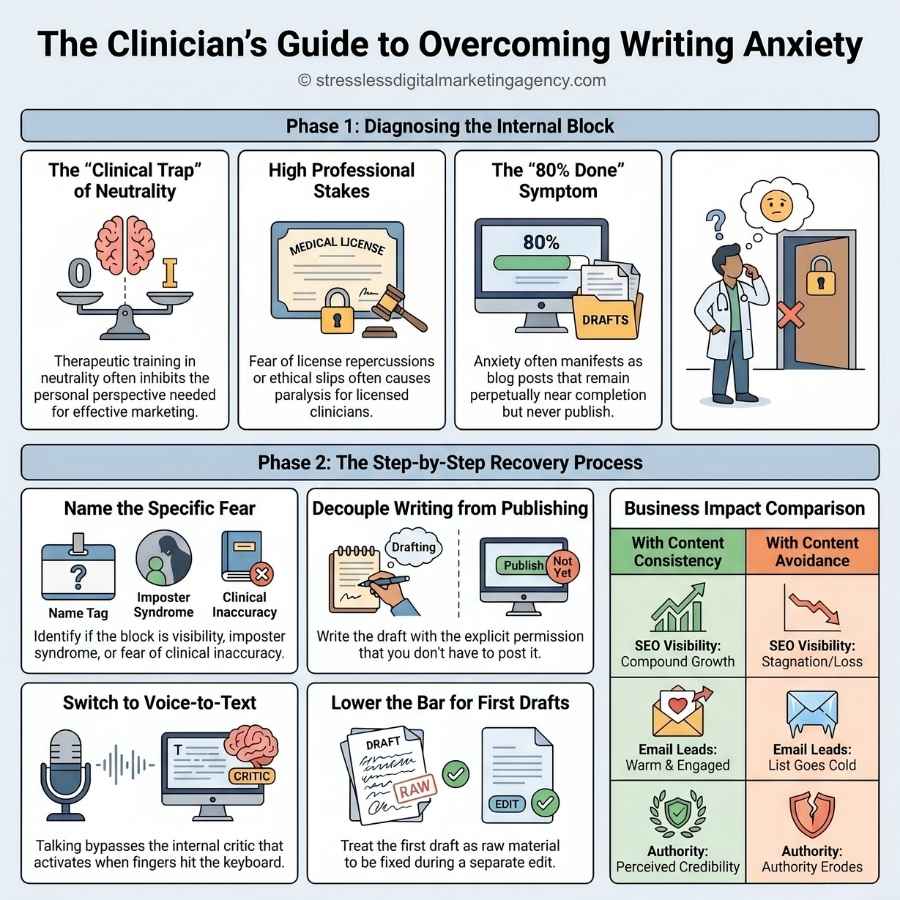
Clinical training works against you here. Years of training in therapeutic neutrality — hold back your personal perspective, don’t self-disclose, create a blank slate so clients can project — produces excellent clinicians and deeply inhibited content creators. When your professional formation has repeatedly rewarded you for staying neutral and penalized you for sharing your own view, the act of writing an opinionated blog post under your name feels like a professional violation even when it isn’t. You’re not just facing a blank page. You’re pushing against years of training that taught you not to do the exact thing effective marketing requires.
The stakes feel different for licensed professionals. A health coach writing a casual social post doesn’t worry about whether it reflects appropriately on their license. A licensed therapist does — or at least the anxiety says they should. The fear of saying something inaccurate, overstating clinical outcomes, misrepresenting a treatment approach, or accidentally crossing an ethical line creates a layer of paralysis that a general entrepreneur doesn’t carry. Whether those fears are proportionate to the actual risk is a separate conversation. What matters here is that they’re real, they’re niche-specific, and they’re almost never named in generic content advice.
Understanding that your writing anxiety has a legitimate professional origin — that you aren’t simply bad at marketing or lazy or undisciplined — is the first thing that actually shifts the experience of it.
What Writing Anxiety Actually Looks Like (It’s Not Just the Blank Page)
The blank page is the obvious symptom. The less visible ones are often more damaging.
For me, writing anxiety has a very specific physical signature — a pit in the stomach, a heaviness, an urge to open four other browser tabs and suddenly become very interested in reorganizing my email inbox. It’s tiredness that appears specifically when a writing task is on the calendar, avoidance dressed as productivity, the mental weight of something that keeps not getting done.
For practice owners I work with, it tends to show up as:
Perpetual near-completion. The blog post that’s been 80% done for three months. The About page that’s been “almost ready” since the site launched. The newsletter draft sitting in the folder you open and then close without finishing.
Topic paralysis. Sitting down to write with no idea what to say — not because there’s nothing to say, but because no topic feels important or original enough to justify the effort. The bar keeps moving. Nothing clears it.
Publish anxiety. Writing something, deciding it’s good enough, and then sitting with the cursor hovering over the publish button for an embarrassingly long time. Wondering whether it’s accurate enough, whether someone will take it out of context, whether a colleague will read it and think you’re misrepresenting your specialty.
Energy cycling and creative blocks. Some people notice their creative energy shifts predictably — with hormonal cycles, with seasons, with the months after a particularly draining clinical stretch. I notice this in my own work. My creative energy correlates with my menstrual cycle in ways I’ve learned to work with rather than fight. If this resonates, Cycle Sync Your Business is worth reading — it maps how hormonal phases affect different types of cognitive and creative work, which has practical implications for when you schedule writing versus other tasks.
None of these patterns mean you can’t write. They mean the conditions for writing aren’t set up to work with your actual psychology.
The Real Roots: Where the Fear Actually Comes From
Writing anxiety for health and wellness providers almost always traces back to one or more of these specific fears — and naming them precisely matters because each one requires a different response.
Fear of visibility. Putting your thoughts out publicly means being findable, readable, and potentially disagreed with. For providers who have built their careers inside the protected container of a therapeutic relationship — where sessions are confidential, where your opinions are rarely published, where your professional identity is held carefully — public writing feels structurally different from everything else you do. It’s exposed in a way the therapy room isn’t.
Imposter syndrome. The nagging belief that you don’t have anything original to say. That everything has already been said by someone with more credentials, more followers, more authority. That your specific angle on your specific specialty isn’t differentiated enough to warrant a blog post.
Here’s what I can tell you from the other side of that experience: when I sat with a brand strategist and answered her questions about my work, my values, and what frustrated me most about the field I’d left — questions that felt more like a clinical intake than a marketing session — I said things out loud I had never put together before. My own expertise, reflected back through someone else’s eyes. The imposter syndrome cleared. Not because my credentials changed. Because I finally saw clearly what I actually had to offer.
The insight that got me: I hadn’t realized that doing content strategy AND website copywriting AND SEO together was a differentiated thing. Most providers have to hire a copywriter OR a content creator. I offered both. That distinction was invisible to me until I articulated it in conversation. Your differentiator is probably similarly invisible to you right now — not because it doesn’t exist, but because you’re too close to it to see it.
Fear of being wrong. Specific to licensed clinicians: the worry that a blog post will contain a clinical inaccuracy, overstate an outcome, or make a claim that misrepresents your professional standards. This fear is worth taking seriously and then proportionately. The solution isn’t to avoid publishing — it’s to write at the fifth-grade reading level that prioritizes clarity over clinical precision, focus on educational content about lived experience rather than treatment claims, and maintain the same ethical orientation in your content that you maintain in your practice.
Fear of redundancy. The market is saturated. Everything has been said. There’s nothing new to say about anxiety, burnout, trauma, or whatever you specialize in.
The answer to this one is specificity, not originality. One of my most effective pieces of content opened with: “The monsters under your bed are real. They just move out from under your bed and into your head once you become an adult.” That’s not a new insight about anxiety. It’s a specific, human, memorable way of describing a familiar experience. Your voice is not the same as anyone else’s voice, and that difference is the differentiator — not a brand new clinical theory.
The Business Cost of Avoiding Content
Writing anxiety is uncomfortable. Chronic content avoidance is expensive. These are different problems and worth treating separately.
When content doesn’t get published consistently, a specific set of downstream consequences compounds quietly:
Organic search visibility stagnates. Google rewards sites that publish helpful, keyword-relevant content regularly. A site that publishes sporadically — or not at all — loses ground to competitors who show up consistently. For practices trying to reduce their dependence on Psychology Today and insurance panels, organic search is one of the few channels that can actually replace that referral traffic at scale. SEO for therapists explains how the visibility loss compounds over time and what consistent publishing does to reverse it.
The email list goes cold. The subscribers who downloaded your lead magnet six months ago and haven’t heard from you since are not warm leads anymore. Every week of silence is a week where a competitor who is sending consistent, helpful emails is getting warmer with your audience. Email content strategy for wellness providers covers what a sustainable sending cadence actually looks like — including what to do when you’ve let the list go quiet.
Authority erodes by comparison. Your potential clients are not evaluating you in a vacuum. They are reading your website alongside three or four others. A competitor who publishes thoughtful content regularly — even if their clinical training is less impressive than yours — will appear more credible to someone who found both of you through Google. Visibility creates a perception of authority, whether or not it accurately reflects expertise.
The referral window closes faster. Even warm referrals Google the name they were given before they book. A website with recent, active, substantive content confirms the referral. A website that looks untouched for months creates hesitation, even if the referral source is trusted.
The opportunity cost accumulates. Every month of inconsistent content is a month where no new pages are indexing, no new searches are being captured, and no new leads are entering the top of the funnel. Content consistency for practice owners maps out exactly what that compounding looks like in the other direction — what consistent publishing actually builds over a 12-month timeline.
What Doesn’t Work (And Why You Keep Trying It)
“I’ll power through it.” Forcing yourself to do something that consistently triggers avoidance doesn’t resolve the avoidance — it depletes you and generates resentment toward the task, which makes the next attempt harder. Willpower is not a content strategy.
Waiting for inspiration. Inspiration is real and useful when it shows up. It is not reliable enough to build a publishing schedule around. Providers who publish consistently are not more inspired than you — they’ve removed the decision about whether to write from their process and replaced it with a system that runs regardless of how they feel that day.
Writing when you have time. There is no “when you have time” in a full clinical practice. Time has to be protected and allocated, not found. Content that gets written only when everything else is caught up gets written approximately never.
Trying to make it perfect. The post you publish imperfectly today outranks the post that never publishes because it wasn’t quite right. Done and indexed beats draft and waiting, every time. The reader does not have access to the perfect version you were theoretically going to write — they only have access to what you published.
What Actually Helps: Practical Strategies That Hold
These are the strategies that address writing anxiety at the source, not just the symptom.
Name the specific fear. Visibility, imposter syndrome, fear of being wrong, fear of redundancy — each one has a different response. Treating them all as “I just hate writing” doesn’t give you anything to work with. Identifying the specific fear does.
Separate the writing session from the publishing decision. One of the most useful reframes for publish anxiety is to give yourself explicit permission to write something that you might not publish. The decision to publish comes later. The writing session is just writing. This removes the evaluative weight from the creative process, which is where a lot of the freeze comes from.
Voice-to-text first, edit second. Talking is almost always easier than writing. I use voice-to-text regularly to get ideas out — speaking the post out loud as if I’m explaining something to someone I trust, then going back to edit what’s been captured. This bypasses the internal critic that activates the moment fingers hit the keyboard, because you’re not “writing” — you’re just talking.
Batch by energy cycle. If your creative energy is noticeably higher at certain points in your week, month, or hormonal cycle, write during those windows and schedule the publishing for later. Batching multiple posts in one high-energy session is dramatically more efficient than writing in fragmented 30-minute windows when you’re already depleted from clinical work.
Pre-decide your topics. Topic paralysis disappears when the topic is already chosen before you sit down. Keep a running list of ideas generated from client questions, intake patterns, and the phrases you find yourself explaining repeatedly in consultations. The day you sit down to write, you aren’t deciding what to write — you’re just executing.
Lower the bar on first drafts. The first draft is not the post. It is raw material. Giving yourself permission to write badly in the first pass — and commit to fixing it in the edit — removes the pressure that triggers the freeze.
When Writing Anxiety Is Telling You Something Real
Sometimes writing anxiety is a clinical-level anxiety response that has attached itself to a specific task. Sometimes it’s something more specific to your content strategy: the writing is hard because you’re not yet clear enough on what you’re trying to say.
If you sit down to write a service page and the words won’t come — not because you’re anxious, but because you genuinely aren’t sure how to describe your approach in plain language — that’s a messaging problem, not a psychological one. The right response there is not to push harder or wait for inspiration. It’s to do the foundation work: get clear on who you serve, what problem you solve, and what language your ideal clients use to describe their experience.
That’s exactly what the brand strategy session that changed my own understanding of my work did for me — it surfaced the clarity that made the writing almost automatic afterward. If your writing feels hard every time, and it’s not fear that’s stopping you but genuine uncertainty about what to say, brand voice for service providers is worth reading before you try to push through another draft.
The Option Nobody Talks About Enough
Here’s the reframe that changed things for me personally: I detest cleaning. Would genuinely rather do almost anything else. So I hire a housekeeper and use the earnings from one client call to cover it — same energy expenditure, dramatically better return on investment.
Content creation is the same calculation. You didn’t build a health and wellness practice to spend your evenings trying to write blog posts that feel terrible to produce. You built it to do the work you’re actually trained for. The question isn’t whether content matters — it clearly does, and the data on what consistent content builds for practice visibility is unambiguous. The question is whether you need to be the one writing it.
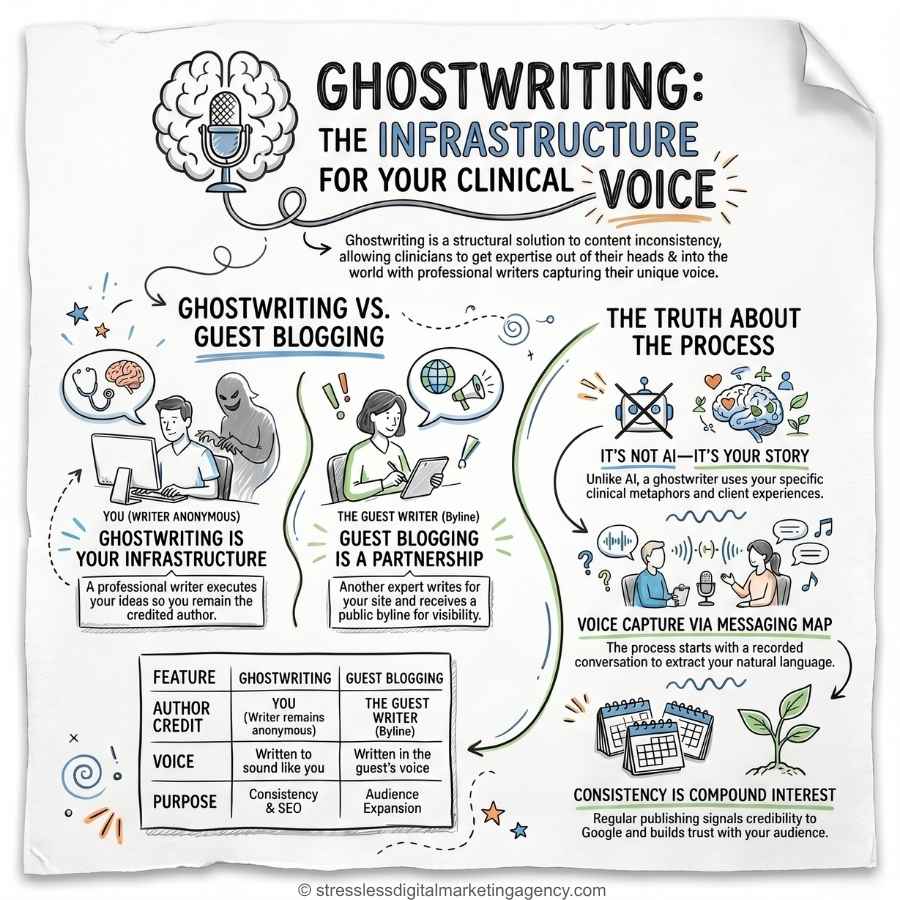
Ghostwriting — having a professional write content in your voice, under your name — is not a shortcut. It’s a strategic decision about where your time creates the most value. For a full explanation of how that works and what it actually produces, what is ghostwriting addresses every objection worth having about it.
And if you’re not ready to fully hand it off but want expert eyes on what you’re creating, the Weekly Copy Review service is a middle path: one piece of content per week reviewed and returned with specific, actionable feedback within 48 hours. You keep writing. The work keeps getting sharper.
FAQs About Writing Anxiety
What is writing anxiety, and how does it affect my business?
Writing anxiety is the persistent fear or dread that makes producing written content feel disproportionately threatening. For health and wellness practice owners, it typically clusters around public-facing content — blog posts, website copy, emails — and results in inconsistent publishing, which directly limits SEO visibility, lead generation, and perceived authority.
Why do I procrastinate on writing even when I know it matters?
Procrastination on writing is almost always a symptom of an underlying fear, not a time management problem. The delay is a defense response. Identifying the specific fear — visibility, imposter syndrome, fear of being wrong, fear of redundancy — gives you something concrete to address instead of trying to override the pattern with discipline.
What are the physical signs writing anxiety is getting in the way?
Common physical signals include tension, a pit in the stomach, fatigue that appears specifically before writing tasks, and a strong pull toward other activities. These are real physiological stress responses attached to a specific trigger. They’re information, not weakness.
Are there quick techniques to get unstuck right now?
Yes. Set a five-minute timer and write without editing — anything, just words on the page. Switch to voice-to-text and speak rather than type. Write in a different location or time of day than usual. Start with the section that feels easiest rather than the beginning. Any of these can break the freeze enough to get momentum.
Is writing anxiety the same as imposter syndrome?
They overlap but aren’t identical. Imposter syndrome is the specific belief that you’re not qualified or differentiated enough to have something worth saying. Writing anxiety is the broader fear response that can include imposter syndrome but also includes fears about visibility, criticism, and professional exposure. Most clinicians experience both.
Should I just hire someone to write for me?
That depends on where you are in your practice and what you want your content to accomplish. If the anxiety is situational and manageable, the strategies above can help you build a sustainable writing practice. If it’s chronic, if it’s consistently getting in the way of the visibility your practice needs, or if the time math simply doesn’t work — then delegating is a legitimate strategic decision, not a failure. How much time outsourcing saves runs the numbers so you can make that decision with real information.
Ready to stop letting writing anxiety make decisions for your practice?
Download the Price and Services Guide to see what done-for-you content looks like and what the investment covers.
Free resources:
- Quiz: What’s Keeping You Stuck With Marketing?
- [Freebie] Stop Panicking When Clients Graduate
- Free Blog Templates for Health & Wellness Providers
Keep reading:
- Content consistency for practice owners — what publishing regularly actually builds
- What is ghostwriting — the option most providers haven’t seriously considered
- How outsourcing saves time — the time and ROI math
- Brand voice for service providers — if the problem is clarity, not fear
- Ultimate guide to content creation — the full content strategy picture