Is Content Marketing Necessary If I Get Referrals? (Yes! Here’s Why.)
If you have ever thought, “I’m already getting referrals — do I really need to blog, post on social, or send newsletters?” — you are not alone, and the question is a fair one. When you are busy seeing clients, managing a practice, and trying to have a life outside of work, it makes sense to want to know what is truly essential and what can be safely skipped.
Here is the honest answer: referrals are wonderful when they happen. They are not a marketing strategy. They are a bonus — unpredictable, uncontrollable, and built entirely on other people’s decisions and timing. A practice that runs on referrals alone is not a sustainable business. It is a job with an uncertain paycheck.
Content marketing is what gives you something referrals cannot: a visibility channel you own, one that keeps working after you log off and does not dry up the moment a referring colleague retires.
Let me walk through exactly why that matters — even if your schedule is currently full.
Key Takeaways
- Referrals are a bonus, not a strategy — they depend entirely on other people’s memory and motivation, neither of which you can control
- Content marketing gives you owned visibility that compounds over time, unlike directories or ads that stop the moment you stop paying
- Even referred clients Google you before they reach out — if they find nothing, the referral often goes nowhere
- SEO-optimized blog posts reach people at high purchase intent, precisely when they are ready to book, which is categorically different from social media reach
- Content does not have to be a second job — one strategic post per month builds more long-term inquiry than a daily social media habit
Is Content Marketing Necessary? Here Are 7 Reasons the Answer Is Yes
1. You Cannot Control a Referral Pipeline — But You Can Build One
Relying solely on referrals means your practice is always one step behind. One month you are turning clients away. The next month you are anxiously checking your inbox, wondering what happened.
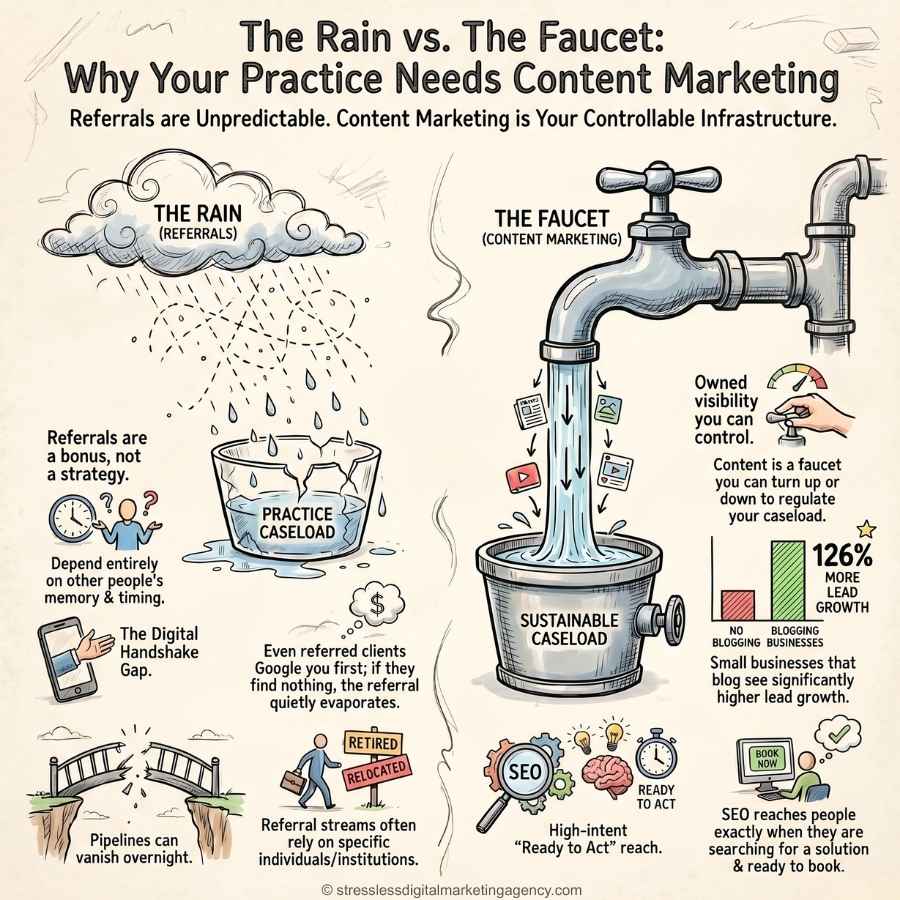
When I was preparing for maternity leave in 2022, content was the thing that made the difference between a frantic sprint and a graceful slowdown. In the earlier stages of my pregnancy, I could turn my marketing channels up — more content, more visibility, building up extra income while I still had the energy. By the third trimester, when walking around the block felt like a small athletic achievement, I scaled back the caseload without panic because the content was still working in the background. That is the faucet analogy I keep coming back to: content is a faucet you can turn up or down. Referrals are rain. You are grateful when it comes, but you cannot plan around it.
For private practice owners specifically, this control question is not theoretical. It is the difference between a practice that grows predictably and one that has a full summer followed by a terrifying January. The full breakdown of which marketing channels offer that kind of control — and which ones reset to zero the moment you stop feeding them — is worth reading alongside this post.
2. Referred Clients Still Google You First
Even when someone gets your name from a trusted source, they will look you up before they call. It is just what people do. You have done it yourself — Googling the contractor before calling back, checking reviews on a restaurant a friend recommended, looking up the therapist a colleague mentioned.
Your potential clients do the same thing, every single time.
My husband and I were once looking for a landscaping company and narrowed it down to three names from word-of-mouth recommendations. Two of them had outdated websites with no content, no recent posts, nothing that told us what it would be like to work with them. We called the third one. Not because the recommendation was stronger, but because their website made us feel certain before we dialed. The others might have been equally good — we will never know, because their digital presence did not give us a reason to find out.
Your content is your digital handshake. It is what a potential client finds when they go looking to confirm that the person they heard about is actually the right fit. If there is nothing there — or worse, something outdated and generic — the referral quietly evaporates and you never know it happened. For a deeper look at what a website needs to actually convert that traffic, the pillar post on SEO for therapists covers the full on-page picture.
3. Content Keeps You in the Room Even When You Are Not There
A few years ago, I started receiving a monthly newsletter from a therapist who specialized in generational trauma. One issue included a book recommendation that reframed something I had been carrying for years in a way no conversation had managed to do. It landed differently than a social media post would have — I had been getting that newsletter for months, there was already a relationship there, and the right message at the right time changed what I did next.
When I was ready to work on it, I reached out to that therapist. Not because they happened to appear in my feed that week. Because they had been showing up consistently in my inbox long before I was ready to act, and when I finally was ready, they were the obvious first call.
That is the function content serves that referrals simply cannot replicate. A referral brings someone to your door at someone else’s timing. Content keeps you present in your ideal client’s world at your own, so that when the moment comes — when they finally decide to get help, when the insurance situation changes, when the life event tips the scale — you are already someone they feel they know.
4. Referrals Can Disappear Overnight
Here is a story I do not tell often, but it is probably the most important one in this post.
When I was working as a therapist with the TBI and traumatic brain injury population at a local hospital, I had a steady referral stream coming from providers at affiliated facilities. I offered something they did not have in-house. The pipeline felt solid. Then I left the agency to open my own practice, fully expecting that the relationships I had built — and the referrals that came with them — would follow me.
They did not. The referring providers were loyal to my employer, not to me. Overnight, the pipeline was gone. What I had mistaken for professional relationships were actually institutional ones, and once the institution changed, so did the flow.
This is not a rare story. Referring colleagues retire, relocate, or reduce their own caseloads. A hospital system restructures and the referral agreement disappears. A Psychology Today algorithm update changes which profiles get seen first. Any single source of clients can be removed from the equation without warning, and if that source is your only one, the impact is immediate and significant.
Content marketing is not immune to change — no channel is — but the owned visibility you build through SEO-optimized blog posts and a well-structured website is far more durable than any referral relationship. A post that ranks for a local specialty keyword keeps sending traffic regardless of what happens to your professional network. This breakdown of why SEO outperforms referrals as a long-term growth channel makes the case in full.
5. Content Reaches People at the Moment They Are Ready to Act
This is the mechanism most practice owners underestimate. There is a fundamental difference between reaching someone who is passively scrolling and reaching someone who is actively searching — and that difference shows up in conversion rates in a way that is hard to overstate.
When someone types “trauma therapist for first responders in [your city]” into Google, they have already had the internal conversation. The decision to get help has been made. They are not browsing. They are looking for the right person to call. SEO-optimized content positions your practice as the answer to that specific search at exactly that moment of readiness.
Social media reaches people in a completely different state. They are scrolling, often avoiding the very thing they need help with, and converting them from a casual pause on your post to a booked client requires many touchpoints over a long time. Both channels have a role, but they are not interchangeable — and treating social media as your primary lead source for private practice is one of the most common and expensive marketing mistakes I see.
For the full argument on why, and what the search intent difference actually looks like in practice, the dedicated post on SEO versus social media for therapists covers it in depth.
6. Content Positions You as the Expert Clients Are Already Looking For
This is the authority-building function of content that referrals cannot replicate, no matter how loyal your referral sources are. A colleague can tell someone you are good. Your content shows them exactly how you think, what you know, and who you are built to help — before they have ever spoken to you.
That matters enormously for private practice because the decision to hire a therapist or wellness provider is inherently vulnerable. Clients want to feel certain before they commit to the first session, not after. A website with a well-written service page and two or three blog posts that speak directly to their experience does more trust-building work than any recommendation, because it creates the feeling of recognition — the sense that you already understand them before they have said a word.
It also matters for pricing. A therapist with a visible, specific, well-articulated online presence is easier to pay out-of-pocket. The content pre-justifies the investment in a way that a Psychology Today listing never can. This guide on writing copy that justifies out-of-network rates goes deep on how that trust-building works at the service page level — but the same logic applies to blog content.
Google’s E-E-A-T framework reinforces this point from the algorithmic side. Experience, Expertise, Authoritativeness, and Trustworthiness are what Google now uses to evaluate whether a piece of content deserves to rank — which means your clinical specialty, your lived experience, and the specificity of your perspective are SEO assets, not just branding ones. The more you write from your actual expertise rather than a generic informational voice, the more both Google and potential clients see you as the credible answer.
7. Evergreen Content Works When You Are Not
Paid ads stop the moment you stop paying. Social media posts have a shelf life measured in hours. Referrals depend entirely on someone else remembering to send you clients at the right time. Evergreen blog content operates on a completely different timeline.
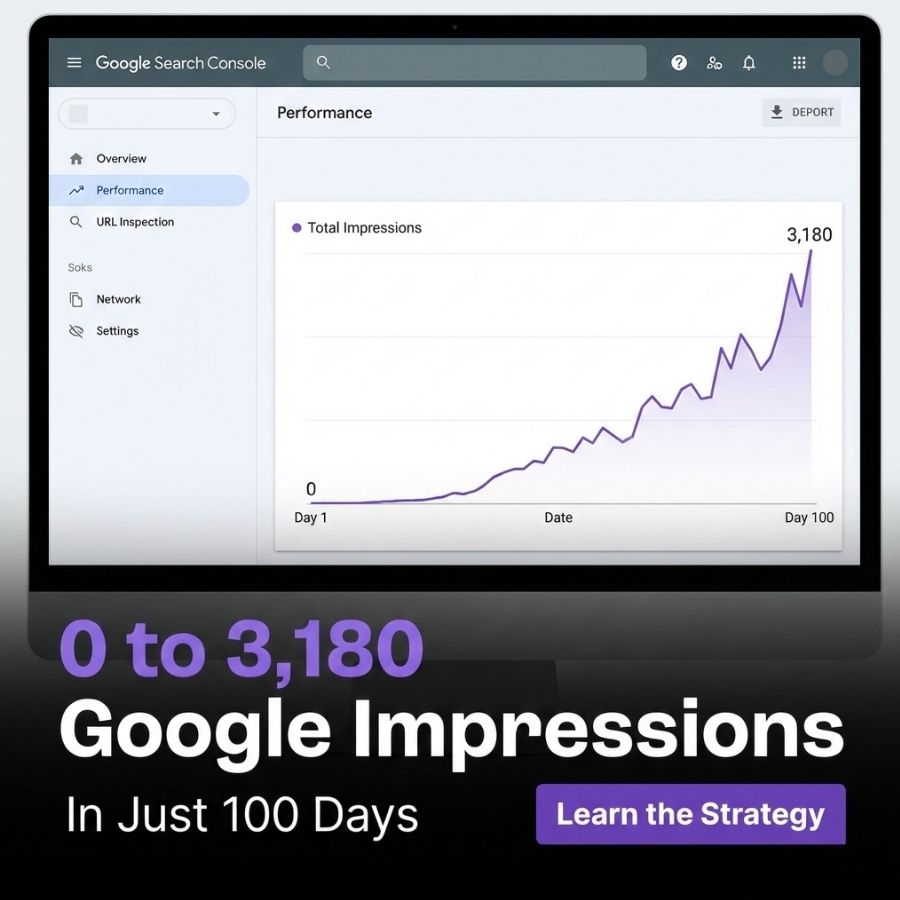
A post that ranks for a relevant keyword — say, “EMDR for childhood trauma in [your city]” or “private pay therapist for postpartum anxiety” — keeps generating traffic for months and sometimes years after you published it. I have affiliate blog posts I wrote years ago that are still being shared, still driving traffic, and still bringing in leads because they answer a specific question people keep searching for. That is the compounding return on owned content that no other marketing channel produces at the same cost.
This is also where the SEO and content relationship becomes most concrete. Consistent blogging generates 55% more website traffic than sites without it, according to MonsterInsights. Small businesses that blog experience 126% more lead growth than those that do not, according to DemandSage. For a full picture of what building that kind of content ecosystem actually looks like in practice — and what it takes to get a blog working for your practice rather than just adding to your to-do list — that breakdown covers the system from foundation to traffic to conversion.
“But I Don’t Have Time to Write a Blog Every Week”
Good news: you do not need to.
The practice owners who get the most from content marketing are not the ones publishing most frequently. They are the ones publishing most strategically — one well-researched, keyword-informed post per month, targeting a specific phrase their ideal clients are actually searching for, linked internally to the service pages that convert. That is the whole system. It does not require a content team or a daily posting schedule.
And if writing is genuinely not where you want to spend your limited bandwidth, that is a reasonable conclusion. Done-for-you content that sounds like you, ranks for the right keywords, and links to the right pages is a legitimate investment in your practice growth. The SEO content ecosystem service handles the research, writing, and internal linking so the system runs without requiring your attention.
The AI question comes up here a lot. Yes, AI can produce content fast. But AI cannot read your Google Analytics and notice that people are bouncing from your services page after ten seconds, or catch that you are getting 800 impressions a month for a keyword you never intended to target, or tell you when to stay the course versus when to pivot. That judgment requires a human who understands your data and your practice. The full post on AI for therapists and when human creativity is irreplaceable covers exactly where the line is.
The Bottom Line
Referrals are a gift. They are not a plan.
Content marketing is the plan — the one that gives you predictable visibility, positions you as the specific expert your ideal clients are already searching for, and builds an asset that keeps working long after you have closed your laptop. For private practice owners who want to stop being dependent on other people’s decisions and start controlling their own client flow, it is not optional. It is the infrastructure the whole thing runs on.
Your Next Step
Download my Price and Service Guide to see exactly how done-for-you content strategy and SEO copywriting works — what is included, what it costs, and how to stop relying on referrals as your primary growth channel.
Or start here for free:
Quiz: What’s Keeping You Stuck With Marketing? Five minutes to find out exactly where your visibility is leaking and what to fix first.
Stop Panicking When Clients Graduate: The practical guide to building a website presence that generates consistent organic inquiries even when your referral pipeline slows down.
Free Blog Templates for Service Providers: A repeatable, SEO-informed structure built specifically for health and wellness clinicians — so you always have a framework to write into.
Keep Reading: Related Posts
- Why Blogging Is One of the Most Valuable Marketing Strategies for Practice Owners
- SEO for Therapists: The No-Fluff Guide to Getting Found on Google
- Why SEO Matters More Than Social Media for Therapists & Coaches
- Marketing Strategy for Private Practice: What Actually Works
- Marketing for Private Practice: Why SEO & Copywriting Are Your 24/7 Sales Team
- How to Justify Out-of-Network Therapy Rates (With Copy That Converts)
- AI for Therapists: Balancing AI and Human Creativity