Why SEO Matters More Than Social Media for Therapists
You finished a solid blog post on a Sunday night, shared it to Instagram, Facebook, and LinkedIn, and waited. By Tuesday it had a handful of likes, one comment from a colleague, and zero inquiries. Meanwhile, someone in your city is typing “therapist for anxiety near me” into a search bar tonight, and your practice isn’t on the page they’re reading. That gap is the entire argument of this post.
Key takeaways, if you only have a minute:
- When someone searches “trauma therapist in [your city],” they’ve already decided to get help. The person pausing on your Instagram post probably hasn’t. That difference in intent is why search converts the way it does.
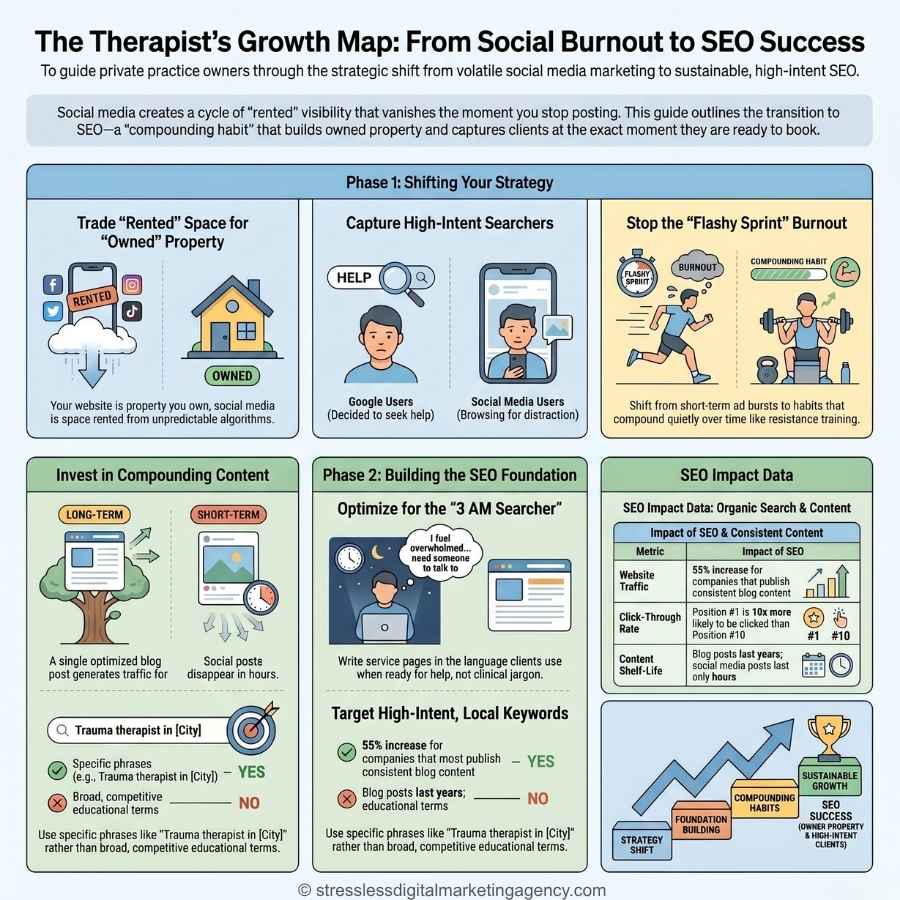
- Your website is property you own outright. Social media is space you rent, under someone else’s rules, with an algorithm that can cut your reach in half overnight.
- A well-optimized blog post keeps generating traffic months and years after you publish it. The equivalent social post is buried by tomorrow morning.
- The most sustainable marketing strategy for a private practice puts SEO as the foundation, with social in a supporting role, not competing for the same job.
- The keywords that fill caseloads fastest aren’t broad educational topics. They’re specific, local, and tied to what your ideal client actually types when they’re ready to book.
The Core Problem With Social Media as Your Primary Channel
Social media is built for distraction. That’s not a criticism so much as an honest description of what these platforms are designed to do. Instagram, TikTok, and Facebook are engineered to keep people scrolling, which means the default state of your audience there is passive and unfocused, not exactly primed to make a decision about their mental health care.
When you post educational content about anxiety, you might reach someone who finds it interesting. You might even plant a seed that matters later. But they’re almost certainly not in a booking mindset at that moment. They’re in an entertainment mindset, and moving someone from a casual scroll to a consultation call takes repeated touchpoints over a long stretch of time before they ever reach out.
Now consider what happens when someone types “EMDR therapist for trauma in [your city]” into Google. That person has already had the internal conversation. They’ve already decided to get help. The search itself is an action, an expression of readiness that scrolling past a post simply doesn’t carry. Your job at that point is to be the most compelling answer to their question, and that’s exactly what SEO positions you to do.
You Don’t Own Your Social Media Presence
Think about the difference between renting and owning. When you rent, someone else sets the rules: what you can do with the space, how long you can stay, and what happens when the terms change without warning. Your social presence works the same way. Instagram can cut your organic reach in half overnight, no notice, no recourse. A platform can shift its entire algorithm, and the audience you spent two years building suddenly sees almost nothing you post. It’s happened to practices that built their whole marketing strategy on a single channel, and when it did, they had nothing to fall back on.
Your website is different. What you publish there belongs to you, stays live as long as you keep the site running, and accrues value over time instead of evaporating in a feed. When Google sends someone to your blog post at 3am on a Saturday, you’re not paying a platform for that referral. You built the road that brought them there.
I used to think about this in terms of Google Maps. Most people use Maps for every trip and get where they’re going, but they never actually learn the city. The moment the signal drops, they’re lost. SEO is learning the streets yourself. You know the shortcuts, and when something changes- and in marketing, something always does- you’re not starting from scratch because you own the map.
What High-Intent Keywords Actually Mean for Your Practice
There’s a common misconception that SEO for therapists means writing broad educational posts about anxiety, depression, or the general benefits of therapy. That content has its place, but it’s rarely where private practice owners see their fastest results.
The keywords that actually drive bookings are specific and local. “Therapist near me” is competitive, vague, and attracts people who might just be browsing. “Trauma therapist in [your city]” has real purchase intent baked into it. A phrase like “EMDR for childhood trauma Philadelphia” signals someone who’s already done their research, already knows the modality they want, and is now just looking for the right provider. The more specific the search, the closer that person is to booking, and the more realistic it becomes for a well-positioned page to actually rank for it.
This is also why strong SEO isn’t only a blogging strategy. Your service pages need to be built for search too, written in the language your ideal clients actually use when they’re ready for help, not the clinical terminology that signals expertise to other providers. A beautifully written About page full of diagnostic acronyms is invisible to the person Googling at midnight. A service page that mirrors the language of their search is what gets found and gets calls.
I think about this the same way I think about training my old dog, Corbin. He was completely treat-focused. If there was food or a toy in it for him, he’d do just about anything. If there wasn’t, he simply wasn’t interested, no matter how much I explained myself. Clients and search engines both work the same way. If your page isn’t talking about how it actually helps the person reading it, in words they’d use themselves, you might as well stop talking. Nobody’s listening, human or algorithm.
How Your Niche Shapes Your SEO Strategy
Here’s a question I get constantly: how does a therapy niche actually impact your SEO strategy? The honest answer is that niche and SEO aren’t two separate decisions. Your niche is what makes specific, high-intent keywords possible in the first place. “Trauma therapist” is a category. “EMDR therapist for first responders with PTSD in Denver” is a niche, and it’s also a keyword nobody else on page one is targeting nearly as precisely.
I learned this myself, somewhere between my clinical career and this one, sitting down with a brand strategist. I walked in expecting marketing questions and got something closer to an intake: who I help, what change I create, what personal belief actually drives the work. By the time I’d answered those questions honestly, on paper, I’d said things out loud about my own positioning I’d never quite put together before. Seeing my own words reflected back through someone else’s structure cleared the fog I hadn’t realized I was working through. It was like putting on glasses for the first time.
SEO and branding for therapists work the same way. You can’t write a genuinely specific service page or a well-targeted blog post until you know precisely who you’re writing it for and why you’re the right person to write it. Niche clarity isn’t a branding exercise that happens separately from SEO strategy. It’s the input SEO strategy runs on. Vague positioning produces vague keywords, and vague keywords don’t rank against a specific, well-defined competitor. I walk through this exact foundation, step by step, in chapter one of my book, which is free to read.
The Compounding Problem With Social Content
Here’s the honest math on a social post: it has a shelf life measured in hours. The algorithm buries it, the feed moves on, and by tomorrow morning almost no one who follows you will see it without paid promotion. That’s not a bug. It’s the design. Platforms built around recency and novelty aren’t built around searchability, and posting more often doesn’t change that.
An SEO-optimized blog post has a completely different relationship with time. When it ranks for a relevant keyword, it keeps generating traffic weeks, months, sometimes years after you hit publish. It can be updated as information changes rather than replaced entirely, and because it exists as real, owned content instead of a disappearing feed post, it can be repurposed into social captions, a newsletter, or links inside future posts, so one well-built piece produces returns across several channels instead of burning up in one.
The data backs this up. Businesses with active blogs generate 55% more website traffic on average than businesses without one (HubSpot, n.d.). And once a post is actually ranking, position matters enormously: the number-one organic search result gets roughly ten times more clicks than the result sitting in position ten (Backlinko, n.d.). That’s not a marginal advantage. It’s the difference between a practice that’s consistently found and one that posts regularly and stays invisible anyway.
Why the Long Game Feels Hard (And Why That’s the Point)
Nobody loses fifty pounds and keeps it off with a thirty-day cleanse. Before my own fitness journey, I tried everything: Atkins, South Beach, Weight Watchers, then Noom, where I lost about ten pounds and gained it right back the week I stopped opening the app. Each one worked while I was actively using it and stopped the moment I stepped away. What actually changed things had nothing to do with a better program. It was habits I could sustain on an ordinary Tuesday when nothing was happening; I was just hungry and tired, and no one was watching. Resistance training three days a week. Tracking protein. Water. None of it glamorous or fast, just consistent effort compounding quietly until I looked back and realized I’d kept nearly fifty pounds off for over a year.
SEO works exactly the same way. Most therapists come to me after the flashy sprint: the paid ad burst that produced a few clients and ate the budget, the Instagram strategy they followed religiously for six weeks before burnout set in. They’re exhausted and still not getting consistent inquiries, and the frustrating part is that it’s not because they didn’t try hard enough. It’s because the channels they invested in stop the moment they step away, instead of compounding while they sleep.
The post you publish in month seven, when traffic is still flat and you’re not sure anyone is reading, is still building authority. Still getting indexed. Still sending one more signal to Google that your site deserves to be shown. Most practices that stay invisible quit around month four, right before the curve tips.
I went through my own version of this panic. Pages in Google Search Console barely moving, that quiet voice insisting something must be broken. I paid for a professional audit to find the mistake. The verdict: nothing was wrong. Google just takes time, especially in a competitive niche. That experience gave me a much more visceral understanding of why so many practice owners give up right at the hardest part, and why the ones who don’t are the ones who eventually get found.
A Side-by-Side Look at Search and Social
| Dimension | SEO and search | Social media |
|---|---|---|
| How people arrive | Search with relevant keywords for what they need | See a post while browsing a feed |
| Mindset in the moment | Actively looking for answers or a provider | Passively scrolling, may not need support right now |
| Where the asset lives | On your own website, findable long after you stop posting | On a platform feed that keeps moving |
| Primary payoff | Qualified leads, visibility, demonstrated authority | Brand awareness, connection with existing followers |
| Cost pattern | Highly cost-effective, can reduce ad spend over time | Requires ongoing content creation just to maintain reach |
How Social Media and SEO Actually Work Together
None of this is an argument for abandoning social media. The most sustainable marketing strategy for a private practice isn’t SEO instead of social. It’s SEO as the foundation, with social doing the job it’s actually good at.
Where social excels:
- Staying visible to people who already know you exist
- Building warmth and personality with your existing audience
- Distributing content you’ve already created elsewhere
A blog post becomes five Instagram captions, a LinkedIn article, and a newsletter with relatively little added effort. That’s a legitimate, efficient use of the channel. Social is also genuinely useful for building referral relationships with other providers, a different pipeline, but a real one.
What social media can’t reliably do is find the person who’s never heard of you and turn them into a booked client. That’s SEO’s job, and the two channels stop competing the moment you let each one do what it’s actually built for. If you want to see how blog content, website copy, email, and social all fit together as one coordinated system, this breakdown of the content ecosystem shows how the pieces connect without any one of them carrying the whole load. And if you’re weighing SEO against every other channel available to a private practice, not just social, this comparison of marketing channels maps all of them side by side.
What to Do First If You’re Starting From Scratch
- Get specific about your niche before you write anything. Vague positioning is the root cause of vague, uncompetitive keywords, so this step isn’t optional groundwork; it’s the actual strategy.
- Write down the exact phrases a prospective client would type to find you, in their words, not clinical terms.
- Confirm your site is actually discoverable by search engines and that your key pages can be indexed. A web developer or SEO professional can verify the technical setup.
- Build or rewrite service pages with both the reader and the crawler in mind: clear answers for the person, clear signals for the search engine.
- Create a small set of long-form pages that answer the questions people ask before booking, like what a first session involves or how you work with a specific concern.
- Keep a lighter social presence that points back to those pages instead of trying to replace them.
That sequence won’t produce a spike in engagement this week. What it produces instead is a set of pages that keep working while you’re in session, on vacation, or asleep. For a practice that runs on trust, being findable at the exact moment someone decides to get help is the most valuable thing your marketing can do.
If handing this off feels uncomfortable, for what it’s worth, I felt exactly that when I first hired a dog walker for my old dog, Corbin. I was embarrassed. Who am I to pay someone to do something I “should” be able to do myself? But the real question was never whether I could technically do it. It was whether it was getting done, and what leaving it undone was actually costing. The same logic applies here. The question isn’t whether you’re capable of learning SEO yourself. It’s whether your website is getting built while you’re capable of learning it, and what staying invisible in the meantime is costing your caseload.
Frequently Asked Questions
Is SEO important for therapists? Yes, and the case for it has only gotten stronger. A therapist relying entirely on referrals and directory listings is dependent on channels she doesn’t control. SEO is the one investment that keeps producing after you stop actively working on it, which matters enormously for a solo or small-group practice with limited hours to spend on marketing at all.
Why is SEO essential for therapists specifically, and not just useful? Because the alternative channels available to a therapist are unusually limited. Paid ads in mental health are expensive and get more competitive every year. Referrals are finite and outside your control. Social media requires constant, ongoing output just to maintain the reach you already have. SEO is the only channel of the four that compounds instead of resetting, which makes it essential rather than optional for anyone trying to build something durable.
What does a solid SEO blog strategy for therapists actually look like? Start from niche, not from a content calendar. Pick the specific population and specific concerns you’re best positioned to serve, then build blog posts around the exact questions that population is searching, not generic mental health topics that every practice in the country is also writing about. Publish on a pace you can sustain, link related posts to each other and to your service pages, and let the niche you already have do the keyword research for you.
Is SEO still worth it now that AI tools answer questions directly? Search remains a major source of the traffic that reaches a website, and the underlying work, being genuinely discoverable and genuinely useful, hasn’t gone anywhere. AI-generated overviews change how results get displayed, but someone deciding to book a consultation still has to land somewhere, and that somewhere is still overwhelmingly a website found through search.
Why is SEO described as cost-effective? Because it builds an asset you own instead of renting attention by the click. Paid ads stop producing the moment you stop paying for them. A well-optimized page keeps attracting visitors long after the work of writing it is done, which matters enormously for a private pay practice watching overhead closely.
Can SEO really bring in therapy and coaching clients? Yes, and the reason is intent. A parent searching for a child therapist or a professional searching for a burnout coach is doing that search on purpose, already looking for exactly what you offer. You’re not interrupting a scroll. You’re answering a question someone typed with real purpose behind it.
Do I have to choose between SEO and social media? No. Social works well for staying connected with people who already know you and supports brand awareness alongside search. SEO is what brings in the people who’ve never heard of you and are actively looking. Most practices do better with a website built for search plus a lighter social presence than with a heavy posting schedule and a site nobody can actually find.
How do I make my website discoverable by search engines in the first place? Start with the step a lot of practices skip entirely: confirming the site can actually be indexed. That means checking with a web developer or SEO professional on the technical side, and writing pages that answer a real question in the words people actually search, not just the words a clinician would use to describe the same thing.
Your Next Step
If you’ve been putting real effort into social media and still getting inconsistent inquiries, the problem is almost certainly not your content quality. It’s the channel. SEO puts you in front of people who are already looking for exactly what you offer.
Chapter one is free, and it walks through exactly how niche, messaging, and SEO fit together to build a website that actually converts: Stay Booked: The Therapist’s Guide to Building a Website That Fills Your Practice.
Sources
Backlinko. (n.d.). Google CTR stats. https://backlinko.com/google-ctr-stats
HubSpot. (n.d.). Business blogging in 2015. HubSpot Blog. https://blog.hubspot.com/marketing/business-blogging-in-2015
Keep Reading: Related Posts
- SEO for Therapists: The No-Fluff Guide to Getting Found on Google
- Marketing Strategy for Private Practice: What Actually Works (And What Doesn’t)
- Marketing for Private Practice: Why SEO & Copywriting Are Your 24/7 Sales Team
- AI for Therapists: Balancing AI and Human Creativity to Attract Private Pay Clients
- How to Justify Out-of-Network Therapy Rates (With Copy That Converts)