SEO for Therapists: Get Found on Google and Fill Your Caseload

Prefer to listen instead of read? Catch this post on the podcast.
You did not become a therapist because you love marketing. You became a therapist to help people, and somewhere between grad school and your license, nobody handed you a plan for filling a caseload online. So here you are, good at your job, with a website that sits quiet while your ideal clients search somewhere else.
Clients start their search for mental health support on Google. That single fact is the reason SEO matters for a therapy practice. This guide keeps it practical: what to fix first, what actually moves the needle, and what you can safely ignore.
Key Takeaways:
- SEO is the practice of making your website visible to people who are actively looking for the services you offer, not the practice of gaming an algorithm
- It works by combining keyword research, quality content, technical basics, local strategy, and a handful of good links
- The most common therapist SEO problem isn’t a lack of content. It’s a mismatch between what ranks and what gets clicked
- SEO is a long game, but it’s the only marketing channel that builds compounding, permanent visibility without an ongoing ad spend
- If you’re getting impressions but no clicks, that’s almost always fixable in an afternoon, and we’ll cover exactly how below
Why SEO Matters for a Therapy Practice
SEO stands for search engine optimization, which is the work of helping your practice show up when someone searches. For therapists, that means connecting with people who are actively looking for care right now, not scrolling past an ad they never wanted to see.
The advantage of search is intent. A person typing a question about their anxiety, their relationship, or their child’s behavior is already partway to booking. When your practice appears then, you’re not interrupting anyone. You’re answering. Compare that to Instagram, where someone scrolling might pause on a post about anxiety for three seconds. Someone Googling “therapist for anxiety in Chicago” is ready to book today. Different intent, different outcome.
Good SEO also compounds. Unlike a one-time ad spend, the pages you build keep working after you publish them. Less than 1% of Google searchers ever click through to the second page of results, which means ranking on page one isn’t a nice-to-have; it’s the difference between being found and being invisible. That’s the trade: front-loaded work now, steady visibility later.
Websites that publish consistent blog content generate roughly 55% more traffic than those that don’t. One more thing worth naming: busy therapists rarely have time for complex marketing, and that’s fine. You don’t need to become a marketer. You need a handful of moves done properly.
A Real Example: The Client Who Found Me Through Blogging
Back when I ran my own therapy practice, in-person networking wasn’t an option (hello, 2020 shutdown, plus a new baby in 2022). Blogging became my primary marketing tool. I wrote a post reviewing a billing platform for therapists and optimized it around phrases people were already searching for.
A few weeks later, I got a call from someone who said she’d found the post on Facebook, found it genuinely helpful, and wanted to know if I was taking on private coaching clients.
One blog post turned into a client relationship that ran for months. That’s the actual mechanism behind everything in this guide: helpful, specific, findable content, sitting there doing the work while you’re in session with someone else.
Build the Foundation: Your Website
Before keywords or content calendars, get the basics right. Most practice websites fail on structure, not effort.
Give every service its own page. Not one long page listing everything you treat. When someone searches for a specific concern, search engines need one obvious page to match to that search. A page that covers couples work, teen anxiety, grief, and trauma all at once gives them nothing specific to point to. Separate pages also help the person deciding whether to call you. They land on the exact thing they searched for, which builds trust immediately.
Write in the language people actually search. Plain language isn’t dumbing down. It’s translation. The words you learned in training are often not the words a client types into a search bar. Your website should feel warm and human, not like a DSM appendix. Potential clients are looking for someone they can trust, not a list of credentials. Read your service page out loud. If it sounds like a textbook, rewrite it the way you’d explain it to a friend over coffee.
I learned this the hard way with my own Psychology Today profile years ago. It said what most profiles say: a list of what I treated, a few credentials, nothing that sounded like a real person. I rewrote it around one specific kind of client instead, using the exact words that client would use to describe what she was going through. I had booked calls within seven days. Nothing about my training or my approach changed. Only the words did, and suddenly the right person could see herself in them instead of scrolling past.
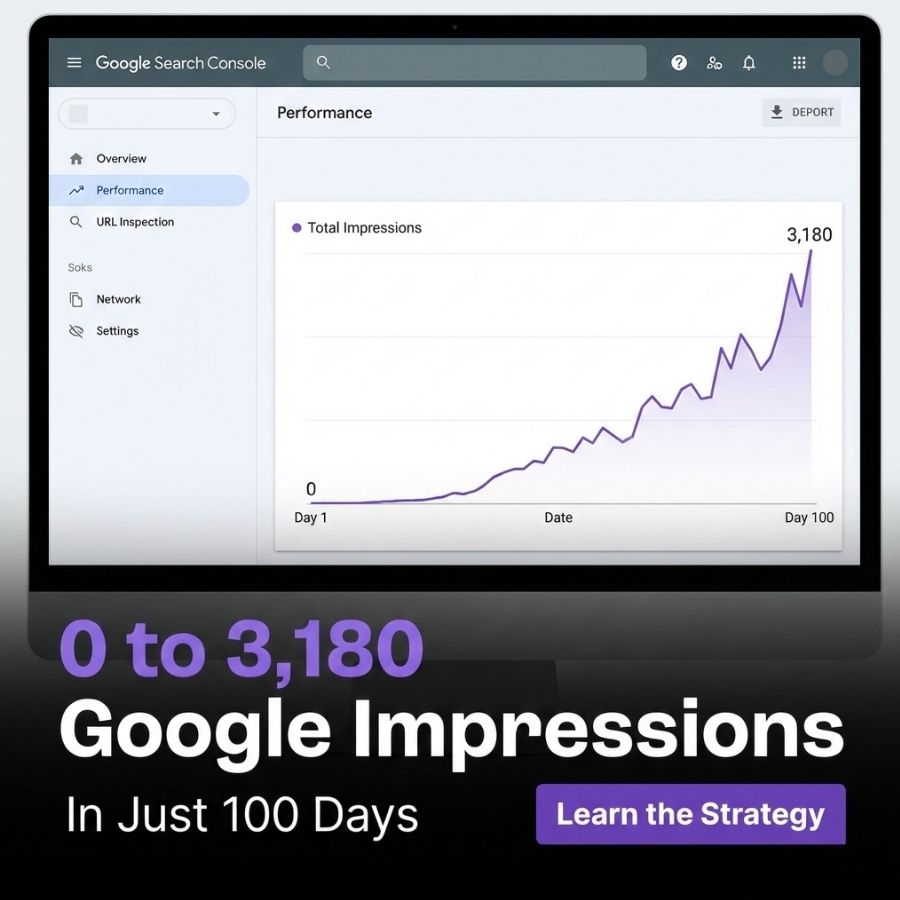
Set up Google Search Console. It’s free, and it tells you which searches are bringing people to your site. Without it, you’re guessing. With it, you can see what people typed before they found you, which pages get attention, and where your site has problems search engines noticed. Set it up once, then check it occasionally. That’s enough to make better decisions than most practices do.
High Impressions, No Clicks: What’s Going On
If you’re reading this because Search Console told you a page is getting impressions but nobody’s clicking, this is one of the most fixable SEO problems there is.
Impressions mean Google is showing your page in search results. No clicks mean searchers are seeing your title and description and choosing something else. The content usually isn’t the issue. The packaging is.
Two things to fix immediately:
Your title tag. This is the clickable headline in search results. If it’s generic, unclear, or doesn’t speak directly to what the searcher wants, they’ll skip it. Compare “What Is SEO?” to “SEO for Therapists: How to Get Found on Google and Fill Your Caseload.” One answers a vague question. The other speaks to a specific person with a specific goal.
Your meta description. This is the 150-160 character preview text under your title. It doesn’t directly affect rankings, but it dramatically affects whether someone clicks. Write it like a mini pitch: tell the reader exactly what they’ll get from the page and give them a reason to choose it over the nine other results.
Local SEO for a Private Practice
Most therapy is local. Even if you offer telehealth, clients usually want to know where you’re based and whether you serve their area. Local SEO is the set of signals that helps you appear for searches tied to a place, including the map pack, the three local results that show up prominently before the organic listings.
- Keep your practice name, address, and phone number identical everywhere they appear online
- Complete your Google Business Profile fully, including services, a description, hours, and photos
- Ask satisfied clients to leave honest reviews, and respond to them professionally
- Make sure your location and service area appear plainly on your website, not buried in a footer
- List your practice in a handful of relevant, legitimate directories rather than dozens of low-quality ones
Consistency is the point. When your details match across the web, search engines can confirm you’re a real, stable practice in a real place.
On-Page Optimization: Small Things That Add Up
On-page optimization covers the elements inside a page that help search engines understand it. None of it is glamorous, and all of it is fixable in an afternoon.
Once you’ve identified a keyword for a page, make sure it shows up in the page title, at least one subheading, the first paragraph, the meta description, the image alt text, and naturally through the body copy, without forcing it. Use one clear page title that describes the service and the location, and make sure it reads like something a human would click. Structure the page with headings that reflect real questions, so both readers and search engines can follow the logic.
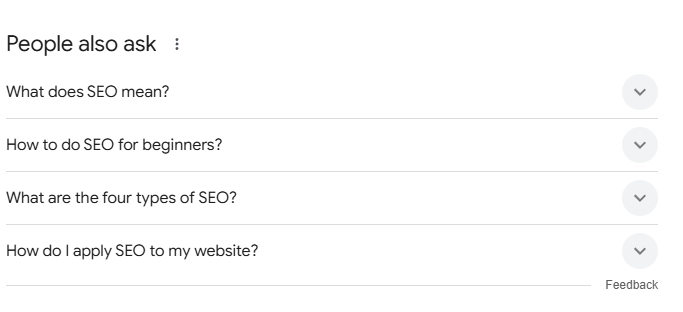
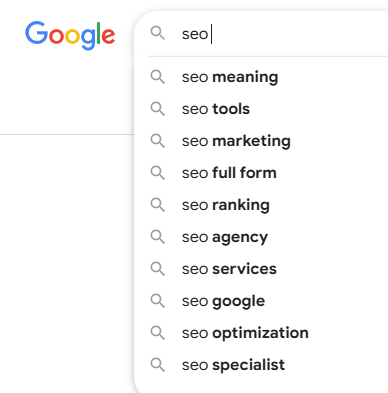
Finding keywords without paid tools. A free tool worth starting with is Answer Socrates, which shows you the exact questions people are searching around any topic, useful for generating blog ideas that already have proven demand. You can also use the Google search bar itself: start typing your specialty and location, and pay attention to the autocomplete suggestions. Scroll to the bottom of any results page for the “related searches” section, or check the “People Also Ask” boxes mixed into the results. All three are free and require no setup.
Link between your own pages (I use Link Whisper for this). Your anxiety page should link to your services overview, your About page, and your contact page. Internal links help search engines understand which pages matter and keep visitors moving toward booking.
Keep visitors from leaving once they land. If someone lands on your site and clicks away immediately, Google notices, and high bounce rates can hurt your rankings over time. Check that your site loads in about three seconds or less on a phone, since that’s where most people will find you. Make sure your navigation gets someone to your services or contact form in a couple of clicks, and that every page has one clear next step. If it’s not obvious how to book a consultation, most visitors simply won’t figure it out for you.
Content That Earns Trust and Builds Authority
Content is where therapy practices have a natural edge. You already know how to explain difficult things with care. Blog posts, guides, and plain-language answers to common questions give search engines more reasons to send people your way, and give visitors more reasons to trust you before they ever call.
Thin, surface-level posts rarely rank for competitive keywords. Google is looking for content that genuinely covers a topic with depth. For most therapy-related keywords, that means 800 to 1,500 words minimum, with real information, not filler. Write with a specific reader and a specific question in mind, then format so the answer is easy to find. Short paragraphs, descriptive headings, and a clear takeaway do more than a thousand words of general advice.
One therapist built a blog specifically around bariatric surgery psychological evaluations, a narrow, unglamorous niche most practices would skip. Since then, referrals from bariatric surgery centers increased, because the content demonstrated exactly the professionalism and clarity those referral sources were looking for. Narrow and specific beats broad and generic almost every time.
Backlinks in Plain Terms
A backlink is a link from another website to yours. When a reputable site links to your practice, it acts as a vote of confidence, and those votes help your pages rank. You earn them by being genuinely useful: contributing to local publications, being quoted in articles about mental health, getting listed in therapist directories like Psychology Today, Alma, Headway, or TherapyDen, partnering with community organizations, or writing something worth linking to.
You don’t need hundreds. A handful of links from relevant, trustworthy sources in your field or region will do more than a pile of links from sites nobody has heard of.
AI Visibility Is Now Part of the Picture
People increasingly ask an AI assistant a question instead of scrolling a list of blue links. That shift doesn’t replace SEO. It raises the bar for clarity.
Content that gets quoted by AI tools tends to be direct. It states an answer plainly, uses headings that match real questions, and avoids burying the point in paragraph five. If a section of your site answers one question thoroughly, it becomes easy to cite, whether a person reads it or a machine summarizes it.
Local SEO, on-page work, and AI visibility now sit together as the three layers of being findable. The good news is that all three reward the same habit: writing clearly for the person who is struggling right now.
Track What Is Working
Paying attention to what people are searching for, and why, separates SEO that works from SEO that just feels busy. Keep an eye on your analytics, but keep it simple.
I still remember pulling up Search Console for a new client early on and feeling my stomach drop. Six straight weeks of a flat impressions graph. It looks like failure the first time you see it. It’s usually just early, and the graph almost never tells you that in the moment. What matters more than any single week is the pattern over a few months.
- Which pages bring in the most visitors?
- Which pages lead to contact form submissions or calls?
- What search terms are new this month?
- Where do people leave your site most often?
Review these monthly. You’re looking for patterns, not perfection. If a page performs well, write more like it. If a service page gets traffic but no inquiries, the copy needs work, not more traffic.

An Order of Operations That Works
- Make sure every service has its own dedicated page
- Rewrite those pages in plain language clients actually use
- Set up Google Search Console and connect your analytics
- Clean up your local listings so details match everywhere
- Add a few blog posts answering the questions clients ask most
- Build a small number of quality links through community and professional connections
- Review your numbers each month and adjust
When It Makes Sense to Hire SEO Help
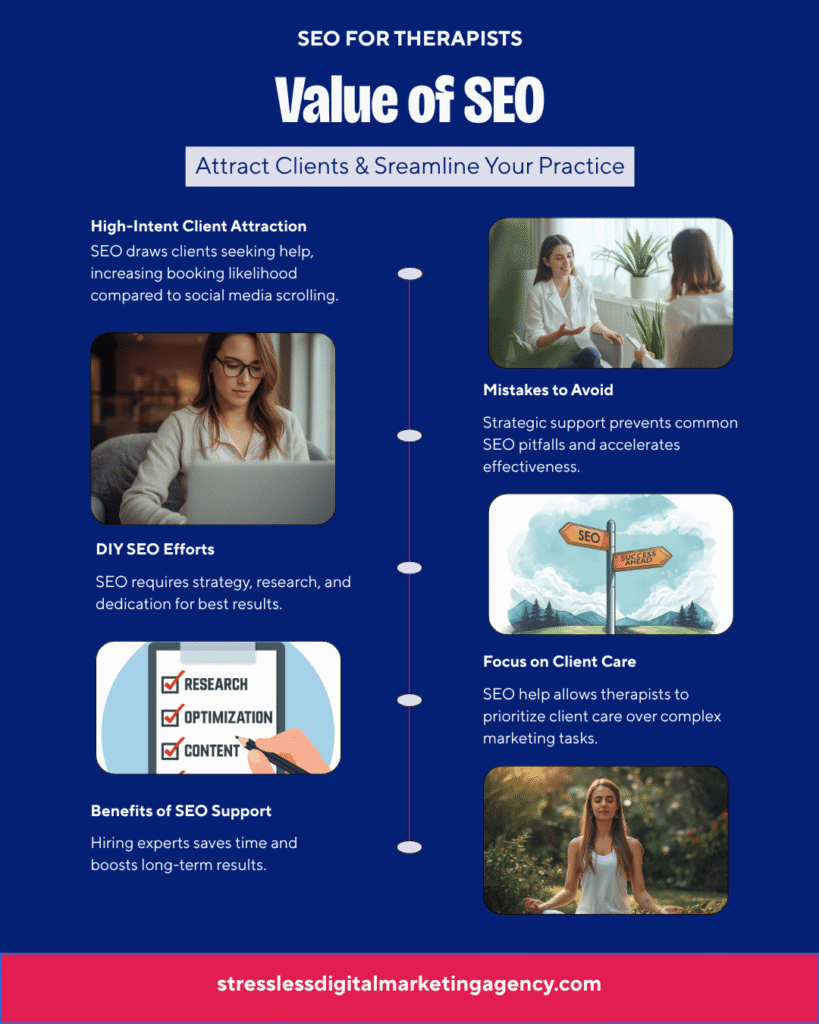
Here’s the honest math: even for someone who genuinely enjoys this work, a properly optimized blog post takes 4 to 6 hours. Not because the writing itself is slow, but because the optimizing is meticulous. Keyword research, formatting, internal linking, meta descriptions, and making sure everything aligns with what Google and AI are actually looking for. That’s the bulk of the work, and it’s the part that’s easy to underestimate.
Hiring help tends to be worth it if:
- You don’t have hours every week to spare, and content keeps sliding to the bottom of your list
- You want to protect your “first impression” with Google rather than guess your way through it
- You’d rather spend your time in your zone of genius, seeing clients, than tracking the latest algorithm update
I’ve watched therapists spend weeks Googling “how to do SEO” instead of booking new clients. That lost time is often more expensive than simply handing the work to someone who already knows it.
Frequently Asked Questions
Is SEO actually important for therapists?
Yes, because clients begin their search for mental health support on Google. If your practice isn’t visible in those results, someone else gets the call. SEO helps therapists connect with people who are actively searching for care, a very different audience from someone passively scrolling social media.
What should I focus on first if I have limited time?
Start with structure. Make sure each service has its own clear page, written in plain language people actually search. Then set up Google Search Console so you can see what’s already working. Those two steps fix the most common problems and give you real information before you spend time on anything else.
What are the best keywords for a therapy practice?
Think in categories rather than one magic phrase: the concerns you treat, the type of therapy you provide, the populations you work with, and the place you practice. Combine those into plain-language phrases people would actually type. Your own Search Console data will show you which of those searches already bring visitors, which is far more useful than a generic keyword list.
Do I need backlinks to rank?
They help, but they’re not the first thing to chase. A well-structured site with clear service pages and genuinely useful content will outperform a messy site with a few links every time. Once your foundation is solid, a handful of links from relevant, reputable sources in your field or region can strengthen your results.
Does SEO actually bring in clients, or just traffic?
It brings in clients, and the intent gap is the reason why. Someone scrolling Instagram might like a post about anxiety and keep scrolling. Someone searching “therapist for anxiety in Chicago” is looking to book, often that same week. SEO reaches people mid-decision, not mid-scroll.
Can I do this myself?
Much of it, yes. Service pages, plain-language rewrites, local listing cleanup, and a monthly analytics review are all manageable for a clinician with a few focused hours. Many practice owners eventually hand off the ongoing content and optimization work because their client hours matter more, and that’s a reasonable trade once your practice is established enough for the math to work.
Ready to Stop Guessing and Start Showing Up?
Every piece of this- the keyword research, the writing, the technical checklist- takes real time each month. This exact strategy, plus the mindset and messaging work that has to happen before any of it sticks, gets a full chapter treatment in Stay Booked. Download Chapter 1 free and see how it fits together.
Or if you want to start for free right now, grab the free blog templates built specifically for health and wellness providers. They give you a repeatable structure for writing SEO-informed posts even if you’ve never blogged before.
Also worth reading:
- SEO for Therapists: Is It Worth Your Time, Money, and Energy?
- Why SEO Matters More Than Social Media for Therapists and Coaches
- How to Build a Content Ecosystem for Your Health & Wellness Therapy Practice
- 3 Ways Your Blog Will Boost SEO and Your Client Bookings
- How SEO Blogs, Newsletters, and Website Copy Guide Clients to Say Yes
- How Long Does SEO Take to Work for a New Website?
- How to Use Google Search Console to Track Your SEO Performance
- Why Your Website Copy Is Not Converting (And How to Fix It)
- Is Content Marketing Necessary If I Get Referrals? Yes — 7 Reasons Why
Sources
- Semrush, “SEO Statistics” (citing Backlinko): less than 1% of searchers click through to the second page of Google results — https://www.semrush.com/blog/seo-statistics/
- MonsterInsights, citing HubSpot research: websites that blog get roughly 55% more traffic — https://www.monsterinsights.com/seo-statistics/