Sales Funnel Content Strategy for Service Providers: How Conversion Copywriting and Sales Psychology Guide Clients to Say Yes
My dog trainer once said something that completely reframed how I think about marketing. He was explaining why dogs stop listening mid-session: “If it’s not about them, they check out. You have to make them the center of every interaction, or you’ve already lost them.”
He was talking about my pitbull. But he was also, accidentally, describing exactly why most health and wellness websites do not convert.
Your potential client is scanning your site with one question in the back of their mind:
- Is this about me?
- Can this person see my situation specifically enough to actually help?
The moment your content answers that question — concretely, in their own language, at the exact stage of the decision process they are in — something shifts. They lean in. They keep reading.
They book.
This is sales psychology applied to copywriting, and it is what determines whether your content funnel produces consistent inquiries or a lot of activity with very little result.
Here is the thing most marketing advice skips: a sales funnel content strategy is not just a collection of content types. SEO blogs, newsletters, and website copy are the vehicles. Sales psychology and conversion copywriting are what power them. Without that layer, you end up with content that checks boxes but does not actually move people.
This post explains how each piece of the funnel works, the psychological mechanism behind it, and how conversion copywriting brings it to life at each stage.
Related: For a detailed breakdown of what an SEO copywriter does and how copy strategy drives the whole system, the SEO copywriting overview covers the full picture.
Key Takeaways
- A sales funnel content strategy only works when each stage is written with an understanding of where your potential client is in their decision process — not just what you want to say to them
- The psychological mechanism behind each content type matters as much as the content type itself: SEO blogs build awareness through relevance, newsletters build trust through familiarity, and website copy converts through specificity and pre-answered objections
- Conversion copywriting is the layer that connects all three — without it, even well-structured funnels produce traffic without inquiries
The Big Picture: How Sales Psychology Maps to Your Content Funnel (AIDA)
Every potential client moves through a predictable internal journey before they reach out. This is how humans make decisions about anything that involves vulnerability, money, or trust. The stages look like this:
- Awareness: Something in their life is not working, and they are finally acknowledging it. They are searching for information, reading, trying to understand. They do not yet know if you exist.
- Interest: They have found you. Now they are evaluating whether you understand their situation well enough to be worth more of their time. This is where they decide whether to keep reading or click away.
- Desire: They believe you can help. Now they are weighing whether you are the right fit specifically — comparing you to alternatives, reading your about page, looking for reasons to trust you over anyone else.
- Action: They are ready to reach out. What happens at this stage depends entirely on whether the copy gives them a clear, frictionless next step at the exact moment they are ready to take it.
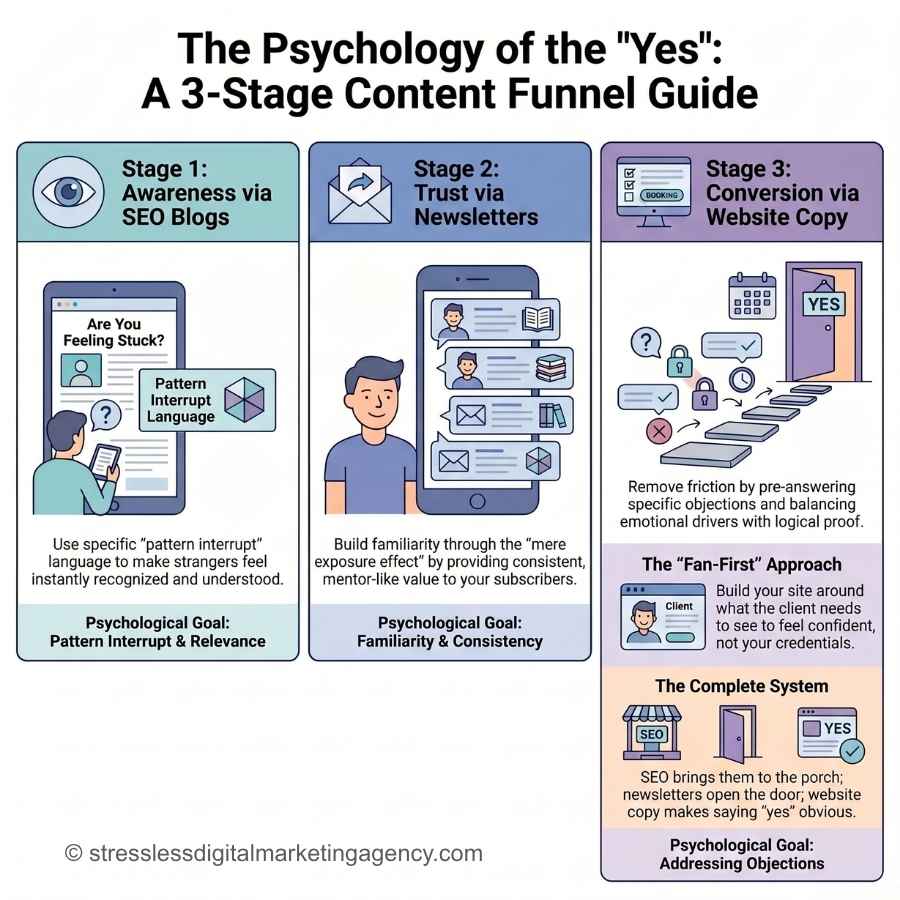
Your content funnel exists to support each stage of this journey. SEO blogs bring in the Awareness-stage reader. Newsletters move a warm reader through Interest and into Desire. Website copy handles Desire and Action — it is where the decision actually happens.
Understanding which stage each piece of content is responsible for changes how you write it. The copy that works for a stranger who has never heard of you is not the same copy that converts someone who has been on your email list for three months. Sales psychology is the discipline of knowing the difference — and writing accordingly.

Stage One, Top Of Funnel: SEO Blogs and the Psychology of Awareness
I opened my private practice in 2020. Private pay. I had done everything I was supposed to do — got licensed, set up a Psychology Today profile, let the word spread through my network.
And then I waited. For months.
What I did not understand yet was that the people who needed my help were not waiting for a referral. They were on Google. Typing in questions at 11pm, searching for someone who could describe their problem better than they could describe it themselves. And I was invisible to all of them because my website had not been built to meet them where they were searching.
That is the awareness problem. And it is the one most health and wellness businesses have without knowing it.
SEO blogs solve the awareness problem by getting your content in front of people who are actively searching for what you offer — before they have any idea you exist. Not through advertising, not through networking, but through organic search. When someone types “why do I feel exhausted no matter how much I sleep” or “how to stop people-pleasing at work” into Google, a well-optimized blog post can be the first place they land that actually makes them feel understood.
THE SALES PSYCHOLOGY AT THIS STAGE
At the awareness stage, your reader has not given you their trust yet. They landed on your page through a search result, which means you had about three seconds to earn their attention before they hit the back button. The psychological principle at work here is pattern interrupt: your opening line needs to name their situation specifically enough that they feel recognized. Not described in general terms — recognized. There is a difference.
Generic: “Many people struggle with anxiety in today’s world.”
Specific: “You do everything right on paper. Full schedule, solid reputation, people who depend on you. And you are exhausted in a way that a weekend off does not fix.”
The second one stops the right person mid-scroll because it describes their actual life, not a category they belong to. That specificity is what SEO blog copy does at its best — and it requires the same voice-of-customer research that drives the rest of the funnel. You are not guessing at what your reader is thinking. You are pulling from the language your actual clients use to describe their experience.
WHAT THIS LOOKS LIKE IN PRACTICE
An awareness-stage blog post is not a sales pitch. It is a useful, educational piece of content that answers a question your ideal client is genuinely asking, written in a way that makes them feel understood rather than lectured to. The copy should be light in personal disclosure but heavy in relevance — think knowledgeable colleague, not confessional. Your reader does not yet know you well enough for depth. They just need to feel seen enough to keep reading.
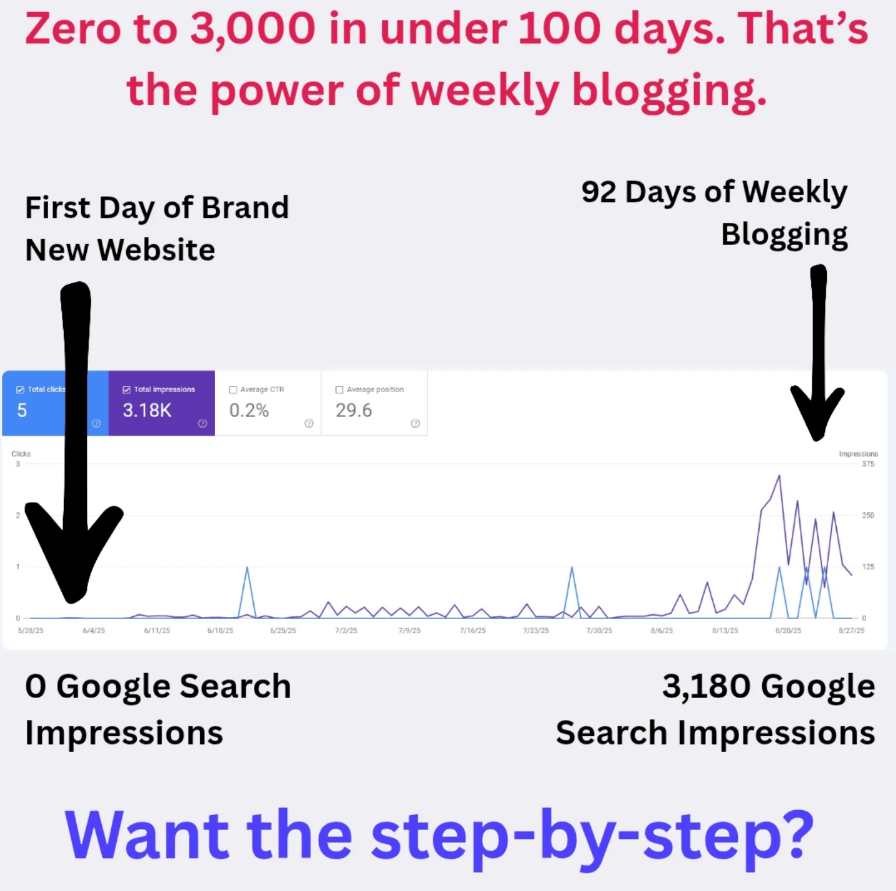
The data from this 92-day case study reflects exactly what awareness-stage content is designed to do: build a consistent stream of new visitors from organic search. Those are not paid clicks. They are people who found this content because it answered something they were already looking for.
Related Read: Understanding the mechanics of how SEO and copywriting work together is covered in detail in the post on copy for a website that converts
Stage Two, Middle Of Funnel: Newsletters and the Psychology of Trust
Once someone has read your blog and felt understood, a certain percentage will want to stay connected. They already feel seen. Now they want more consistent contact — a reason to keep coming back.
This is the interest-to-desire stage, and it is where the relationship between your content and your potential client deepens from “this person seems to get it” to “I think this is the person who can help me.” The newsletter is the primary vehicle for that deepening — and the psychology behind why it works is more specific than most people realize.
THE SALES PSYCHOLOGY AT THIS STAGE
Trust is not built through expertise alone. It is built through familiarity and consistency over time. Your potential client is on your list because your content already resonated. What the newsletter does is repeat that experience, regularly, until familiarity tips into genuine confidence.
There is a psychological principle at work here called the “mere exposure effect” — humans tend to develop a preference for things they encounter repeatedly. It is why a song you initially ignored becomes one you know all the words to after a few weeks on the radio. Consistent newsletter content creates that same effect. Your reader keeps seeing your name, your thinking, your point of view. Over time, that repetition builds the kind of familiarity that feels like trust.
But — and this is where conversion copywriting matters more than most people expect — the newsletter only builds trust if it is written in a way that continues to make the reader the center of the experience. The moment newsletter content becomes primarily about you, it stops building the right relationship. Your reader’s attention is not guaranteed. It is earned, every single issue, by making them feel that what you have to say is relevant to their life right now.
WHAT THIS LOOKS LIKE IN PRACTICE
Newsletter copy lives at a deeper emotional register than SEO blog content. This is where you share meaningful reflections, patterns you observe in your work, and personal anecdotes that illuminate something your reader is navigating. Not a diary — a mentor’s perspective. Warm and human enough to feel like a real relationship, grounded and purposeful enough to reinforce confidence in your expertise.
The goal is not to sell in every email. It is to be present, consistently, in a way that makes reaching out feel like the natural next step when the reader is finally ready — rather than a cold leap to a stranger.
The ROI on email marketing is well-documented. For every $1 spent on email marketing, some reports show businesses can see as much as $43 back. An average open rate around 27% outperforms most social media platforms significantly. But those numbers only hold when the content is genuinely valuable — which means written with the reader’s experience at the center, not the sender’s agenda.
Related Read: How to Build an Email Content Strategy That Converts

Stage Three, Bottom Of Funnel: Website Copy and the Psychology of Conversion
I took my daughter to a Savanna Bananas baseball game last summer. Their whole philosophy is “fan first” — every single decision about the experience is built around the audience’s enjoyment. The seats, the entertainment, the concessions, the pacing. Nothing about the experience was designed for the organization’s convenience. It was all designed for us.
I could not stop thinking about how different that is from most health and wellness websites.
Most practice websites are built around the practice owner’s preferences. Credentials that feel important to display. Methodology that feels professionally significant. A structure that makes sense to someone who already understands the field. And then a visitor arrives — someone who has been working up the courage to finally look for help, who is quietly asking “is this about me?” — and the answer the page gives them is: not really.
Fan-first website copy flips that entirely. Every page is built around the question: what does my ideal client need to see, at this exact moment, to feel confident enough to take the next step?
THE SALES PSYCHOLOGY AT THIS STAGE
By the time a potential client reaches your website’s service pages or contact page, they are at the Desire-to-Action stage. They are not undecided about whether to get help — they are deciding whether you are the right person to provide it. The psychology operating here is entirely different from the awareness stage.
At this stage, the primary conversion barriers are objections and uncertainty. Your reader is carrying questions they may not have articulated yet: Will this work for me specifically? What does the process actually look like? What happens after I reach out? Is this worth the investment? Copy that anticipates and pre-answers those questions removes the friction that stands between interest and action.
This is where voice-of-customer research becomes most critical. The objections your ideal client carries are not generic — they are specific to your niche, your service type, your fee structure, your approach. A functional medicine client’s hesitations are different from a therapy client’s, which are different again from a health coaching client’s. Conversion copywriting built on actual client language — the phrases people use in reviews, in intake conversations, in the questions they ask before booking — addresses the specific version of doubt your reader is carrying. Generic copy cannot do that.
There is also the question of what the copy leads with. Purchases — especially in health and wellness — are driven as much by emotion as by logic. A client might pursue functional medicine not just to improve a lab value, but to finally feel confident in their own body again. A therapy client might be seeking not just symptom reduction, but the reassurance that someone can hold the complexity of their situation without reducing it. Website copy that only addresses the logical case for your service — credentials, modality, process — misses the emotional driver that actually motivates action.
The copy has to do both: affirm the emotional need and support it with the logical case. That is the dual job of conversion copywriting at the bottom of the funnel.
WHAT THIS LOOKS LIKE IN PRACTICE
Strong website copy at this stage does several specific things. It opens with the reader’s experience rather than the provider’s credentials. It explains the transformation concretely — not “you will feel better” but a specific, sensory description of what changes. It addresses objections before the reader has to ask them, which reduces friction at the exact moment it matters most. And it places the CTA at the moment of highest trust rather than only at the bottom of the page.
The specific pages that carry the most conversion weight — homepage, service pages, about page, contact page — each have a distinct psychological job. Understanding which job each page is doing changes how every section of that page should be written.
For a full breakdown of the most common reasons website copy stops converting — and the specific fixes for each — the post on why website copy isn’t converting goes through each failure point in detail.

How the Three Stages Work as a System
Here is what it looks like when all three stages are working together with conversion copywriting doing its job at each one.
Someone searches for “why do I shut down during conflict” and lands on an SEO blog post that describes that experience so specifically that they feel like the post was written for them. That is the awareness stage doing its job: an SEO-optimized piece of content surfaces to the right person at the right moment because it was built around the language they actually search.
They subscribe to the newsletter. Over the following weeks, they receive consistent, thoughtful emails that continue to mirror their experience and build genuine familiarity with your voice and perspective. They are not being sold to — they are being shown, repeatedly, that you understand their world. That is the trust-building stage compounding.
And then one day, something tips. They have been thinking about reaching out for weeks. They head to the services page. The copy there does not list modalities and session formats. It opens with a description of their situation that feels accurate. It walks them through what the process actually looks like. It answers the question they have been quietly carrying — “will this actually work for me?” — before they have to ask it. And there, at the exact moment they feel most ready, is a clear, warm invitation to take the next step.
SEO brings the stranger to the front porch. The newsletter builds the relationship that makes the door feel safe to knock on. The website copy answers the door in a way that makes saying yes feel obvious.
Remove any stage, and the system breaks. You can have traffic without conversions. You can have a warm list that never books. You can have compelling website copy that nobody ever finds. The system only works when all three stages are written with the psychology of that stage in mind — and when the copy across all three is consistent enough that the reader feels like they are building a relationship with one coherent voice, not three separate pieces of content.
If you are trying to figure out whether a missing or underperforming stage is behind your own traffic-without-inquiries problem, the diagnostic post on why visitors aren’t becoming clients is worth reading before you start rewriting anything.
What This Means for Your Marketing Right Now
You do not need to rebuild everything at once. But you do need to be honest about which stage of your funnel is underperforming — because fixing the wrong one wastes time and money.
If you have very little organic traffic, the awareness stage is broken. You need SEO-optimized content that answers the questions your ideal clients are actively searching. More social media posts will not fix this. More networking will not fix this. Content that shows up in search will.
If you have traffic but low conversion, the problem is almost certainly in the website copy. The visitors are arriving — they are just not finding the copy that makes them feel seen specifically enough to reach out. That is a sales psychology and conversion copywriting problem, not a design problem.
If you have a warm list but low bookings, the middle-to-bottom transition is leaking. Either your newsletter is not building the kind of trust that eventually tips into readiness, or your service pages are not doing the conversion work once a ready reader arrives.
Most practices have at least one stage that is either missing or not written with the psychology of that stage in mind. Identifying which one it is first is how you fix the right problem.
For a comparison of how an SEO copywriter, a web designer, and an SEO agency each contribute to building this system — and which one to hire for which problem — the breakdown of all three roles covers that clearly.
Ready to Build a Funnel That Actually Converts?
A sales funnel content strategy is not a set-it-and-forget-it project. But it is a build-once-and-compound system — meaning the blog posts you write today, the website copy you get right this year, and the email list you grow consistently will be doing conversion work for you years from now without starting over every Monday.
That is the difference between owned visibility and rented visibility. Social media, directories, paid ads — these only work while you are actively feeding them. A well-built content funnel, grounded in conversion copywriting and sales psychology, keeps working whether you post this week or not.
If you want to understand what getting this built for you looks like — what the process involves, what the investment is, and what the realistic timeline to results looks like — download the price and services guide.
Not sure which stage of your funnel is the weak point? The free marketing quiz identifies your biggest visibility gap in about two minutes.