Brand Voice for Service Providers: What It Is, Why It Matters, and How to Build Yours
When I opened my private practice, I was convinced my credentials would do the talking. I had the training, the specialty, the clinical hours. I figured that once people could see my background, they would understand why I was the right fit. I was wrong.
For almost a year, I went weeks at a time without a single inquiry. My Psychology Today profile sat there, accurate and professional, listing everything I was qualified to do. And it did almost nothing. Not because the information was wrong, but because it read like a resume. Clients searching for a therapist are not reading resumes. They are looking for a human being they feel safe discussing their most vulnerable thoughts and fears with.
That realization is what eventually led me to work with a copywriter who helped me translate what I actually knew (specifically my brain injury and stroke specialty) into language that connected with the people I was built to help. When I finally stopped trying to sound like every other clinician and started sounding like myself, something shifted. Within seven days of updating my profile with that new copy, my phone started ringing again.
I tell that story not to make a point about Psychology Today, but to make a point about brand voice. Because what changed was not my credentials. Those had not moved. What changed was how I communicated what made me different, and who I was speaking to when I wrote it.
That is what brand voice does, and what I will be diving deeper into throughout this post.
What Is Brand Voice?
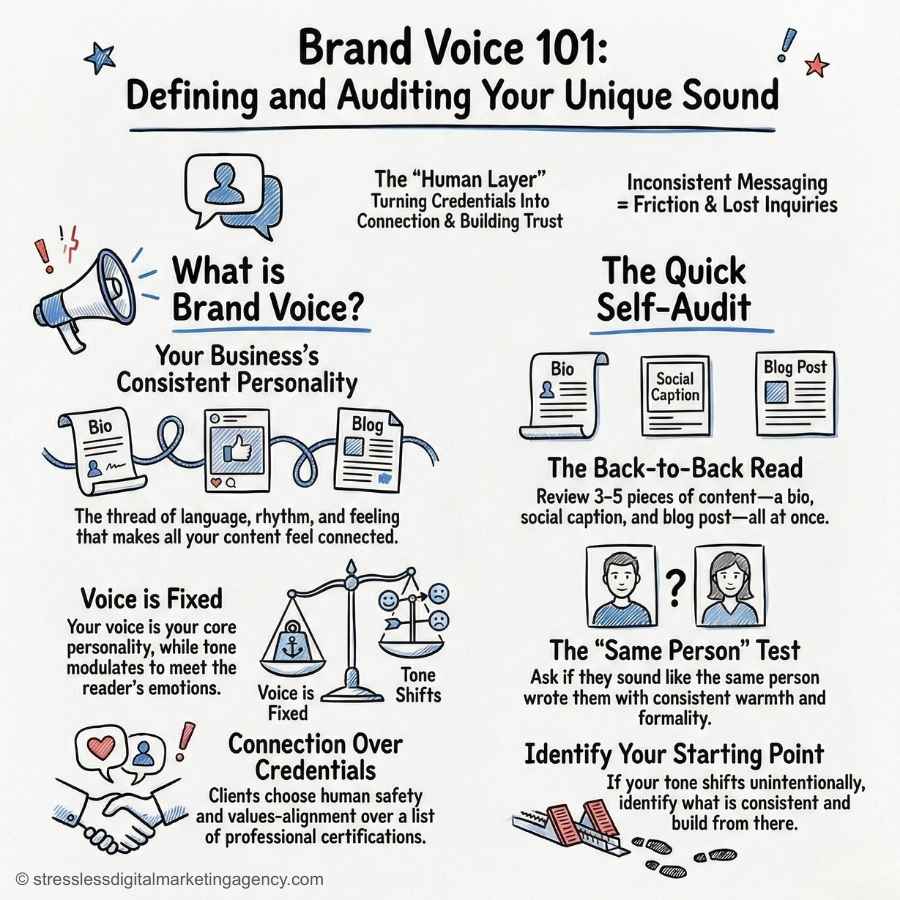
Brand voice is the consistent personality your business communicates through language. It is how you sound in writing — the words you choose, the rhythm of your sentences, and the feeling someone gets after reading your content.
Brand voice is the thread that makes your website, blog, emails, and social content feel like they came from the same person. Because they should.
| Think of it this way: Your brand voice is who you are as a practitioner: your values, your worldview, your approach to care. It does not change depending on what you are writing. What shifts is your tone — the way you express that voice, depending on the context. More on that distinction in the next section. |
For health and wellness providers, especially, this matters in a way that goes beyond marketing. When someone is deciding whether to work with a therapist, a coach, a dietitian, or any service provider in this space, they are making a trust decision before they ever book a call. Your brand voice is what either builds that trust or quietly undermines it.
Brand Voice vs. Brand Tone: Why Both Matter for Service Providers
Brand voice and brand tone are related but not interchangeable, and confusing them is one of the most common reasons service providers end up with messaging that feels inconsistent.
Your brand voice is fixed. It is the core personality of your business in written form. Warm, direct, evidence-based, approachable, no-nonsense — whatever combination of traits reflects how you genuinely show up in your work. It does not change between an Instagram caption and a service page.
Your brand tone shifts. Tone is how your voice adapts to the context and the emotional state of your reader. A welcome email might carry a warmer, more conversational feel. A blog post on a clinical topic might be more measured. A social post might be lighter and more direct. The voice underneath stays the same. The tone modulates around it.
For service providers, this distinction matters because your potential clients move through different emotional states before they ever book. They need to feel informed, then understood, then confident enough to take action. Your voice builds recognition over time. Your tone meets them where they are in the moment.
How Your Brand Voice Affects Your SEO and Client Trust
Most service providers think of brand voice as something to polish after the real marketing work is done. But your brand voice directly shapes two of the most important factors in your online growth: search visibility and client conversion.
Brand Voice and SEO
Search engines rank content that demonstrates expertise, authority, and trustworthiness. Your brand voice is the human layer that makes those signals legible to real readers.
When your content sounds consistent, specific, and genuinely knowledgeable, it builds topical authority — the signal Google uses to determine whether your site deserves to rank for a cluster of related searches. Generic, interchangeable copy does not build that. Distinct, voice-driven content does.
Brand voice also affects the behavioral signals that influence rankings. When your writing sounds like you, readers stay on the page longer, engage more, and are more likely to click through to a second page. Those signals tell search engines your content is worth surfacing again.
Brand Voice and Client Trust
For health and wellness providers, trust is the conversion mechanism. Clients are not purchasing a product. They are deciding whether to invite someone into one of the most personal areas of their lives. A website that sounds clinical, generic, or inconsistent does not earn that trust.
A clear, consistent brand voice does three things before a client ever books: it signals competence, communicates values alignment, and creates the sense of familiarity that makes someone feel safe enough to reach out.
This matters even more if you areout-of-network or private pay. When a client is choosing to invest real money without the buffer of insurance coverage, they need more than a credential list. They need to understand specifically why you are worth it. Your brand voice is what makes that case — not your CV.
| The bottom line: Your brand voice is not separate from your SEO strategy. It is what makes your SEO strategy work by turning search traffic into actual client inquiries. |
What Unclear Messaging Costs You in Bookings
Vague brand messaging is not neutral. It actively costs you clients, and most providers do not realize it is happening because the damage is invisible. You do not see the people who landed on your website, could not figure out what made you different, and left without ever reaching out.
Here is what unclear messaging looks like in practice:
- A homepage that lists modalities and credentials but never speaks to what a client actually feels or needs
- A bio that reads like a resume instead of an introduction to a real human being
- Blog content that could have been written by anyone in your field — no distinct perspective, no recognizable voice
- Social captions that go quiet for weeks, then come back sounding like a different person
Each of these is a brand voice problem. And each one creates friction at the exact moment a potential client is deciding whether to trust you enough to reach out.
| Before I worked with a copywriter, my practice depended entirely on word-of-mouth and whoever happened to find my Psychology Today profile. I went weeks without a single inquiry. After I finally had copy that communicated my brain injury specialty in language that clients could actually connect with, I started getting calls within seven days of updating my profile. The credentials had not changed. The voice had. |
The compounding cost is not just lost bookings today. It is the exhausting loop of manual outreach and referral networking you stay stuck in when your website is not doing its job. Referrals are valuable. But they are not scalable. A clear brand voice, applied consistently to your website and content, is what turns your online presence into something that generates inquiries while you are actually seeing clients.
| A question worth sitting with: If a potential ideal client landed on your website right now, with no prior introduction, would they immediately understand who you help, how you help them, and why you are the right fit? If the answer is anything other than a clear yes, your brand voice work starts there. |

How to Build Your Brand Voice as a Health and Wellness Provider
Building a brand voice is not about manufacturing a persona. It is about excavating the one you already have and creating a framework to express it consistently. Years after working with that first copywriter, I went through a full brand strategy process with a brand specialist. Her questions surprised me.
She did not start with my services or my target market. She asked about my personal life. My values. What I cared about outside of work. What my ideal client does in their free time. What I never wanted to be associated with. By the time I walked out of that session, I remember thinking: that felt exactly like an intake assessment.
It made sense. The questions that help a therapist understand a new client are the same questions that help a brand strategist understand what makes a business truly distinct. Not your modalities. Not your credentials. The whole human picture behind the practice.
Here is a starting framework you can work through on your own:
1. Name Your Core Traits
Identify three to five adjectives that describe how your brand communicates. Not how you want clients to feel — how you actually sound. Warm and direct. Evidence-based and approachable. Calm and no-nonsense. These become the anchor for every content decision you make going forward.
2. Define What You Say and What You Do Not Say
A strong brand voice is as much about what you avoid as what you use. If you never use clinical jargon in your marketing, say so. If you use inclusive, non-stigmatizing language, make it explicit. If fear-based messaging is off-limits, document it. This becomes the guardrail that keeps your content consistent even when someone else is writing it.
3. Listen to How You Actually Talk
Record yourself explaining your work out loud, or pull from a consultation transcript. The words you reach for naturally, the analogies you use, the way you put someone at ease in a first conversation — that is your brand voice in its rawest form. Start there.
4. Ask the Personal Questions
Some of the most revealing brand voice work comes from the same questions you would ask a new client. What do you value most in how you do your work? What do you never want to be? What does your ideal client care about outside of their presenting problem? What would it mean to them to find you? The answers to those questions are the foundation of a voice that actually resonates.
5. Create a Repeatable Reference
A brand voice guide does not need to be a 40-page document. It needs to be something you — or anyone writing for your brand — can actually reference. A one-page summary with your voice traits, key phrases, your do-not-use list, and two or three writing samples is enough to create consistency across everything you publish.
6. Apply It Everywhere, Consistently
Your website. Your blog. Your email nurture sequence. Your social captions. Brand voice only builds recognition when it shows up everywhere and consistently. One great piece of writing in your voice does less than twelve consistent pieces across a year.
All Resources on Brand Voice and Messaging
- What Are Brand Voice Guidelines (And Why Do They Matter)?
- Brand Voice vs. Brand Tone: Why the Difference Matters for Your Therapy Practice
- Why Therapy Practices Need Foundational Messaging Before Any Other Marketing
Ready to Stop Guessing and Start Sounding Like Yourself?
The work I described above — finding your voice, excavating what makes you distinct, building a framework you can actually use — is exactly what the Foundational Messaging Map is designed to do.
In a single structured session, we go deep on your brand voice, ideal client profile, core offers, and the transformation you provide. The questions feel less like a marketing exercise and more like the kind of intake conversation that gets to what actually matters. You walk away with a polished document that includes your positioning statement, core messaging pillars, and a language guide — what to say, and what to stop saying.
No more copy that sounds like everyone else. No more second-guessing what to put on your homepage. Just clear, specific messaging that sounds like you and speaks directly to the clients you are built to help.
Get Clarity on Your Brand Voice
Download the Price and Service Guide to learn about the Foundational Messaging Map and see if it is the right next step for your practice.
Not ready to dive in yet? Start here for free:
- Quiz: What’s Keeping You Stuck With Marketing? — Find your #1 visibility blocker in under 3 minutes
- [Freebie] Stop Panicking When Clients Graduate: Your Website’s Guide to Organic Inquiries
- Free Blog Templates For Service Providers: Designed Specifically For Health & Wellness Clinicians