Marketing for Private Practice: Why SEO & Copywriting Are Your 24/7 Sales Team

Why Your Graduate Degree Didn’t Teach You the Most Important Business Skill (And What to Do About It)
You spent years mastering clinical nuance. Trauma responses, attachment patterns, nervous system regulation — whatever your specialty, you went deep, and it shows in your work.
But here is what your degree almost certainly left out: how to actually get clients.
Not through word-of-mouth, which is unpredictable and completely outside your control. Not through insurance panels, which pay you a fraction of what your expertise is worth. Through a system — one that consistently attracts the right people even when you are not actively marketing, even when you are fully booked, even when your top referral source takes a sabbatical.
If you are currently DIY-ing your website at 10pm after a full day of sessions, rewriting the same homepage paragraph for the fourth time, and still not getting inquiries, you are stuck in what I think of as the messy middle. You have the clinical expertise. You are genuinely good at this work. What you are missing is not more effort. It is the two systems that do the selling while you focus on the serving.
The first is SEO, your 24/7 matchmaker. The second is strategic copywriting, your 24/7 salesperson. This post is about both: what they are, why clinicians specifically struggle without them, and how to stop running a business that requires you to be the whole system.
Key Points:
- Clinical excellence is the product; SEO and strategic copywriting are the distribution — and one without the other leaves a practice invisible regardless of how good the clinical work is
- Most therapist marketing fails not because of effort but because of a systems problem: scattered tactics instead of a connected, compounding ecosystem
- The CEO mindset shift — from reactive posting to a proactive content system — separates practices that compound their visibility from those that perpetually start over
- Search intent is the mechanism that makes SEO more valuable than social media for private practice growth
- One well-structured blog post generates an entire month of marketing content when it is built inside a real ecosystem
The Myth That Is Keeping You Invisible
There is a belief that floats around private practice circles: if I’m good enough at what I do, clients will find me. I believed it when I opened my own practice. I was not expecting to spend months in near-silence waiting for referrals that trickled in slowly, wondering what I was missing.
Here is what that belief gets backwards. Clinical excellence is the product. SEO and copywriting are the distribution. You can be the most skilled therapist in your city and still be completely invisible to the person sitting at their kitchen table at midnight, finally ready to ask for help, typing a search into Google that you could have answered perfectly — if your website had shown up.
That person does not find you because you are good. They find you because your website is built to be found. The mechanics of that are learnable, buildable, and entirely separate from your clinical skill. And the good news is that you do not have to figure them out from scratch.
Why DIY Marketing Burns You Out (And Why That Is Not a Willpower Problem)
Nobody in your graduate program covered keyword research, conversion copywriting, or how to structure a blog post so Google ranks it alongside everything else you learned to do for your clients. And yet, the moment you open a private practice, all of that lands on your plate — on top of clinical hours, documentation, continuing education, and running an actual business.
The pattern most practice owners recognize immediately when they hear it described: you know you should be blogging, but you have not posted in months. You spent real hours rewriting your website and still are not getting inquiries. You post on social media occasionally and it feels like shouting into an empty room. Your income is tied to referrals that arrive unpredictably, and the whole thing feels like a cycle you cannot get ahead of no matter how hard you work.
This is not a motivation problem. It is a systems problem. Marketing does not work when you are the system — when every piece of content requires you to start from scratch, when every month depends on whether the right person happened to mention your name, when there is no structure running underneath any of it. The answer is not to try harder at the scattered approach. It is to replace scattered with strategic.
For a clear look at how the four main marketing channels available to private practice owners actually compare — SEO, referrals, paid ads, and social media — and which ones build lasting assets versus which ones reset to zero the moment you stop paying, this breakdown of marketing strategy for private practice covers the full channel landscape.
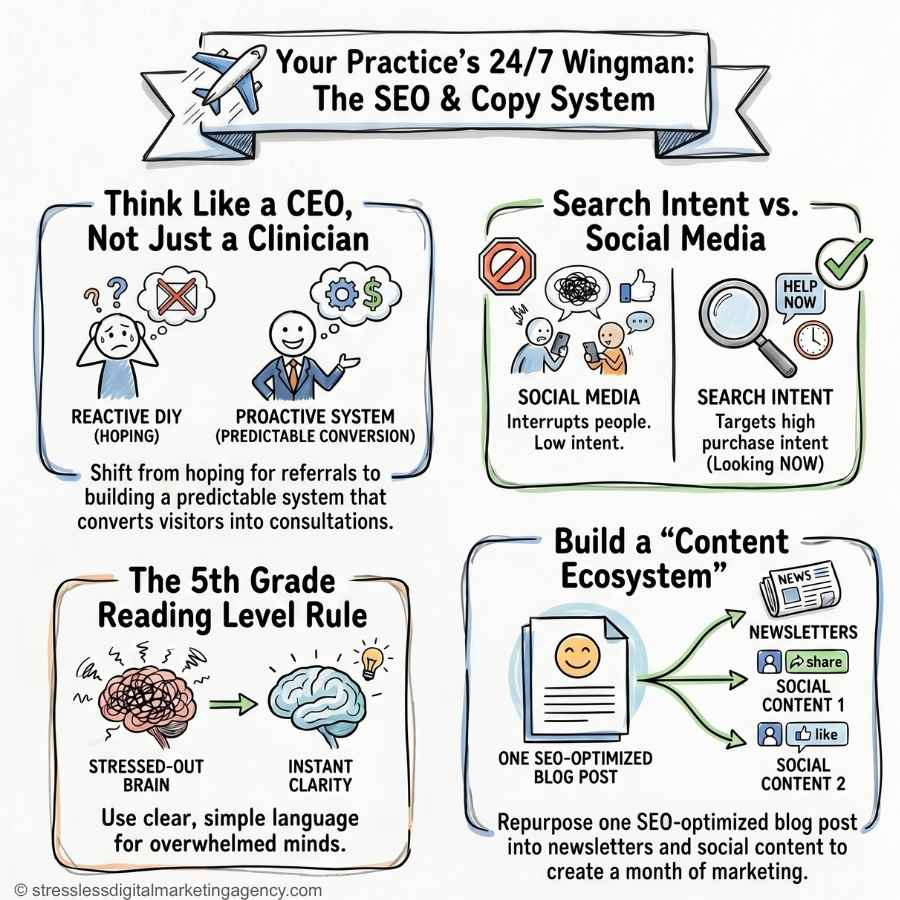
The CEO Mindset Shift: From Practitioner to Business Owner
The shift that changes everything is not a new tactic. It is a completely different frame.
From: “I need to post on Instagram today” — reactive, guilt-driven, producing content that disappears from feeds in hours. To: “I have a content ecosystem that works 24/7” — proactive and structured, producing assets that compound in value over time.
From: “I’ll write a blog when I have time” — which, honestly, means never. To: “My SEO blogs bring in new clients every month” — predictable visibility that does not require you to keep feeding it.
From: “I hope someone refers me a client this month” — anxious and dependent on other people’s decisions. To: “My website converts visitors into consultations” — consistent, running whether you are in session, on vacation, or asleep.
That is the CEO mindset. It is not about doing more. It is about building systems that run without you needing to tend them daily. And it starts with understanding two things that most therapist marketing completely skips: search intent and content ecosystems.
Marketing for Private Practice: Why Search Intent Matters More Than Follower Count
Most marketing advice aimed at therapists centers on social media. Show up consistently. Post educational content. Build an audience. And there is a place for that in a complete marketing strategy — but it is a supplemental role, not a foundational one, and here is the structural reason why.
Social media is disruptive marketing. You are trying to stop someone’s scroll while they are looking at their cousin’s vacation photos or watching a cooking video. They are not looking for help right now. You are interrupting them and hoping they happen to be ready. The conversion rate on that kind of attention is low because the timing almost never aligns with the need.
SEO is the opposite. When someone types “anxiety therapist in [your city]” or “EMDR for childhood trauma near me” into Google, they have already made the decision to get help. They are not browsing. They are actively looking for someone specific to call. That high purchase intent is what makes SEO a more powerful lead source for private practice — and why SEO outperforms social media for practices that want consistent, predictable inquiries rather than occasional visibility spikes.
3 Strategic Shifts to Make Your Marketing Actually Work
1. Stop Writing for Your Licensing Board
Most therapy website copy is written as if a clinical supervisor might read it. The language is precise and professional and almost entirely opaque to the person who actually needs to feel seen in it. “I utilize evidence-based modalities including cognitive behavioral interventions and trauma-focused psychodynamic approaches,” tells a potential client almost nothing about whether you can help them.
Compare that to: “I help people who feel anxious all the time learn how to calm their nervous system and feel safe in their own body.” That version is no less accurate. It is translated — rendered in the language of someone whose nervous system is overwhelmed and who needs to recognize themselves in what they are reading. Your website’s job is not to demonstrate competence to your peers. It is to make a stranger feel understood before they have ever spoken to you.
This translation layer is especially high-stakes for practices trying to attract private-pay clients, where a potential client is already weighing a significant out-of-pocket investment. If your copy does not make the value obvious in plain language, the rate on your service page does all the wrong work.
2. Build a Content Ecosystem, Not Random Posts
One well-written, SEO-optimized blog post built around a keyword your ideal clients are already searching for does something that ten scattered social posts cannot. It ranks on Google. It generates traffic weeks and months after you publish it. It links to your service pages and warms up the people who land on them. And because it is a real piece of content with shelf life, it can be repurposed: sent to your email list as a newsletter, broken into social captions, referenced in future posts.
One strategic blog post can fuel an entire month of marketing content. That is what an ecosystem does — it creates compounding return on a single investment of effort, rather than requiring you to start from scratch every single week. For the full breakdown of how that structure works, this guide on building a content ecosystem covers every layer: blogs, website copy, email, and the internal linking that makes them work together.
3. Check the Technical Basics Before You Blame Your Content
Sometimes your marketing is not working because of a simple technical issue — not because your content is bad or your copy is wrong. Your sitemap may not be connected to Google Search Console. Your site may be loading slowly on mobile. You may have broken internal links, sending visitors to dead pages.
I spent weeks on my own site, wondering why traffic was not growing, assuming the problem was my content. Eventually, I discovered that my sitemaps were not connected to Search Console at all — Google was not even being told to come look. The fix took minutes. The lesson took longer: always check the technical basics before you diagnose a content problem that may not exist.
What a Real Content Ecosystem Looks Like
Your website is the home base. Every other piece of content you create should connect back to it. Here is what the full structure looks like:
SEO blogs are the entry point — they get found by people actively searching, bring new traffic to your site, and link internally to your service pages so that traffic actually has somewhere to go. The no-fluff SEO guide for therapists breaks down exactly how this works from keyword selection through on-page structure.
Strategic website copy makes visitors feel understood once they arrive. It speaks their language, reflects their specific situation back to them, and makes the next step feel obvious rather than uncertain.
Email newsletters maintain the relationship over time. A subscriber who found you through a blog post is not necessarily ready to book that week — but with consistent, valuable email content, you stay in their consideration until they are.
Service pages are the close. This is where a visitor who already trusts you decides to reach out. If your service pages still read like clinical intake forms, even warm leads will hesitate at the finish line.
Those four elements working together is a system. Any one of them alone is just a tactic.
What Happened When I Stopped Paying for Ads
When I was running my private practice, I spent real money on Google Ads for three months. I got some clients. The cost per client was unsustainable, and the moment I stopped paying, the traffic stopped entirely — nothing compounded, nothing carried forward. Every dollar I spent bought eyeballs I did not own.
Years later, when I invested in professional website copy and started publishing one to two optimized blog posts per month for my business, the results looked nothing like that. Within six months, traffic had grown from roughly 10 visitors per month to more than 200. Three to five organic inquiries per month, from search, with no ad spend underneath any of it. The difference between renting visibility and building it is exactly that stark — and it is also exactly why the first six months of SEO feel like nothing is happening, right before everything starts to compound.
Why Most Therapists Struggle With This (And It Is Not Your Fault)
You were not taught any of this. Your graduate program covered everything you needed to become a skilled clinician and nothing you needed to run the business side of a private practice. Marketing strategy, conversion copywriting, SEO — all of it became your responsibility the day you hung a shingle, with no curriculum and no supervisor to debrief it with.
The most successful practice owners are not the ones doing everything themselves. They are the ones who recognized early that building systems — or hiring someone to build those systems — is a better return on their time than perpetually DIY-ing their marketing from scratch. The question is never whether you can do it. It is whether it is actually getting done, and what leaving it undone is costing you month after month.
How I Help Practice Owners Build These Systems
There are three ways I work with health and wellness business owners:
Website Copywriting transforms your site from a digital brochure into a high-conversion asset that builds trust and guides visitors toward booking. It starts with a foundational messaging session to surface the positioning language that makes your practice both findable and compelling.
SEO Content Ecosystem is an ongoing retainer that handles blog content, internal linking strategy, and newsletter copy so the system keeps running without requiring you to produce it. Minimum two posts per month, built around keywords your ideal clients are already searching, linking back to the service pages that convert.
Strategic Consultation is a 60-minute session for practice owners who want to DIY their marketing but need a clear map: what to prioritize, what to fix first, and what to stop wasting time on.
Your Next Step
If you are tired of DIY-ing your marketing at 10pm, wondering why your website is not getting inquiries, or relying on referrals and hoping your caseload holds — this is the invitation to build something that works differently.
Download my Price and Service Guide for a full breakdown of services, pricing, and process. No pressure, no sales call required — just clear information so you can make a confident decision about what fits.
Or start here with something free:
Quiz: What’s Keeping You Stuck With Marketing? Five minutes to find out exactly where your visibility is leaking — most practice owners are surprised by what comes up.
Stop Panicking When Clients Graduate: A practical guide to building the kind of website presence that generates organic inquiries even when your referral pipeline goes quiet.
Free Blog Templates for Service Providers: A repeatable structure for writing SEO-informed blog posts, built specifically for health and wellness clinicians.
The Bottom Line
You did not spend years earning your degree only to struggle to fill your caseload. The people who need your help are out there right now, searching for exactly what you do. They just need to be able to find you — and when they arrive, your website needs to be built to receive them.
SEO and strategic copywriting are not marketing extras. They are the infrastructure that makes the rest of your practice sustainable. And you do not have to build it alone.
Questions about marketing for private practice? Get in touch — I am happy to help you figure out where to start.

Keep Reading: Related Posts
- SEO for Therapists: The No-Fluff Guide to Getting Found on Google
- Which Marketing Strategy Is Best for Your Private Practice
- Why SEO Matters More Than Social Media for Therapists & Coaches
- AI for Therapists: Balancing AI and Human Creativity to Attract Private Pay Clients
- How to Justify Out-of-Network Therapy Rates (With Copy That Converts)