Building an Online Business as a Health and Wellness Provider
I Didn’t Come to Marketing Through Marketing. I Came to It Through a Caseload.
For years, my professional life ran on referrals, a waiting list, and the quiet assumption that if I was good at the work, the work would find me. That assumption held up fine inside a practice someone else had already built. It collapsed the moment I tried to build something of my own.
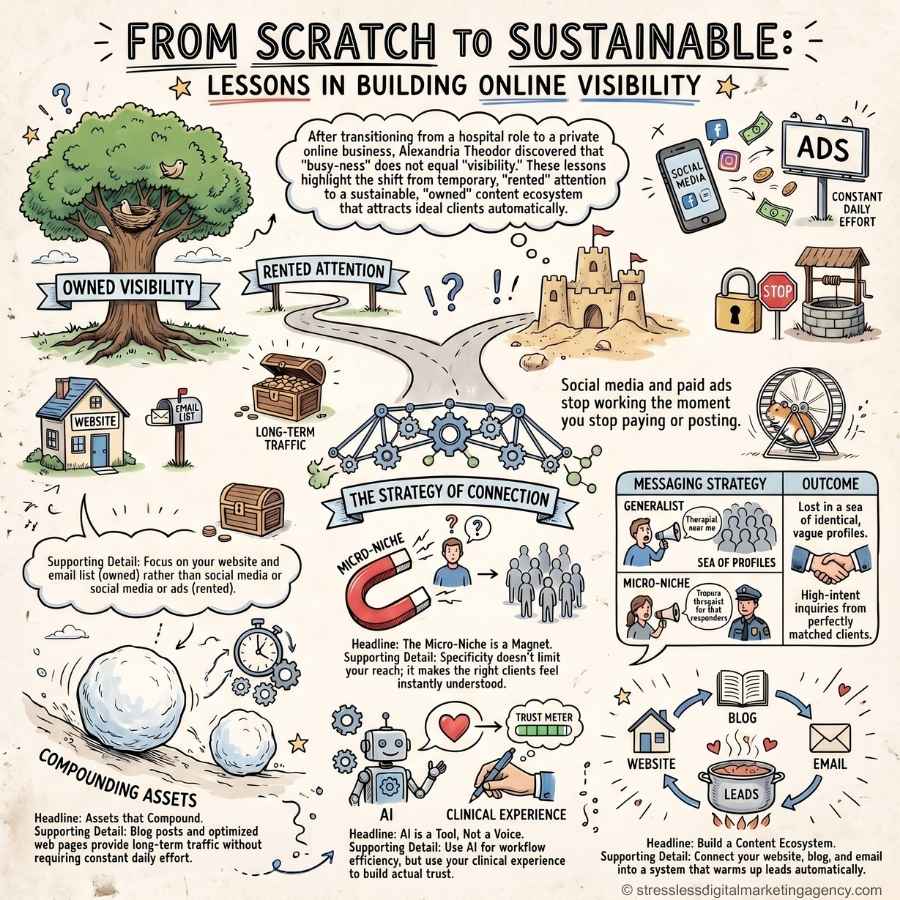
What I learned, slowly and at some expense, is that building an online business as a health and wellness provider comes down to ownership more than marketing. Most clinicians I know are renting their visibility from platforms that can change the rules whenever they feel like it. The ones who build something durable own it.
The Difference Between Owned Visibility and Rented Reach
Rented reach is a social post that performs well today and disappears tomorrow. It’s a directory listing you pay for and a platform whose algorithm decides who sees you. There’s still value in it. You just don’t control it, and you can’t build a practice on something you don’t control.
Owned visibility is your website, your email list, and the body of content you’ve published under your own name. These are assets. They accumulate. A blog post you wrote two years ago can still bring in an inquiry this week, and that’s a lot more than can be said for a post that scrolled out of someone’s feed an hour after you published it.
I learned this the expensive way. I opened my private-pay practice in 2020, assuming clients would flood through the door. They didn’t. After months of crickets, I hired someone to write my website and my Psychology Today profile. Things picked up, but the person I hired didn’t believe in SEO, so we ran Google Ads instead, and I got a firsthand lesson in what renting visibility actually costs. Every single day, I was paying for eyeballs I didn’t own. Once I understood SEO, I realized I could get the same attention without a bill attached to every click.
I’ve thought about that lesson through a different lens since then, too. For years I used a travel agency for every trip. The itinerary was planned for me, and it was efficient right up until something changed and I had no idea where I actually was. That’s what depending entirely on paid ads or a directory listing feels like. You’re renting someone else’s map. When the rates go up, when the algorithm shifts, when the directory changes its rules, you’re the one left standing there with no idea which way to go. SEO is building your own map instead. You learn the streets. You know the shortcuts. And when something changes, you’re not starting from zero.
| Rented channel | Owned asset |
|---|---|
| Reach decided by a platform | Reach decided by search and your list |
| Value resets with every post | Value compounds over time |
| You follow someone else’s rules | You set your own publishing rhythm |
| Audience belongs to the platform | Audience belongs to you |
This isn’t a niche problem, either. In the most recent federal data available, 58.5% of U.S. adults said they’d used the internet to look for health or medical information in just the second half of 2022 (Centers for Disease Control and Prevention, 2023). Your future client is already searching. The only question is whether what they find belongs to you or to a platform you’re renting from.

Start With the Unsexy Foundation
Every guide to starting an online business says roughly the same thing, and the reason is that it’s true. You start with a plan. Know your audience, your operating costs, and your competition. You handle the practical pieces, registering the business and launching a website, and then you go find your first customers.
Clinicians tend to skip straight to the website because it’s the part that feels creative. The plan is the part that keeps you from rebuilding that website three times in eighteen months.
Think of it the way you’d think about frosting a cake. You can’t frost a cake that hasn’t cooled. The icing slides off, the layers separate, and the whole thing looks like a disaster even when the cake itself was good. Foundational messaging is the cooling rack. Skip it, and every layer of marketing you stack on top slides right off. The redesign, the blog posts, the SEO work, all of it lands wrong when the base was never set. You can’t skip steps in baking, and you can’t skip them here either.
Know who you’re actually writing for
Market research sounds corporate, but for a solo practitioner it looks like answering a short list of questions. Who’s the person you want to sit across from? What have they already tried? What words do they use to describe their problem, versus the clinical words you’d use? The gap between those two vocabularies is usually where a website loses people.
Do the math before you do the marketing
Operating costs for an online business are real even when there’s no storefront. Software, hosting, insurance, continuing education, and your own time all count. If you know your numbers, you can decide how many clients you need and at what pace, which tells you whether your marketing plan is ambitious or just unrealistic. That’s a kinder calculation to make before you launch than after.
Micro-Niching Is Positioning, Not Limitation
The most common objection I hear from clinicians is that narrowing their focus will shrink their client pool. In practice, the opposite tends to happen. A clear position makes you findable to the people who are searching with urgency, and it quietly filters out the inquiries that were never going to convert anyway.
I saw this play out in my own work before I ever built it for a client. For a long time I had a Psychology Today profile, and I was listed, and I waited. Weeks went by without a single call. I assumed the market was slow or I wasn’t networking enough. Then I rewrote the profile. I didn’t do a full overhaul. I just stopped writing like a resume and started writing like someone who knew exactly who she helped: brain injuries, strokes, the people who fell through the cracks of a medical system that sent them home before they were actually okay. Within seven days, I had calls. Not because I’d suddenly gotten more qualified or the algorithm had shifted. The right people finally saw themselves in what I wrote.
Micro-niching isn’t about turning away clients who already trust you. It’s about deciding what your website leads with. If you work with anxious high-achieving professionals, your homepage should sound like it was written for them, not for everyone who stumbles onto it. A generalist page trying to speak to all people ends up speaking to none of them.
The practical test is simple. Can a stranger read your homepage for fifteen seconds and say back who you help and why it matters? If not, the problem is positioning, not traffic.
Your Website Is a Growth Engine, Not a Brochure
The single most expensive mistake I see is treating a website like a digital business card. A brochure describes you and asks nothing of the visitor. A growth engine earns attention and gives it somewhere to go.
- A clear service page for each thing you actually offer, written for the person searching for it
- A visible, low-pressure way to get in touch that doesn’t require a twenty-minute phone call as the first step
- Proof that you’re a real human with real credentials, in plain language rather than credential shorthand
- A reason to come back, which is usually a blog that answers the questions your clients ask you in session
I think about this the same way I think about Van Gogh. I’ve always loved his work, the movement and emotion you can see in the paintbrush strokes. There’s a contemporary artist, Andrea Jacobs, whose paintings I’ve seen where someone was there to explain the piece to me, and it changed everything about how I understood it. A lot of times when I’m standing in a museum in front of something, I think: it’s beautiful, but I have no idea what it’s trying to say. When someone explains it, I can actually appreciate what the artist meant instead of just guessing. That’s what copywriting does for a website. A beautifully designed site with no context is a painting with no guide. A visitor looks at it and thinks: this is nice, but what does it mean for me, and what am I supposed to do next?
None of the fixes above require a designer’s budget. What they require is deciding what you want a visitor to do before they arrive, and then removing every obstacle between them and doing it.
The Content Ecosystem That Compounds
Blog posts, website pages, and email all do different jobs, and the mistake is running them as separate projects. Your blog answers the question someone typed into a search bar. Your service pages convert that reader once they understand you. Your email list keeps the ones who aren’t ready yet.
Together, these three create an effect solo practitioners tend to assume only big brands get: consistent inquiries without a fresh scramble every month. The reason is mechanical. Content you’ve published keeps working while you’re seeing clients. Your email list keeps working while you sleep, and it isn’t a small return, either. Marketers who track it closely report an average of $36 back for every $1 spent on email marketing (Litmus, n.d.). You’re not feeding the machine constantly, because the machine holds onto what you already put in.
The practical version for a busy clinician is unglamorous. Publish on a schedule you can actually keep. Write about what your clients ask. Send something to your list regularly, even when it feels small. No single piece does the compounding. The habit does.
Where AI Fits and Where It Doesn’t
AI is genuinely useful for the parts of content work nobody enjoys: outlining, generating variations of a headline, tightening a paragraph you’ve rewritten four times, brainstorming the questions a topic should answer. I use it for all of that myself, usually by talking my ideas into my phone and letting it help me polish them.
What it can’t supply is the reason a potential client chooses you over the practice three towns over. That reason lives in specific, human details: the way you describe a moment you’ve seen in session, the phrasing no template would produce, the clinical judgment underneath a claim. It’s a lot like when people ask ChatGPT questions they should really be bringing to a therapist. As a clinician, I know what’s solid and what isn’t. To an untrained eye, the difference is invisible, and that can genuinely hurt someone. Your website copy works the same way. AI can write words on a page. Strategy is the part it can’t give you, and strategy is the whole job.
If you use it, use it on the scaffolding. Keep the story and the expertise yours.

Getting Your First Clients Without Guessing
Almost every structured guide to online business ends the same way: get your first customers. That’s where clinicians freeze, because it requires saying out loud what you do.
I watch my daughter work on jigsaw puzzles sometimes, and it reminds me of this exact moment. She’ll have the right piece in her hand and just can’t get it to fit, completely frustrated. From where I’m standing, I can see clearly that if she turns it ninety degrees, it clicks. She’s too close to it to see that, and she doesn’t know what she doesn’t know yet. I’ve done a hundred of these puzzles. I know to find the corners first, build the edges, sort by color. She’s guessing and checking and hoping for the best. Practice owners are usually holding the right piece, too. They just need someone who can see the angle they’re missing.
Start where the trust already exists: former colleagues, referral sources, communities you already belong to. Then make sure every one of those conversations has somewhere to land, which is your website and your email list. A referral that arrives at an unclear homepage has still left your practice. Just later than it should have.
From there, treat publishing as a steady drip instead of a dramatic launch. One useful article, one email, one clear service page. Repeat. That’s the whole system, and it works precisely because you can keep doing it while holding a caseload.
Frequently Asked Questions
What’s the first step in building an online business as a clinician? Start with a business plan before you touch design or marketing. Know your audience, your operating costs, and your competition. From there you handle practical setup, including registering the business and launching a website, and then you focus on getting your first clients. Skipping the plan is what leads to rebuilding the same website over and over.
Do I have to niche down if my practice already has clients? You can keep serving the clients who already trust you while narrowing what your website leads with. Micro-niching is a positioning decision, not a rule about who’s allowed to walk through your door. Clarity about who you help best makes you easier to find and filters out inquiries that were never a good fit.
Can AI write my website copy and blog posts? Use it for outlines, headline variations, and rough drafts, but keep the human story and clinical expertise in your own hands. The specific details that make a reader trust you are exactly the parts generated text tends to flatten. Treat AI as a workflow tool that speeds up the scaffolding, not as your brand voice.
How do I get my first online clients? Begin with people who already know your work: former colleagues, referral sources, and communities you belong to. Then make sure those conversations have somewhere to land. A clear service page and an email list mean a referral that arrives curious actually converts instead of quietly leaving your site without reaching out.
How long before content starts producing inquiries? There’s no fixed timeline, and anyone promising you one is guessing. What matters is whether your foundation is in place: clear positioning, service pages that convert, and an email list capturing the people who aren’t ready yet. Content compounds over time, so consistency matters more than any single post or a fast start.
Building an online business while you’re also a clinician is slower than most marketing advice suggests. That’s not a flaw in your effort. It’s the honest shape of it. Own your visibility, stay narrow enough to be unmistakable, and let the content you publish keep working long after you’ve closed the laptop for the day.
If you want the full roadmap, not just the pieces, grab the first chapter of my book free: Stay Booked: The Therapist’s Guide to Building a Website That Fills Your Practice.
Your Next Step
If you have been feeling like your online business is more reactive than strategic — chasing the next platform, hoping the next post lands, relying on referrals that may or may not show up this month — this is the invitation to build something different.
Download my Price and Service Guide for a full look at how done-for-you SEO copywriting and content strategy works, what is included, and what it costs to build an online presence that actually works as a system.
Or start here for free:
Quiz: What’s Keeping You Stuck With Marketing? Five minutes to find out exactly where your visibility is leaking. Most practice owners are surprised by what comes up.
Stop Panicking When Clients Graduate: The practical guide to building the kind of website presence that generates organic inquiries even when your referral pipeline goes quiet.
Free Blog Templates for Service Providers: A repeatable SEO-informed structure for health and wellness clinicians — so you always have a framework to write into, even when starting feels impossible.
Sources
- Centers for Disease Control and Prevention, National Center for Health Statistics. (2023). Health information technology use among adults: United States, July–December 2022 (NCHS Data Brief No. 482). https://www.cdc.gov/nchs/products/databriefs/db482.htm
- Litmus. (n.d.). Email marketing ROI. https://www.litmus.com/resources/email-marketing-roi
Keep Reading: Related Posts
- SEO for Therapists: The No-Fluff Guide to Getting Found on Google
- Marketing for Private Practice: Why SEO & Copywriting Are Your 24/7 Sales Team
- Marketing Strategy for Private Practice: What Actually Works (And What Doesn’t)
- Why SEO Matters More Than Social Media for Therapists & Coaches
- AI for Therapists: Balancing AI and Human Creativity to Attract Private Pay Clients
- Why Blogging Is One of the Most Valuable Marketing Strategies for Practice Owners
- How to Justify Out-of-Network Therapy Rates (With Copy That Converts)