Health & Wellness Email Marketing Strategy: ROI, Trust-First Tactics & Packages
There is a Reiki principle I think about a lot in marketing contexts. It goes: just for today, I will not worry. Not forever. Not as a lifetime commitment. Just today.
Email marketing requires the same mindset. Not every email converts immediately. Not every newsletter produces a booking that week. But the relationship you are building with every send — the subscriber who has been reading you for four months and finally reaches out, the past client who forwards your email to a colleague, the person who was not ready last spring but is now — that accumulates in ways that are genuinely hard to measure until you look back and realize it has been doing quiet, steady work the whole time.
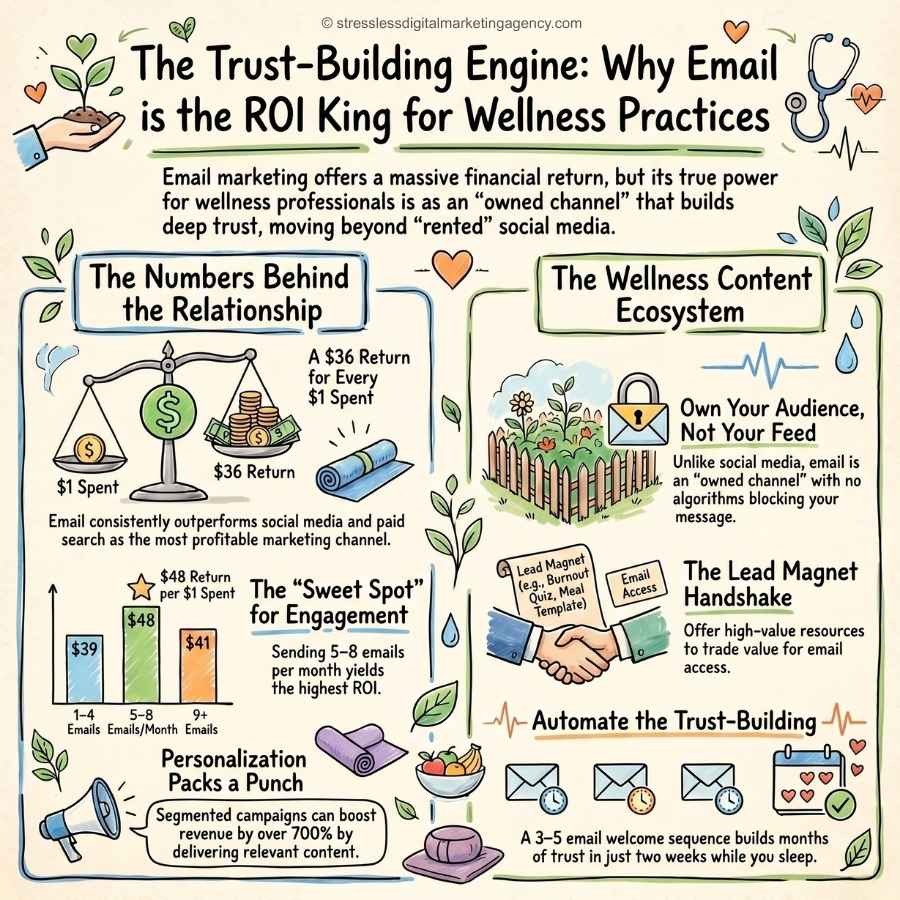
For health and wellness practice owners who are wondering whether email marketing is worth their time, the data is unambiguous. For every $1 spent on email, the average return is $36, according to Litmus — outperforming social media, paid search, and most other channels by a significant margin. But the number alone undersells what email actually does for a private practice. The ROI is not just financial. It is relational. And for a business built on trust, that might be the more important part.
This guide covers what email marketing actually looks like in a health and wellness practice, why it belongs in your content ecosystem alongside your SEO and blog strategy, and how to build it without adding another exhausting obligation to your week.
Key Points
- Email consistently delivers $36 for every $1 spent — and that return increases with personalization and automation
- Your email list is an owned channel, meaning no platform algorithm decides who sees your content or whether your message gets delivered
- Email subscribers are your warmest leads — they already know you exist, they asked to hear from you, and they are further along the path to booking than anyone finding you through search for the first time
- A welcome sequence of three to five emails, written once and automated, does more conversion work than most practice owners realize
- Email and SEO are not competing strategies — they work best in combination, with blog content driving new traffic and email converting the people already in your world
Why Email Belongs in a Practice Marketing Strategy
Think about the different kinds of people who might encounter your practice on any given day. Someone finding a blog post through a Google search is encountering you for the first time, probably while they are still in the research phase. A social media follower knows you exist and reads your posts occasionally. An email subscriber is different from both of them. They found something you created that was valuable enough to trade their email address for. They opted in. They said, in a quiet but deliberate way, I want to hear from you.
That is a meaningfully different relationship, and it converts differently because of it.
SEO-optimized blog content does the top-of-funnel work — it brings new people to your website through search, often people who are actively looking for what you offer. Email handles what comes next. The person who downloads your lead magnet and reads your welcome sequence for two weeks is not the same prospect as someone who found your website yesterday. By the time they reach out, the trust is already there. The consultation call becomes logistics, not convincing.
This is why content marketing for private practice works best as a system rather than a collection of separate tactics. Blog posts drive the traffic. Email nurtures the relationship. Your service pages close the gap. Each element does a job the others cannot, and email’s job — keeping you present with people who are interested but not yet ready — is one that no other channel handles as well.
Email Builds Trust Before You Ever Get on a Call
Here’s something most health and wellness providers don’t realize: email isn’t just a marketing tool—it’s a trust-building engine.
When someone subscribes to your email list, they’re giving you permission to show up in their inbox regularly. That’s a privilege. And when you use that space to provide value—whether it’s educational content, helpful tips, personal stories, or thoughtful insights—you’re building a relationship long before they ever book a session with you.
By the time someone gets on a consultation call, they often feel like they already know you. They’ve read your emails. They’ve seen how you think. They understand your approach. That makes the sales process easier, faster, and way less awkward for everyone.
This is backed by data. Research shows that 80% of customers are more likely to purchase from brands that offer personalized experiences.³ When your emails speak directly to someone’s pain points, answer their questions, and show them you understand what they’re going through, you’re not just another name in their inbox—you’re the obvious choice when they’re ready to take action.
The Data: What Email Actually Returns
For a business owner making marketing budget decisions, the numbers are worth knowing clearly.
Email marketing delivers an average return of $36 for every $1 spent, according to Litmus. Some analyses report even higher figures — $38 per dollar in certain markets, and as high as $68 per dollar for service-based e-commerce. Nearly one in five companies achieves an email ROI of 7,000% or more, which translates to $70 returned for every $1 invested.
To put that in context: paid ads stop working the moment you stop paying. Organic social media reaches roughly 5–10% of your followers on a good day. An email, by contrast, lands directly in someone’s inbox every time — no algorithm deciding whether they see it, no platform fee required, no uncertainty about delivery.
The frequency data is also worth noting. Sending five to eight emails per month produces the highest ROI, which translates to roughly one to two emails per week. You do not need to email daily to see results. Consistent, valuable contact on a sustainable schedule outperforms a high-volume approach that you cannot maintain.
The engagement lift from personalization is significant, too. Personalized subject lines alone increase open rates by 26–29%. Segmented campaigns — where different subscribers receive content relevant to where they are in the relationship — can boost revenue by over 700% compared to unsegmented sends. These are not marginal improvements. They are the difference between an email list that sits dormant and one that actively converts.
Let’s look at some specific benchmarks so you can see how email stacks up:
Overall Average ROI: $36–$38 for every $1 spent
Sending Frequency Impact: – 1-4 emails per month: $39 per $1 spent – 5-8 emails per month: $48 per $1 spent (the sweet spot) – 9+ emails per month: $41 per $1 spent
List Size Impact: – Under 500,000 subscribers: $39 per $1 spent – Over 500,000 subscribers: $44 per $1 spent – Over 10 million subscribers: $46 per $1 spent
What “Owned Channel” Actually Means for Your Practice
One of the most important strategic advantages of email is something most practice owners overlook until something goes wrong with another channel.
Social media platforms have systematically reduced organic reach over the past decade. Instagram went from showing your posts to most of your followers to showing them to roughly 10%, on a good day. Facebook prioritized video, then Stories, then Reels — each shift requiring practice owners to learn new formats just to maintain the same visibility they had before. TikTok’s algorithm is a mystery. Paid ad costs on every platform fluctuate with demand, making a predictable ROI genuinely difficult.
Email does not work that way. You send an email, and it arrives in your subscriber’s inbox. Your platform cannot decide today that you need to boost the post to reach the people who asked to hear from you. The subscriber gave you permission directly, the data is yours, and the relationship cannot be revoked by a third party’s policy change.
This is what “owned channel” actually means — not just a marketing term, but a practical distinction that matters every time a platform shifts its algorithm or a directory changes how profiles are ranked. Your list is portable, permanent, and completely under your control. For a deeper look at how owned channels compare to rented ones across all four marketing options, this marketing strategy breakdown maps the full picture.
How to Use Email in a Health & Wellness Practice
Building the List First
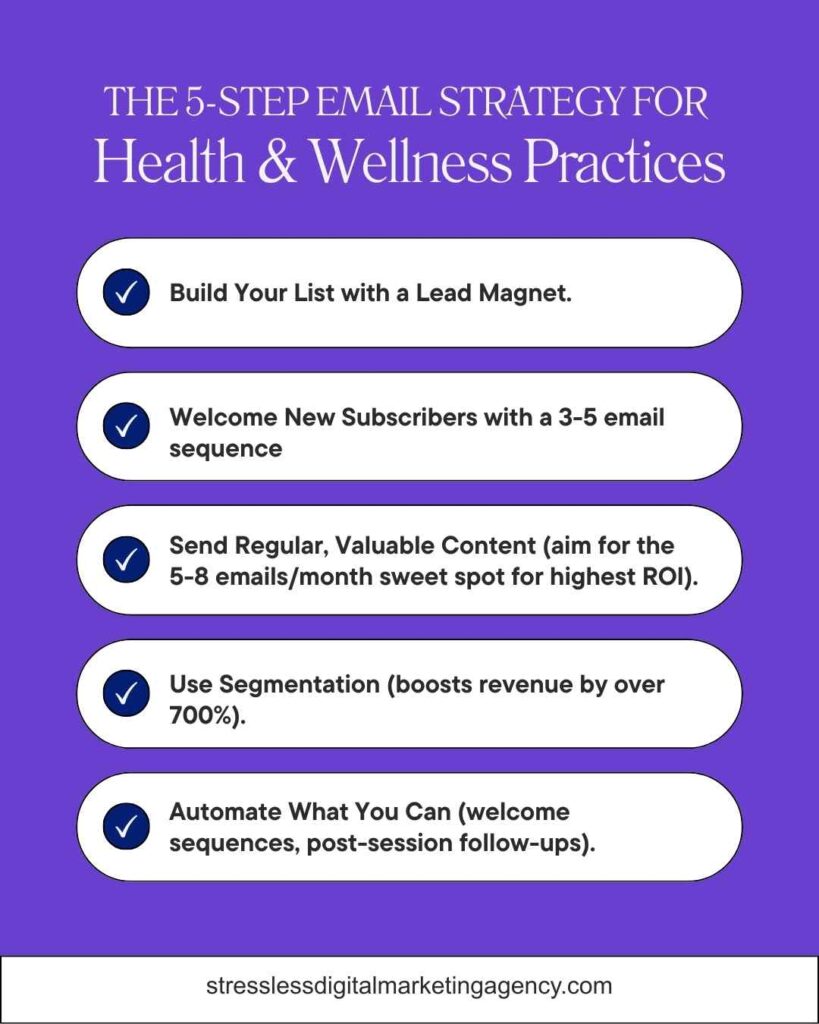
Before any email strategy works, people need to be on your list. The most reliable mechanism is a lead magnet — a specific, high-value free resource that someone downloads in exchange for their email address.
The lead magnet works best when it solves one precise problem rather than covering broad ground.
- A checklist (e.g., “5 Signs You Need Therapy” or “10 Questions to Ask Before Starting Physical Therapy”)
- A guide (e.g., “Stop Panicking When Clients Graduate: Your Website’s Guide to Organic Inquiries”)
- A self-assessment (e.g., “Are You Experiencing Burnout? Take This Quick Quiz”)
- A template (e.g., “Meal Prep Template for Busy Parents”)
- A video or audio training (e.g., “3 Breathing Techniques to Calm Your Nervous System”)
- A quiz (e.g., “What’s Keeping You Stuck With Marketing?“) — [If you are looking to build your own quiz, here is a review of the tool I use called Interact]
Getting the lead magnet in front of people requires visibility, which is where SEO and email reinforce each other rather than compete. Blog posts bring new readers to your site. A well-placed lead magnet offer on those pages converts readers into subscribers. The benefits of blogging post cover that traffic-to-subscriber pathway in detail if you want to understand how the two connect.
The Welcome Sequence
Once someone subscribes, the first few emails they receive from you set the tone for everything that follows. A welcome sequence — typically three to five automated emails sent over one to two weeks — does the trust-building work that otherwise takes months of inconsistent contact to achieve.
The welcome sequence structure that works for most practices looks something like this:
- Email 1: Deliver the lead magnet, introduce yourself briefly, and set expectations for future emails
- Email 2: Share your story—why you do this work and who you help
- Email 3: Provide more value (a helpful tip, resource, or insight related to their pain point)
- Email 4: Introduce your services and invite them to book a consultation
Welcome emails achieve up to an 80% open rate, which is dramatically higher than regular newsletters. Nearly half of everyone who clicks through an automated welcome sequence eventually makes a purchase. These are not abstract statistics — they represent the compounding value of showing up consistently for someone in the first two weeks after they raised their hand and said they wanted to hear from you.
Consistent Value After the Welcome
After the welcome sequence ends, the job is to stay present without becoming noise.
One to two emails per week is the sweet spot for most practices. What should you send? The same kind of content you’d share in a blog post or on social media, but delivered directly to their inbox:
- Educational content that answers common questions
- Personal stories that build connection
- Tips and strategies they can implement right away
- Updates about your services or availability
- Invitations to book (but not in every email—focus on value first)
The value-first principle matters here. Marie Forleo, who has built her business largely on email, emphasizes giving real value consistently rather than treating the list as a direct sales channel. Your subscribers gave you access to their inbox — using it primarily to ask them to book undermines the relationship. The goal is to remain genuinely useful so that when they are ready to take action, reaching out to you is the obvious move.
Segmentation and Automation
Not everyone on your list is in the same place. A new subscriber who just downloaded your lead magnet is in a completely different stage than someone who has been reading your emails for six months and has never reached out. Treating them identically means both are getting content that does not quite fit.
Segmentation examples:
- New subscribers get your welcome sequence
- People who downloaded a specific lead magnet get follow-up emails related to that topic
- Past clients get re-engagement emails or referral requests
- People who opened your “Book a Session” email but didn’t book get a gentle follow-up
Personalized emails see a 29% increase in open rates and a 41% increase in click-through rates. Segmented campaigns can boost revenue by over 700% compared to unsegmented sends. Those gains come from the fundamental principle that a message tailored to where someone actually is in their journey lands differently than a generic broadcast.
Automation handles the mechanics once the sequences are written. Automated emails achieve a 42% average open rate compared to 25% for regular campaigns, and they account for 41% of all email orders despite representing only 2% of email sends. Writing your welcome sequence once and letting it run for every new subscriber means your highest-performing emails keep working without requiring your ongoing attention.
The Data Summarized:
Here’s what strong email marketing looks like:
- Overall Open Rates: 25.10%–39.64%¹
- Overall Click-Through Rates: 1.50%–3.25%¹
- Overall Conversion Rates: 0.07%–2.53%¹
But here’s where it gets interesting: personalization and automation dramatically improve these numbers.
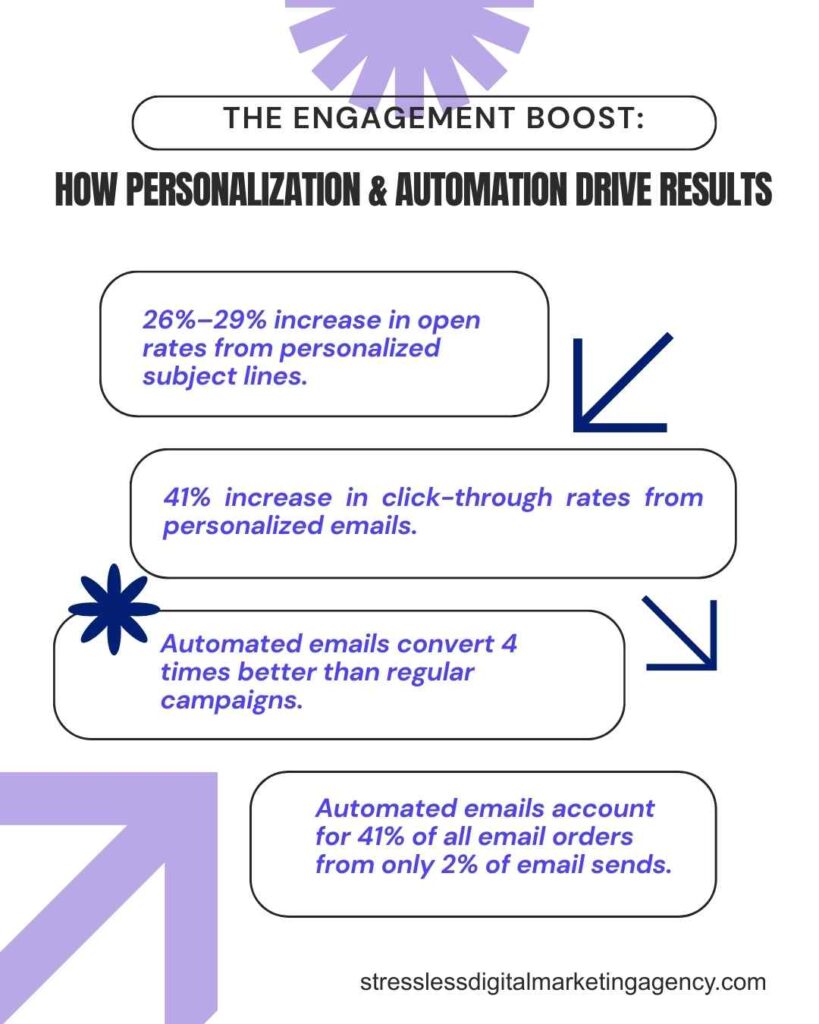
- Personalized Subject Lines: 26%–29% increase in open rates¹ ³
- Personalized Emails: 29% increase in open rates, 41% increase in click-through rates²
- Automated Emails: 42.1% open rate, 5.4% click rate, 1.9% conversion rate³
Let’s put that in context. If you’re sending generic, one-size-fits-all emails, you’re missing out on massive engagement gains. When you personalize your emails—even something as simple as using someone’s name or segmenting by interest—you see nearly 30% more opens and 41% more clicks.²
And automated emails? They convert 4 times better than regular campaigns.¹ That means welcome sequences, abandoned cart emails (if you sell products), and post-session follow-ups are some of the highest-performing emails you can send.
Why Email and SEO Work Together
One of the most useful reframes for practice owners who are trying to figure out where to put their limited marketing time: SEO and email are not competing for the same budget. They serve genuinely different moments in the client journey and make each other more effective when they run together.
SEO brings new people to your website — people actively searching for what you offer, who may be encountering you for the first time. That traffic represents a real opportunity, but most of those first-time visitors are not ready to book on their first visit. Email is the mechanism that captures the ones who are interested but not yet ready, keeps the relationship alive, and eventually converts them.
Why SEO matters more than social media for consistent private practice inquiries is a case worth understanding before deciding how to allocate your marketing time — because the answer changes how you think about what email is actually for. It is not a replacement for visibility. It is what you do with the visibility once you have it.
For the full picture of how blog content, website copy, and email function as a connected system rather than three separate marketing projects, this breakdown of marketing for private practice covers how each piece connects and what order to build them in.
Three Common Objections — Answered Honestly
“Email marketing is too salesy, and I don’t want to push people.”
This is the most common hesitation I hear, and it comes from a legitimate place — nobody wants to feel like a billboard in someone’s inbox. The reframe worth considering: the practice owners who feel salesy in their email marketing are usually the ones sending emails that are primarily about their services rather than primarily about their readers. When the content is genuinely useful — when it answers a question, offers a perspective, or gives someone something they can actually use — it does not feel salesy. It feels like a service.
“My clients are not online enough for email to matter.”
If your clients can book a session, respond to your intake paperwork, and communicate between sessions by phone or text, they have email. The question is not whether they have it — it is whether you are using it intentionally to build the relationship before and between sessions.
“Email marketing is dead.”
This is one of the most persistent myths in marketing, and it’s simply not true.
88-93% of people check their email every single day.² The number of email users worldwide is expected to hit 4.6 billion in 2025.³ And 77% of marketers reported a surge in email engagement in 2023.¹
Marie Forleo actively debunks this myth, stating that after over 22 years in business, email remains her “number one way that we convert prospects into buyers.”¹¹ The reality is that email is more effective than ever—it’s just that the strategies have evolved.
“Do I need a huge list to make money?”
Nope. And this is actually one of the best things about email marketing.
Marie Forleo introduces the concept of a “million-dollar email list,” which derives its value from the cumulative spending of engaged subscribers—not the size of the list.¹¹ She has a relatively small but “mighty” list that has generated significant sales.²¹
Engagement matters more than size. A list of 500 people who love your work and trust you will outperform a list of 10,000 people who barely remember subscribing.
“I don’t have time to write emails every week.”
Fair concern, given what a full clinical caseload actually demands. The practical answer is that the welcome sequence — the emails that matter most — is written once and automated. If you invest three to four hours setting up a five-email welcome sequence, that sequence runs for every new subscriber indefinitely. The ongoing newsletter burden comes later, and by then, the value of a list that is actively converting tends to change how the time feels.
If writing is genuinely not where you want to spend limited bandwidth, done-for-you email sequences are part of the SEO content ecosystem service. The strategy, the writing, and the internal linking all handled — so the system runs without requiring your ongoing attention.
Trust-First Email Marketing: What That Actually Means for Practitioners
Trust-first” is a phrase that gets used loosely in marketing, but it has a specific meaning for health and wellness providers that is worth naming directly — because the clinical context changes the ethics of how you use email, not just the strategy.
When someone subscribes to your list as a potential therapy client, they are often in a vulnerable moment. They are not browsing for a product. They are considering asking a stranger to help them with the hardest thing happening in their life. The emails you send them during that consideration period have real stakes, and treating that inbox access as a direct-sales channel does active harm to the relationship you are trying to build.
Trust-first email marketing for practitioners means the ratio of value to ask is heavily weighted toward value — especially early. In practical terms: your welcome sequence should give before it invites. Three emails of genuine, useful, relevant content before you mention your services is a reasonable baseline. Educational content that helps someone understand their own situation, even if they never book with you, is the right standard. Emails that primarily exist to promote your availability should be rare, clearly labeled, and sandwiched inside content that actually serves the reader.
This is also why your email voice matters as much as your email frequency. Clinical language in your emails creates the same distance it creates on your service pages — it signals competence to other clinicians and creates a subtle barrier with the person who needs help. The most effective emails I have seen from wellness practitioners read like a thoughtful colleague talking, not a newsletter template performing expertise. First person, specific stories, real observations from clinical practice. The kind of content that makes someone think: this person actually understands what I am going through.
There is a practical clinical boundary worth noting too. Email is not a therapeutic channel, and your subscribers are not your clients. The warmth and specificity of your content should not blur that line — it should build trust in a way that leads people toward booking a proper session, not toward expecting clinical-level support from a newsletter. That distinction is especially important for therapists navigating dual-relationship ethics in small professional communities.
Trust-first email marketing is not slower or less effective than a sales-forward approach. It is more effective, because the people who book after reading content that genuinely helped them are already aligned, already committed, and far less likely to drop out after the first session. The conversion that happens at the end of a trust-first email sequence is a different quality of yes.
A Wellness Email Marketing Strategy: What the Plan Actually Looks Like
For practice owners who want a concrete framework rather than a general case for email, here is the strategy that works for most health and wellness businesses — not a complicated system, but a clear sequence with a role for each component.
Phase 1 — Build the foundation (months 1–2). Choose an email platform (ConvertKit, Flodesk, and Mailchimp are the most common for solo practices), set up a lead magnet that solves one specific problem for your ideal client, and write a three-to-five email welcome sequence. Do not skip the welcome sequence to get to the newsletter faster — welcome emails generate up to 320% more revenue than standard campaigns, and they run automatically for every new subscriber without ongoing effort.
Phase 2 — Establish consistent contact (months 2–4). Start sending one email per week to your growing list. Repurpose the blog post you published that month, add a personal observation or clinical story that is not in the blog, and close with a soft invitation — a link to your contact page, a reminder that you have availability, a prompt to forward the email to someone who might benefit. No hard sell. Just consistent, useful presence.
Phase 3 — Segment and refine (months 4+). Once you have a few hundred subscribers and a few months of send data, look at what is actually getting opened and clicked. The topics that generate engagement are the ones your audience cares most about — those are your next blog posts, your next lead magnets, your next service page angles. Use that data to segment: new subscribers on the welcome sequence, existing subscribers on the newsletter, past clients on a separate re-engagement track if relevant.
Phase 4 — Add sequences for specific situations. Once the core system is running, automation can handle more specific moments — a sequence for people who clicked your services page but did not reach out, a short series for clients approaching graduation from therapy, an affiliate or digital product sequence if you have income diversification goals. These are built once and run quietly, doing conversion work without requiring your attention.
The whole system can be in place and functional in about sixty to ninety days of part-time effort. After that, the ongoing time commitment is one email per week — roughly forty-five minutes to an hour if you are repurposing content you have already created. For practices that want the writing handled entirely, the done-for-you option covers email sequences as part of a complete content ecosystem build.
Email Marketing Packages for Wellness Professionals: What to Look For (And What’s Available)
If you are searching for email marketing support for your health or wellness practice, the options range from DIY platform subscriptions to full done-for-you strategy and writing. Understanding what each level actually includes helps you make a decision that matches your actual needs rather than just your available budget.
DIY platforms. Tools like ConvertKit (now Kit), Flodesk, and Mailchimp offer subscriber management, automation, and basic analytics at low monthly costs. They handle delivery and reporting — but they do not write your emails, build your strategy, or tell you what to send. If writing and strategy are where you get stuck, a platform subscription alone does not solve the problem.
Strategy consultation. A one-time or short-term engagement where a strategist reviews your current email situation, recommends a sequence structure, and gives you a clear content plan. You still do the writing, but you have direction. This is the right fit for practice owners who are comfortable writing but unsure what to prioritize.
Done-for-you email sequences. A copywriter writes your welcome sequence, your regular newsletter format, and any specific sequences (services page follow-up, client graduation, re-engagement) directly in your voice. This requires a foundational messaging process first — a deep-dive conversation where the writer gets into your clinical perspective, your positioning, and your ideal client’s language — so the output sounds like you, not a template.
Full content ecosystem (email + blog + website). The most comprehensive option, where email sequences are built as part of a complete visibility strategy alongside SEO-optimized blog content and website copy. Everything points in the same direction: blog content drives traffic, lead magnets grow the list, email nurtures subscribers, service pages convert. This is the approach covered in my SEO and content services, and it is what I recommend for established practices that are ready to stop piecing together disconnected tactics and build something that compounds.
When evaluating any email marketing support for your wellness practice, the questions worth asking: Does this person understand the ethics and clinical context of health and wellness marketing? Can they write in your specific voice rather than a generic professional tone? Do they understand SEO well enough to connect your email strategy to your broader visibility goals? A copywriter who only understands email in isolation will produce sequences that convert existing subscribers — but miss the upstream work that keeps the list growing.
For pricing, process details, and examples of what done-for-you email looks like in practice, the price and service guide has the full breakdown.
Where Email Fits in Your Content Ecosystem
The content ecosystem that builds predictable private practice visibility is not complicated in structure. Blog content drives new search traffic. Lead magnets convert readers to subscribers. Email nurtures subscribers over time. Service pages close the gap when someone is ready. Each element does a specific job the others cannot do, and email’s role — keeping you present with people who are already interested — is quietly one of the most valuable positions in the whole system.
The practices that grow consistently are the ones where all four of those pieces are working together. The ones that plateau are usually strong in one area and missing another. Referral-dependent practices have the trust piece but not the visibility. Strong SEO without email loses the subscribers who were close to booking but needed more time. Email without SEO works the existing audience without growing it.
For the honest breakdown of how each of those gaps shows up and what to build first, the marketing for private practice guide walks through the sequence. And for the case against depending on referrals as a primary growth channel — with the data on what happens when that pipeline shifts — the content marketing necessity post covers that argument in full.
Your Next Step
Download my Price and Service Guide to see how done-for-you email sequences, blog content, and website copy work together as a complete content ecosystem — what is included, what it costs, and how the system is built.
Or start here for free:
Quiz: What’s Keeping You Stuck With Marketing? Find out exactly where your visibility and conversion are leaking before you invest more time in any single channel.
Stop Panicking When Clients Graduate: A practical guide to building a website presence that generates consistent inquiries even when your referral pipeline goes quiet.
Free Blog Templates for Service Providers: A repeatable SEO-informed structure built specifically for health and wellness clinicians — the starting point for getting content that builds your email list.
Keep Reading: Related Posts
- SEO for Therapists: The No-Fluff Guide to Getting Found on Google
- Why SEO Matters More Than Social Media for Therapists & Coaches
- Is Content Marketing Necessary If I Get Referrals?
- Marketing for Private Practice: Why SEO & Copywriting Are Your 24/7 Sales Team
- Marketing Strategy for Private Practice: What Actually Works
- Why Blogging Is One of the Most Valuable Marketing Strategies for Practice Owners
Works Cited
- 80+ Must-Know Email Marketing Statistics for 2025 – Cognism, accessed July 6, 2025, https://www.cognism.com/blog/email-marketing-statistics
- 40+ Email Marketing Statistics to Know in 2025 – Nutshell CRM, accessed July 6, 2025, https://www.nutshell.com/blog/email-marketing-statistics
- 33+ email marketing stats you need to know in 2025 – Wix.com, accessed July 6, 2025, https://www.wix.com/blog/email-marketing-statistics
- Three Areas To Watch In E-Commerce In 2025—And How Brands …, accessed July 6, 2025, https://www.forbes.com/councils/forbesbusinesscouncil/2025/01/03/three-areas-to-watch-in-e-commerce-in-2025-and-how-brands-can-prepare/
- The email marketing advantage: 4 benefits for marketers – Klaviyo, accessed July 6, 2025, https://www.klaviyo.com/blog/email-marketing
- The New York Times newsletters have an amazing open rate – Toast Studio, accessed July 6, 2025, https://www.toaststudio.com/en/articles/new-york-times-newsletters-amazing-open-rate/
- Email Marketing Statistics 2025: Key Insights – Omnisend, accessed July 6, 2025, https://www.omnisend.com/blog/email-marketing-statistics/
- Email Marketing ROI Statistics: The Ultimate List for 2025, accessed July 6, 2025, https://www.emailmonday.com/email-marketing-roi-statistics/
- Email Marketing ROI Benchmarks + How To Calculate It – Moosend, accessed July 6, 2025, https://moosend.com/blog/email-marketing-roi/
- Email marketing ROI: Average return on email marketing – EmailTooltester.com, accessed July 6, 2025, https://www.emailtooltester.com/en/blog/email-marketing-roi/
- Is Email Marketing Dead? Definitely NOT – Marie Forleo, accessed July 6, 2025, https://www.marieforleo.com/blog/email-marketing-myths
- Is email marketing still effective in 2024 to 2025? – Quora, accessed July 6, 2025, https://www.quora.com/Is-email-marketing-still-effective-in-2024-to-2025
- 2025 Email Marketing Statistics for Nonprofits, accessed July 6, 2025, https://www.nptechforgood.com/101-best-practices/email-marketing-statistics-for-nonprofits/
- 12 Authentic Marketing Strategies to Supercharge Your Business – Marie Forleo, accessed July 6, 2025, https://www.marieforleo.com/blog/marketing-strategies
- Your Email List Starter Guide | Amy Porterfield, accessed July 6, 2025, https://www.amyporterfield.com/emailkickstart
- The Million-Dollar Email List: How To Build An Engaged Subscriber …, accessed July 6, 2025, https://www.talkingshrimp.com/million-dollar-email-list
Need help building your email list, creating lead magnets, or writing email sequences that actually convert? Let’s work together to turn email marketing into a reliable source of new clients for your practice.