AI for Therapists: Attract Private Pay Clients Without Losing Your Voice
Before I was a copywriter, I got accepted into art school.
I brought my portfolio to the admissions review, a cut-paper portrait of my cousin, and the admissions person accepted me on the spot. I ended up not going. I chose psychology instead, and then eventually found my way to this work, where I get to use both. But I think about that acceptance a lot when I talk to therapists about AI and what it can and cannot do for their marketing.
Because here’s what I learned from years of making art and then years of writing copy: the best work is never the most technically perfect. It’s the most honest.
Two therapy websites can have the exact same credentials, the same layout, the same modality list, and one of them gets calls while the other collects digital dust. The difference is almost never technical. It’s almost always voice. And voice is precisely what AI cannot give you.
AI for therapists marketing their private practices is everywhere right now, drafting website copy, writing social captions, generating blog outlines, and increasingly, sitting quietly behind the scenes handling notes and scheduling. As a retired therapist and copywriter who works nearly exclusively with private practice owners, I hear the same worry on repeat: is AI going to replace me?
The short answer is no. But the longer answer is more useful, so let’s get into it. This guide on AI for therapists breaks down exactly where AI genuinely helps a private practice, where it falls flat, and how to use it without losing the voice that actually gets a client to pick up the phone.
Key Takeaways
- AI is a genuinely useful efficiency tool, both in your marketing and increasingly in your clinical admin, but it cannot replicate the lived experience, clinical judgment, or distinctive voice that makes a therapist’s marketing actually convert
- Human creativity, authentic storytelling, values-based discernment, and real trust-building are more important now than before AI existed, not less
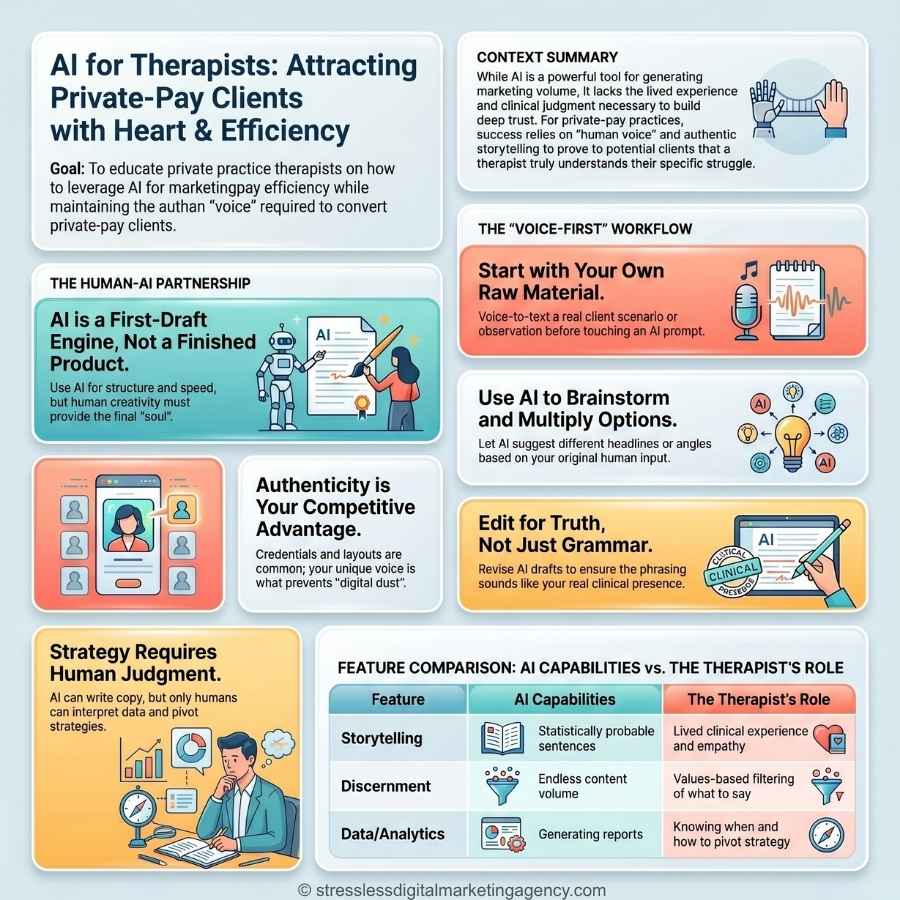
- The most effective use of AI is as a first-draft engine, not a finished product: you generate, then you make it yours
- Where AI falls completely flat is strategy: reading your actual data, knowing when to pivot, and making judgment calls that a language model simply cannot make
- Content that connects is content that says something true about who you are and who you help; no tool generates that for you
Where AI Is Already Earning Its Place
Before getting into what AI can’t do, it’s worth being honest about where it’s already doing real work in a therapy practice, because most of that work has nothing to do with marketing at all.
Most of the credible AI activity in mental health right now is happening in documentation and administration, not in the therapy room. Tools like Mentalyc, Upheal, Blueprint, and TheraPro position themselves as HIPAA-compliant AI scribes that generate session notes, treatment plans, and progress tracking, some reporting they save clinicians several hours a week on paperwork alone. Those are vendor descriptions, not independent audits, so treat any specific time-savings claim as a starting point rather than a verdict, and always confirm a tool’s privacy documentation, its Business Associate Agreement, and exactly how it handles protected health information before you record a single session.
AI is also showing up in treatment planning as a scaffold, helping clinicians weigh client preferences alongside evidence-based guidelines, and in scheduling and practice management as rule-based admin support. Used well, none of that replaces your clinical judgment. It just clears the paperwork so you have more time for the actual session.
The part that surprised me most, though, is how much this has become a clinical conversation, not just an operational one. The American Psychological Association’s 2026 Chatbots and Mental Health Survey found that roughly three-quarters of psychologists now say their patients are bringing up AI chatbot use in session, whether for emotional support, self-diagnosis, or as what some patients describe as “an additional mental health professional”. A companion paper in JAMA Psychiatry goes further, arguing clinicians should be asking clients how they’re using AI the same way they’d ask about sleep or substance use, because it often surfaces things a client hasn’t felt safe sharing directly.
If your own clients are already asking whether a chatbot can replace you, your website copy and your consultation language need a clear, confident answer about what human therapy offers that a chatbot can’t. That’s a marketing question now, not just a clinical one.
Why AI Won’t Replace Your Human Voice
When I first started using AI in my own business, I treated it like an extra pair of hands. I was coming off years of clinical burnout, saying yes to every client, every workshop, every committee, and I was exhausted in the specific way that happens when you give without a floor under you. AI felt like a lifeline. I could get ideas out faster, structure drafts without staring at a blank page, and stop losing entire evenings to content creation.
What I found, though, is that efficiency without soul produces content that looks right and lands flat. The AI-generated draft had structure. It had sentences. It had the approximate shape of a marketing post. What it didn’t have was anything that would make someone stop scrolling and think: this person gets it.
That gap, between technically adequate and genuinely connective, is where your human creativity lives. Here’s what that actually looks like across the four things AI cannot do for you.
1. Voice and Authentic Storytelling
AI can generate words in any style you describe. What it cannot do is live your life. It doesn’t know what it felt like to hold space for a client in crisis at 5pm on a Friday, or the particular exhaustion of a caseload that was full but somehow still not paying the bills, or the moment you finally said no to insurance panels and felt terrified and relieved at the same time. Those are the stories your ideal clients are looking for, not because they want to hear about your struggles specifically, but because specific stories are the proof that you actually understand theirs.
Your ideal private-pay clients aren’t choosing you solely on credentials. Plenty of therapists have credentials. They’re choosing you because somewhere in what you wrote, they recognized themselves. That recognition only happens when the story is real, and real stories come from you, not from a language model making statistically probable sentences about anxiety treatment.
Pro tip: use AI to help organize and shape a story you’ve already lived. Voice-to-text your way through it first, then let AI help you clean it up. The raw material has to be yours.

2. Discernment and Values-Based Filtering
One of the most important things I carried from clinical training into copywriting is this: being busy is not the same as being effective. I watched clients fill their schedules with insurance clients they didn’t want to see, write endless social posts that got likes but not calls, and spend hours on marketing that felt like performance rather than positioning.
AI can generate content volume indefinitely. It cannot tell you which content is actually worth creating, which message serves your ideal client, or when something that sounds professional is quietly working against your positioning. That filter- what you say yes to, what you leave out, and what you’re actually trying to communicate- is a values question. It requires judgment developed over years of clinical work and real business experience. It is not a prompt.
A generic post about “five signs you might need therapy” is easy to produce and endlessly forgettable. A post about the specific moment your ideal client is usually in when they Google you, the particular exhaustion, the thing they’ve already tried, the way they describe themselves when they finally reach out, requires you to actually know your client. AI cannot supply that knowledge. You can.
3. Real Trust-Building
Trust is the whole game in private practice marketing, especially for private-pay practices, where clients are making a deliberate, self-funded choice and need to feel certain about it before they ever pick up the phone.
AI can generate polished email sequences and consistently formatted social posts. What it cannot do is show up authentically. It cannot share the moment you doubted whether private pay was even viable for you. It cannot describe what it actually felt like when a client achieved something in session that you had both worked toward for months. It cannot be the reason someone reads your bio and exhales, finally, someone who actually understands.
Trust in private practice is built on specificity and humanity, not polish. The content that builds it reflects a real person with real clinical experience who has thought carefully about who they help and why it matters. That’s a you problem, in the best way. No tool solves it for you.
I think about the Savannah Bananas a lot when I explain this to clients. They’re a baseball team that built a rabid following not by being the most technically polished team on the field, but by putting the fan’s experience first in every single decision, right down to letting a breakdancing first base coach steal the show. Nobody remembers a team for its perfectly average performance. People remember being genuinely seen and delighted. A private-pay practice works the same way. The therapist who wins isn’t the one with the most polished credentials list. It’s the one whose website makes a specific, struggling person feel like someone finally gets it.
For a deeper look at what trust-building copy looks like in practice, particularly when you’re trying to justify out-of-network rates to clients who are weighing their options, private pay positioning is worth reading before you touch your service pages.
4. Strategy, Pivoting, and Reading Real Data
This is the one most people miss, and it’s the most important.
We were supposed to be in the Bahamas for Valentine’s Day. Family trip, warm beaches, the whole thing. Then my daughter got sick, and plans got canceled overnight. Pivot required.
Marketing works exactly the same way. You can have the perfect content calendar, the right keywords mapped out, a beautifully scheduled blog strategy, and then something changes. Traffic drops after a Google update. A post that should have ranked doesn’t. Your ideal client starts searching for something slightly different from what they were six months ago. What happens next isn’t a content question. It’s a strategy question, and AI cannot answer it.
AI can write copy. It cannot look at your Google Analytics and notice that people are bouncing from your services page after 10 seconds, then figure out why. It cannot check your Google Search Console and catch that you’re getting 800 impressions a month for a keyword you never intended to target, which means you’re missing an opportunity. It cannot tell you whether a plateau in your traffic means you need to wait or change direction entirely. That judgment call requires someone who is watching your actual data in real time and knows enough about your practice to make it.
That distinction between AI as a writing tool and a human strategist who reads the room is the whole reason I build analytics into every client engagement. The no-fluff SEO guide for therapists covers exactly what data you should track and how to interpret it if you want to start there.
What Good AI-Assisted Marketing Actually Looks Like
I use AI in my work. I’m not going to pretend otherwise, and I don’t think you should either. Voice-to-text lets me get a draft out before I can second-guess it. AI helps me restructure an outline when I’ve been staring at it too long. For clients, I use it to accelerate first drafts so the bulk of my time can go to the work that actually requires a human: refining the voice, finding the right story, making sure the SEO strategy is sound, and the internal structure is working.
The distinction I keep coming back to is this: my science brain still wants evidence for everything. I’m a former clinician. I want data. I want to see the mechanism. But I’ve also been a Reiki practitioner long enough to know that not everything that works leaves a measurable trace.
SEO and AI have a lot in common with Reiki in that way. You don’t always get to see the results immediately. You keep publishing, keep optimizing, keep making the work more honest and more specific, and then one day the rankings move, the inquiries come, and it’s not because something dramatic changed. It’s because you kept showing up consistently with something real to say. AI can write something that looks like that consistency. It cannot produce the thing underneath it that makes it land.
The content that actually fills private-pay practices is not the most produced or the most frequent. It’s the most accurate, accurate about who the client is, what they’re struggling with, and what working with you actually changes. That accuracy is yours.
A Practical Split of Labor
A simple rule keeps the balance intact: AI handles volume, repetition, and structure. You handle story, judgment, and the final word.
| Task | Better handled by | Why |
|---|---|---|
| Blog topic brainstorming | AI, filtered by you | Fast volume of angles, but only you know which ones actually reflect your niche |
| First-draft structure | AI | Gets you past the blank page without deciding what’s true yet |
| Service page copy | You, supported by AI | Directly tied to trust and conversion, so the voice has to be yours |
| Client-facing language about AI itself | You | Clinical and ethical judgment no tool can substitute for |
| Reading your analytics and deciding what’s next | You | Strategy requires context AI doesn’t have access to |
How to Use AI for Therapists Without Losing Your Voice: A Practical Framework
If you want to use AI effectively without producing content that sounds like everyone else’s, here’s the workflow that protects both efficiency and authenticity.
Start with your own words. Voice-to-text a story, a client scenario, a frustration you hear repeatedly in consult calls, a question you get asked all the time. Don’t start with a prompt. Start with a real observation, and then use AI to help you shape and structure it.
Use AI to brainstorm, not to finalize. AI is excellent at generating options: different angles on a topic, different headlines for the same post, different ways to phrase a value proposition. Use it to multiply your choices, then make your own decision about which direction is actually aligned with your voice and your positioning.
Edit with intention, not just proofreading. Every time you revise an AI-generated draft, you’re making a creative decision. That’s where your voice comes back in. The sentence AI wrote might be accurate, but flat. Your revision makes it true. Don’t just correct grammar. Change the phrasing to something that sounds like how you actually talk about this work.
Watch the data. Consistently review what’s performing in Google Search Console and Google Analytics, so you know whether your content is working, why it’s working, and when the strategy needs to shift. AI can help you produce content faster, but it can’t tell you what to produce next. That decision lives in your data. If you’re not sure how to read it, the SEO performance tracking guide walks through the numbers that actually matter.
Connect AI output to a real content strategy. Volume without direction is just noise. Every piece of content, whether AI-assisted or not, should serve a keyword, link to a service page, and move your ideal client one step closer to reaching out. This breakdown of the full content ecosystem shows how all the pieces, blog, website, email, need to work together for any of them to convert reliably.
Ethics, Transparency, and Data You Can Stand Behind
None of this works if it isn’t handled responsibly, and that part isn’t optional just because a tool feels convenient.
Before adopting any AI tool, whether it’s writing your marketing copy or drafting session notes, confirm how it meets the privacy and compliance standards that apply to your practice, and check the specific requirements in your jurisdiction with your licensing board or a qualified professional. Vendor pages describe features. They don’t determine whether a tool is appropriate for your setting, and that verification step is yours to do, not something a product page will do for you.
The same care applies to marketing content. If you use AI to draft something, be transparent with your audience about what that means for your brand, and take responsibility for every word that appears under your name. Given that clients are increasingly bringing AI into the therapy room itself, having a clear, honest answer for how you personally use it, both in your practice and in how you talk about your work online, is quickly becoming part of what makes a practice feel trustworthy rather than generic.

What This Means for Attracting Private-Pay Clients Specifically
Private-pay clients are making a different kind of decision than insurance clients. They’re not just looking for a therapist who accepts their plan. They’re actively choosing to invest in their own care, which means they’re evaluating you more carefully, reading your website more thoroughly, and looking for a level of clarity and specificity that makes the investment feel obvious rather than uncertain.
Generic, AI-produced content doesn’t clear that bar. It’s not bad enough to repel people, it’s just indistinct enough that nothing clicks. The practice that stands out in a private-pay search is the one whose website reads like the therapist actually knows who they’re writing for. Every sentence answers the implicit question the reader is already asking: is this person for me?
Your human voice is what answers that question. AI can format the answer. It cannot supply it.
For a broader look at marketing strategy for private practice, what channels actually compound over time, why referrals alone leave you vulnerable, and how SEO fits into a sustainable visibility system, that post covers the full picture.
How I Work With Therapists on AI-Informed Copy
The process I use with every client starts with a detailed copywriting brief, a structured conversation designed to surface the things you already know about your clients and your work but have never quite said out loud. That raw material, your actual clinical perspective, your real stories, your specific positioning, is what I then build every piece of content from. AI speeds up the drafting. Your insight is what makes it land.
Long before I was writing SEO content for therapists, I was running a postpartum Etsy shop with a newborn asleep on my chest, figuring out slowly and by hand what actually made a stranger trust a small, specific business enough to buy from it. That instinct, that specificity beats polish, is the same one I bring into every brief. It didn’t come from a tool. It came from doing the unglamorous version of this work myself first.
Every client gets two rounds of revisions, so the final copy genuinely sounds like them. And because content without visibility data is just guesswork, I connect Google Analytics and Google Search Console into the workflow so we know whether what we’re building is actually working, and can adjust when it’s not.
The transformation I see most often isn’t just better rankings. It’s practice owners who stop second-guessing their own voice and start showing up online the way they show up in a session: clear, specific, and genuinely useful. That’s when private-pay clients start reaching out.
Frequently Asked Questions
Can AI write my therapy practice’s website copy?
It can draft a starting point. The details that actually convert private-pay clients, your niche, your approach, how you talk about hard moments, are things AI doesn’t know. Use it for outlines and rough drafts, then rewrite in your own voice before anything goes live.
Is it ethical to use AI in a therapy practice?
Ethical use comes down to transparency, privacy, and clinical judgment. Confirm your obligations with your licensing board, protect client information with a proper Business Associate Agreement wherever session data is involved, and stay responsible for every decision regardless of what a tool suggests.
Will AI replace therapists?
Current clinical AI tools are built for documentation, treatment planning, and practice management, not for replacing the therapeutic relationship. The APA’s own 2026 survey found the large majority of psychologists don’t believe chatbots will replace human therapists, even as more patients bring AI into the conversation. On the marketing side, the same logic holds: AI can format your message, but it can’t be the reason someone trusts you enough to reach out.
How do I keep my voice when using AI for marketing?
Give AI the scaffolding tasks and keep the meaning for yourself. Use it to brainstorm angles, outline articles, and tighten drafts, then replace anything generic with language from real sessions and real conversations with clients. Read every sentence out loud. If it could appear on any other therapist’s website, rewrite it until it sounds like you.
Your Next Step
If you’ve been using AI and wondering why your content still isn’t converting, the answer is almost always that the strategy and the human voice are missing, not the output volume.
Everything in this post, the four things AI can’t replace, the ethics of using it responsibly, how to keep your voice intact, gets a full chapter treatment in Stay Booked. Download Chapter 1 free and see exactly how it fits into building a practice that fills itself.
Keep Reading: Related Posts
- SEO for Therapists: The No-Fluff Guide to Getting Found on Google
- Marketing Strategy for Private Practice: What Actually Works (And What Doesn’t)
- Why SEO Matters More Than Social Media for Therapists & Coaches
- Marketing for Private Practice: Why SEO & Copywriting Are Your 24/7 Sales Team
- How to Justify Out-of-Network Therapy Rates (With Copy That Converts)
Sources
- American Psychological Association, 2026 Chatbots and Mental Health Survey (companion coverage via NPR): roughly three-quarters of surveyed psychologists report patients discussing AI chatbot use in session — https://www.npr.org/2026/04/10/nx-s1-5780796/artificial-intelligence-ai-mental-health-chatgpt-jama-psychiatry
- Saba, S.K. & Weeks, W.B., “Patients Use AI, Clinicians Should Ask How,” JAMA Psychiatry (2026) — https://jamanetwork.com/journals/jamapsychiatry/fullarticle/2847068