The Truth About Ethical Marketing for Therapists: 5 Myths

There’s a stigma around promoting yourself in the mental health field, and it’s easy to see why marketing feels uncomfortable or even unethical to many clinicians. The NASW Code of Ethics is explicit that we shouldn’t manipulate or coerce people into services they don’t need. Read that literally enough, and even something as simple as a well-placed ad starts to feel like crossing a line.
Here’s the distinction worth holding onto: there’s a real difference between sharing your message and letting people know you exist, versus being a pushy salesperson. When I’m the one shopping, the last thing I want is someone rushing at me with a product I didn’t ask about. I’m an educated, resourceful adult, and if I need help, I’ll ask for it. I think about marketing for a practice the same way. If someone is searching for therapy, they’re already going online, asking friends, or consulting other professionals to find the right fit. Our job is simply to make sure we’re easy to find when they do.
This post walks through five myths I hear constantly about marketing, particularly digital marketing, and makes the case for why ethical marketing is the bridge between your expertise and the people who need it. Whether you’re filling one-on-one sessions, building out specialized services like groups or evaluations, or branching into non-clinical offers like a book or a course, the same principle holds.
Myth #1: Marketing Is Manipulative
A common belief is that marketing tricks people into buying something they don’t need. Manipulative marketing exists. Edelman’s Trust Barometer has tracked a real, multi-year decline in public trust toward businesses and business leaders, and that erosion of trust is part of why marketing carries such a stigma in a field built on genuine care.
But manipulation isn’t the marketing. It’s the execution.
I think about it like a pair of soccer shoes. You can sell them by saying “these won’t fall apart in the first month like the cheap ones,” which plants doubt and fear. Or you can sell them by saying “these are built to last the whole season,” which builds confidence. Same product, same facts, completely different feeling in the reader’s chest. That’s the entire difference between manipulative marketing and ethical marketing. It’s a framing choice, not a character flaw baked into promoting yourself.
At its core, marketing is education, connection, and offering a solution to someone already looking for one. It’s about helping people make an informed decision, not forcing them into something they don’t want. That matters more now than ever, because people are skeptical, and pushy tactics simply don’t convert the way transparency and trust do.
If you want it boiled down further, ethical marketing really rests on three things. Transparency, which means describing your approach and your specialties in plain language, without overselling what therapy can do. Consent, which means people choose to hear from you and you never share identifying client details without permission. And strategy, which means making deliberate choices about who you serve and what you say, rather than hoping the right person stumbles onto your homepage. Manipulation is a tactic. It was never a requirement, and you can build a full caseload without it.
For the therapist in private practice, most people have never experienced therapy before, and marketing helps bridge that gap by showing what actually happens in the room. Sharing your approach, your reason for doing this work, and even success stories (with client confidentiality fully intact) gives potential clients a preview of what it’s like to work with you. That isn’t manipulation. That’s connection with people already searching for help.
For the therapist diversifying their income, say you’ve written a book on managing anxiety; your marketing might raise awareness about common anxiety challenges while pointing to your book as a resource. You’re not exploiting someone’s struggle. You’re offering a solution to a problem they’re already trying to solve.
Marketing should always respect your audience’s intelligence. It isn’t about manipulation. It’s about connection, education, and helping people find what they need, in a way that stays aligned with your values as a clinician.
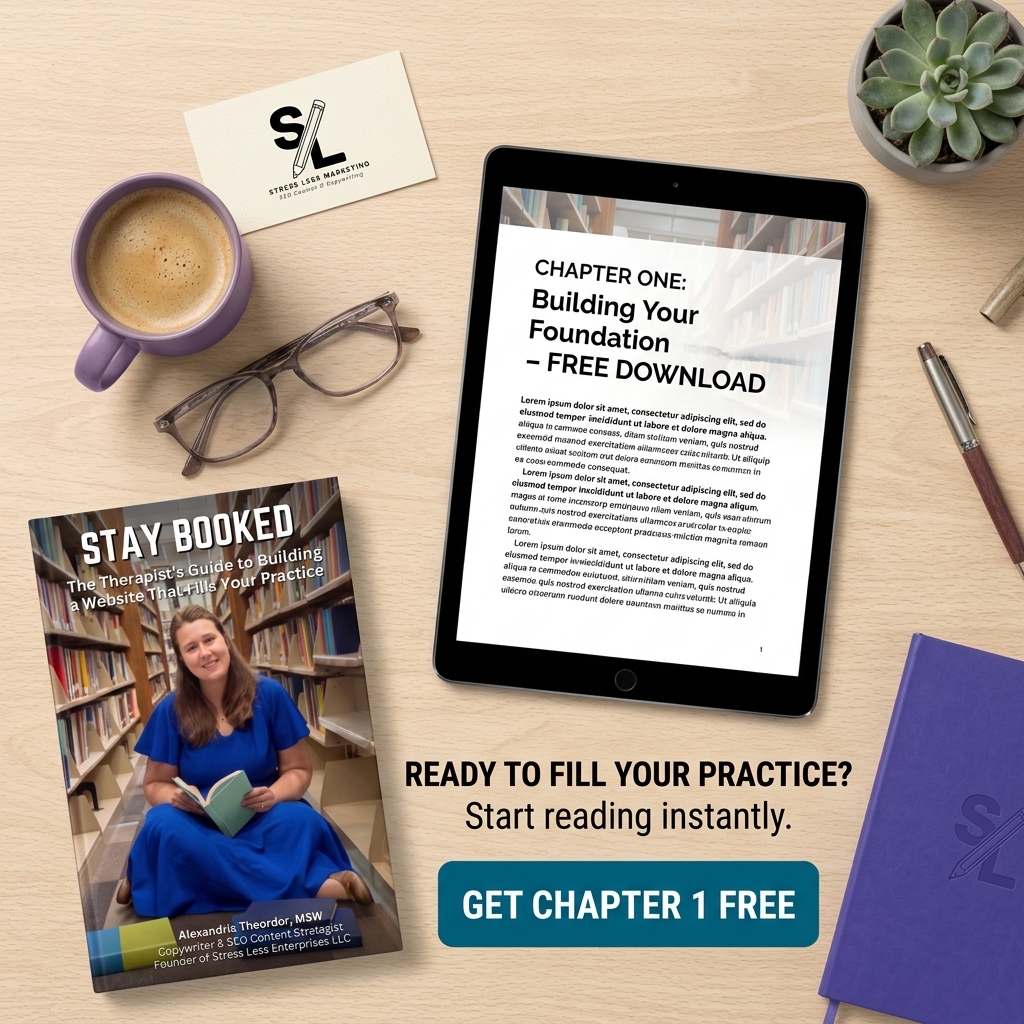
Download Chapter 1 of Stay Booked free and see exactly how ethical, non-salesy marketing gets built into a therapy website from the ground up.

Myth #2: Clients Will Just Find Me Through Word of Mouth
Relying solely on referrals limits your practice, because referrals are unpredictable and you’re at the mercy of someone else’s business. When I ran my own private practice, referral flow depended on a dozen small variables I had zero control over: how busy a referring office was that month, whether they already had a go-to therapist on their list, how well the front desk staff actually knew and trusted my name. Some months were full. Other months I was reminded, uncomfortably, how fragile “word of mouth” really is as a business strategy.
If you’re relying on other therapists for referrals, the honest reality is that they’ll prioritize their own caseload first. Unless you’ve built a genuine relationship with them, they’re not going to send someone your way just because you mentioned you have an opening.
Referrals still matter, and they carry real weight. But very rarely does someone take a recommendation and run with it without checking further. What’s the first thing you do when a friend recommends someone? You Google it. A strong online presence validates a referral once it’s given, and it often fills the gap referrals leave behind.
A few things worth remembering:
Referrals are unpredictable and often seasonal, which creates income instability you can’t plan around.
Word of mouth relies entirely on your existing network, which may not match where you want your practice to grow.
Referrals often come from a narrow demographic, limiting the diversity of who finds you.
Plenty of potential clients will never hear about you through word of mouth at all, no matter how good your work is.
A digital presence doesn’t just validate the referrals that do come in. It gives people the chance to research, sit with the idea, and get comfortable before reaching out. Some people are ready to commit after a little information. Others need days of reading before they’ll pick up the phone. Blog content gives both kinds of readers a place to land, helping them understand your viewpoint, name their own problem more clearly, and build the confidence that you’re the person who can help.
Myth #3: Marketing Feels “Salesy” or Inauthentic
Many therapists feel uncomfortable promoting their own services because we’re trained to keep the focus on the client, not ourselves. Marketing can feel topsy-turvy in a field built around healing and helping other people.
Here’s the truth: marketing doesn’t have to feel inauthentic, and it doesn’t even have to center you. It can be a natural extension of wanting to help more people, focused entirely on how your services solve someone else’s problem.
I left graduate school with a full clinical toolkit and absolutely no idea how to talk about my own work to a stranger scrolling on their phone at midnight. That gap is the norm for most clinicians, not the exception. Clinical training builds the expertise. It just never teaches you the words that help people find that expertise.
But you already have the skills to market authentically, because they’re the same skills you use every day in session.
Active listening. You already listen deeply to understand a client’s needs and struggles. Use that same skill in your marketing by writing content that answers the questions your potential clients are actually asking, not the ones you assume they’re asking.
Empathy. Your ability to validate a client’s experience translates directly into marketing that speaks to real emotions and real challenges, instead of language that feels like a pitch.
Motivational interviewing. You’re already skilled at laying out options and letting someone arrive at their own decision. Marketing works the same way. You’re not selling. You’re presenting the choice clearly enough that someone can recognize themselves in it.
Education over promotion, sharing your story, and being transparent about how you work all do more than a sales pitch ever could. A blog post explaining the difference between CBT and EMDR, for instance, turns a decision into an informed conversation instead of a sales pitch, and it respects the reader’s autonomy the whole way through.
There’s a related fear worth naming here, because it usually hides behind the same discomfort. A lot of therapists hedge on specifics because saying something concrete feels too close to a promise, so the website ends up describing a clinician who could practice in any city and treat any population. Vague copy feels safer in the moment. It doesn’t protect anyone, and it leaves the reader unable to tell whether you’re the right fit for what they’re carrying. Naming your focus, whether that’s a population, a modality, or a specific issue, isn’t exclusionary. It’s information. It’s also the fastest way to save both of you a consultation call that was never going to lead anywhere.
Myth #4: I Don’t Need Marketing Because I’m Fully Booked
If you’re fully booked, this is actually the moment to double down, not step back. A full caseload isn’t a reason to stop marketing. It’s a chance to refine your strategy for the long haul.
I think about the Savannah Bananas here, the baseball team that built a rabid, sold-out fan base not by winning championships but by treating every single fan like the most important person in the stadium, even after tickets were already impossible to get. They never stopped building the relationship just because demand was high. If anything, a full house gave them more room to experiment and double down on what made people fall in love with them in the first place.
A full caseload gives you the exact same room. When you’re fully booked, you can market from a place of abundance instead of desperation, and that confidence comes through in your tone. You also have current client feedback to draw from- the language clients actually use to describe what’s working- which makes your marketing sound more like you and less like a template.
A full schedule is also the moment to consider whether you want to build beyond one-on-one sessions. Groups, workshops, or a resource like a book let you reach people who aren’t ready for individual therapy yet, without adding another body to your caseload.
And business is cyclical. Client turnover, discharges, and natural breaks happen to every practice eventually. Consistent marketing keeps your pipeline warm through the slow stretches, so you’re never scrambling to fill space that opened up unexpectedly. A full calendar today doesn’t guarantee a full calendar in six months. Marketing now is what protects the practice you’ve built.
Myth #5: Marketing Is Too Time-Consuming or Expensive
Many therapists assume marketing eats either their time or their budget, and often both. In reality, digital marketing is one of the more affordable ways to attract clients, even in the earliest stage of a practice.
Traditional advertising, print ads, radio spots, carries a real price tag. Digital marketing doesn’t have to. Many email platforms, MailerLite included, offer a generous free tier that will carry a small list through the first year or more of a practice. Blogging costs little beyond a domain and hosting, and unlike a paid ad, a blog post you write today keeps working for years without another dollar spent. Social platforms like Instagram and LinkedIn are free to use, and consistency matters far more there than ad spend does.
The real time-saver is repurposing. Picture one sheet of cookies coming out of the oven and being separated onto a cooling rack: same batch of dough, several individual pieces, each one useful on its own. One blog post works the same way. Write a single post on managing anxiety in daily life, and that one afternoon of writing becomes an Instagram caption, a handful of quote graphics for LinkedIn, a section of your next newsletter, and a downloadable resource, all from content you already created. That’s not extra work. That’s one piece of a bigger picture getting cut down into the shapes it needs to fill.
Scheduling and automation tools do the heavy lifting. A booking tool that handles consultation requests automatically, an email sequence that nurtures a new subscriber without you writing a single follow-up by hand- these systems buy back hours every single week without costing much at all.
Marketing doesn’t need to consume your day or your budget. What works for a brand-new practice will look different from what works for a practice with a five-year track record, but the underlying tools stay efficient and affordable at every stage.
The Ethical Side of Marketing for Therapists
When someone searches for therapy, they often don’t know how to articulate their struggle or which type of therapy actually fits their needs. In that context, marketing becomes education. It helps someone make an informed decision, so that when they do reach out, they’re more likely to land with a therapist who’s actually the right fit. That’s not manipulation. That’s giving someone the information they need to choose confidently, in a field where the right fit can genuinely change the outcome.
A few ways to keep your marketing client-centered and value-driven:
Lead with education, not promotion. Blog posts, videos, and webinars that explain how therapy works let potential clients make an informed decision instead of absorbing a pitch.
Share your values and therapeutic approach openly so clients can tell whether your style matches what they’re looking for before they book a session.
Name your specialization clearly. If you work with eating disorders, couples, or grief, say so directly. It prevents mismatches and helps the right person recognize you as the answer to their specific problem.
Lead with verifiable credentials, not outcome promises. List your license, your training, and the modalities you’re actually qualified to practice. Those are facts you can document. What happens in the room belongs to the client, and no marketing copy should promise a result or a timeline you can’t guarantee.
Keep your social media boundaries clear. A post can talk about your work, your process, and the questions clients ask you all day long, but the moment a story needs a real client’s details to make sense, that’s the line. Use a de-identified or composite example instead, or draw from your own experience. The same goes for language: even a post that unintentionally stigmatizes a mental health issue works against the reason you’re posting in the first place.
Handle reviews with more care than a typical business would. A Software Advice survey of more than a thousand patients found that 77% used online reviews as the first step in finding a new doctor, so reviews clearly matter to how people choose a provider. But even replying to a review can confirm that someone is your client, which is exactly the kind of disclosure your licensing board and HIPAA care about. Check what your board allows before you build any review strategy, and lean toward private feedback over public testimonials when clinical care is involved.
Use testimonials that reflect real progress, framed around the client’s growth rather than a sales pitch.
Be transparent about availability, fees, and session structure up front, so nothing about working with you comes as a surprise later.
Marketing Can Be Honest, and It Can Still Work
Marketing isn’t manipulation, and it isn’t inauthentic. It’s a bridge between the help you’re equipped to give and the people who are already looking for it. Every skill that makes you good at therapy, empathy, active listening, the ability to meet someone where they are, is also what makes you good at marketing, once you stop treating the two as opposites.
If you’ve been hesitant to promote your practice, consider what’s at stake: every potential client you don’t reach may keep struggling without the support they need. Ethical, effective marketing is simply how you close that distance.
Download Chapter 1 of Stay Booked free and start building a website and content strategy that markets your practice honestly, without ever feeling like you’re selling.
Frequently Asked Questions
Does marketing violate my professional ethics code? No. Ethics codes set standards for how you market, not whether you’re allowed to. The recurring themes are transparency about what you offer, consent before using any client information, and a deliberate strategy behind what you say. Confirm the specifics with your own licensing board, since requirements vary.
Can I ask current clients to leave a Google review? This is where practices get into trouble, because a review can reveal that someone is your client. Handle Google reviews carefully and stay mindful of HIPAA. Many clinicians ask for general feedback instead of a clinical testimonial, and check with their licensing board before building any review strategy at all.
Is it unethical to use client stories on social media? Sharing identifying details without consent crosses a clear line, whether it’s a caption or a photo. If a point needs a story to land, use a composite or de-identified example, or share your own experience instead.
Can I niche down without turning people away? Specializing isn’t the same as refusing to help. Naming your focus clearly is part of the transparency ethical marketing depends on, because it’s what lets someone judge whether you’re the right fit. Vague copy doesn’t protect anyone. It just makes the decision harder for the person who needs to make it.
Sources
- Edelman. Edelman Trust Barometer. Edelman. https://www.edelman.com/trust/trust-barometer
- Software Advice, cited in Becker’s ASC News. 77% of Patients Read Online Reviews When Choosing New Physician — 5 Insights. https://www.beckersasc.com/?p=42294