Why Am I Not Getting Clients Even Though People Visit My Website?
Your Health and Wellness Website Has a Visitor Problem. And Traffic Is Not the Fix.
You built the website. You have a logo, a color palette, and a decent headshot. You list your services. You might even rank for a couple of searches. But the inquiries? Inconsistent at best. Nonexistent at worst.
Most health and wellness business owners assume this is a traffic problem. Get more eyes on the page, and the bookings will follow. So they invest in ads, post more on Instagram, and hope the algorithm rewards them.
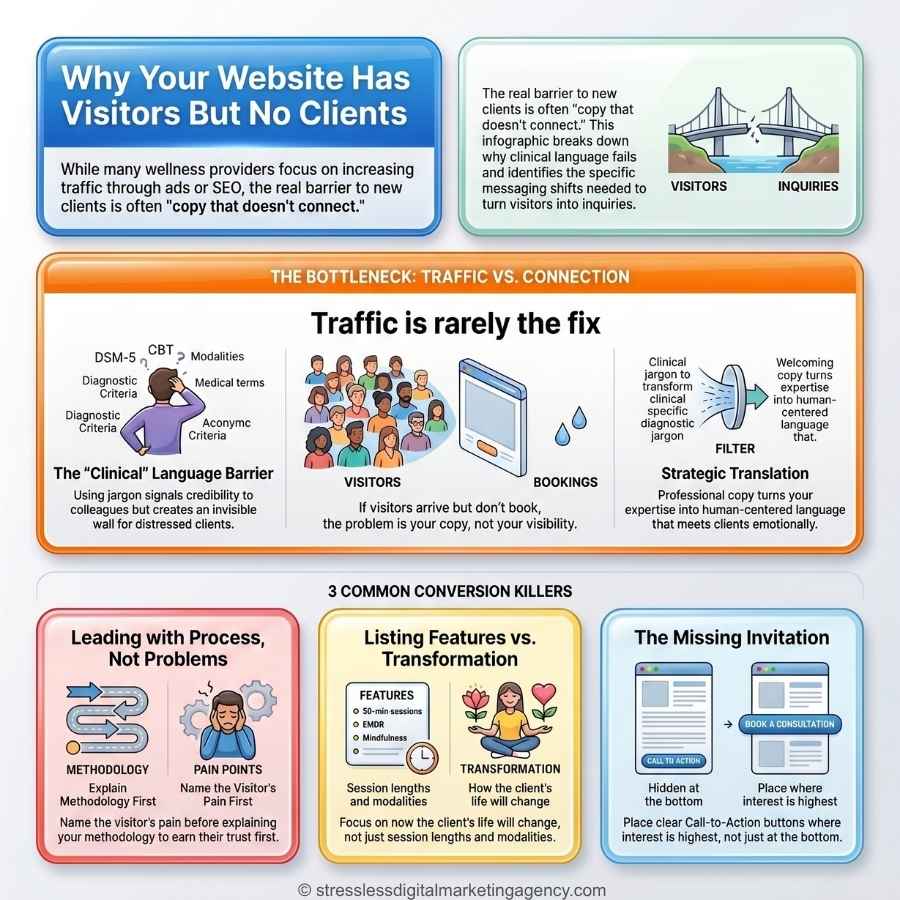
The real problem is almost never traffic. It is copy.
If you want to understand the full picture of what copy does — and what separates SEO copywriting from general website writing — the SEO copywriting overview covers that in depth. This post focuses on the specific gap between traffic and conversion, and why copy is almost always what’s sitting in between.
What Happens When Copy Does Not Connect
Potential clients land on your website already primed to say yes. They Googled a specific phrase. They found you. They are open. But then they read your homepage, and it says something like this:
“I provide a warm and supportive environment where clients can explore their thoughts and feelings.”
Every therapist, coach, and wellness provider in your city says that. That sentence describes a professional standard. It does not describe your client. It does not name their problem. And it gives them zero reason to choose you over the next five tabs they have open.
So they leave. Not because your work is not excellent. Because your words did not reach them.

The Invisible Wall Between Your Expertise and Your Ideal Client
I was a mental health therapist before I became a copywriter. I know this gap intimately. We are trained to use precise clinical language because precision matters in clinical settings. It signals credibility to colleagues. But your potential client is not reading your website in a clinical setting. They are on their phone at 11pm, wondering if they will ever feel better.
I was reading a book recently on social anxiety — genuinely fascinating content — but I could barely get through it. The language was so elevated, I needed to constantly translate it in my head. No real-life examples. Just research and jargon. And I thought: this is exactly what clients experience when they land on a wellness website full of clinical terms. The help is there. They just cannot find it through the words.
What Professional Website Copywriting Actually Fixes
A professional website copywriting service for health and wellness providers is not about making your site look better. It is about the strategic translation work that turns your expertise into language that connects and converts. That means:
- Identifying the exact phrases your ideal clients use when they search for help
- Structuring service pages to answer the questions a potential client is already holding
- Writing homepage copy that meets the client where they are emotionally, not just clinically
- Building in SEO strategy so the right people find you before you ever need to sell them
Before any of that writing happens, the foundation has to be set. That is what foundational messaging does — it identifies the specific positioning, language, and client insights that make all the copy work.
One thing worth knowing before you hire: a VA who writes content and a copywriter are not doing the same job. If you’re weighing those two options, the distinction between a copywriter and a VA is worth understanding before you make that call.
How to Know If Copy Is Your Bottleneck
Read your homepage out loud. Ask yourself: can someone with no clinical background immediately understand who I help and how? Does my service page describe my client’s lived experience, or just the modality I offer? Are people landing on my site and leaving without reaching out?
If your answer to the last question is yes, no amount of new traffic will fix the problem. And if you are wondering what it costs to wait on getting this right, that answer is probably larger than you think.
When you are ready to move to private pay and build an organic inquiry pipeline, the next step is understanding how to use your website to convert organic visitors.
Your website should work harder than your referral network. That only happens when the copy is doing its job.
The Most Common Copy Problems That Kill Conversions
Most health and wellness websites that have traffic without inquiries share a recognizable pattern. It is worth naming them plainly so you can identify which one applies to you.
Your homepage leads with your process, not your client’s problem. Describing your methodology before naming what your visitor is experiencing asks them to care about how you work before they’ve decided they trust you. Flip the order — start with the problem, earn attention, then explain your approach.
Your service page is a list of offerings, not a case for transformation. Bullet points of modalities and session lengths don’t answer the question every prospective client is actually asking: will this work for me? Copy that walks a reader through what changes after working with you — specifically, concretely — does far more conversion work than a features list ever will.
There is no clear next step at the right moment. A visitor who has read your about page, scrolled your services, and nodded along to everything you’ve written will still leave without reaching out if there is no well-placed, low-friction invitation to do so. A CTA buried at the bottom of a long page doesn’t count. The invitation needs to meet them at the moment of highest interest, which is usually earlier than most practice owners expect.
If you recognize your website in any of these, the full breakdown of why website copy stops converting goes deeper on each one — with specific fixes rather than just diagnosis.
Ready to stop losing potential clients at the copy level? Download the price and services guide to see what working together looks like, or fill out the contact form if you’re ready to get started now.