Why Therapy Practices Need Foundational Messaging Before Any Other Marketing
Here is a scenario that plays out more often than it should. A therapist invests in a website redesign. The site looks clean, professional, and well-organized. Six months later, the inquiry volume has not moved. The phone is not ringing any more than it did before. They are still dependent on referrals and Psychology Today. Nothing changed.
The website was not the problem. The messaging underneath it was.
This is the most expensive mistake I see therapy practices make: investing in marketing execution before the foundation is in place. A beautiful website built on unclear messaging is still unclear. Blog content written without a defined voice still sounds like everyone else. SEO that drives traffic to a page that does not convert is just expensive traffic.
Foundational messaging is the work that makes everything else work. And for therapy practices, it is not optional. It is the starting line. Here is why, and what happens when you skip it.
What Foundational Messaging Actually Is
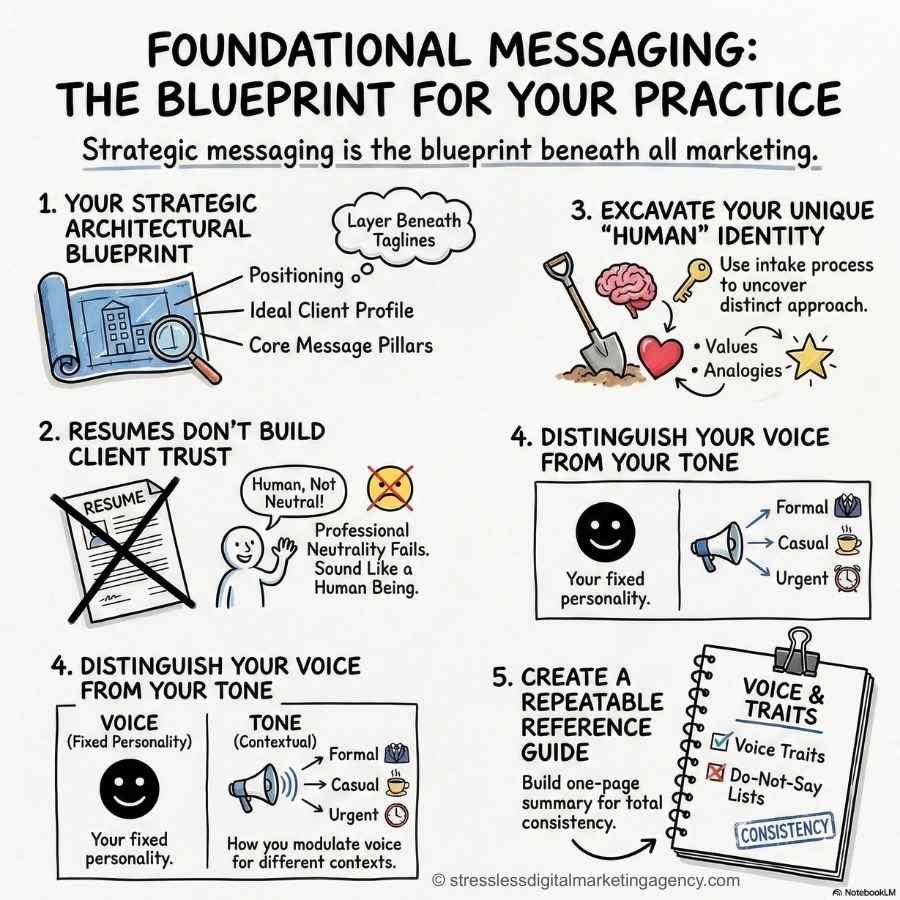
Foundational messaging is the strategic layer underneath your tagline and elevator pitch. It includes your positioning, ideal client, core message pillars, and language that connects your expertise to client needs. Think of it as the architectural blueprint. Everything else — the website, the blog, the Psychology Today profile, the email newsletter — gets built on top of it.
For a deeper look at how this connects to your brand voice, read the full guide on building a brand voice for service providers. For now, let’s focus on why the foundation has to come first.
The Blank Slate Problem: Why Therapist Training Works Against Your Marketing
There is a reason so many therapy practice websites read like they were written by the same person. And it has nothing to do with copywriting skill.
Therapists are trained, deliberately and correctly, to be a blank slate. The model is rooted in classical theory: minimize the clinician’s presence so the client’s own material can surface without interference. It is genuinely good clinical practice.
It is terrible marketing practice.
When therapists write their own website copy or try to describe their practice, they default to the same professional neutrality that serves them in session. The result is copy that is accurate, ethical, and completely indistinguishable from every other therapist in the directory. Credentials are listed. Modalities are named. A warm, generic welcome is extended. Nothing says who this person actually is, what they believe, or why this practice is the right fit for a specific client in a specific season of their life.
I worked with a perinatal and new parent therapist whose intake document was one of the most thorough I have ever read. She had a sophisticated theoretical framework, a genuine specialty, and a deeply personal reason for doing the work she does. When I asked her to tell me what made her different from other therapists in her space, she paused for a long time. She genuinely did not know how to answer. The things that made her extraordinary had never been named out loud as differentiators. They were just how she worked. By the end of our session, she had identified six distinct aspects of her practice that no other therapist in her market was communicating. None of them required new skills. They just required the right questions.
This is what foundational messaging work actually is. Not manufacturing a persona. Not crafting a personal brand from scratch. Excavating what is already there and naming it in language that connects.
Why Posting More Content Is Not the Answer
When therapy practices feel invisible online, the most common instinct is to produce more content. More blog posts. More social media. More email. More presence.
The problem is not volume. It is the foundation underneath the content.
Content without foundational messaging tends to share a recognizable set of problems:
- It covers broad, general topics because the niche has never been clearly defined
- It sounds different from post to post because there is no documented voice to anchor it
- It gets written in a rush, leans on credentials to establish authority, and never quite lands
- It generates impressions and maybe some engagement, but it does not convert to inquiries
More of that content does not fix the problem. It compounds it. You end up with a larger body of work that still does not sound like you, still does not speak to a specific client, and still does not give someone a clear reason to choose your practice over another.
| The uncomfortable truth: If your current content could be published on any other therapist’s website without anyone noticing, you do not have a content problem. You have a messaging foundation problem. And no amount of posting will solve it. |

The Hidden Cost of Wanting to Be Hands-Off
One of the most common things I hear from therapists exploring marketing support is some version of: “I just want someone to handle it. Take it off my plate completely. Tell me what to approve, and I will approve it.”
I understand that impulse completely. You are already managing a full caseload, running a business, and trying to maintain a life outside of the office. The idea of handing your marketing to someone who will figure it out is genuinely appealing.
Here is the reality: the most hands-off approach to marketing is actually the most expensive one, because it produces work that does not sound like you and does not convert. When a copywriter or content agency is given nothing to work from, they fill in the blanks with generic. And generic does not build private pay practices.
Good foundational messaging work requires depth of collaboration. It requires pulling the actual words out of your mind, because the words that will resonate with your ideal clients are the ones already in your head — the way you describe your approach in a consultation call, the analogy you use to explain a modality, the specific thing you believe about how change actually happens. None of that is transferable without conversation.
The Foundational Messaging Map session is structured exactly this way. It is a 60 to 90-minute interview that functions more like a clinical intake than a marketing meeting. I am asking about your values, your history, your ideal client’s inner world, what you never want to be associated with, and what you do on a Tuesday afternoon that has nothing to do with your practice. Because all of those details are what separate a messaging document that sounds like a human being from one that sounds like a directory listing.
The investment up front is real. But it is a fraction of what gets wasted on websites, content retainers, and ad campaigns built on an unclear foundation.
What Foundational Messaging Actually Looks Like in Practice
Before a single word of copy gets written for a client, I need to understand who they are as a practitioner at a level most marketing processes never reach.
The process starts with a detailed intake that the client completes before we ever get on a call. It covers everything from their clinical approach and ideal client profile to their personal values, the things that get them out of bed on hard days, and what they wish more people in their field stood for. It typically takes one to two hours to complete thoroughly.
Then we get on a call. And this is where the real work happens.
I once had a client who had completed the most thorough intake I had ever read. Deep theoretical grounding, a genuinely distinctive specialty, a clear clinical philosophy. When I asked her what made her different, she could not answer. Everything that made her extraordinary had never been named as a differentiator. It was just how she practiced.
By the end of our session, she could articulate six specific, concrete aspects of her practice that no other therapist in her market was openly communicating. None of them required her to become someone different. They just required the right questions and someone who knew how to listen for the answers.
What comes out of that session is a Foundational Messaging Map: a polished document that includes your positioning statement, core messaging pillars, your ideal client profiles, a language guide covering what to say and what to avoid, and light keyword observations that align your messaging with how clients actually search. It is the document that makes every piece of copy and content that follows work the way it should.
| What clients say after the session: The most common response is that it felt less like a marketing meeting and more like finally getting clarity on something they had been circling for months. Many say they did not realize how much they had to say until someone asked the right questions. |
Signs Your Practice Is Ready for Foundational Messaging Work
Foundational messaging is not for every practice at every stage. It is specifically valuable when:
- Your website has been live for more than six months, and inquiries have not grown meaningfully
- You have tried writing your own content, and it consistently does not sound like you
- You have hired a copywriter before, and the result felt generic or required endless revisions
- You are transitioning to private pay or out-of-network and need your copy to justify the investment
- You have a clear specialty, but cannot seem to communicate what makes your approach distinct from others who share it
- You want to hand off your content to a writer or VA, but have nothing concrete to brief them with
If any of those sound familiar, the problem is almost certainly a missing foundation, not a missing content calendar. Building that foundation is what makes the brand voice guidelines and the content that follows actually work.
The Logical First Step Is Not More Content. It Is This.
Before you write another blog post, update your Psychology Today profile again, or hire someone to manage your social media, get your messaging right. Everything else becomes dramatically more effective when the foundation is in place. And everything else becomes expensive noise when it is not.
The Foundational Messaging Map is designed to do exactly this: give you the clarity, language, and strategic framework that makes all future marketing work the way it should. It is a single, structured session. The output is a document you keep and use across every platform, every piece of content, and every person who ever writes a word on behalf of your practice.
Get Your Messaging Foundation in Place
Download the Price and Service Guide to learn exactly how the Foundational Messaging Map works and what you walk away with.
Not ready to dive in yet? Start here for free:
- Quiz: What’s Keeping You Stuck With Marketing? — Find your #1 visibility blocker in under 3 minutes
- [Freebie] Stop Panicking When Clients Graduate: Your Website’s Guide to Organic Inquiries
- Free Blog Templates For Service Providers: Designed Specifically For Health & Wellness Clinicians