The Silent Salesperson: How Powerful Copy for a Website Brings In More Sales
There is a contemporary artist named Andrea Jacobs. What makes her work different is that she is always present when someone views it — standing nearby, ready to explain what the piece is trying to say. Most of us have stood in front of a painting thinking: it’s beautiful, but I have no idea what it means for me. The explanation changes everything. Suddenly, you see what the artist intended. The connection lands.
That is exactly what happens on a website when the copy is doing its job.
A beautifully designed site with unclear copy is a painting with no guide. Visitors look at it thinking: this seems impressive, but what does it mean for me? What do I do next? They click away, not because they weren’t interested, but because the words never gave them a reason to stay.
The copy for a website is your 24/7 sales team, your first impression, and often your only chance to earn a prospective client’s trust before they move on. When it’s working, visitors become inquiries without you lifting a finger. When it’s not, even the most beautiful site in your niche will bleed potential clients you will never know you lost.
This post covers what sales-driven web copy actually looks like, why most health and wellness websites fall short of it, and what changes when the words are built with strategy behind them.
Related: For a deeper look at the full role of an SEO copywriter — including the research and strategy that happens before a single word is written — the SEO copywriting overview covers it in depth.
What “Copy for a Website” Actually Means
Website copy is every word on your site — headlines, body paragraphs, service descriptions, FAQs, calls to action, button text. All of it. Not just the long paragraphs people skim over, but the six-word headline that either earns a visitor’s attention or loses it in the first three seconds.
What makes website copy different from a blog post, a social caption, or an email is the primary job it is doing. Blog content informs. Social content builds awareness. Website copy — specifically the pages that matter most for conversion — has to do all of that and then persuade a reader to take a specific next step.
Website copy that sells is not aggressive or pushy. It does not feel like a hard pitch. The best sales-driven web copy reads like a knowledgeable, warm conversation with someone who clearly understands your situation. It answers the questions you were already holding. It makes the next step feel obvious rather than pressured.
That is a higher bar than most practice owners realize going in. And it is why the gap between a website that looks good and a website that actually generates consistent inquiries almost always comes down to the words.
Why Most Health and Wellness Websites Fail at This
I rewrote my own Psychology Today profile once. Not a full overhaul — I just stopped writing like a resume and started writing like someone who knew exactly who she helped. Within seven days, I had calls. Not because I was suddenly more qualified. Not because the algorithm changed. Because the right people finally saw themselves in what I wrote.
That is the whole job of copy for a website. And it is what most health and wellness practices are not doing.
The pattern I see most often: a practice owner writes their site in their professional voice. Credentials up front. Modality names prominent. A bio that reads like a LinkedIn profile. It is technically accurate. It is professionally appropriate. And it connects with almost no one who does not already know what those terms mean.
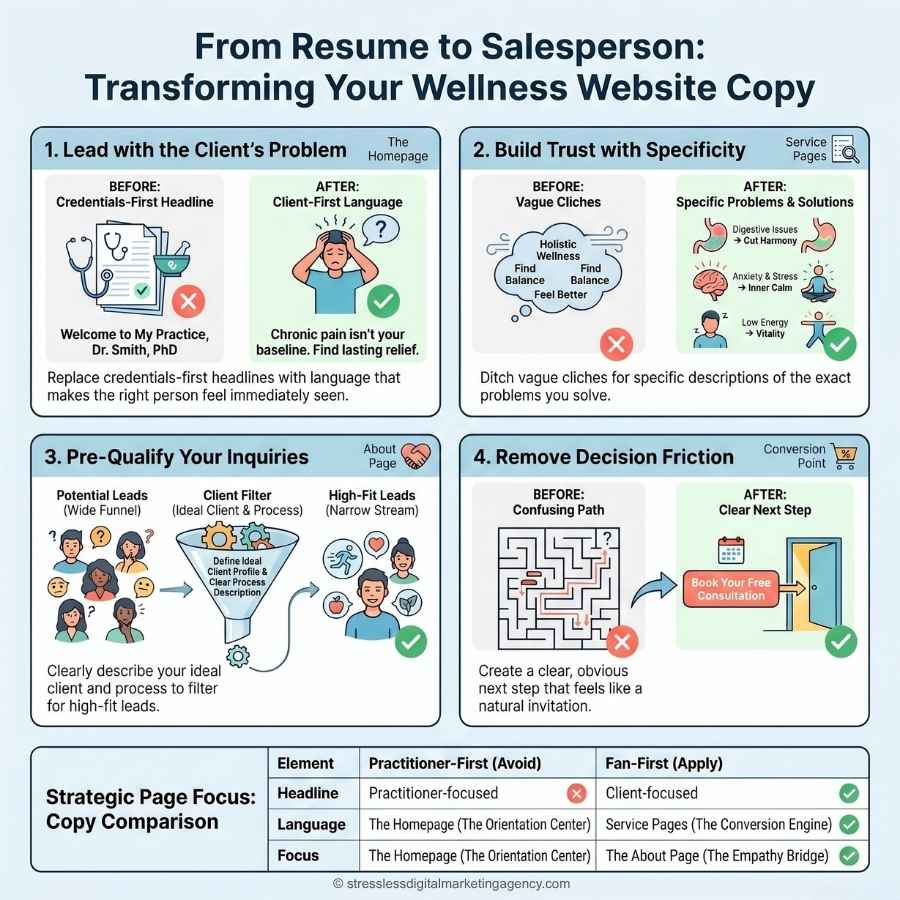
Your prospective client is not searching for your certifications. They are searching from a problem. They type things like “why do I feel exhausted no matter what I do” or “acupuncturist for chronic pain near me” or “nutritionist who actually listens.” If your homepage leads with your credentials instead of their experience, it fails the first test of website copy that sells — which is making the right person immediately feel seen.
The Savanna Bananas baseball team has a philosophy called “fan first.” Every single decision — the seats, the entertainment, the concessions, the experience — is built around the audience’s enjoyment, not the organization’s preferences. Most websites are built around the practice owner’s preferences. Credentials that feel important to display. Language that feels professionally appropriate. Structure that makes sense to someone who already understands the field.
Fan-first copy flips that. Every page is built around the question: what does my ideal client need to see right now to take the next step?
What Sales-Driven Web Copy Actually Does
It earns attention before it asks for anything
The headline on any given page has one job: make the right reader want to keep reading. Not dazzle them. Not impress them with how much you know. Just create enough relevance and curiosity to keep them on the page for another 10 seconds.
A headline that says “Welcome to My Practice” earns nothing. One that says “Chronic pain does not have to be your baseline” earns attention from a very specific person who has been quietly hoping that is true. Sales-driven web copy opens with the reader’s world, not the provider’s credentials.
It builds trust through specificity
Vague promises are everywhere online. “Compassionate, evidence-based care.” “A holistic approach to wellness.” “Meeting you where you are.” These phrases are not wrong — they are just so common that they have stopped meaning anything. They do not differentiate. They do not build trust. They blend in.
What builds trust is specificity. The name of the exact problem you solve. A description of your ideal client that is accurate enough to make them feel identified. A process explanation that answers the questions a hesitant prospect is already holding. Details are what make generic copy feel personal, and personal is what converts.
It pre-qualifies the right clients
One thing that rarely gets talked about in conversations about website copy that sells: good copy filters as much as it attracts. When your pages clearly describe who you help best, what the investment looks like, what the experience involves, and what the outcome is, you stop getting inquiries from people who are not a fit.
For health and wellness business owners specifically, this matters a lot. Every discovery call with a client who was never going to book costs time you cannot recover. Sales-driven web copy does the pre-qualification work before anyone picks up the phone, which means the inquiries you do get are warmer, more informed, and more likely to convert.
It removes friction from the decision
A prospective client who has read your site, resonated with your approach, and understood your process should have one clear, obvious next step waiting for them at exactly the moment they are ready to take it. Not buried at the bottom of a long page. Not hidden behind a vague “learn more” button. Right there, at the peak of their interest, with language that makes the action feel natural rather than transactional.
This is what most practice websites get wrong about calls to action. The CTA is not a closer — it is an invitation. The best ones feel like a logical continuation of the conversation that just happened on the page.
If your site is already getting traffic but visitors are not converting into inquiries, the issue is almost always here — in the specificity, the trust-building, and the clarity of the next step. The full breakdown of why website copy stops converting goes deeper into each of these failure points with specific fixes.
The Pages That Do the Most Work
Not every page on your site carries equal conversion weight. Understanding which ones matter most for generating inquiries helps you prioritize where the copy needs to be strongest.
The homepage
This is where most visitors land first, and it has the highest stakes of any page on your site. Its job is not to explain everything — it is to orient the right person immediately and give them a reason to go deeper. A strong homepage names who you help, what changes after working with you, and where to go next. Everything else can live on other pages.
Service pages
These are where the actual conversion work happens. A service page that lists what you offer is a menu. A service page built as sales-driven web copy walks a reader through the problem they are experiencing, introduces your approach as the solution, explains what the process looks like, addresses the hesitations they are carrying, and closes with a clear invitation. The gap between those two versions is often the gap between a site that gets inquiries and one that gets traffic.
The about page
Most about pages are written about the practice owner. The best ones are written for the prospective client. Your background, your training, your experience — these build credibility, but only after you have established that you understand the reader’s situation. Lead with empathy, then introduce your expertise as the reason they can trust you to help.
The contact or booking page
This is not the place to introduce friction. Short, warm, and clear. One form. One action. Any uncertainty a visitor feels at this stage — about what happens next, about whether they are reaching out to the right person, about what the first step actually involves — will make them leave. Copy for a website contact page has one job: to make reaching out feel easy.
If you are trying to figure out which of these pages to prioritize first, the guide to where health and wellness business owners should start with SEO copy walks through the decision based on where your site is right now.
What Goes Into Copy That Actually Converts
Writing is the visible part. The research and strategy underneath it are what make the difference between copy that sounds nice and copy for a website that actually sells.
Voice-of-customer research
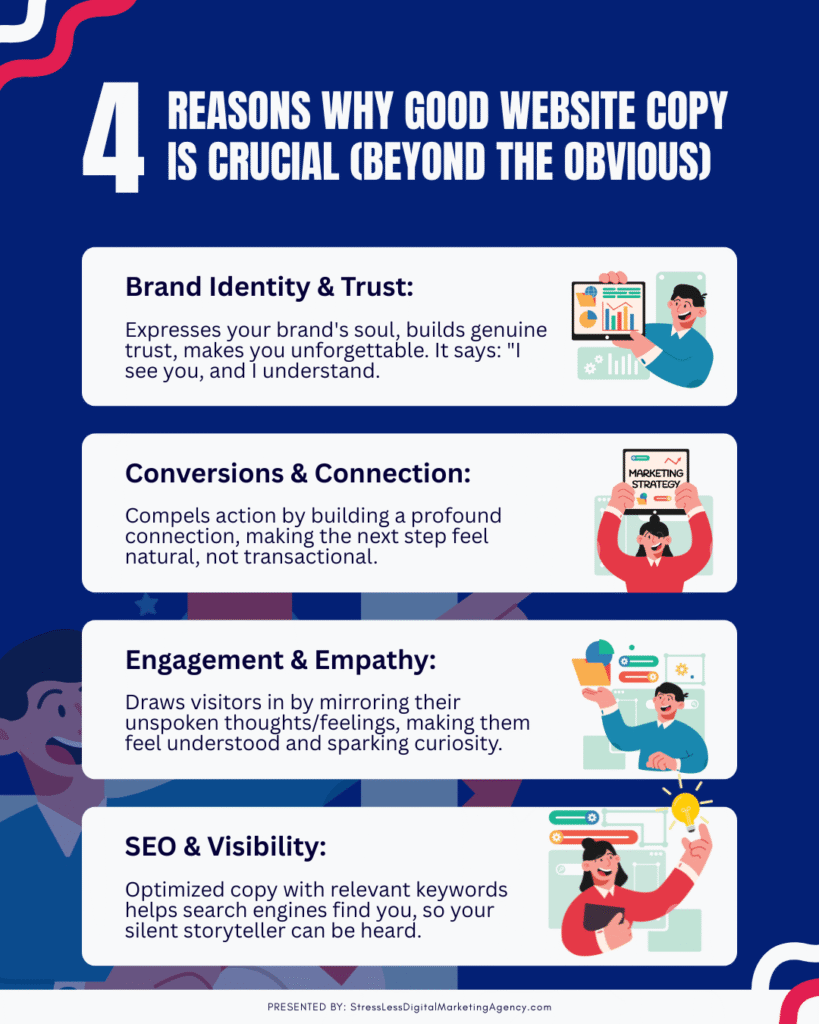
The best copywriting is not created — it is compiled. I am not sitting down and inventing language from nothing. I am pulling what your ideal clients already say: in reviews, in intake forms, in the questions they ask before they book, in the way they describe their own situation. That language, organized and shaped into a page structure that mirrors how a real person makes decisions, is what makes copy feel as if it were written specifically for the reader.
This is where my clinical background does something most copywriters cannot replicate. Years of sitting with people in intake sessions — listening not just to the presenting problem but to the language underneath it, the real concerns, the unspoken fears — trained a kind of listening that translates directly into copy. I am not guessing at what your clients need to hear. I am drawing on thousands of hours of understanding how people describe what is hard and what would feel like relief.
Structure and hierarchy
Sales-driven web copy is not a wall of text. It is a carefully considered sequence of information, designed to meet a reader at their current level of awareness and move them forward. Visitors scan before they read. Headlines carry the most weight. Subheadings do almost as much work. Body paragraphs fill in the details for the readers who have already been earned.
Getting the structure right means every section of a page is doing a specific job — and nothing is there that does not earn its place.
SEO built in from the start
Copy for a website can be beautifully written and completely invisible if it is not built around the phrases your ideal clients are actually searching. Keyword research is not a separate step that happens after writing — it shapes what gets written, which topics get addressed, which phrases appear in headlines, and how pages are structured. The goal is copy that Google can surface to the right person at the right moment, and that person immediately recognizes it as relevant when they land on the page.
If you are wondering whether you need both a copywriter and an SEO strategist, or whether one person can do both, the comparison of what an SEO copywriter, a web designer, and an SEO agency each handle clearly answers that question.
The Principles Behind Copy That Works
These are not rules to follow mechanically. They are the reasons why effective copy looks the way it does.
Be concise — but not at the expense of connection. Online readers skim, and dense paragraphs get skipped. Shorter is usually better. But cutting so aggressively that the emotional resonance disappears is its own problem. The goal is not brevity for its own sake; it is saying exactly what needs to be said in the fewest words required to say it well.
Clarity over cleverness. The most common mistake in health and wellness copy is defaulting to language that sounds sophisticated but leaves the reader working too hard to understand what you mean. If a prospective client has to puzzle out what you offer, they will not. Plain language that speaks directly to the problem converts better than elegant language that obscures it.
Consistency builds recognition. Your voice — the tone, the rhythm, the perspective — should be recognizable whether someone is reading your homepage, a blog post, or an email from your newsletter. That consistency is what makes a brand feel trustworthy rather than assembled from parts.
Structure is navigation. Break pages into scannable sections with meaningful subheadings. Use spacing. Keep paragraphs short. None of this is aesthetic preference — it is the difference between a page that gets read and one that gets closed. Guide visitors through the content rather than presenting it as a single undifferentiated block.
Edit for emotion, not just accuracy. Grammar tools will catch errors. They will not tell you whether a sentence lands. Read your copy out loud. If a line reads like a brochure rather than a person speaking, rewrite it until it reads as if you are explaining something to someone who genuinely needs what you offer.
What the Write My Website Package Includes
If you are ready to stop guessing whether your website is working and start knowing for sure, the Write My Website package delivers copy for a website built to rank and convert.
Here is what is included:
- Homepage: A first impression designed to orient the right visitor immediately, establish trust, and move them toward your services.
- About Page: Your background and your “why” — written to build genuine credibility and give prospective clients a reason to choose you specifically.
- Service Page: A deep-dive page on a specific offer or specialty, written to speak directly to the person you help best and walk them through every question they are carrying before they reach out.
- Specialty Page: A second focused page that expands your SEO footprint and targets a specific niche or population.
- Contact Page: Short, warm, and frictionless. One clear action. No confusion about what happens next.
Every page includes keyword research tailored to your niche, meta titles and descriptions, internal linking recommendations, URL slug guidance, and clear CTAs that feel like a natural next step rather than sales pressure.
Ready to Make Your Website Work Harder Than You Do?
Trying to write your own sales-driven web copy while running a full practice is one of the more exhausting things a health and wellness business owner can take on. Not because you cannot write — most of you can — but because the research, the strategy, the keyword work, and the structural thinking that happens before the writing starts are genuinely time-consuming, and they require a different kind of attention than delivering your clinical work does.
The investment in getting it right pays back in inquiries that come in while you are with clients, in visitors who arrive informed and already bought in, and in copy that does not need to be redone in six months because it was built on guesswork.
Download the price and services guide to see what working together looks like, or take the free marketing quiz to identify your biggest visibility gap before deciding on your next step.
Not ready to hand it off yet? The practical guide to writing your own website copy walks through the process step by step for practice owners who want to DIY first.