Benefits of Blogging for Therapists: One Post vs a Year of Social Media
About nine months after my daughter was born, I needed to bring in extra income. I wasn’t seeing clients at the volume I had before, holding space for a caseload after holding a newborn all day was not sustainable, so I started selling my therapy documentation note templates on Etsy. They sold well. The problem was Etsy takes a significant commission, so I started researching how to move traffic directly to my own website instead.
That research led me to blog posts and review pages. I started writing content, redirecting people away from the Etsy storefront, and learning SEO almost entirely by accident. The products started selling from my own site. Then affiliate marketing came into the picture, and something interesting happened: the more traffic my site got, the more Google noticed that people were coming back, spending time there, sharing the posts. When I published something new, it started ranking faster. The whole thing compounded on itself.
It took about a year before the site reached around 800 page views a month. That sounds modest until you remember it started at zero, and I was doing most of it one-handed while breastfeeding.
That’s the actual story of how I learned what blogging does. Not from a course or a certification, but from watching it work in my own business while running on interrupted sleep and a very small window of daily focus time. What I’ve built since, and what I now help health and wellness practice owners build, is a more intentional version of the same thing: strategic, keyword-informed blog content that works as a long-term visibility asset rather than a content hamster wheel.
Key Takeaways
- A well-optimized blog post builds traffic for months or years after publication, unlike social media content, which disappears within hours
- Blogging targets the high-intent search queries your ideal clients are already typing when they’re ready to get help, which converts at a fundamentally different rate than social media reach
- Each post doubles as repurposable content that fuels emails, social captions, and podcast talking points, multiplying the return on a single investment of time
- Blogs handle client objections and pre-sell your services quietly, before a potential client ever gets on a call with you
- Strategic blogging builds the topical authority that makes your service pages rank higher too, it’s not just traffic for its own sake
A Blog Post Is Built to Be Found. A Social Post Is Built to Be Scrolled Past.
A blog post you published months ago can still be bringing inquiries through your contact form this week. A social media post you published this morning will be buried in the feed by the afternoon. That difference is the whole argument for blogging in a private practice.
The mechanical gap between the two channels matters more than most therapists realize.
- A blog post lives on a URL you own. It can be indexed by search engines, linked to from other pages, updated when your thinking evolves, and sent to a prospective client in an email.
- A social post lives inside a feed someone else controls. It competes with everything else in that feed, disappears from view quickly, and can’t easily be found again later.
- A blog post can rank for dozens of related searches over time. A social post tends to be seen mostly by people already following you, many of whom are colleagues rather than future clients.
One post, working for years, compounds. A year of posts, each visible for a day, doesn’t. This isn’t really a comparison of blog versus social media. It’s a durable asset versus a rented moment.

The Most Important Thing Blogging Does That Social Media Cannot
When someone types “anxiety therapist in [your city]” or “EMDR for childhood trauma near me” into Google, they aren’t browsing. They’ve already had the internal conversation, already made the decision to get help, and are now looking for the right person. That’s the highest-intent audience your marketing will ever reach, and SEO-optimized blog content is how you show up for them at exactly that moment.
Social media does something different. It reaches people who are scrolling, often passively, often while avoiding the very thing they need help with. That audience is real and worth nurturing, but converting someone from a casual follow to a booked client requires many touchpoints over a long period. The person Googling “trauma therapist” at 11pm is already three steps ahead of the person who paused on your Instagram post.
This is why SEO consistently outperforms social media as a lead source for private practice owners. The intent behind the search is categorically different, and blog content is the mechanism that gets you in front of it. For a complete look at how blogging fits into the broader picture of marketing strategy for private practice, including how it sits alongside referrals, ads, and directories, marketing strategy for private practice covers all four channels.
The Benefits of Blogging for Therapists
Benefit 1: Visibility That Keeps Working After You Log Off
A social post has a shelf life measured in hours. The Instagram algorithm moves on, the feed refreshes, and by tomorrow morning, most of your followers won’t have seen it, regardless of how good it was.
A well-built blog post does the opposite. Once it ranks for a relevant keyword, it keeps generating traffic, weeks, months, sometimes years after you hit publish. You’re not starting from zero every Monday morning. You’re building something that compounds.
The numbers behind this are significant. Companies that publish consistent blog content generate roughly 55% more website traffic than those without, and small businesses that blog see about 126% more lead growth than those that don’t. Those aren’t marginal differences. They represent the gap between a practice that gets found consistently and one that posts regularly and stays invisible in search.
What made this concrete for me was watching my own site traffic grow from essentially nothing to several hundred visitors a month, driven entirely by blog posts and review content I’d written over time. No ads. No ongoing effort once the posts were live. Just compounding return on content I’d already invested in.
Benefit 2: You Show Up for the Right Search at the Right Moment
Not all keywords are equal. Writing a broad educational post about “what is anxiety” reaches a wide audience, most of whom are curious rather than ready to act. The posts that drive bookings are the specific, local, high-intent ones: “trauma therapist for first responders in [city],” “EMDR for complex PTSD Philadelphia,” “private pay therapist specializing in postpartum anxiety.”
The more specific the search phrase, the closer the person is to booking, and the more achievable it is for a focused, well-positioned post to actually rank for it. Keyword strategy for therapists isn’t just about picking topics that interest you. It’s about understanding what your ideal client types into Google when they’re finally ready to reach out, and then building content that answers exactly that question.
There’s a practical guideline worth knowing here: posts generally need to be at least slightly longer and more thorough than whatever is currently ranking in position one for your target phrase. That doesn’t mean padding the word count. It means genuinely covering the topic in a way that earns the click and keeps the reader engaged. A 5th-grade reading level is a good target. Not because your clients are unsophisticated, but because they’re reading on their phones, between tasks, often while their nervous system is already stretched. Clarity is a form of care.
Benefit 3: One Post Fuels Everything Else
As a preschool mom who gets a few focused hours a day to actually work, I need every piece of content I create to earn its keep. Blogging is the only marketing activity I know of where one investment produces usable material across multiple channels simultaneously.
A single well-written blog post becomes the source material for a newsletter that goes to your warmest leads. It becomes three or four Instagram captions when you pull the most relevant sections out. It becomes talking points for a podcast interview or a workshop. If you use voice-to-text to draft it, even the rambling transcript has value, that raw material often contains the most honest, specific language your audience connects with most.
The content ecosystem that makes private practices visible isn’t complicated. Blog content drives new search traffic. That traffic links through to service pages that convert. Newsletters take the same content to people already in your world who are warming up but not yet ready to book. Each channel does a specific job, and the blog is the source that feeds all of them. For a detailed look at how that works, the full content ecosystem guide walks through every layer.
Benefit 4: Blog Content Handles Objections Before the Discovery Call
Think about what your potential clients are worried about before they reach out. Whether the investment is worth it. Whether their situation is bad enough. Whether online therapy works as well as in-person. Whether you take their insurance. Whether they’ll have to retell their whole history. Whether starting therapy means admitting things they aren’t ready to admit.
Every one of those hesitations is a blog post. And when a potential client has read your answer to their specific concern before they ever get on the phone with you, the discovery call changes completely. You’re not spending half the call walking through your process or managing doubts. You’re ironing out logistics with someone who already trusts you.
This is the pre-selling power of strategic content, and it works through a simple principle: people who need time to process make better decisions when they have a private space to do it without pressure. A blog post is that space. They can read it at midnight, revisit it the next day, send it to their partner, and sit with it until the yes feels ready. Private pay positioning is a good example of what this looks like in practice, copy designed to handle the “why is this so expensive” question before it becomes a barrier.
Benefit 5: Blogs Lift Your Entire Website’s Performance
This is the part most people miss. Blogging doesn’t just drive standalone traffic to individual posts. It builds topical authority for your whole domain, which is what makes your service pages rank higher too.
When Google sees that your site consistently publishes helpful, specific, well-structured content about trauma therapy, anxiety treatment, or private pay counseling, it starts to treat your service pages as more relevant for those same topics. Internal links from your blog posts to your service pages pass authority and signal to Google that those pages deserve attention. The blog is the traffic engine, but the service pages convert visitors into clients, and the two work together in ways that make both perform better than either alone.
One post with a strong internal link to your services page outperforms a dozen posts that link nowhere. This is why on-page SEO- not just writing good content, but structuring it so every piece points somewhere useful- is the difference between a blog that builds your practice and a blog that just fills your archives.
Benefit 6: Blogging Can Generate a Completely Separate Income
Beyond attracting clients, blog content can generate income through affiliate marketing: recommending tools, books, software, or billing platforms you already use and believe in, and earning a commission when someone purchases through your link. The key is that the recommendation has to be genuine. Readers notice the difference between a real review and a sponsored placement.
In practice, this can be substantial. A single affiliate review post I wrote, referring therapists to a billing software platform, earned over $14,000 in credits within four months. Another review post has brought in over $10,000 and continues to generate passive income month after month. That income came from content I wrote once, positioned well, and left to compound.
Benefit 7: Blogging Is Good for You, Not Just Your Practice
There’s a benefit that has nothing to do with clients or revenue, and it’s the one I think gets talked about the least.
A 2023 longitudinal study published in the International Journal of Environmental Research and Public Health followed 194 emerging adults over several months and found that blogging was linked to greater perceived social support and fewer memory slips, both of which were associated with better mental health over time. That tracks with what I hear from clients: writing regularly sharpens how you explain your work, and that clarity tends to show up in consultations, referrals, and professional conversations, not just on the page.
There’s also something to the practice of taking responsibility for your own visibility rather than waiting on referrals to decide your caseload for you. Writing consistently is one of the few marketing activities where you’re not performing; you’re just getting clearer about what you already know.
What Makes a Therapy Blog Post Work
A therapy blog isn’t a marketing brochure with a headline. The posts that perform tend to share a few traits.
- They answer a real question clients ask, in the words clients use
- They reflect your unique clinical voice rather than a generic wellness tone
- They give the reader something useful before asking for anything
- They’re written for one reader, not for an audience
Topic selection does a lot of the heavy lifting here. The questions you answer in session every week, the misconceptions you correct, and the situations you wish people understood before they waited a year to call are usually your strongest starting points, and they’re the ones AI or a generic content calendar can’t hand you.
How to Start Without Burning Out
The most common blogging mistake private practice owners make is treating it like an extra obligation rather than a system. You don’t need to publish weekly. You need to publish strategically: one well-researched, keyword-informed post per month that targets something your ideal client is already searching for, links internally to your service pages, and gives someone enough useful information that they leave your site feeling like you already understand them.
That’s the whole bar. One post per month, built on keyword research rather than inspiration, following a structure that serves both the reader and the search engine. Keep a running list of client questions as they come up, draft in a voice you’d actually use in the room rather than a marketing department voice, and update older posts when your thinking changes instead of always starting from scratch.
I think about this the same way I think about the gym. The version of me who shows up for twenty tired minutes three times a week outlasts the version who commits to an hour a day and quits by week three. Nobody builds a strong practice off one heroic content sprint. They build it off the boring, repeatable version they can still do on a bad week.
If writing isn’t where you want to spend your limited time, the done-for-you content ecosystem service handles the research, writing, and internal linking so the system runs without requiring your bandwidth. The free blog templates are also worth downloading if you want to DIY it, they give you the structure so you’re never starting from a blank page.
The Revenue Math Behind Consistent Blogging
Here’s a grounded way to think about the return. If your average client pays $150 per session and attends weekly, one new ongoing client from organic search is roughly $600 per month in additional revenue. Three new clients are $1,800. Six is $3,600. Just three or four consistent clients acquired through SEO-driven blog content can cover the cost of a full content investment, and everything beyond that is compounding return.
The honest caveat: this takes six to nine months to gain real traction. SEO is not a quick fix, and any source telling you otherwise isn’t being straight with you. What it is is the most cost-effective long-term visibility channel for a private practice with a limited marketing budget, because once the content is ranking, it keeps working without ongoing spend.
A few more numbers worth knowing:
- Around 80% of businesses now use blogs as a marketing tool
- Businesses that prioritize blogging are about 13 times more likely to see a positive return on their marketing investment
- B2C blog content receives roughly 9.7 times more shares than content without a blog behind it
That traffic builds week after week, month after month, with no extra effort from you once the post is live.

Frequently Asked Questions
Do therapists really need a blog if they already post on social media?
They serve different purposes. Social media keeps you visible to people who already follow you, while a blog helps you get found by people searching for help for the first time. Blogging expands the searches you show up for and demonstrates clinical expertise in a way a caption can’t. Many practices benefit from both, but only one is an asset you actually own.
How often should a therapist blog?
Consistency matters more than volume. One well-researched post a month, published reliably, will outperform an ambitious weekly schedule you abandon after two months. Start with a pace that fits around your caseload and let it grow from there.
What should a therapist write about?
Start with the questions clients ask you most often: the misconceptions you correct, the concerns that make people hesitate to call, and the situations you wish people understood sooner. Write about what you already explain well, in the words your clients use, not the words from your training.
Does blogging bring in clients, or just traffic?
It can bring in clients, and it tends to work differently than social media does. Someone who finds your post through a search is often closer to booking than someone who sees a post in a feed, because they were already looking before they ever found you.
Your Next Step
If you’ve been wanting to start blogging but keep stalling on what to write, how to structure it, or whether it’s even worth the effort, this is the data telling you it is.
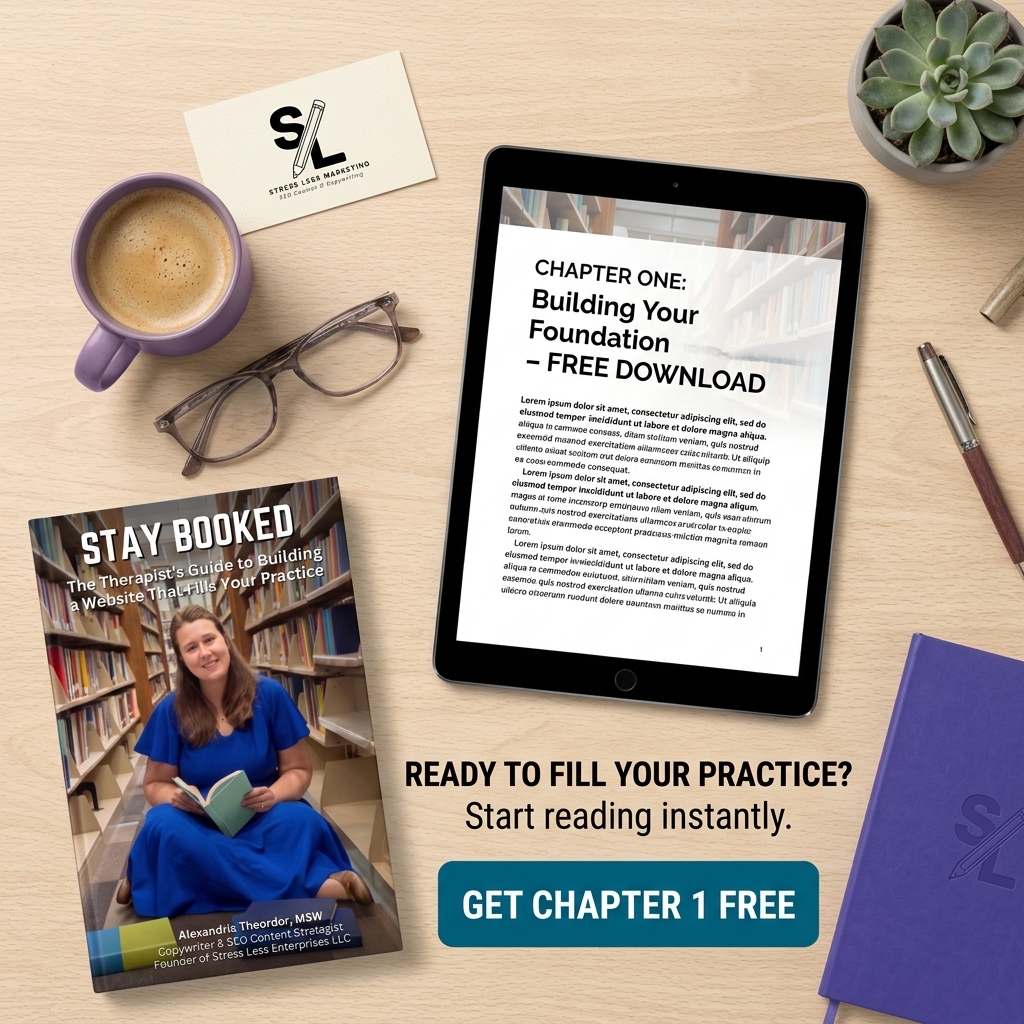
The full story of how I built a content system from scratch, one Etsy shop and one newborn nap schedule at a time, along with the exact framework I now use with clients, gets a full chapter treatment in Stay Booked. Download Chapter 1 free and see how it all fits together.
Keep Reading: Related Posts
- How to Justify Out-of-Network Therapy Rates (With Copy That Converts)
- SEO for Therapists: The No-Fluff Guide to Getting Found on Google
- Why SEO Matters More Than Social Media for Therapists & Coaches
- Marketing Strategy for Private Practice: What Actually Works (And What Doesn’t)
- Marketing for Private Practice: Why SEO & Copywriting Are Your 24/7 Sales Team
- How I Wrote One Affiliate Blog Post That Brought In Over $10K (And Counting)

Sources
- DemandSage, “Business Blogging Statistics” (55% traffic increase, 126% lead growth, 13x ROI likelihood, 9.7x more shares for B2C content) — https://www.demandsage.com/business-blogging-statistics/
- Tekniker, I. & Cheung, R.Y.M. (2023), “Do Bloggers Have Better Mental Health? The Social, Cognitive, and Psychological Benefits of Blogging in Emerging Adulthood,” International Journal of Environmental Research and Public Health — https://www.ncbi.nlm.nih.gov/pmc/articles/PMC10138563/