Why Does Content Creation Feel Overwhelming? (Answered)
My husband and I travel differently.
He does the deep dive — researches fifty restaurants, reads every review, builds a spreadsheet, whittles it to a short list. I customize from a template and enjoy the ride. Before I met him, I used a travel agency entirely. I don’t like driving in unfamiliar cities. I don’t like having too many options. I want: here are three choices — pick one and go.
The trips where I tried to plan everything myself? Exhausting before we’d even left. Too many decisions. Too many tabs open. Too much time researching instead of actually going anywhere.
That is content creation for most health and wellness practice owners.
Not because the work is actually that hard. Because the decision load around it is enormous, the options feel infinite, and nobody handed you a clear map when you opened your practice. You know content matters — Google, visibility, clients finding you, all of it — and that knowledge somehow makes the paralysis worse. You’re not overwhelmed and blissfully unaware. You’re overwhelmed while completely aware of what it’s costing you. That particular combination is its own special kind of dread.
So let’s actually answer the question. Not with vague reassurance, but with the specific reasons content creation overwhelms health and wellness providers — and the structural fixes that make it manageable.
The Real Reasons Content Creation Feels Overwhelming
The standard advice for content overwhelm is: do less, focus on one platform, be consistent. That’s not wrong, exactly. It’s just treating the symptom.
The overwhelm isn’t random. It has specific causes, and each one has a specific fix. Naming them matters because “just simplify your content strategy” doesn’t help you actually sit down and write on a Tuesday when you’ve just finished six back-to-back therapy sessions and still have notes to complete.
Reason 1: You’re Fighting the Wrong Channel
The most common form of content overwhelm I see in health and wellness practices has nothing to do with the writing itself. It’s the exhaustion of pouring consistent energy into channels that aren’t working and don’t compound.
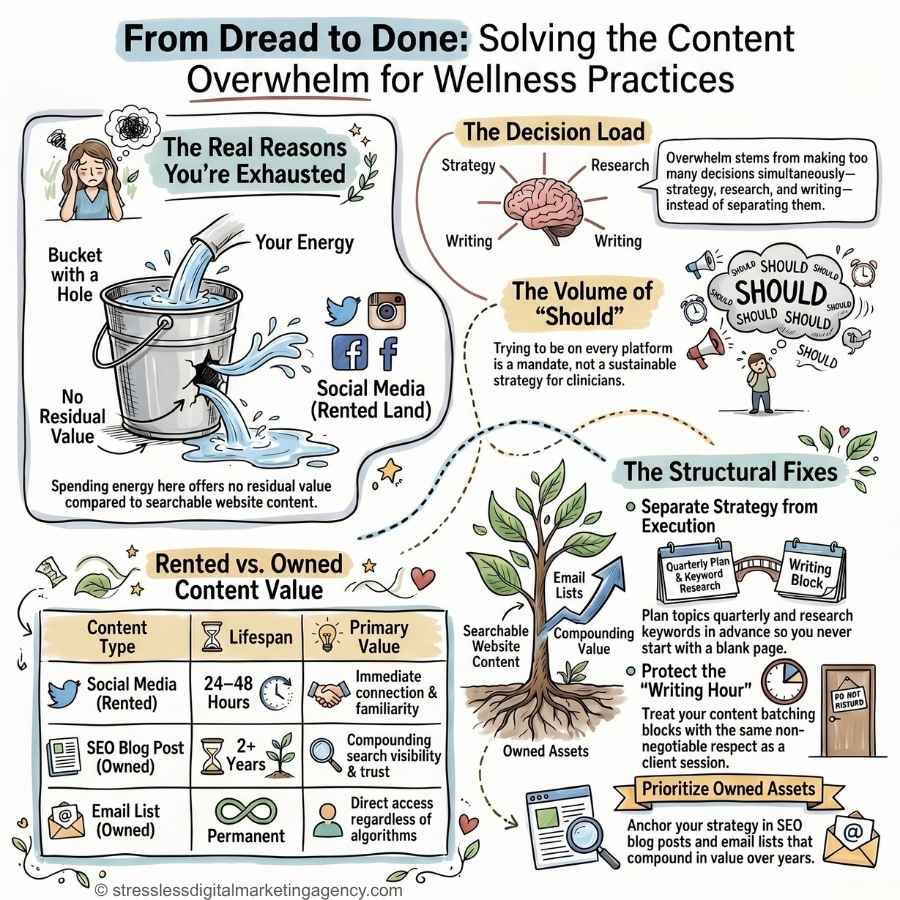
Instagram is the obvious example. Practice owners spend hours on reels and carousels. The posts do fine for 24 hours. Then the algorithm moves on, the post disappears, and next week you’re doing it all over again. No accumulation. No residual value. You’re not building anything — you’re just refilling a bucket with a hole in it, every single week.
That constant effort with minimal compounding return is genuinely exhausting. And the exhaustion gets misidentified as content overwhelm when it’s actually channel mismatch.
Social media has a place in a practice’s marketing. It builds familiarity, it deepens connection with existing followers, and it can amplify content you’ve already created. What it cannot do is replace owned, indexed, searchable content on your own website. A blog post you published two years ago can still be sending you traffic today. An Instagram post from two years ago is essentially gone.
Practice owners who are posting on Instagram three times a week with little ROI are spending their creative energy on the most time-intensive, least compounding channel available to them — while the owned channels that would actually build long-term visibility sit empty. The overwhelm isn’t a personality flaw. It’s a structural misallocation.
For the full picture of why owned content outperforms social across every metric that matters to a practice, the ultimate guide to content creation covers the compounding visibility argument in depth.
Reason 2: You Have No System — Only Willpower
Willpower is not a content strategy. It depletes. And it depletes faster for people who are already spending significant cognitive and emotional energy on clinical work every single day.
The providers who publish consistently are not more motivated than you. They’ve built a system that runs regardless of motivation. The topics are pre-decided. The format is established. The writing block is on the calendar and protected like a client hour. The decision about whether to create content this week has been removed from the equation entirely — because it was made in advance, when energy was available, rather than in the moment when it isn’t.
When content lives entirely in the “I’ll get to it when I have the bandwidth” category, it never happens. Not because you don’t care. Because “when I have bandwidth” doesn’t exist in a full clinical practice. Bandwidth has to be created structurally, not discovered accidentally.
Content consistency for practice owners walks through exactly what that system looks like — including the quarterly topic planning approach that eliminates the blank page problem before it starts.
Reason 3: You’re Trying to Create AND Strategize at the Same Time
This is the one that creates the most invisible friction.
When you sit down to write a blog post and don’t have a topic yet, you’re doing three jobs simultaneously: strategic planning (what should I write about), keyword research (what are people actually searching for), and content creation (the writing itself). Those are three different cognitive modes. Trying to run all three at once in a single sitting is like trying to do a therapy intake, session notes, and billing in the same 50-minute block. It’s not that any one of them is too hard — it’s that the context-switching between them is the expensive part.
The fix is separation. Strategy and topic planning in one session, writing in another. When you sit down to write with a keyword already researched, a working title already set, and an outline already roughed out, the actual writing becomes a fraction of the effort. The cognitive overhead disappears because the decisions are already made.
This is also why ghostwriting works so efficiently for practice owners who have tried to DIY their content and burned out — the ghostwriter handles the strategy, the research, and the execution in separate passes, which is a level of separation most solo providers can’t give themselves.
Reason 4: The Volume of “Should” Is Deafening
At some point in the last decade, “content marketing” went from a strategy to a mandate, and the mandate kept growing. Blog posts. Instagram. LinkedIn. TikTok. Reels. YouTube. Podcast. Newsletter. Threads. Pinterest. Email sequences. Lead magnets.
Every platform has advocates insisting it’s the most important one. Every marketing expert has a different opinion on the right publishing cadence. Every comparison to a competitor who seems to be everywhere produces another layer of should.
The cumulative weight of all those shoulds is exhausting before you’ve written a single word. And for health and wellness providers who didn’t go into clinical training to become content creators — who chose this work because they wanted to help people, not build a media operation — the should feels like an indictment rather than a strategy.
Here’s the actual answer: you don’t need to be everywhere. You need to be findable, trustworthy, and consistent in the places your ideal clients are actually looking. For most health and wellness providers at the established practice stage, that means an SEO-optimized website with regular blog content, a functional email list, and a social presence that amplifies rather than anchors. That’s it. Everything beyond that is optional and should be added only when the foundation is solid.
The content ecosystem guide for wellness practices maps that foundation specifically — what to build first, what to add later, and what you can safely ignore without losing visibility.
Reason 5: You Haven’t Separated Owned from Rented
This framing shift changes the math on every content decision.
Rented visibility is any channel where someone else controls your reach — social media algorithms, Psychology Today, insurance panel directories, Google Ads, referral networks. These channels are useful but fragile. Instagram can reduce your organic reach overnight. Psychology Today can change its algorithm. Referral sources retire, relocate, or simply dry up. You’re building on someone else’s infrastructure, and they can change the rules at any time.
Owned visibility is your website, your blog, your email list. Content you publish on your own domain stays indexed. A blog post you wrote in 2022 still shows up in search today if it was properly optimized. Your email list belongs to you regardless of what any platform does. Nobody can raise the rates on your own website.
The practices that stop feeling overwhelmed by content are usually the ones who’ve made this distinction clearly. Instead of feeling like they need to maintain everything simultaneously, they prioritize the owned channels that compound and treat the rented ones as amplifiers rather than foundations.
The overwhelm doesn’t disappear entirely. But it gets significantly lighter once you stop treating a disappearing Instagram post with the same strategic weight as an indexed blog post that will keep working for years.
What Content Creation Actually Looks Like When It’s Working
Not glamorous. Not effortless. Genuinely manageable.
It looks like one focused writing day per month that produces two blog posts, batched without interruption. It looks like those posts feeding a newsletter that goes out automatically the week each post publishes. It looks like a social caption extracted from the blog — not created fresh — because the ideas are already written and just need reformatting.
It looks like a quarterly planning session where twelve topics get mapped to keywords so that no writing session ever starts with a blank page and an open question. It looks like a content calendar that gets protected the same way client hours get protected — not flexible, not bumped, not negotiable.
I went from treating content as something I’d get to when the rest of my work was done — which meant it rarely happened — to treating it as scheduled infrastructure. The volume of work didn’t change dramatically. The decision fatigue disappeared almost entirely. That shift made consistency structurally possible in a way that motivation alone never had.
The practical mechanics of building that system are in content consistency for practice owners — including the batching approach, the quarterly planning method, and the repurposing framework that turns one piece of content into five.
The Structural Fix: What Changes Everything
The overwhelm has a structural cause, which means it has a structural fix. Here’s what that actually involves:
Narrow the channels. Pick owned content first — SEO blog posts and email — and let those anchor everything else. Social is supplemental. Treat it accordingly.
Separate strategy from execution. Do keyword research and topic planning in a quarterly session. Write from a pre-decided list. Never start a writing session without a topic already chosen.
Protect the time. Batch writing into one dedicated block per month. Put it on the calendar before anything else. Treat it like a client hour — because in terms of what it builds for your practice over time, it is.
Lower the bar on first drafts. The draft is raw material, not the finished product. Permission to write badly in the first pass removes the freeze that perfectionism creates.
Measure what actually matters. Organic search traffic, email subscriber growth, and inquiry form completions from blog posts — not Instagram likes. Google Search Console is free and shows you exactly which content is earning you search visibility. Let that data guide your decisions instead of vanity metrics.
When Overwhelm Is Telling You Something Specific
Sometimes content creation feels overwhelming because of the workload. And sometimes it’s telling you something more specific.
If writing itself is the sticking point — not the strategy or the time, but the actual sitting down and producing words — that’s more likely writing anxiety than a systems problem. The two look similar from the outside but require different responses. Writing anxiety for health and wellness providers, especially licensed clinicians, has specific roots in clinical training and professional identity that are worth understanding before you assume a better calendar will fix it.
If you sit down to write and genuinely don’t know what to say — not from fear, but from real uncertainty about your message, your niche, or what makes your approach distinct — that’s a brand voice and messaging problem. No amount of productivity systems will make writing feel easier when the foundation underneath it is unclear. The clarity has to come first.
And if the content is happening but nobody is finding it — if you’re publishing consistently and still not seeing search traffic or inquiries — that’s an SEO strategy problem, not a content creation problem. SEO for service providers covers what the missing piece usually is.
The Option That Removes the Constraint Entirely
I hired a photographer on every trip abroad before I started traveling with my husband. Not because I couldn’t take photos myself. Because they handled the logistics so I could actually be present and enjoy the experience instead of managing it.
At the Savanna Bananas baseball game — the team built entirely around a “fan first” philosophy — we splurged on premium seats. I could have gotten a hot dog from the cheap seats. I paid for someone else handling the logistics so I could be there with my daughter without managing anything. She got her milkshake. I got to watch her light up instead of digging for my card.
That is what done-for-you content does for a practice owner who has been carrying this alone.
The SEO Content Ecosystem retainer produces a full month of content — two SEO-optimized blog posts, one email newsletter, repurposed social captions, and strategic internal linking throughout — without a single hour of writing on your end. Your expertise and your voice are captured in a recorded Foundational Messaging Map session. Everything built from that point forward sounds like you, ranks for what your clients are searching, and connects back to your service pages.
The overwhelm doesn’t get managed. The constraint gets removed.
Download the price and services guide to see exactly what’s included and what the investment looks like.
FAQs: Content Creation Overwhelm
Why does content creation feel so overwhelming even when I know it’s important?
Because knowing something is important doesn’t reduce the decision fatigue, time cost, or skill gap involved in doing it well. Content creation for a health and wellness practice involves strategy, keyword research, writing, editing, SEO optimization, and publishing — multiple distinct tasks that most providers try to compress into a single sitting. The overwhelm is a rational response to an unrealistic ask, not a character flaw.
What is the hardest part of content creation for most practice owners?
Topic selection and the blank page. Both disappear when topics are pre-decided in a separate quarterly planning session before you sit down to write. The writing itself is rarely the actual bottleneck — the decision overhead around it is.
How do I get over fear of content creation?
Distinguish the type of fear first. If it’s perfectionism, lower the bar on first drafts and commit to editing as a separate pass. If it’s fear of visibility or imposter syndrome, writing anxiety addresses the specific psychology involved. If it’s overwhelm from not knowing what to say, start with brand voice and messaging clarity before working on volume.
How much content does a health and wellness practice actually need?
Two well-written, SEO-optimized blog posts per month, paired with a newsletter and basic social repurposing, are enough to build meaningful compounding visibility over a 12-month timeline. More is not better if it’s unsustainable. Consistency at a lower volume outperforms sporadic bursts at high volume every time.
What should I focus on first — social media or my website?
Your website, every time. Social media content disappears. Website content compounds. An SEO-optimized blog post published today can still send you traffic in three years. An Instagram post from today will be functionally invisible in 48 hours. Build the owned asset first; use social to amplify it.
When does outsourcing make sense?
When the time cost of DIY is higher than the investment in professional help, factoring in both clock hours and the mental overhead of carrying it alone. How outsourcing content saves time runs through the honest math, including the opportunity cost calculation at typical therapy session rates.
Free resources:
- Quiz: What’s Keeping You Stuck With Marketing?
- [Freebie] Stop Panicking When Clients Graduate
- Free Blog Templates for Health & Wellness Providers
If you liked this post, be sure to read…
- Ultimate guide to content creation — strategy, tools, and the compounding visibility argument
- Content consistency for practice owners — the system that actually holds
- Writing anxiety for clinicians — if the writing itself is the sticking point
- Brand voice for service providers — if you’re not sure what to say
- How outsourcing content saves time — the honest time and ROI math
- What is ghostwriting — the option most providers haven’t seriously considered