3 Ways Your Blog Will Boost SEO (and Your Client Bookings)

The first time I rewrote something for SEO purposes, I wasn’t thinking about algorithms at all.
I had a Psychology Today profile. I was listed, open for business, doing everything I’d been told to do. Weeks went by with almost no calls. I kept assuming the market was slow, or I wasn’t networking hard enough, or there was just too much competition in my area.
Then I stopped writing like a resume and started writing like someone who specialized in something specific: brain injuries, strokes, the patients who’d been discharged before they were actually okay. Within seven days, I had calls.
Not because I was suddenly more qualified. Because the right people finally saw themselves in what I wrote.
That’s the whole job of a strategic blog. It’s about putting the right words in the right places so that when your ideal client sits down at their kitchen table and types their problem into Google, your name is the one that comes up — and your words are the ones that make them think: finally, someone who gets it.
Here are the three specific ways blogging makes that happen.
Key Takeaways
- Blogging Expands Your Keyword Footprint: Each blog post creates new opportunities to rank for search terms, helping Google connect your services to client searches and building topical authority for higher rankings.
- Blogging Strengthens Your Internal SEO Foundation: Regular blogging with strategic linking and clear headings makes your website more organized and interconnected, improving navigation for both Google and readers.
- Blogging Builds Authority and Trust: By offering real solutions in your posts, you demonstrate expertise and build trust with potential clients, making them more likely to choose your services.
- Consistency is Key: Consistent, SEO-backed blogging leads to increased website visibility, more inquiries, and ultimately, a fuller client book.
- Blogging Bridges the Gap: If your website isn’t showing up on Google, blogging helps Google understand how to match your services with what people are searching for.
1. Blogging Expands Your Keyword Footprint
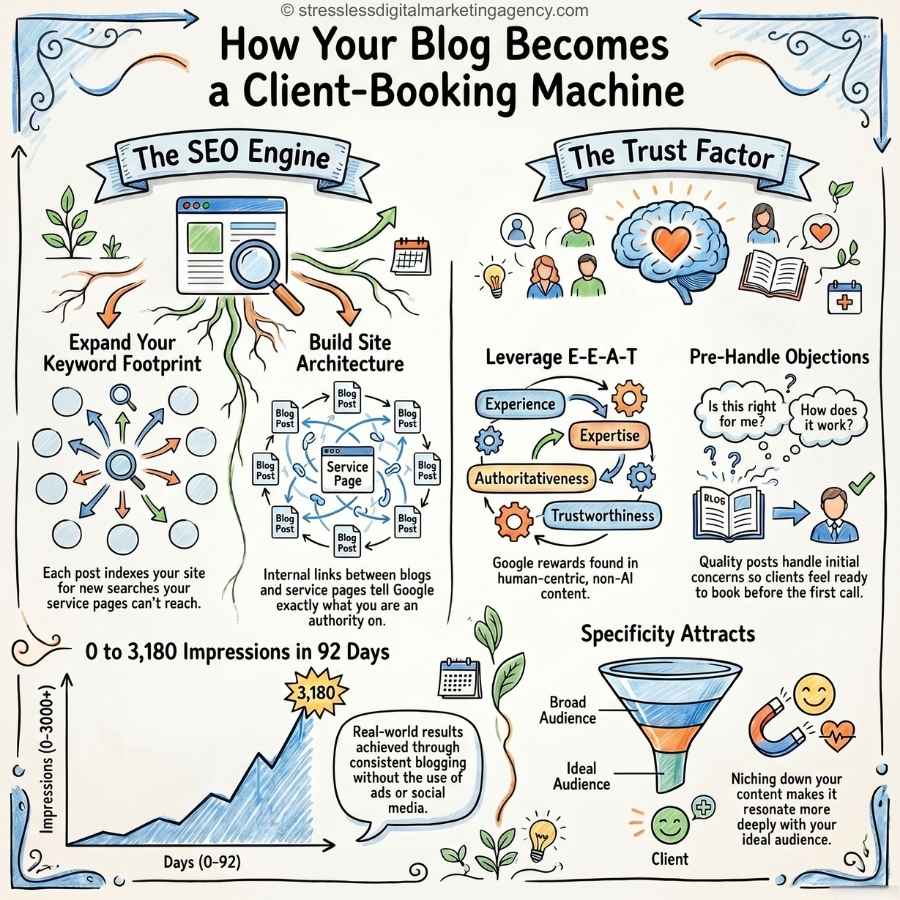
Your service pages can only rank for so many searches at once. A homepage targeting “therapist in New Jersey” can’t simultaneously rank for “what to expect in your first therapy session,” “how do I know if I have burnout,” and “is EMDR covered by insurance.” Those are completely different searches typed by completely different people at completely different stages of deciding to get help.
Each blog post you publish is a new page Google can index for a new search. A post about burnout symptoms brings in readers who don’t yet know they need therapy. A post about what to expect in a first session reaches people who are close to booking but nervous. A post on insurance versus private pay reaches the ones doing final comparisons before they pick up the phone. Over time, your site starts appearing for dozens of searches it was completely invisible to before.
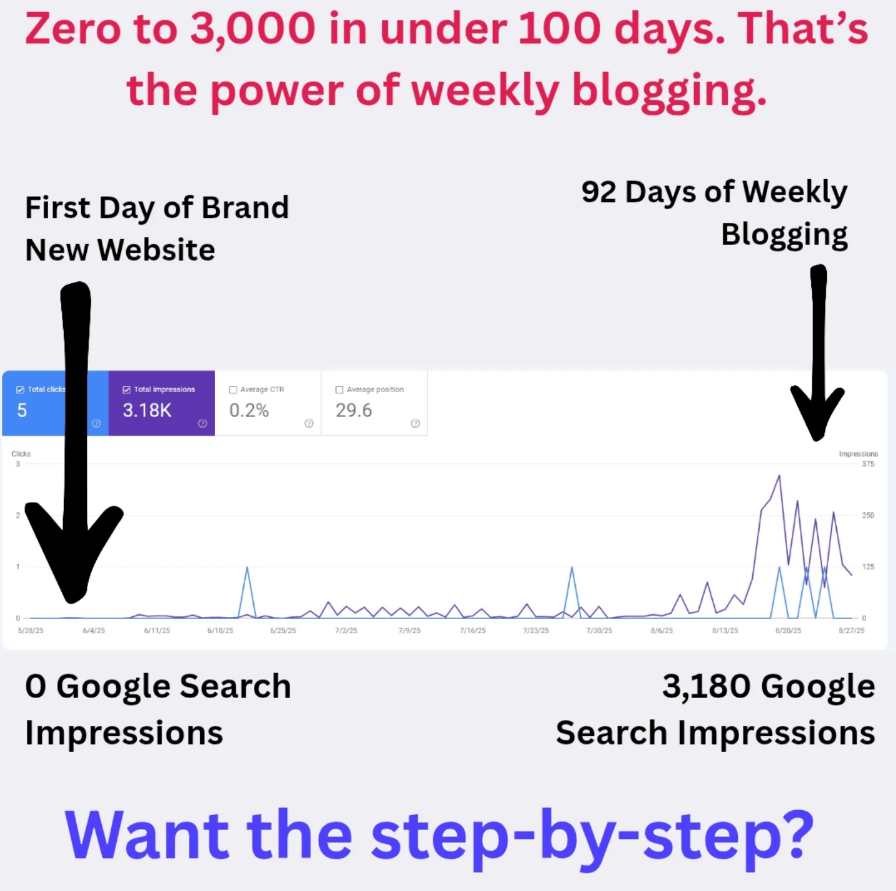
I watched this happen on my own site. Around nine months postpartum, when I wasn’t able to see therapy clients at the capacity I’d been used to, I started writing blog posts and landing pages to drive people to my digital products. I built it mostly during nap times. In 92 days of consistent, targeted blogging, organic impressions went from zero to 3,180. No ads, no social media sprints, no email blasts. Just content that matched what people were already typing into Google.
That’s what topical authority means in practice: your site becomes the resource on a topic because you’ve covered it from enough angles that Google trusts you to answer related questions, not just the one you originally optimized for.
One more thing worth knowing: niching down in your content doesn’t narrow your audience the way most people fear it will. I think about this every time I watch Bluey with my daughter. It’s a kids’ show, but parents love it just as much. The writers didn’t try to speak to everyone — and that specificity is exactly what makes it resonate with everyone. If you write posts specifically for trauma therapists or postpartum dietitians or cash-pay physical therapists, the clients who work with anxiety, burnout, or chronic pain will still find themselves in your words. Specific content attracts the right people. It doesn’t repel everyone else.
Want to know how long it takes for that footprint to start building? How Long Does SEO Take to Work for a New Website breaks it down month by month.
And once you’re tracking, How Do You Know If Your SEO Is Working shows you the leading indicators to watch before the rankings catch up.
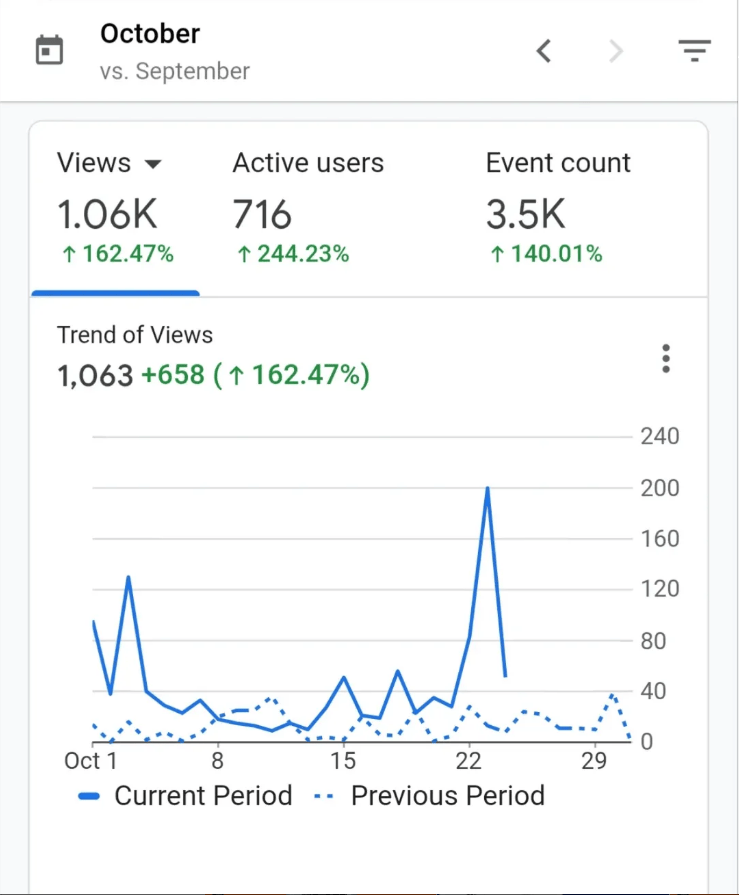
2. Blogging Strengthens Your Internal SEO Foundation
Google doesn’t evaluate your pages in isolation. It reads your whole site and builds a picture of what you’re actually an authority on. A site where every page connects logically to related pages — where your blogs link to your service pages, and your service pages link back to your most in-depth resources — tells Google something important: this person knows their topic, and their site is organized enough to prove it.
Think of your blog as the connective tissue of your website. Each post has the potential to link to a service page, a related post, or a resource that moves the reader one step closer to reaching out. A post about managing anxiety links naturally to your individual therapy page. A post about EMDR links to your specialty page and your FAQ. The reader moves through your site with intention, and Google follows the same path when it crawls your content.
I see this most clearly with service providers who’ve been publishing for months and wondering why nothing is moving. When I dig into their sites, the content is usually solid. What’s missing is the architecture underneath it. Posts exist in isolation, service pages have no incoming links from the blog, and Google can’t identify what the site is most authoritative on. The effort was there. The structure to make it work wasn’t.
Strategic internal linking also does something most people overlook: it passes ranking signals from new posts to older pages that have been sitting quietly. Publish a new post, link it to a page that’s been indexed but hasn’t moved, and you give that page a fresh signal that something relevant is pointing to it. It’s one of the simplest optimization moves available, and it costs nothing but a few minutes per post.
While you’re building that internal structure, it’s worth making sure your existing links are actually working. How to Check for Broken Links on Your Website shows you how to find them fast.
For the full picture of how internal linking fits into a complete SEO strategy, see SEO for Service Providers: The Complete Guide, which covers all four layers.
3. Blogging Builds Authority and Trust
Clinical training teaches you to be a blank slate. Stay neutral, don’t disclose, let the client lead. That’s excellent therapy. For marketing, it’s a quiet disaster.
Your ideal client isn’t in your office yet. They’re on Google at 11pm, reading five different therapist websites that all say the same thing: warm, welcoming, safe space, no judgment. Those aren’t differentiators — they’re table stakes. The practices that get found and get called are the ones that are willing to have a point of view. To say specifically who they’re for. To be slightly uncomfortable for the people they’re not trying to attract.
Blogs give people a window into your expertise before they’ve ever spoken to you. When your posts offer real insight — not surface-level tips, but the kind of nuanced, experience-backed thinking that only comes from doing this work for years — readers start to feel like they already know you. That familiarity is what makes it easier to reach out. People don’t hire strangers. They hire people they’ve already decided to trust.
Google calls this E-E-A-T: Experience, Expertise, Authoritativeness, Trustworthiness. In a landscape flooded with AI-generated content, it increasingly rewards content that demonstrates real lived experience. Your clinical background, your specific process, the way you frame a problem — these aren’t just personality touches. They’re ranking signals. A post that includes a genuine clinical observation or a specific personal story will outperform a well-structured post that could have been written by anyone.
There’s also a practical side to this that doesn’t get talked about enough. When potential clients read two or three of your posts before they reach out, the discovery call is completely different. They’ve already processed their initial concerns. They’re not starting from scratch on deciding whether they like you. You spend less time explaining what you do and more time figuring out whether you’re the right fit. The blog did the objection-handling before the conversation even started.
Google’s approach to evaluating authority has shifted significantly in the last two years. AI’s Transformative Impact on SEO covers what actually changed and what you can ignore.
What This Looks Like in Practice
Nobody loses weight and keeps it off by doing a 30-day cleanse. They change what they eat on a Tuesday when nothing is happening and they’re just hungry. The habit is what makes it compound.
Blogging for SEO works the same way. It’s not the launch campaign. It’s the post you publish in month seven when you’re not sure anyone is reading. Month one, you cover a question your clients ask constantly. Month three, you write something that addresses the main objection you hear on discovery calls. Month six, you tackle the comparison question your ideal client searches before deciding who to book with.
By month six or seven, the site starts appearing for searches it wasn’t ranking for in month one. Some of those posts are now linking to service pages that are seeing more traffic. Calls start coming in from people who found you through search and had already done their homework before reaching out.
One thing I’d add: snow days are search days. When people are stuck inside with nowhere to be, they tackle the to-do list they’ve been putting off. That therapy appointment they’ve been meaning to book. The specialist they’ve been meaning to research. The consultation they’ve been thinking about for months. If your website isn’t showing up when they go looking, you’re not part of that conversation. A strategic blog means you are.
For a breakdown of what the numbers look like at each stage, The SEO Slow Burn: How to Measure SEO Results and Performance is the right next read.
What Happens When You Don’t Blog Strategically
Publishing without a strategy is more frustrating than not publishing at all, because you’re putting in the time and not seeing results, which makes it easy to conclude that blogging just doesn’t work for your practice.
What’s usually happening is that the posts aren’t targeting keywords anyone is actively searching for, they’re not connecting to each other or to your service pages, and they’re covering such a wide range of topics that Google can’t identify what your site is an authority on. The content exists. The structure that makes it work doesn’t.
If your traffic has stalled or dropped after an initial period of publishing, Why Did My Website Traffic Drop walks through the most common reasons. And if you’re not sure which posts are actually driving traffic, I Used to Guess What Was Working in My Business — Then I Discovered UTM Tracking solves that problem directly.
How I Help Service Providers Get Found on Google
Every content project at Stress Less starts with a Foundational Messaging Map: a structured 60 to 90 minute conversation that surfaces your brand voice, your ideal client profile, and the specific language that makes your approach distinct. Before a single post gets written, the message has to be clear. You can’t frost a cake that hasn’t cooled. The icing slides off, the layers separate, and everything looks like a mess even when the underlying work is good. Foundational messaging is the cooling rack. Skip it, and every piece of content you put on top of it lands wrong.
From there, posts are written to do the three things this post covers: expand your keyword footprint, strengthen your internal structure, and build the kind of trust that makes someone feel ready to reach out before they’ve spoken to you. Written at a reading level that’s clear and skimmable, because your clients are distracted people reading on their phones — not academic colleagues with time to translate clinical language into plain English.
If you’ve been sitting on a website that isn’t getting found, the Service and Price Guide is a clear first step. It covers what’s included, how the process works, and what it costs.
Not ready to outsource yet? Grab my Free Website Guide to Organic Inquiries — filled with the same tools and recommendations I use to help clients plan content that gets found.

Final Word
Blogging works when it’s built on the right foundation: keywords your ideal clients are actively searching for, a structure that helps Google understand what your site is about, and content that demonstrates enough real expertise that a reader trusts you before they’ve met you.
None of this requires posting every day. It requires showing up consistently with content that has a purpose — and connects back to the rest of what you’ve built.
If you want the full framework before you start, SEO for Service Providers: The Complete Guide to Getting Found on Google covers everything from the ground up.