Slow Sites, Lost Clients: Here’s What You Need to Know About Websites
When I first started my business, I didn’t think twice about my website host. I picked the cheapest option I could find — shoutout to Bluehost — popped up a homepage, and told myself, I’ll upgrade when I make more money. And for a while, it was fine.
But as my traffic grew, my site started getting buggy. Pages wouldn’t load, visitors would bounce, and I’d sit staring at my screen hoping it would cooperate, right when I was trying to make a good impression.
This reminded me of a lesson I learned the hard way in the kitchen. I once decided to grind lamb myself for burgers — very ambitious — except I didn’t have the right equipment and used a food processor instead. Not only did it do a mediocre job, it left all the gristle intact, which meant I had to spend two hours hand-picking through six pounds of minced lamb to clean it up. The lesson: if you don’t set yourself up with the right tools from the start, you end up doing twice the work later. Website hosting is exactly like that.
If you’re anything like the clients I work with — a visionary business owner wearing way too many hats — you don’t have time to troubleshoot tech issues or wait for pages to load. Your website should work, plain and simple. And that starts with where it’s hosted.
This is more than a technical decision. It’s a strategic one — and it’s one of the foundational building blocks of a website that works for your business around the clock. If you want to understand how hosting fits into your broader SEO picture, my complete SEO guide for service providers covers the full foundation.
Key Takeaways:
- A quality website host is essential for fast load times, reliability, and a professional online presence — especially as your traffic and content grow.
- Cheap hosting can work short-term, but it often breaks down under higher traffic and heavier site demands. Upgrading is part of business growth.
- Website speed impacts both user experience and SEO, so your host’s performance directly affects your visibility in search.
- One-page websites may be quick to build, but they limit long-term SEO potential.
- Multi-page sites allow for more keyword targeting and lead generation.
- Your copy, blog content, and future offers need room to grow. Choose a hosting platform that can scale with your business.
Why You Should Listen to Me
I’m not a tech expert. I’m a business owner, just like you. I’ve built my brand from scratch, worn all the hats, and made the classic “just get it live” mistakes — including using the cheapest hosting I could find.
I also know what it’s like to build a website from zero. When my daughter was about nine months old, I started selling documentation templates on Etsy to bring in some income while I wasn’t seeing clients at full capacity. They took off quickly. But Etsy takes a large commission, so I built my own website and started redirecting traffic there instead. That site started at zero visits and grew to around 800 views a month after about a year — all organic, all SEO-driven, all built from a laptop while managing a newborn. That’s when I really understood what a well-hosted, well-structured website could do for a service-based business.
I work with therapists, coaches, and service providers every day who are trying to grow their business online without turning into full-time marketers or web developers. Everything I share comes from lived experience, trial and error, and figuring out what actually supports long-term growth without burning you out.
Affiliate Disclaimer: This page contains affiliate links and is a member of the Amazon Services LLC Associates Program. If you make a purchase using one of these Amazon links, we may receive compensation at no extra cost to you. See our Disclosure Policy in the Legal Hub for more information.
Website Hosting 101: My Top Tips For A Successful Website
1. People Don’t Wait for Slow Sites — They Click Away
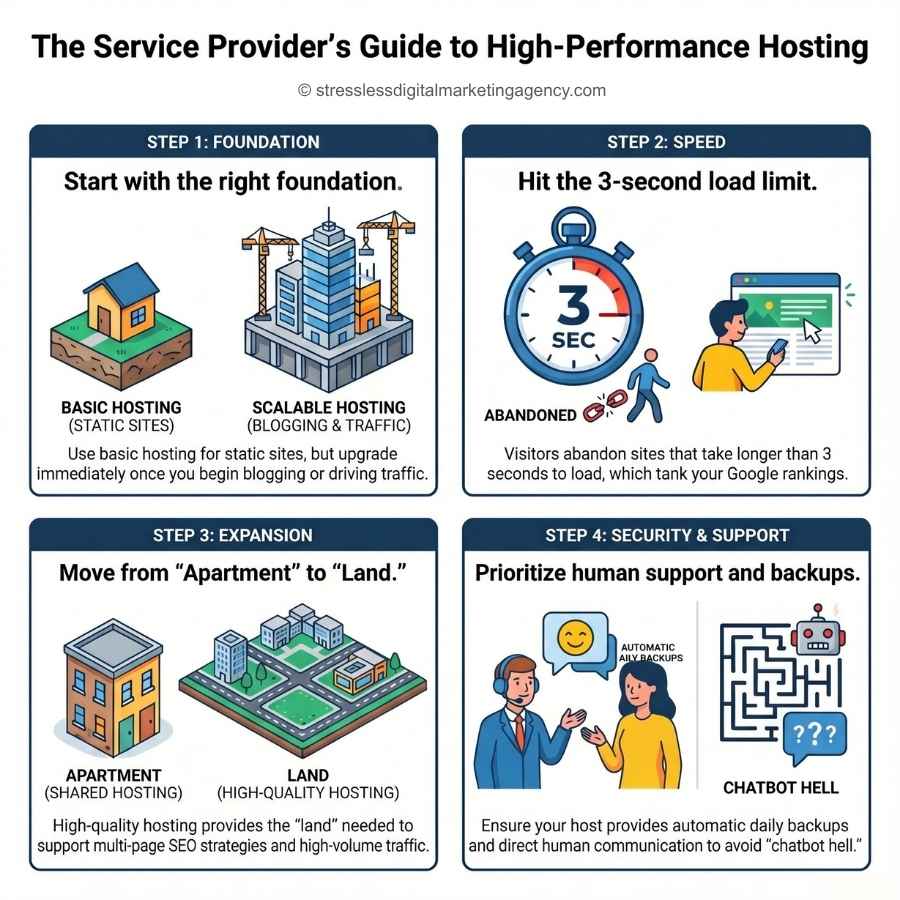
You only have a few seconds to make a first impression. If someone lands on your homepage and it takes more than 2–3 seconds to load, they’re gone.
Think about your own habits: would you wait for a slow-loading website?
A high-quality host ensures your site is fast, reliable, and always online. That’s not just good for user experience — it’s critical for your brand’s reputation. Nothing says “not ready for business” like a site that crashes or stalls every time someone tries to open it.
This also isn’t just about aesthetics. A high bounce rate — meaning visitors land on your page and leave immediately — is a signal Google uses to evaluate the quality of your content. If people aren’t staying, Google assumes your site isn’t helpful and deprioritizes it in search results. Your hosting is part of that equation. For a full breakdown of how speed and bounce rate connect to rankings, see my post on why website traffic drops.

2. What Got You Here Won’t Get You There
Cheaper hosting plans can work when you’re getting a few hundred visits a month. But once people start finding your blog, signing up for your freebie, or sharing your links — you need a host that can handle that growth.
I learned this the hard way. I used Bluehost for about four years. In the beginning, when my site was mostly static — a home page, an about page, a few service pages sitting untouched — everything ran fine. Then in 2022 I started blogging actively, and that’s when the problems started. As my site grew with more images, pages, and videos, it got noticeably slower. It started crashing frequently. Updates caused issues. And when I finally needed customer support? I entered what I can only describe as the seventh ring of hell.
Bluehost customer support read from a script and rarely engaged with my actual question. Their go-to solution was to send me a link to a technical article. Or — my personal favorite — offer help for an additional fee. The breaking point came when I was locked out of my own website for an entire week. I dove into Facebook groups, read every blog post I could find, and scoured Google reviews looking for an alternative. After narrowing it to two options — SiteGround and Lyrical Host — I went with Lyrical Host (affiliate link). Knock on wood: I have not had a single outage since.
3. Why I Chose Lyrical Host — And Why I’d Choose Them Again
Out of all the hosts I researched, I could not find a single negative review of Lyrical Host. I looked hard. I scoured blog posts and Google reviews. Everyone said the same thing: the customer service is nearly white-glove. For someone who had just spent a year fighting with chatbots and script-readers, that was exactly what I needed.
Here’s what made the decision easy:
Daily backups included with every plan. When I was on Bluehost, I tried twice to set up Jetpack as a paid backup service. I thought I’d done it correctly. Customer support confirmed it looked good. Then the day I actually needed a backup, it turned out the installation had never worked properly and there was “nothing they could do.” With Lyrical Host, daily backups are automatic and included. No separate service. No setup risk. No nasty surprises.
Human support via email. No chatbots. No phone queues. You send an email, a real person responds. They’re based in England, so if you reach out late at night US time, there may be a few hours’ wait — but I’ll take a few hours over an endless chatbot loop every single time. They understand the issue immediately, and if there’s ever confusion, we sort it out with screenshots or a quick Loom video.
They go beyond just hosting. When images on my site weren’t loading, they walked me through the fix and in some cases just handled it themselves. When plugins stopped working, they recommended substitutes. This saved me hours of research and trial and error I would have spent alone.
They saved me from an unnecessary $3,000 mistake. I once received a free SEO audit from a specialist and was horrified by the results — a long list of urgent problems that needed fixing. In a panic, I started reaching out to web developers for quotes. Before pulling the trigger, I messaged Lyrical Host for guidance on my site’s speed and performance. They reassured me that my site was nowhere near as broken as the audit suggested, explained that the feedback was designed to manufacture urgency, and enrolled me in their free speed optimization course. That conversation saved me thousands of dollars in unnecessary fees for problems that didn’t actually exist.
A resource library packed with extras. As a customer, you get access to free monthly stock photos, social media content ideas, AI tips, Google Analytics cheat sheets, Canva templates, and more. Small things, but they add up and save real time.
👉 Use code StressLess10 for 10% off your first order: Get started with Lyrical Host here
4. Website Hosting Is Like House Hunting for Your Website
Here’s how I explain it to clients: your website is your business’s home online. Hosting is the land it sits on.
A budget host is like a tiny starter apartment — perfect for just you and your dog. But as your business grows (more services, more traffic, maybe even multiple offers), you need more space, stronger support, and better infrastructure.
If you’re adding blog content regularly, hosting a podcast, or selling digital products, your site needs to handle that load. Don’t wait until things break before you upgrade. By then you’ve already lost visitors, lost rankings, and lost trust you’d built over months of consistent work.
5. Your Copy (and SEO) Deserve a Solid Foundation
Let’s say you’re publishing blogs every week — which is one of the highest-leverage things you can do for organic visibility. Each post adds to the weight and depth of your site, and your hosting plan needs to scale with that.
There’s also a moment I’ll never forget from my own SEO journey. I was getting some traffic but was frustrated it wasn’t growing faster. I kept second-guessing my copy, wondering what I was saying wrong. Turns out, I hadn’t checked whether my sitemaps were properly connected to Google Search Console — and they weren’t. The moment I fixed it, everything shifted. The lesson: never assume you know where the problem is. Sometimes the foundation has a crack you haven’t looked for. If you’re not sure whether yours is solid, start by checking your Search Console data.
If you’re running multiple offers — say therapy services and a coaching program — you might even want a separate website for each. Look for a host that allows multiple domains under one plan without doubling your cost. Lyrical Host allows this, which is one of the reasons I’ve stayed.
6. Speed Isn’t Just for Users — It’s an SEO Gamechanger
Google cares about speed. If your site takes too long to load because of bloated images, clunky plugins, or a slow host, your rankings suffer. Google measures whether your site delivers a good experience, and a slow site doesn’t.
Quick tips to boost your site speed right now:
- Upload JPEGs instead of PNGs when possible
- Use a free image compressor like FreeConvert
- Only install the plugins you actually use
- Clean up old drafts and unused themes
- Make sure your image alt text is clean and intentional — missing or bloated alt text quietly drags on performance
SEO isn’t just about keywords. It’s about the full experience your site delivers. For a deeper look at how all the on-page pieces work together, my complete SEO guide for service providers connects the dots.
7. Don’t Box Yourself In With a One-Page Site
Those Canva or Wix templates that let you throw together a landing page in a day? Great for getting started. Limiting for long-term SEO.
Google needs pages to crawl. The more quality content you have — blog posts, freebie landing pages, service pages — the more opportunities you have to show up in search for the specific things your ideal client is already searching for. A one-page website tells people you exist. A multi-page website with a blog shows them what you know, who you help, and why you’re the right choice. Each page can rank independently for different search queries.
If you want your business to grow organically, your site needs:
- An About Page
- A Services or Work With Me Page
- Blog content — ideally evergreen and optimized
- Landing pages for each lead magnet
- A clear, simple navigation menu
All of that requires a host that can keep up. Wondering how long it takes for a well-structured site to gain traction in search? I break down realistic timelines in how long SEO takes to work.
Final Thoughts: Think Long Term
A great website isn’t just beautiful — it’s functional. It loads fast, works consistently, and creates a seamless experience for your people. That’s what builds trust. That’s what keeps visitors coming back. And that’s what grows your email list, books clients, and sells your offers.
Your website is an asset, not a business card. The service providers who grow consistently are the ones who treat their site like infrastructure — something worth investing in, maintaining, and building on over time. The ones who treat it as an afterthought are the ones who end up wondering why they’re invisible online even after years in business.
Your hosting is the foundation under that asset. Get it right before your growth outpaces it.
👉 I use and recommend Lyrical Host. Use code StressLess10 for 10% off your first order. For my full breakdown of the migration experience, what I love, and what to watch out for, read the complete Lyrical Host review here.
Ready to make your website work harder for your business?
Download my price and service guide to see how I help service providers build content and copy that turns a well-hosted site into a consistent inquiry engine.
Not sure what’s holding your marketing back? Take the free quiz: What’s Keeping You Stuck With Marketing?