
Disclaimer Page Resources
A quick note: I am not a lawyer, and nothing on this page is legal advice. Please consult your malpractice insurance provider or a licensed attorney for guidance specific to your situation.
Affiliate Disclaimer: This page contains affiliate links and is a member of the Amazon Services LLC Associates Program. If you make a purchase using one of these Amazon links, we may receive compensation at no extra cost to you. See our Disclosure Policy in the Legal Hub for more information.
That said, here are the tools I actually use to keep my business legally covered.
Termly.io handles the foundation. It generates privacy policies and terms of service for free, and it’s a solid starting point for any service-based business website. You can access it at https://termly.io.
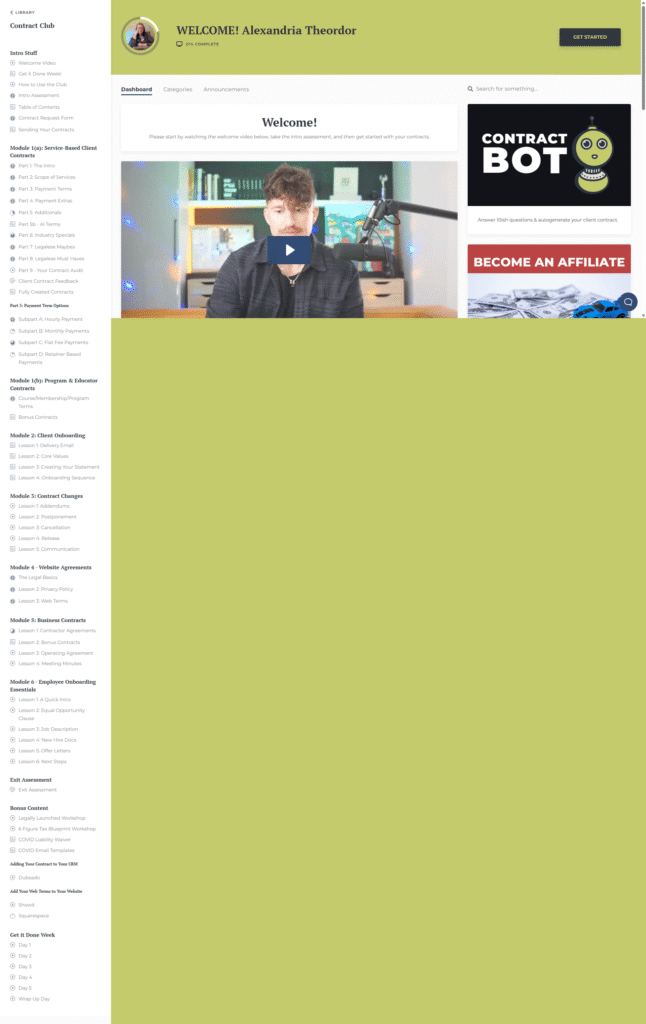
Contract Club is where I go to personalize and layer in the specifics. It was created by Braden Drake, an attorney who specializes in small businesses, so the language is written for people like us — not corporate legal departments. Inside the membership, you get video walkthroughs paired with Word document templates you can cut, paste, and customize. There are modules covering client contracts, website agreements, contractor agreements, onboarding documents, and more. They’ve also built out a Contract Bot that generates a client contract from about 10 short questions. I bought access a while ago, and the content has expanded significantly since then. You can learn more via my affiliate link: Contract Club (affiliate link — I earn a small commission at no extra cost to you).
Contract Club: What’s Inside
Contract Club is a membership program created by Braden Drake, a lawyer who focuses on small business legal needs. The platform is structured as a video library with downloadable Word document templates for each topic. You watch a short video explanation, then customize the corresponding document for your business.
The curriculum covers six main modules plus bonus content:
Module 1(a): Service-Based Client Contracts — This is the core module, covering scope of services, payment terms, payment extras, additionals, AI terms, industry-specific clauses, legalese essentials, and a contract audit process. Payment term options are broken into subparts for hourly, monthly, flat fee, and retainer-based payment structures.
Module 1(b): Program & Educator Contracts — Covers course, membership, and program terms, plus bonus contracts.
Module 2: Client Onboarding — Includes delivery email templates, core values, creating your client statement, and onboarding sequence guidance.
Module 3: Contract Changes — Covers addendums, postponement, cancellation, release, and client communication templates.
Module 4: Website Agreements — Legal basics, privacy policy, and web terms.
Module 5: Business Contracts — Contractor agreements, operating agreements, and meeting minutes.
Module 6: Employee Onboarding Essentials — Equal opportunity clause, job descriptions, new hire documents, offer letters, and next steps.
A standout feature is Contract Bot (upsell for an added fee) — a tool that generates a customized client contract by answering about 10 questions.
My approach: I start with Termly for the structure, then refine the language using Contract Club templates. The combination gives me documents that are both legally grounded and specific to how my business actually operates.